
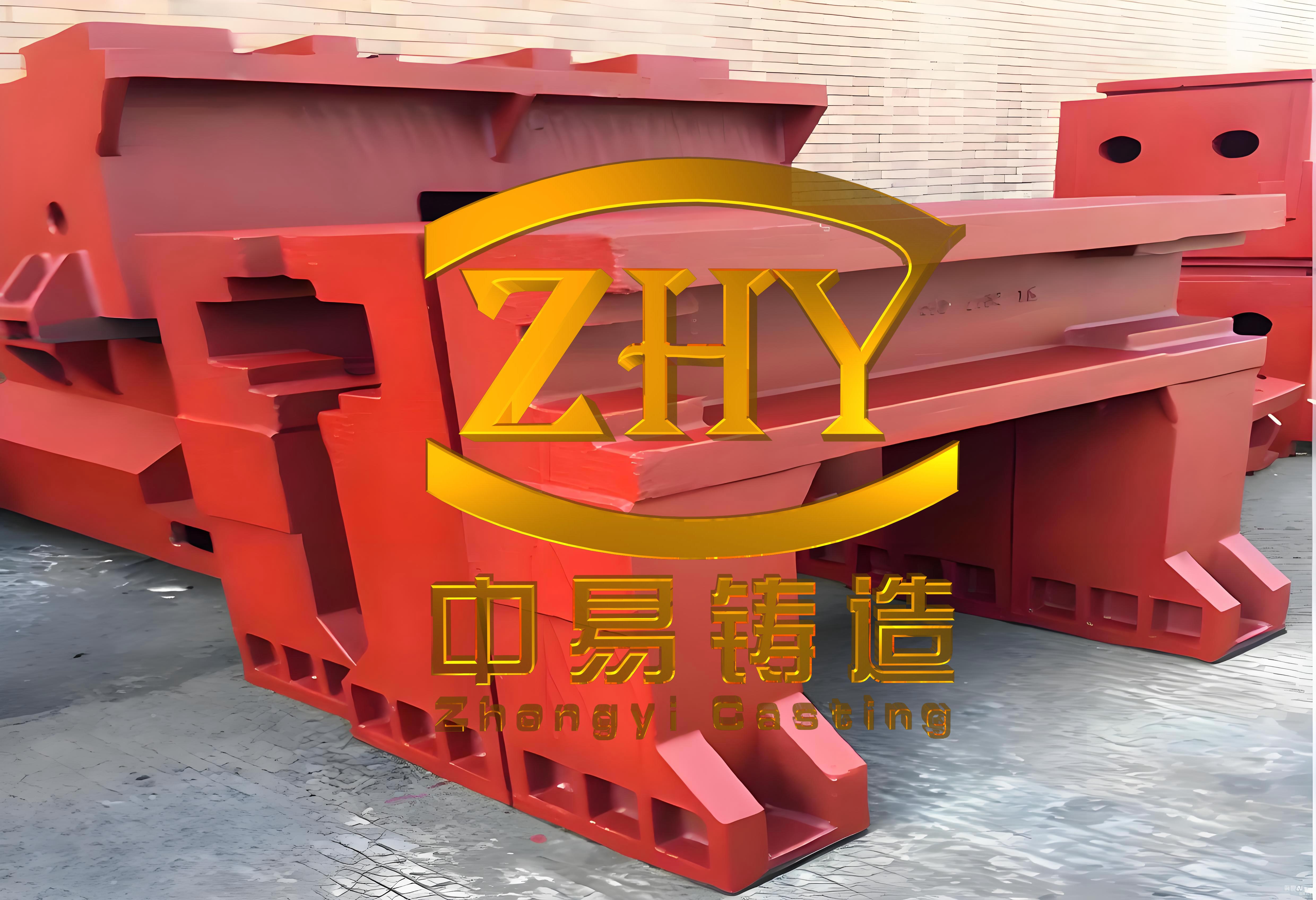
As a casting engineer specializing in the production of large and medium-sized castings, I have extensively worked with self-hardening sands for machine tool castings, such as those used in machine beds, presses, compressors, turbines, and rolling mill frames. In my experience, the use of continuously mixed self-hardening sands has proven to be the most effective method for small-batch production of these critical components. The designer’s perspective emphasizes key factors like the cost of molding materials, the number and properties of material components, initial hardening time (from filling to pattern removal), total hardening time (from filling to mold closing or pouring), and the shakeout properties after casting, including the potential for reclamation. These aspects are crucial for achieving overall mechanization in foundry departments.
In my practice, I have primarily used four types of self-hardening sands suitable for this production: furan resin-based sands, water-glass-based loose self-hardening sands, water-glass-based fluid self-hardening sands, and cement-based fluid self-hardening sands. For cores in large machine tool castings, I have also employed fluid sands bonded with resins using specialized methods, though their high cost limits application to core-making. A common advantage of these materials is the elimination of the drying process for molds and cores, though minor drying may be necessary when using water-based coatings. Each material has distinct characteristics that influence the choice of molding method, which is decisive for achieving mechanization.
To illustrate the differences, I have compiled a comparative table of these materials based on my observations. The table highlights properties such as compressive strength, hardening time, and reclaimability, all of which are vital for optimizing the production of machine tool castings. For instance, furan resin sands offer high strength but are expensive and contain nitrogen, which can impair performance. In contrast, water-glass sands are more affordable but may present challenges in reclamation. The table below summarizes these properties:
| Property | Furan Resin Sand | Water-Glass Loose Sand | Water-Glass Fluid Sand | Cement Fluid Sand | Resin Fluid Sand (Special Method) |
|---|---|---|---|---|---|
| Compressive Strength (MPa) | 1.5–2.0 | 1.0–1.5 | 0.8–1.2 | 1.2–1.8 | 1.8–2.2 |
| Initial Hardening Time (min) | 10–30 | 20–40 | 15–35 | 30–60 | 5–15 |
| Total Hardening Time (min) | 60–120 | 90–180 | 80–150 | 120–240 | 30–90 |
| Reclaimability | Difficult | Moderate | Moderate | Challenging | Difficult |
Furan resin sands, despite their advantages in strength and hardening speed, are often limited by cost and availability. In one project involving machine tool castings weighing up to 5 tons, I designed a molding department with a movable continuous mixer. All molds were produced using flasks, and the entire process was supported by overhead cranes to avoid constraints. The high strength of furan resin sand allowed for flaskless molding, as seen in a production line for valve castings, where a closed roller conveyor system facilitated mold hardening, pouring, and cooling. The equation for calculating the required sand volume for a machine tool casting can be expressed as: $$ V_s = k \cdot A_m \cdot h $$ where \( V_s \) is the sand volume, \( A_m \) is the mold area, \( h \) is the mold height, and \( k \) is a compaction factor typically ranging from 1.1 to 1.3 for self-hardening sands.
Water-glass-based sands, both loose and fluid, offer a cost-effective alternative. For example, in a modern production line for machine tool castings, I implemented a system with a continuous mixer positioned above a roller conveyor. After filling, molds were transferred to a belt conveyor to prevent vibration during hardening. A shuttle car then moved the flasks to a stripping device, and molds were transported via jib cranes for coating, closing, and pouring. The hardening time for water-glass sands can be modeled using the Arrhenius equation: $$ t_h = A \cdot e^{\frac{E_a}{RT}} $$ where \( t_h \) is the hardening time, \( A \) is a pre-exponential factor, \( E_a \) is the activation energy, \( R \) is the gas constant, and \( T \) is the temperature in Kelvin. This is critical for scheduling in machine tool casting production.
In urban settings with limited space, I have adopted vertical arrangements for molding departments. For instance, in a foundry producing machine tool castings, pattern storage was located on the ground floor, and molds were filled on the second level using continuous mixers. A vibrating table compacted the sand, and a turnover device removed patterns, with patterns returned via elevators. This approach saved significant floor space and avoided underground pits, which is essential in areas with high water tables. The productivity gain from such mechanization can be quantified as: $$ P = \frac{N_m}{t_c} $$ where \( P \) is the production rate, \( N_m \) is the number of molds per cycle, and \( t_c \) is the cycle time. For machine tool castings, this often results in a 20-30% increase in output.
Cement fluid sands are another option I have used, particularly for their durability in large castings. However, their longer hardening times require careful planning. In a typical setup, two continuous mixers were employed—one for backing sand and another for facing sand—with a vibrating station for compaction. The molds were then processed through a hardening zone, coating stations, and drying chambers. The economic viability of using cement sands for machine tool castings can be assessed using a cost function: $$ C_t = C_m + C_l + C_e $$ where \( C_t \) is the total cost per casting, \( C_m \) is the material cost, \( C_l \) is the labor cost, and \( C_e \) is the energy cost. Given the low material cost, cement sands can be advantageous for high-volume batches of machine tool castings.
For core-making in machine tool castings, I have utilized fluid sands with resin binders via specialized methods. These cores exhibit excellent shakeout properties but are expensive, so their use is restricted to complex cores. In a dedicated core shop, a mechanized system included sand mixers, distributors, and conveyor systems for coating and drying. The strength of these cores can be predicted using a formula based on binder content: $$ \sigma_c = \alpha \cdot B_c^\beta $$ where \( \sigma_c \) is the core strength, \( B_c \) is the binder concentration, and \( \alpha \) and \( \beta \) are empirical constants derived from testing. This ensures reliability in machine tool castings where cores define internal geometries.
Environmental considerations are paramount in modern foundries. The reclamation of used sands is a persistent challenge, especially with materials like furan resins, which are difficult to recycle. I have implemented systems to treat and reuse sands, reducing waste by up to 50% in some cases. The environmental impact can be evaluated using an emission index: $$ E_i = \frac{W_w}{W_c} $$ where \( E_i \) is the emission index, \( W_w \) is the waste generated, and \( W_c \) is the total casting weight. For machine tool castings, aiming for an \( E_i < 0.1 \) is a sustainable target.
In conclusion, the mechanization of foundry departments for machine tool castings using self-hardening sands has revolutionized small-batch production. Through the adoption of continuous mixers, conveyor systems, and vertical layouts, we have achieved higher efficiency, improved working conditions, and reduced physical labor. The choice of molding material—be it furan resin, water-glass, or cement-based—depends on specific requirements like cost, hardening time, and reclamation. Future advancements should focus on enhancing sand reclamation technologies to minimize environmental footprint. As I reflect on my experiences, the integration of these methods has consistently delivered superior quality machine tool castings, meeting the demands of various industries while adhering to sustainability goals.