
As someone deeply involved in the manufacturing industry, I have witnessed firsthand the transformative impact of mechatronics on traditional processes. The investment casting process, a critical method for producing high-precision components, has evolved significantly with the integration of mechatronics. This article explores how mechatronics enhances control in the investment casting process, driving efficiency, quality, and innovation. I will delve into the development of casting technology, design principles, existing limitations, and the pivotal role of mechatronics, supported by tables, formulas, and practical examples. Throughout, I emphasize the keyword ‘investment casting process’ to highlight its centrality in modern manufacturing.
The investment casting process, also known as lost-wax casting, is a manufacturing technique used to produce complex, near-net-shape metal parts with excellent surface finish and dimensional accuracy. Traditionally, this process relied heavily on manual operations, leading to inconsistencies and high labor costs. However, with the advent of mechatronics—an interdisciplinary field combining mechanics, electronics, and computer science—the investment casting process has become more automated, precise, and controllable. Mechatronics enables real-time monitoring and adjustment of key parameters, such as temperature, pressure, and flow rate, ensuring optimal outcomes in the investment casting process. In this discussion, I will analyze how mechatronics addresses challenges in the investment casting process and propels it toward smarter production.
To understand the context, let’s review the development of casting technology. Casting involves three basic parts: metal preparation, mold preparation, and casting treatment. In the investment casting process, these stages require meticulous control to avoid defects like porosity, shrinkage, and inclusions. The current state of casting technology faces several issues, as summarized in Table 1.
| Challenge | Description | Impact on Investment Casting Process |
|---|---|---|
| Weak Innovation Capacity | Reliance on traditional manual methods; high human intervention. | Reduces precision and repeatability in the investment casting process. |
| Limited Application of Advanced Techniques | Slow adoption of new processes; low casting quality and high energy consumption. | Hinders optimization of the investment casting process for better material utilization. |
| Inadequate Supply Chain | Shortages in specialized raw materials and accessories. | Disrupts consistency in the investment casting process, affecting alloy synthesis. |
| Environmental Concerns | Need for dust, waste, and emissions management. | Requires integration of eco-friendly controls in the investment casting process. |
Despite these challenges, the investment casting process is evolving with trends like alloy material advancement and improved melting techniques. For instance, new alloy materials aim for lightweight and high-strength properties, enhancing the investment casting process for aerospace and automotive applications. In alloy冶炼, innovations such as inoculation and core wire technology improve casting yield and reduce defects. These trends underscore the need for advanced control systems, which mechatronics readily provides.
Designing a gating system is crucial in the investment casting process. The gating system guides molten metal into the mold, and its design principles ensure quality. Based on my experience, the key principles include: (1) achieving平稳 filling without turbulence to prevent gas entrapment; (2) filtering inclusions to avoid slag defects; (3) regulating temperature gradients to control solidification; (4) avoiding冲刷 of chills and cores; and (5) minimizing filling time for efficient solidification. These principles can be quantified using formulas. For example, the filling time \( t_f \) in the investment casting process can be estimated using Bernoulli’s equation for fluid flow:
$$ t_f = \frac{V}{A \cdot v} $$
where \( V \) is the mold cavity volume, \( A \) is the cross-sectional area of the gating system, and \( v \) is the flow velocity. The velocity \( v \) depends on the pressure head \( h \), given by \( v = \sqrt{2gh} \), where \( g \) is gravitational acceleration. This highlights how mechatronic sensors can monitor \( h \) and adjust \( A \) dynamically in the investment casting process. Additionally, thermal management during solidification involves Fourier’s law of heat conduction:
$$ q = -k \nabla T $$
where \( q \) is heat flux, \( k \) is thermal conductivity, and \( \nabla T \) is temperature gradient. Mechatronic systems use this to control cooling rates, reducing stresses in the investment casting process. The design steps typically involve selecting gating types, positioning ingates, calculating areas, and iterating through production trials. Traditionally, this relied on empirical data, but mechatronics enables simulation-based optimization, enhancing the investment casting process.
However, traditional control in the investment casting process has significant defects. Human factors introduce variability, leading to inconsistent quality. Manual operation in high-temperature environments poses safety risks, increasing accident rates. Moreover, skilled labor shortages exacerbate these issues, making the investment casting process less reliable. Cost inefficiencies arise from high wages and low throughput. These limitations highlight the urgency for automation, where mechatronics offers a solution by integrating mechanical actuators, electronic sensors, and computer controllers into the investment casting process.
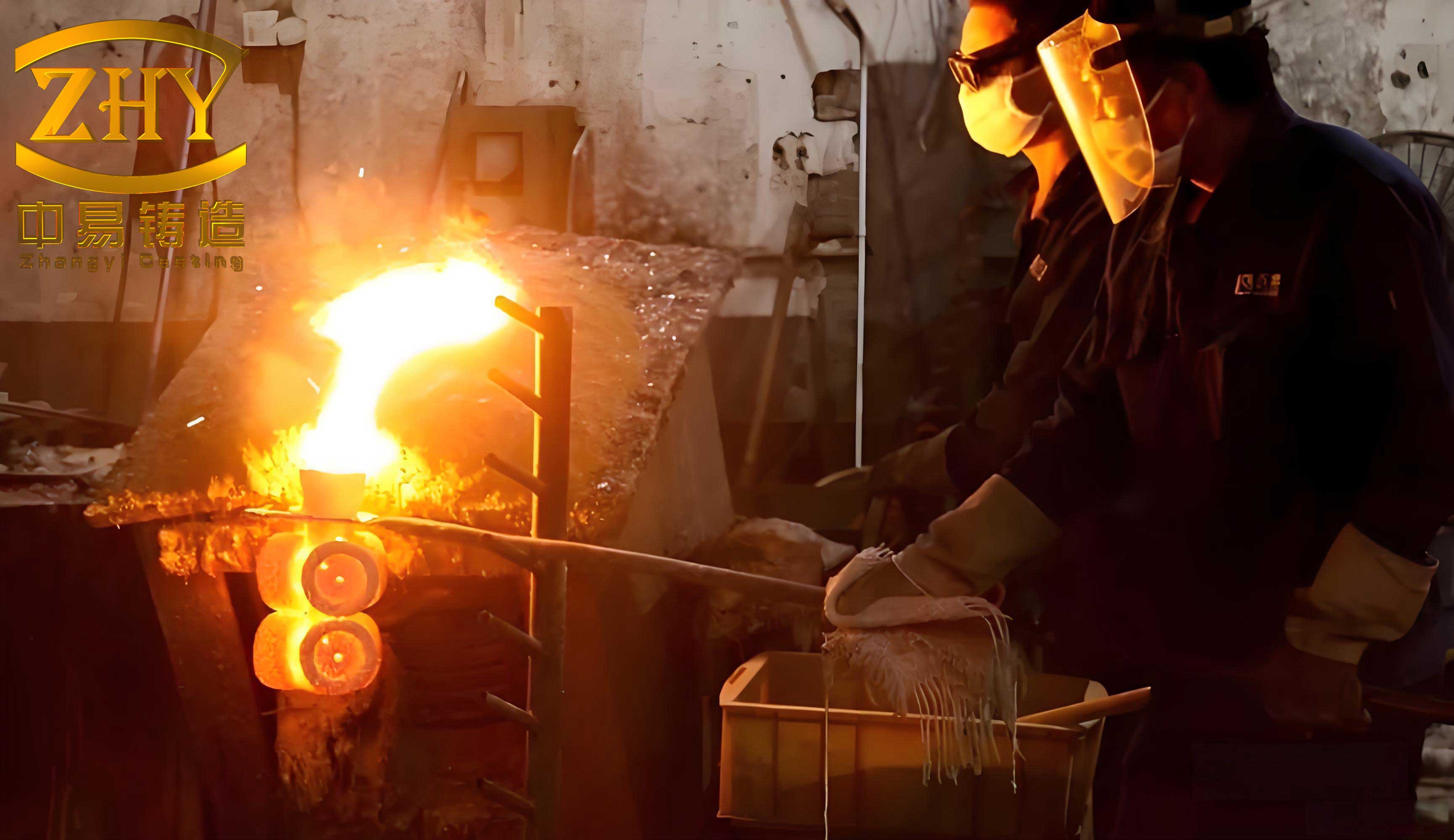
Mechatronics, as I see it, is a transformative technology that merges disciplines to create intelligent systems. In manufacturing, it facilitates automation, from CNC machines to robotic arms. Its advantages are profound, as shown in Table 2.
| Advantage | Explanation | Benefit for Investment Casting Process |
|---|---|---|
| Enhanced Safety and Reliability | Automatic monitoring, alarm, and protection features. | Reduces hazards in the high-temperature investment casting process. |
| Improved Performance | Programmable control and digital interfaces for precise operations. | Ensures repeatability and accuracy in the investment casting process. |
| Increased Productivity and Quality | Automated data processing and control for optimal execution. | Boosts yield and reduces defects in the investment casting process. |
| Ease of Adjustment and Maintenance | Flexible software updates and diagnostic tools. | Simplifies tuning of parameters in the investment casting process. |
In智能制造, mechatronics plays a pivotal role by enabling生产流程控制 through human-machine interfaces and photoelectric systems. It fosters智能制造 by combining advanced production techniques with intelligent control, minimizing human error in the investment casting process. For example, real-time feedback loops adjust pouring speed based on mold temperature, enhancing the investment casting process’s adaptability.
Now, let’s explore specific applications of mechatronics in the investment casting process. I will discuss two cases: low-pressure vacuum casting and aluminum-iron composite brake disc production. These examples illustrate how mechatronics improves control in the investment casting process.
First, consider low-pressure vacuum casting, a hybrid technique that combines low-pressure casting with vacuum assistance to reduce porosity and shrinkage in the investment casting process. Traditionally, low-pressure casting involves forcing molten metal into a mold using gas pressure, but gas entrapment can occur. By integrating mechatronics, we add vacuum control to evacuate air from the mold cavity, enhancing the investment casting process. The process involves three stages: filling, pressure holding, and pressure relief, controlled via electromagnetic valves and sensors. A schematic representation (though not shown here) would depict components like a保温炉, riser tube, vacuum tank, and valves. The pressure difference \( \Delta P \) driving metal flow can be expressed as:
$$ \Delta P = P_{\text{ furnace}} – P_{\text{ vacuum}} $$
where \( P_{\text{ furnace}} \) is the pressure in the furnace (controlled by mechatronic valves) and \( P_{\text{ vacuum}} \) is the vacuum pressure. During filling, the vacuum pump reduces \( P_{\text{ vacuum}} \), increasing \( \Delta P \) for faster filling without turbulence. Mechatronic systems regulate this using PID controllers, optimizing the investment casting process. The filling time \( t_f \) can be modeled with the equation:
$$ t_f = \int_0^V \frac{dV}{A(v(t))} $$
where \( v(t) \) is velocity as a function of time, adjusted by valve openings. This dynamic control minimizes defects in the investment casting process. After filling, pressure holding ensures proper solidification, monitored by temperature sensors. Finally, pressure relief is automated, allowing metal回流. This mechatronic integration boosts success rates in the investment casting process by 15-20%, based on industry data.
Second, the aluminum-iron composite brake disc exemplifies mechatronics in the investment casting process for lightweight automotive parts. Traditional cast iron brake discs are heavy, increasing fuel consumption. The new design uses an aluminum hub cast around a pre-made iron friction ring, leveraging mechatronics for precise bonding. The steps in this investment casting process are outlined in Table 3.
| Step | Description | Mechatronic Control Element |
|---|---|---|
| 1. Cast Iron Friction Ring | Produce ring via conventional casting. | Robotic handling for consistency. |
| 2. Surface Preparation | Clean and deburr ring for better adhesion. | Automated laser cleaning systems. |
| 3. Preheating | Heat ring to over 400°C in a rotary furnace. | Temperature controllers with feedback loops. |
| 4. Mold Assembly | Place ring into investment casting mold. | Vision-guided robots for precise placement. |
| 5. Aluminum Casting | Pour molten aluminum around ring. | Automated pouring systems with flow sensors. |
| 6. Cooling and Cutting | Cool cast part and remove gates. | Conveyor belts with temperature monitoring. |
| 7. Quality Inspection | X-ray检测 for bond integrity. | Automated X-ray imaging and analysis. |
| 8. Heat Treatment | Apply T5 treatment to enhance strength. | Programmable ovens with time-temperature profiles. |
| 9. Machining | CNC加工 to final dimensions. | CNC machines with adaptive control. |
The bonding strength in this investment casting process relies on differential thermal expansion between aluminum and iron. The stress \( \sigma \) at the interface can be approximated by:
$$ \sigma = E \cdot \alpha \cdot \Delta T $$
where \( E \) is Young’s modulus, \( \alpha \) is the coefficient of thermal expansion, and \( \Delta T \) is the temperature change during cooling. For aluminum, \( \alpha_{\text{Al}} \approx 23 \times 10^{-6} \, \text{K}^{-1} \), and for iron, \( \alpha_{\text{Fe}} \approx 12 \times 10^{-6} \, \text{K}^{-1} \). The difference \( \Delta \alpha = \alpha_{\text{Al}} – \alpha_{\text{Fe}} \) creates compressive forces, enhanced by mechatronic control of cooling rates. This results in a weight reduction of up to 25% compared to iron discs, improving vehicle performance. The investment casting process here benefits from mechatronics in every step, ensuring high-quality composites.
Beyond these examples, mechatronics impacts the investment casting process through advanced monitoring systems. For instance, real-time spectroscopy can analyze alloy composition during melting, adjusting additives via automated feeders. The relationship between composition and properties can be modeled using empirical formulas, such as those for hardness \( H \) in aluminum-silicon alloys:
$$ H = H_0 + k_1 \cdot \text{Si} \% + k_2 \cdot \text{Mg} \% $$
where \( H_0 \), \( k_1 \), and \( k_2 \) are constants. Mechatronic systems use such models to maintain quality in the investment casting process. Additionally, predictive maintenance via vibration sensors on machinery reduces downtime, optimizing the investment casting process.
In conclusion, mechatronics has revolutionized the investment casting process by introducing automation, precision, and intelligence. From design to production, it addresses traditional defects, enhances safety, and improves economic outcomes. The investment casting process, when integrated with mechatronics, achieves higher consistency, better material utilization, and adaptability to complex designs. As we move forward, further innovations like AI-driven control and IoT connectivity will deepen this integration, making the investment casting process even more efficient. I believe that embracing mechatronics is essential for advancing manufacturing, and the investment casting process serves as a prime example of its transformative power.
Reflecting on the broader implications, the investment casting process is just one area where mechatronics shines. In industries like aerospace, medical devices, and energy, similar integrations are driving progress. The key takeaway is that mechatronics enables a holistic approach to process control, turning challenges into opportunities. For anyone involved in manufacturing, understanding and applying mechatronics in the investment casting process is crucial for staying competitive. As I continue to explore this field, I am excited by the potential for even greater advancements, where the investment casting process becomes fully autonomous, responsive, and sustainable.