
The development of spheroidal graphite iron as a high-strength cast metal material over recent decades represents a significant advancement in metallurgy. Compared to steel, spheroidal graphite iron offers distinct advantages, including superior castability and relatively lower production costs. Its increasing production volume and the continuous enhancement of its properties have enabled its successful partial replacement of forged and cast steels, solidifying its position as a promising structural metal. The mechanical performance of any metallic material is intrinsically linked to its underlying microstructure; the specific morphology and distribution of phases dictate the resultant properties. Spheroidal graphite iron is no exception. Therefore, a fundamental and detailed study of its metallography is a prerequisite for a deep understanding and effective utilization of this material. This article presents an in-depth analysis from a first-hand perspective on common defects encountered during the production of spheroidal graphite iron, specifically QT450-10A grade castings, with a focus on differentiating their characteristics, understanding their root causes, and formulating robust preventative strategies.
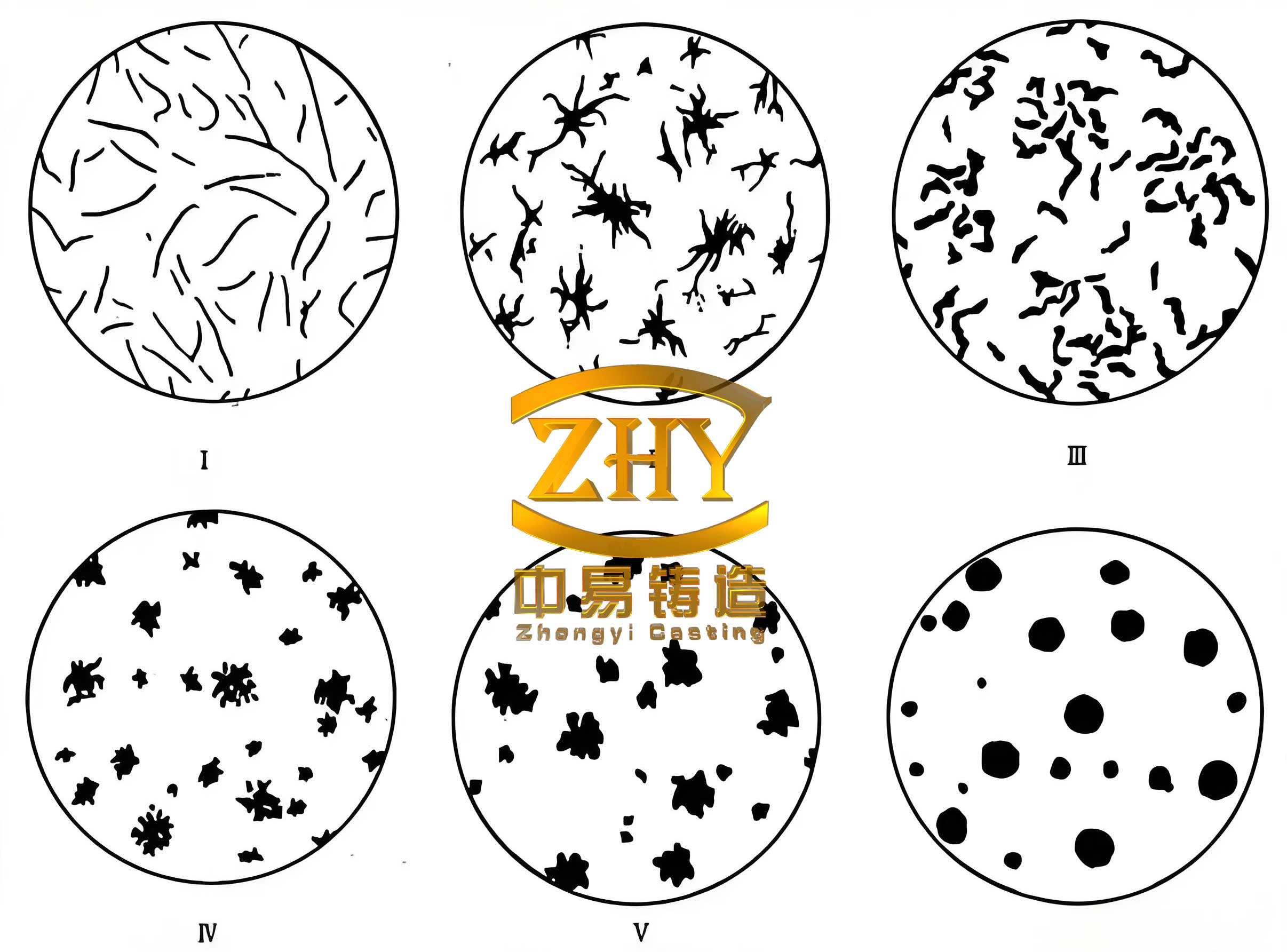
The unique properties of spheroidal graphite iron arise from the spheroidal shape of its graphite precipitates, as opposed to the flake form found in gray iron. This morphological difference, achieved through melt inoculation and spheroidizing treatments, drastically reduces the stress-concentrating effect of graphite, thereby unlocking high tensile strength combined with considerable ductility and toughness. The matrix of spheroidal graphite iron can be tailored through alloying and heat treatment to be primarily ferritic, pearlitic, or a mixture of phases (austempered), offering a wide range of mechanical properties. The successful production of high-integrity castings in spheroidal graphite iron, however, is highly sensitive to process parameters. Minor deviations in chemistry, treatment, or foundry practice can lead to various internal and subsurface defects that critically impair mechanical performance, particularly fatigue life and impact resistance.
1. Microshrinkage Porosity: Analysis and Mitigation
1.1. Microstructural Characteristics and Identification
Microshrinkage, or interdendritic shrinkage, is a common yet often misinterpreted defect in spheroidal graphite iron castings. Under standard optical microscopy at moderate magnifications (e.g., 100-200x), microshrinkage can appear as irregular, often interconnected dark regions situated preferentially along the boundaries of eutectic cells. These regions may resemble elongated or clustered forms that can be mistakenly identified as degraded (vermicular or flake) graphite resulting from poor inoculation or fading. This misdiagnosis can lead to corrective actions focused solely on melt treatment, potentially exacerbating the actual issue. The key to accurate identification lies in examining the three-dimensional nature of the defect. Scanning Electron Microscopy (SEM) analysis reveals its true character: the features are not flat graphite flakes but rather three-dimensional, “cauliflower-like” or dendritic cavities with a distinct, irregular surface topography. This contrasts sharply with the smooth, rounded surfaces of true graphite spheroids. Energy Dispersive X-ray Spectroscopy (EDS) point analysis within these cavities typically shows a composition similar to the base matrix, with no significant enrichment of elements associated with slag or inclusions, confirming their nature as voids rather than non-metallic phases.
1.2. Formation Mechanism and Contributing Factors
Microshrinkage forms during the final stages of solidification. As the melt cools, austenite dendrites grow first, forming a skeletal network. The remaining liquid, enriched in carbon and other solutes, is trapped within the interdendritic channels. The solidification of this last liquid is accompanied by contraction. If this volumetric contraction cannot be compensated by the influx of feed metal from still-liquid regions or by the expansion caused by graphite precipitation, tiny, interconnected voids remain. The propensity for microshrinkage in spheroidal graphite iron is governed by a complex interplay of factors:
a) Chemical Composition:
The Carbon Equivalent (CE) is paramount. A low CE reduces the amount of graphite precipitated, thereby diminishing the useful expansion that can counteract the shrinkage of the liquid and austenite phases. The carbon equivalent for spheroidal graphite iron is typically calculated as:
$$ CE = \%C + \frac{\%Si + \%P}{3} $$
An optimal range is crucial. Alloying elements significantly influence shrinkage behavior. Manganese (Mn) segregates strongly to the interdendritic liquid, increasing its freezing range and hindering feeding. Elements like Chromium (Cr) and Phosphorus (P) promote carbide formation and shrink the eutectic temperature range, increasing shrinkage tendency. While Copper (Cu) can improve strength, excessive amounts promote pearlite and can increase microshrinkage. Residual Magnesium (Mg), essential for graphite spheroidization, also increases shrinkage tendency if too high by expanding the solidification range and forming carbides.
b) Solidification Dynamics and Feeding:
The solidification pattern is critical. Sections that solidify directionally towards a riser are well-fed. Isolated hot spots or regions where thermal gradients are shallow lead to pasty, mushy zones where feeding is extremely difficult. The fundamental pressure driving feeding can be described as:
$$ P_{feed} = \rho g h – \frac{2\gamma}{r} $$
where \( \rho \) is the melt density, \( g \) is gravity, \( h \) is the metallostatic head, \( \gamma \) is the melt surface tension, and \( r \) is the radius of the interdendritic channel. In the fine channels of the mushy zone, the capillary pressure term \( \frac{2\gamma}{r} \) becomes significant and can oppose feeding.
c) Molding and Core Materials:
Insufficient mold rigidity can lead to a phenomenon known as “mold wall movement.” During the graphite expansion phase of spheroidal graphite iron solidification, the internal pressure can push the mold walls outward, effectively increasing the casting volume. If the mold yields, this expansion is not translated into effective feeding pressure for other sections of the casting, leading to internal shrinkage in areas that should have been fed.
d) Inoculation Practice:
Effective inoculation promotes a large number of small, uniformly distributed graphite spheroids. This results in a fine, equiaxed eutectic cell structure with shorter and more open interdendritic channels for feeding. Inadequate or faded inoculation leads to fewer, larger eutectic cells with longer, more tortuous channels, severely impeding liquid metal flow and promoting microshrinkage at cell boundaries.
| Factor | Typical Target Range | Effect on Microshrinkage Tendency | Mechanism |
|---|---|---|---|
| Carbon Equivalent (CE) | 4.4% – 4.7% | Low CE → High Tendency | Reduces graphite expansion volume. |
| Residual Magnesium (Mg) | 0.03% – 0.05% | High Mg → High Tendency | Increases freezing range, promotes carbides. |
| Manganese (Mn) | < 0.5% | High Mn → High Tendency | Segregation, enlarges pasty zone. |
| Phosphorus (P) | < 0.03% | High P → High Tendency | Forms low-melting phosphide eutectic, impedes feeding. |
| Chromium (Cr) | < 0.1% | High Cr → High Tendency | Strong carbide former, increases shrinkage. |
| Copper (Cu) | < 0.6% | Moderate Cu → Neutral/High* | Promotes pearlite; excessive amounts increase shrinkage. |
| Inoculation Efficiency | High nodule count, small size | Poor → High Tendency | Creates large eutectic cells with poor feeding paths. |
| Mold Hardness/Strength | High (e.g., 85-95 on scale) | Low → High Tendency | Allows mold wall movement, wasting expansion pressure. |
1.3. Comprehensive Preventive and Corrective Measures
Controlling microshrinkage requires a holistic approach targeting chemistry, process design, and foundry practice.
1. Optimized Chemistry: Maintain CE in the upper range suitable for the section thickness, balancing the risk of graphite flotation. Strictly control shrinkage-promoting elements (Mn, P, Cr). Use high-purity charge materials (low residual elements). Precisely control spheroidizing treatment to achieve the minimum effective residual Mg level.
2. Advanced Inoculation Strategy: Implement a multi-stage inoculation process: a base inoculation in the ladle followed by an effective late stream inoculation (post-inoculation). This ensures a high nodule count (e.g., > 120 nodules/mm²) and refines the eutectic structure. The total silicon addition from inoculants should be controlled, typically resulting in a final silicon increase of 0.6% to 0.9%.
3. Rigorous Process Design: Employ Computational Solidification Modeling to predict shrinkage locations accurately. Design rigging systems (risers, chills, cooling fins) based on simulation results. Use exothermic or insulating sleeves on risers to maximize feeding efficiency. Strategically place chills to promote directional solidification towards risers and eliminate isolated hot spots.
4. Robust Molding Practice: Use high-strength molding systems (e.g., rigid chemically bonded sands). Ensure consistent and adequate mold compaction. Regularly verify mold hardness using standardized testers. For critical castings, consider the use of molds with higher refractory aggregate or bonded with high-temperature resins to resist wall movement.
2. Slag-Related Blowholes (Slag Entrapment and Gas Porosity)
2.1. Microstructural Characteristics and Differentiation from Shrinkage
Defects arising from slag entrapment often manifest as subsurface blowholes or pinholes. Under optical microscopy, the voids may appear rounded or irregular, sometimes associated with dark, non-metallic inclusions. At first glance, they might be confused with isolated shrinkage pores. The critical differentiation again comes from SEM/EDS analysis. Whereas microshrinkage cavities have a dendritic, metallic fracture appearance, slag blowhole interiors often appear smoother and may be lined with or adjacent to distinct non-metallic phases. EDS analysis is definitive: it reveals significant enrichment of elements associated with slag-forming reactions. Point scans within or around the defect will show peaks for Oxygen (O), Magnesium (Mg), Sulfur (S), Silicon (Si), and sometimes Calcium (Ca) or Aluminum (Al), far exceeding their levels in the sound matrix. This chemical signature is the “fingerprint” of slag/gas reaction products.
2.2. Root Cause Analysis: The Slag-Gas Interaction
The formation of slag-related blowholes in spheroidal graphite iron is inherently linked to the high reactivity of magnesium. During and after the spheroidizing treatment, several competing reactions can occur at the melt surface and within the melt if inclusions are present.
a) Primary Slag Formation: The spheroidizing alloy (typically FeSiMg) introduces reactive Mg into the melt. Mg has a high affinity for oxygen and sulfur:
$$ [Mg] + [O] \rightleftharpoons (MgO) $$
$$ [Mg] + [S] \rightleftharpoons (MgS) $$
These compounds, along with oxidized silicon (SiO₂), form a dross or slag on the melt surface. If this slag is not thoroughly removed before pouring, it can be entrapped into the casting.
b) Gas Evolution and Pore Nucleation: Moisture is the primary enemy. Water can be introduced via damp charge materials (rusty scrap, un-dried alloy additions), humid air, or moisture in molding sands (especially in green sand or from incomplete curing of resin-bonded sands). At high temperatures, water dissociates, and hydrogen dissolves into the melt:
$$ H_2O (g) \rightarrow 2[H] + [O] $$
The solubility of hydrogen in liquid iron is much higher than in solid iron. During solidification, hydrogen is rejected and can supersaturate the remaining liquid, forming gas bubbles. These bubbles can nucleate preferentially on the surfaces of solid inclusions like MgO or MgS. The presence of such inclusions dramatically lowers the energy required for pore formation. The combined defect—a gas pore nucleated on a slag particle—is a classic slag blowhole.
c) Secondary Reactions from Molds/Cores: Organic binders in chemically bonded sands (e.g., phenolic urethane, furan) can break down at the metal interface, releasing gases containing H, O, C, and S. Sulfur from the binder can react with Mg in the metal surface to form MgS, potentially causing pitting or sub-surface porosity. High nitrogen content from certain binders can also contribute to porosity.
| Source | Introduced Species | Resulting Reaction/Defect | Key Preventive Action |
|---|---|---|---|
| Damp/Wet Charge Materials | H₂O | Hydrogen dissolution, oxide formation, slag. | Use dry materials; pre-heat alloys (>>200°C). |
| High-Sulfur Charge (Pig Iron, Scrap) | S | Excessive MgS slag formation, consumes Mg. | Control base S level (<0.015% pre-treatment). |
| Inefficient Slag Removal | MgO, MgS, SiO₂ Slag | Slag entrapment acting as pore nuclei. | Effective skimming; use of slag-coating fluxes. |
| High Moisture in Molding Sand | H₂O (vapor) | Subsurface hydrogen pinholes. | Control sand moisture/content; ensure proper curing. |
| Sulfur & Nitrogen from Resin Binders | S, N₂ | Surface reaction: MgS formation; nitrogen porosity. | Use low-S/N binders; apply protective mold wash. |
| Oxidizing Melting Atmosphere | O₂ | Increased melt oxidation, more dross. | Minimize turbulence; melt under slightly reducing conditions. |
| Pouring System Design | Turbulence | Entrains air and existing slag. | Design gating for laminar, pressurized flow. |
2.3. Integrated Prevention Strategy for Slag and Gas Defects
Eliminating slag-related blowholes requires meticulous control over the entire process chain, from melting to pouring.
1. Melt Preparation and Treatment:
• Charge Materials: Use clean, dry, and low-rust charge. Pre-heat all additives (FeSiMg, inoculants, etc.) to above 150-200°C to drive off moisture and adsorbed gases.
• Melting Practice: Melt under a covering flux if possible to minimize oxidation. Ensure the furnace lining is in good condition. Allow the molten iron to settle for 1-2 minutes after reaching temperature to let inclusions float up.
• Spheroidizing Process: Use a well-preheated treatment ladle (>600°C). Employ treatment methods that minimize turbulence and exposure to air, such as sandwich method in a covered ladle or tundish cover reaction chambers. Precise Mg addition based on initial S content is critical to avoid excess residual Mg, which increases slag volume.
• Post-Treatment: Skim thoroughly and aggressively after treatment. Consider using a slag-coating agent to coalesce fine dross for easier removal. Perform a second skimming immediately before pouring.
2. Rigorous Mold/Core Control:
• For chemically bonded sands, implement strict quality control on reclaimed sand to limit the buildup of sulfur and nitrogen. Regularly add new sand to the system to dilute contaminants.
• Ensure cores are fully cured. Apply a high-quality refractory wash (e.g., zircon-based) to create a barrier between the metal and the sand binder system.
3. Optimized Gating and Pouring System Design:
• Design gating systems based on the principles of pressurization to prevent aspiration. Use systems with tapered sprues, well-designed sprue bases, and runner extensions to trap the first metal containing slag.
• Incorporate effective slag traps, such as whirl gates or filter boxes with ceramic foam filters. Filters are highly effective at removing non-metallic inclusions.
• Ensure molds are assembled tightly to prevent metal from leaking at parting lines and bypassing the designed gating system.
• Train pourers to maintain a full pouring basin and a continuous, rapid pour to keep the sprue choked, ensuring a quiet, non-turbulent fill.
3. Additional Common Defects in Spheroidal Graphite Iron and Control Philosophies
Beyond microshrinkage and slag blowholes, other defects warrant attention in the production of high-quality spheroidal graphite iron castings.
3.1. Chunky Graphite (Exploded Graphite): This appears as large, irregular, and often interconnected graphite clusters in heavy-section castings (>~100mm). It severely reduces mechanical properties, especially ductility and thermal conductivity. It is caused by slow cooling and specific local chemistry (e.g., rare earth balance, high Ce). Prevention involves careful control of inoculation (avoiding over-inoculation), adjusting rare earth content in the spheroidizer, and using chills to increase local cooling rates.
3.2. Carbide Formation (Chill): Hard, brittle iron carbides (Fe₃C) can form in thin sections or at edges due to rapid cooling, especially in alloys with high Mn, Cr, or low inoculation efficiency. This leads to machining difficulties and brittle behavior. Prevention is achieved by ensuring effective inoculation, avoiding excessive carbide-promoting elements, and adjusting pouring temperature and mold materials to moderate cooling rates in critical areas.
3.3. Shrinkage Cavities (Macroshrinkage): These are larger, visible cavities typically located in thermal centers near hot spots, distinct from the microscopic interdendritic shrinkage. They result from inadequate feeding. Prevention relies entirely on sound risering and chilling practice, guided by solidification simulation.
4. A Framework for Systematic Quality Control in Spheroidal Graphite Iron Production
A proactive, data-driven approach is essential for consistent quality. A comprehensive framework includes:
1. In-Process Monitoring: Real-time thermal analysis during melting and treatment can predict CE, undercooling, and nodule count. Spectroscopy provides fast chemical feedback. Regular checks of melt quality via wedge chill tests or rapid carbon equivalent determination are invaluable.
2. Destructive and Non-Destructive Testing (NDT): Regularly section and evaluate castings from critical jobs. Use ultrasonic testing to detect internal shrinkage and slag inclusions. Radiography (X-ray) is highly effective for visualizing internal defects in complex castings.
3. Metallographic Database: Maintain a historical record of microstructures (graphite shape, size, distribution, matrix) and corresponding mechanical test results. This database becomes a powerful tool for diagnosing issues and optimizing processes.
4. Statistical Process Control (SPC): Apply SPC charts to key variables: final chemistry (C, Si, Mg, Mn), pouring temperature, mold hardness, tensile strength, and elongation. This helps identify process drift before it leads to scrap.
In conclusion, the production of defect-free spheroidal graphite iron castings is a complex engineering challenge requiring a deep understanding of metallurgical principles and foundry processes. Microshrinkage and slag-related blowholes are two prevalent issues that can be differentiated through advanced microstructural analysis. Their prevention is not achieved by a single action but through a meticulously controlled and integrated system encompassing chemistry design, advanced melt treatment, robust molding, intelligent process design using simulation, and rigorous quality assurance. By adopting such a systematic approach, foundries can significantly enhance the consistency, reliability, and performance of spheroidal graphite iron components, fully realizing the potential of this versatile and high-performance engineering material.