
The performance and service life of cast components are fundamentally dictated by their internal microstructures. In the context of a manganese steel casting foundry, controlling these microstructures to achieve desired properties like high strength and wear resistance is a primary objective. For heavy-section castings, such as those used in critical railway components, this challenge is amplified due to inherent low thermal conductivity leading to coarse grains, developed dendrites, and segregation of impurities. Traditional trial-and-error methods for grain refinement are time-consuming and costly. Therefore, the development and application of numerical simulation tools to predict and control solidification microstructure have become a focal point of modern foundry science. This article, from a researcher’s perspective, delves into the use of a coupled Cellular Automaton (CA) and Finite Element (FE) method to simulate, analyze, and ultimately guide the optimization of solidification structures in heavy-section high manganese steel castings.
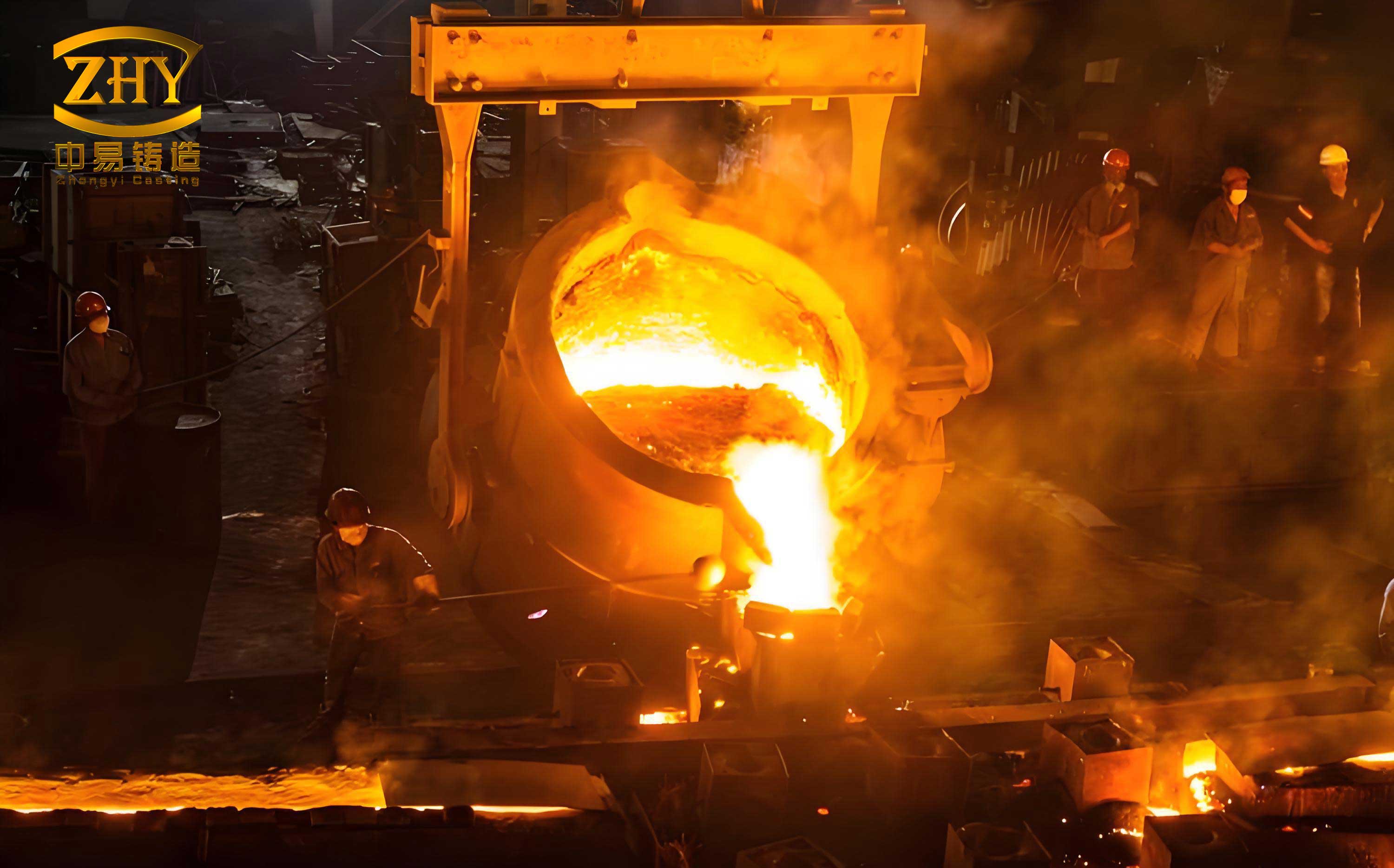
The core challenge in a manganese steel casting foundry, especially for thick sections, stems from the material’s low thermal diffusivity. During solidification, slow heat extraction fosters the growth of large columnar and equiaxed grains. Furthermore, low-melting-point phases and inclusions tend to segregate at these coarse grain boundaries, creating potential sites for crack initiation and propagation, which ultimately leads to premature failure through spalling or cracking in service. The railway frog casting, a quintessential heavy-section high manganese steel component, exemplifies this problem. Achieving grain refinement and microstructural homogeneity is not merely an academic goal but a critical necessity for enhancing the integrity and safety of such components. This is where predictive computational modeling becomes an indispensable tool for the manganese steel casting foundry, allowing for virtual experimentation and process optimization before metal is ever poured.
The methodology employed here hinges on a multi-scale simulation approach. The macro-scale transport phenomena—heat transfer, fluid flow, and mass transfer—during solidification are solved using the Finite Element Method (FEM). This provides the foundational thermal and fluid dynamic conditions, such as temperature fields and cooling rates, which act as the driving force for microstructural evolution. The micro-scale phenomena of nucleation and grain growth are then simulated using the Cellular Automaton (CA) technique, which is physically grounded in nucleation mechanisms and dendrite growth kinetics. Commercial casting simulation software, like ProCAST, integrates these two methods. The FE module calculates the macroscopic solidification conditions, and the CA module uses these conditions to stochastically simulate the nucleation of grains and their subsequent competitive growth, predicting the final grain structure, including size, morphology, and the columnar-to-equiaxed transition (CET).
The mathematical models underpinning this coupled simulation are crucial for accuracy. For nucleation, a continuous model based on a Gaussian distribution of nucleation sites is used. The density of nuclei, n, activated at a given undercooling, $\Delta T$, is given by:
$$
n(\Delta T) = n_{max} \frac{1}{\sqrt{2\pi}\Delta T_{\sigma}} \exp\left[-\frac{1}{2}\left(\frac{\Delta T – \Delta T_{max}}{\Delta T_{\sigma}}\right)^2\right]
$$
where $n_{max}$ is the maximum nucleation density, $\Delta T_{max}$ is the mean nucleation undercooling, and $\Delta T_{\sigma}$ is the standard deviation. The accurate determination of $n_{max}$ is vital, as it represents the effective number of heterogeneous substrates available in the melt within a manganese steel casting foundry environment.
For the growth of dendrite tips, a simplified form of the KGT (Kurz-Giovanola-Trivedi) model is often employed, relating the tip growth velocity, $V_{tip}$, to the local constitutional undercooling, $\Delta T_c$:
$$
V_{tip}(\Delta T_c) = a \cdot (\Delta T_c)^b
$$
where $a$ and $b$ are material-dependent constants. For the high manganese steel in this study, a simplified relation $V_{tip}(\Delta T_c)=5.85\times10^{-6}(\Delta T_c)^2$ was used. The latent heat release during growth is integrated back into the FE heat transfer calculation, ensuring a fully coupled thermo-microstructural simulation.
Simulation Setup and Baseline Validation for Manganese Steel Casting Foundry Conditions
The subject of this study is a heavy-section high manganese steel railway frog casting. A critical region of this casting, characterized by a thick cross-section and complex thermal interactions with chills and risers, was selected for detailed microstructural simulation. The initial simulations aimed to establish a baseline corresponding to the conventional sand-casting process in a typical manganese steel casting foundry. Key process parameters were a pouring temperature of 1450°C and an estimated average cooling rate of 0.1 °C/s in the thick section. Through an iterative calibration process where simulation results were matched against experimental metallographic data, the effective nucleation parameters for the conventional process were determined. The maximum nucleation site density, $n_{max}$, was found to be approximately $2 \times 10^7 m^{-3}$ with a mean undercooling, $\Delta T_{max}$, of 10 K.
The simulation results for this baseline case successfully reproduced the experimentally observed coarse and non-uniform microstructure. The structure was dominated by long, coarse columnar grains growing from the chill surfaces, transitioning into a central region of relatively large equiaxed grains. This agreement validated the CA-FE model setup, confirming that the chosen physical models and parameters could reliably replicate the solidification behavior under standard manganese steel casting foundry conditions. This baseline serves as a critical reference point for evaluating the impact of process modifications.
| Process Parameter | Baseline (Conventional) | Effect on Microstructure |
|---|---|---|
| Pouring Temperature | 1450 °C | Establishes baseline thermal gradient and superheat. |
| Cooling Rate (Avg.) | 0.1 °C/s | Slow cooling promoting coarse grain growth. |
| Nucleation Density ($n_{max}$) | $2 \times 10^7 m^{-3}$ | Limited nuclei lead to large columnar and equiaxed grains. |
| Simulated Grain Structure | Coarse columnar + coarse equiaxed | Validated against experimental macro/micrograph. |
The Impact of Pouring Temperature and Superheat
With the validated model, the influence of key foundry variables was investigated. The first variable was pouring temperature, which directly controls the metal superheat. Simulations were run with increased pouring temperatures of 1500°C and 1550°C, keeping all other parameters, including the nucleation density ($2 \times 10^7 m^{-3}$), constant.
The results were systematic and significant. Increasing the pouring temperature led to a marked coarsening of the microstructure. The columnar grains became thicker and more developed. While the length of the columnar zone did not increase dramatically, the primary dendrite arm spacing within the columnar grains increased. This is attributed to the higher initial heat content, which reduces the thermal gradient over time more gradually and allows for longer diffusion-controlled coarsening of the dendritic branches. The transition zone and the final equiaxed region also exhibited larger grain sizes. The higher superheat delays the onset of widespread nucleation in the bulk liquid, allowing fewer nuclei to survive and grow to a larger size before impingement. This series of simulations clearly demonstrates a fundamental challenge in the manganese steel casting foundry: reducing pouring temperature to minimize grain size must be balanced against the need for sufficient fluidity to fill the mold.
The temperature history at different points in the casting cross-section, extracted from the FE model, provides further insight. Points closer to the chill show a rapid temperature drop, promoting a high nucleation rate and a fine initial chill zone. Points in the thermal center show a much slower cooling profile, residing in the mushy state for an extended period, which favors the growth and coarsening of a smaller number of equiaxed grains. The competition between columnar growth, driven by the external temperature gradient, and equiaxed growth, driven by bulk undercooling and available nuclei, is the central drama of solidification. The simulations visualize this competition and its outcome under different thermal regimes.
Grain Refinement via Nucleation Control: Simulating a Foundry Optimization
The most direct path to microstructural improvement in a manganese steel casting foundry is grain refinement. The baseline simulation confirmed that the inherent nucleation density in the conventional process is too low. Therefore, the focus shifted to simulating the effect of intentionally increasing the number of potent nucleation sites. This represents foundry practices like inoculation or, as specifically studied here, the stream addition of fine, solid metal particles of the same composition during pouring.
In the CA model, this is simulated by increasing the maximum nucleation density parameter, $n_{max}$. A simulation was run with $n_{max} = 5 \times 10^7 m^{-3}$, representing a moderate addition of grain refiner, while maintaining the 1450°C pouring temperature. The results were transformative. The microstructure became significantly finer and more homogeneous. The columnar grains were thinner, and the central equiaxed region consisted of a much larger number of smaller grains. The mechanism is clear: a higher density of nuclei activates at lower undercoolings, resulting in a larger number of grains growing simultaneously. These grains impinge upon each other much earlier, limiting their final size. The columnar front is also more easily blocked by this dense network of equiaxed grains, promoting a earlier CET and a more isotropic structure. This simulated microstructure aligned excellently with experimental results obtained from castings where 2 wt.% of 1mm diameter steel particles were added during pouring, validating the model’s predictive power for process optimization in the manganese steel casting foundry.
However, refinement has a limit. A further simulation was conducted with an even higher nucleation density of $n_{max} = 1 \times 10^8 m^{-3}$. While the grain structure remained very fine, the simulation revealed a potential defect: the formation of isolated porosity or shrinkage micro-porosity. The mechanism simulated here is physical: an extremely high number of nuclei leads to the rapid formation of a dense, interlocking solid network very early in the solidification sequence. This network can obstruct the interdendritic channels needed for liquid metal to feed solidification shrinkage occurring in the last stages of freezing. Consequently, isolated pockets of liquid become trapped and form shrinkage porosity upon final solidification. This critical insight from simulation provides a crucial upper bound for the grain refiner addition in a manganese steel casting foundry. Excessive refinement can be detrimental, trading coarse grains for shrinkage defects.
| Simulation Scenario | Key Parameter: $n_{max}$ | Simulated Microstructure | Interpretation & Foundry Guidance |
|---|---|---|---|
| Conventional Process | $2 \times 10^7 m^{-3}$ | Coarse, non-uniform columnar/equiaxed grains. | Baseline state; leads to inferior properties. |
| Optimized Refinement | $5 \times 10^7 m^{-3}$ | Fine, homogeneous grains. Uniform structure. | Ideal target. Achieved with ~2 wt.% stream-added particles. |
| Excessive Refinement | $1 \times 10^8 m^{-3}$ | Extremely fine grains, but with simulated porosity. | Defect risk. Sets upper limit for refiner addition (~<3 wt.%). |
Summary and Perspectives for the Manganese Steel Casting Foundry
The application of CA-FE coupled simulation provides a powerful, physics-based window into the complex solidification processes occurring within a manganese steel casting foundry. This study specifically demonstrates its utility for heavy-section castings:
- Baseline Correlation: The model successfully replicated the coarse microstructure of conventional sand-cast high manganese steel, calibrating the effective nucleation density to approximately $2 \times 10^7 m^{-3}$ under standard conditions.
- Process Variable Analysis: Simulations quantified the detrimental effect of excessive superheat (high pouring temperature) on grain coarsening, providing a scientific basis for optimizing pouring temperature in practice.
- Process Optimization Guidance: The core finding was the simulation of grain refinement via increased nucleation. It predicted that increasing the effective nucleation density to about $5 \times 10^7 m^{-3}$ would yield a fine, uniform microstructure, a prediction confirmed experimentally by stream addition of metal particles.
- Defect Prediction: Crucially, the model also forecasted a potential process limit, indicating that pushing nucleation density too high (e.g., $1 \times 10^8 m^{-3}$) could induce shrinkage porosity, thereby defining a safe operating window for grain refiner addition.
The mathematical framework, combining the nucleation law $$ n(\Delta T) = n_{max} \frac{1}{\sqrt{2\pi}\Delta T_{\sigma}} \exp\left[-\frac{1}{2}\left(\frac{\Delta T – \Delta T_{max}}{\Delta T_{\sigma}}\right)^2\right] $$ with the growth kinetics and macro-transport FE solution, forms a comprehensive digital twin of the solidification event. For the manganese steel casting foundry, this translates from empirical guesswork to a predictive science. It allows engineers to virtually test different gating systems, chill placements, riser designs, and inoculation strategies specifically for challenging heavy-section high manganese steel castings. The outcome is a directed path towards achieving reliable, high-integrity cast components with optimized microstructures, enhancing performance, safety, and economic efficiency in demanding applications like railway infrastructure.