
The study of high-chromium white cast iron is fundamental to advancing wear-resistant material technology. This class of ferrous alloys derives its exceptional performance from a unique microstructure dominated by hard chromium carbides embedded in a metallic matrix. This article presents a comprehensive analysis based on experimental research into the as-cast structure of several hypoeutectic high-chromium white cast iron compositions. We will delve into the profound influence of chemical composition, specifically the chromium-to-carbon ratio, on the type, morphology, and distribution of carbides. Furthermore, the phenomenon of elemental segregation at microstructural boundaries and its implications will be examined. The foundational understanding of these microstructural characteristics is critical for the intelligent design and heat treatment of high-chromium white cast iron components for demanding applications such as rolling mill rolls, slurry pumps, and crusher liners.
The primary carbide phases encountered in high-chromium white cast iron are (Fe,Cr)3C (M3C), (Cr,Fe)7C3 (M7C3), and (Cr,Fe)23C6 (M23C6). The transition from one dominant carbide type to another is not arbitrary but follows predictable thermodynamic and kinetic principles governed by alloy chemistry. The stability fields of these carbides can be broadly mapped against chromium content and the Cr/C ratio. For instance, alloys with lower chromium content and lower Cr/C ratios tend to favor the formation of M3C carbides, which often manifest as a continuous, brittle network encircling the primary austenite dendrites. This configuration can be detrimental to toughness. In contrast, at higher chromium contents and Cr/C ratios, the more thermodynamically stable M7C3 carbide becomes predominant. This carbide typically exhibits a discontinuous, rod-like or hexagonal morphology and is itself surrounded by the metallic matrix, which becomes the continuous phase. This reversal in continuity significantly enhances the fracture toughness of the white cast iron while retaining high wear resistance. The M23C6 carbide generally appears under conditions of very high chromium content or specific heat treatments. The morphology and interconnectivity of these carbides are directly linked to the service failure modes of components, including spalling, crack propagation, and wear mechanism transitions.
Experimental Methodology
The investigation was conducted on a series of hypoeutectic high-chromium white cast iron samples. The experimental workflow encompassed alloy preparation, microstructural characterization, phase identification, and property assessment.
Sample Preparation and Chemical Composition
Alloys were melted in a medium-frequency induction furnace and cast into standard Y-block sand molds to obtain consistent solidification conditions. The chemical composition of the investigated alloys, determined via optical emission spectrometry, is presented in Table 1. The Cr/C ratio, a critical parameter, is calculated for each sample.
| Sample ID | C | Cr | Si | Mn | Cr/C Ratio |
|---|---|---|---|---|---|
| A | 2.8 | 12.5 | 0.6 | 0.5 | 4.46 |
| B | 3.0 | 15.0 | 0.6 | 0.5 | 5.00 |
| C | 2.6 | 18.0 | 0.7 | 0.6 | 6.92 |
| D | 2.4 | 22.0 | 0.7 | 0.6 | 9.17 |
| E | 2.2 | 25.0 | 0.8 | 0.7 | 11.36 |
Microstructural and Phase Analysis
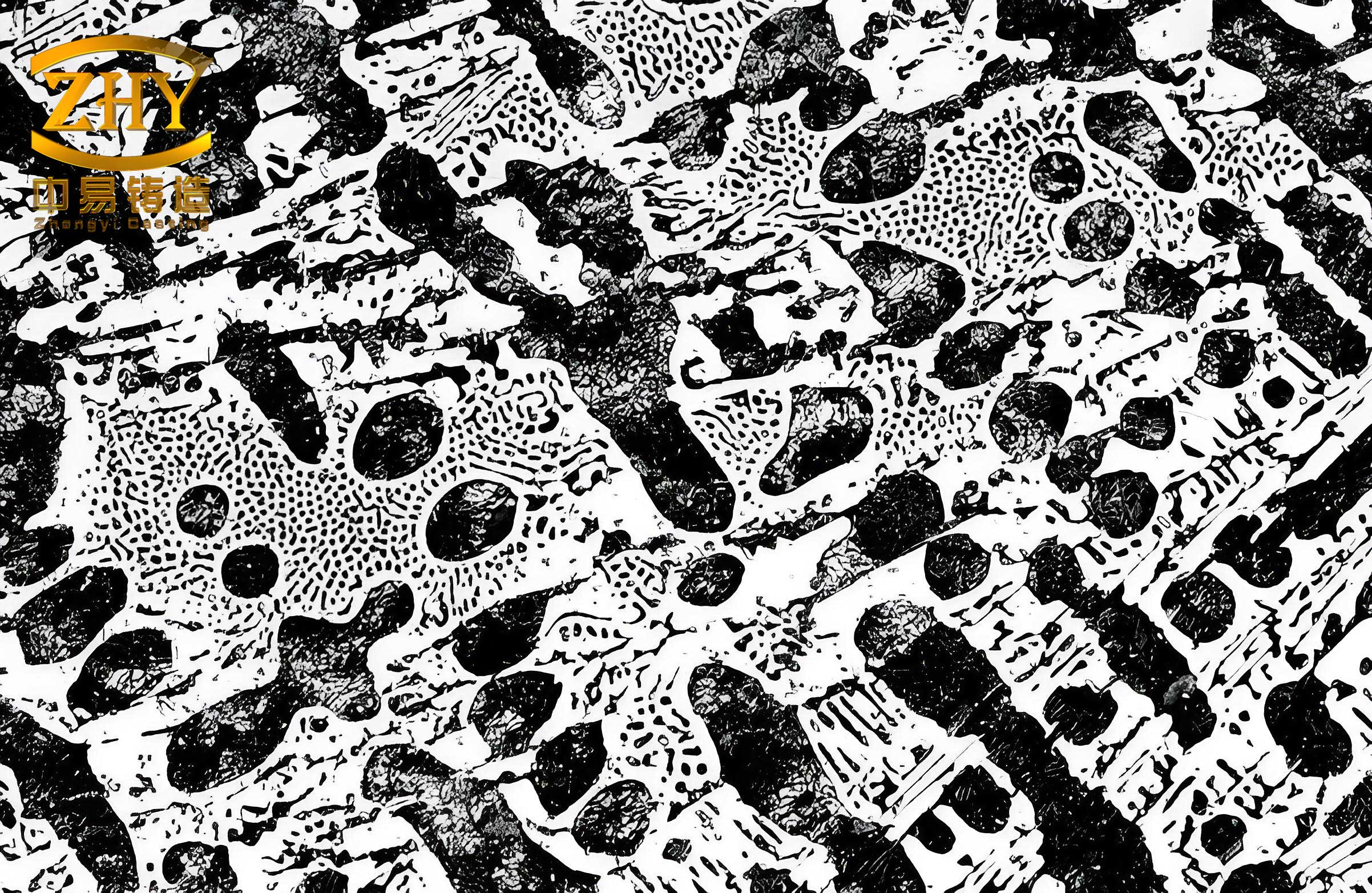
Metallographic samples were sectioned from identical locations on the Y-blocks to ensure comparability. Specimens were prepared using standard grinding and polishing techniques. To reveal the microstructure effectively, an etchant composed of hydrochloric acid, nitric acid, and glycerol was employed. Microstructural observation was performed using optical microscopy (OM) and scanning electron microscopy (SEM).
Phase identification of the eutectic carbides was conclusively determined using X-ray diffraction (XRD) analysis. The distribution of key alloying elements, particularly chromium (Cr) and molybdenum (Mo), within the primary matrix and the carbide phases was analyzed using energy-dispersive X-ray spectroscopy (EDS) attached to the SEM, including both point analysis and line scanning techniques.
Hardness Measurement
The macroscopic bulk hardness was measured using a Rockwell hardness tester. Additionally, the micro-hardness of the eutectic carbide phases was evaluated using a Vickers micro-hardness indenter under a low load. The reported micro-hardness values represent the average of at least five individual measurements taken on different carbide particles or regions to ensure statistical significance.
Results and Discussion: Microstructural Evolution
The as-cast microstructure of all samples consisted of primary austenite dendrites (which subsequently transformed to pearlite or other transformation products depending on cooling rate and composition) and interdendritic eutectic carbides. The defining characteristic was the dramatic change in the carbide phase’s identity and morphology with increasing Cr/C ratio.
Carbide Phase Identification and the Role of Cr/C Ratio
XRD analysis provided definitive evidence of the carbide transition. The results, correlated with the Cr/C ratio, are summarized in Table 2.
| Sample ID | Cr/C Ratio | Dominant Eutectic Carbide Phase |
|---|---|---|
| A | 4.46 | M3C |
| B | 5.00 | M7C3 |
| C | 6.92 | M7C3 |
| D | 9.17 | M7C3 + M23C6 |
| E | 11.36 | M23C6 |
This transition can be rationalized through thermodynamic stability. The formation energy of M7C3 becomes lower than that of M3C as the activity of chromium in the melt increases (higher Cr/C ratio). The approximate boundary for this transition in hypoeutectic white cast iron is often cited near a Cr/C ratio of 5-6. At even higher ratios, the M23C6 carbide becomes stable, initially appearing in mixture with M7C3 before becoming dominant. This progression can be conceptually described by considering the effective chromium content available for carbide formation. A simple empirical relationship for the critical ratio (Rc) to avoid M3C can be expressed as:
$$R_c = \frac{[Cr]_{eff}}{[C]} \approx k$$
where [Cr]eff is the chromium not in solid solution but available for carbides, and k is a constant typically between 5 and 6 for standard cooling conditions. For the high-chromium white cast iron studied, the global Cr/C ratio serves as a reliable indicator.
Carbide Morphology and Microstructural Continuity
Optical and SEM microscopy revealed corresponding morphological shifts. Sample A (M3C) exhibited a classic continuous, interconnected carbide network that outlined the prior austenite dendrite boundaries. This structure leads to a brittle, crack-sensitive white cast iron. In Samples B and C (M7C3), the carbide morphology changed dramatically to isolated rods or elongated hexagonal crystals. These carbides were embedded within the metallic matrix, making the matrix the continuous phase. This morphology drastically improves toughness, as crack propagation must navigate through the tougher metallic phase. The mixed carbide structure in Sample D showed both rod-like M7C3 and blockier M23C6 particles. Sample E, dominated by M23C6, displayed more blocky or script-like carbides. The change in continuity is a pivotal concept in designing a tough yet hard white cast iron.
Hardness Characteristics
The hardness measurements reflect the interplay between carbide hardness and matrix structure. Results are shown in Table 3.
| Sample ID | Dominant Carbide | Macro-Hardness (HRC) | Carbide Micro-Hardness (HV0.1) |
|---|---|---|---|
| A | M3C | 62 | 1250 ± 80 |
| B | M7C3 | 60 | 1550 ± 100 |
| C | M7C3 | 59 | 1650 ± 90 |
| D | M7C3+M23C6 | 58 | 1700 ± 110 (M7C3) / 1350 ± 70 (M23C6) |
| E | M23C6 | 56 | 1300 ± 60 |
A clear trend is observable: as the Cr/C ratio increases, the macro-hardness shows a slight decreasing trend, which can be attributed to a higher retained austenite content or softer matrix phases in the higher-chromium white cast iron. Conversely, the micro-hardness of the primary eutectic carbide increases from M3C to M7C3, reflecting the intrinsic hardness of the chromium-rich carbide. The M23C6 carbide is somewhat softer than M7C3. The relationship between carbide micro-hardness (Hv) and the atomic fraction of chromium in the carbide (XCr) can be approximated for the (Cr,Fe)7C3 type in white cast iron by a linear strengthening model:
$$H_v^{carbide} \approx H_0 + \alpha \cdot X_{Cr}$$
where H0 is the base hardness of the iron carbide and α is a strengthening coefficient.
Elemental Distribution and Segregation
EDS analysis provided detailed insights into the partitioning of alloying elements during the solidification of this high-chromium white cast iron.
Chromium (Cr) distribution showed a distinct pattern. Within both the primary matrix and the carbide phases, chromium content was relatively uniform. However, a consistent and significant finding was the presence of a negative segregation of chromium at the immediate interface between the carbide and the matrix. Line scans across the interface revealed a dip in chromium concentration over a narrow region approximately 1-2 µm wide. This depletion zone suggests that during the final stages of eutectic solidification, diffusion of chromium towards the growing carbide may not be fully compensated, creating a local microenvironment leaner in chromium. The average chromium content in both phases increased with the overall Cr/C ratio of the alloy.
Molybdenum (Mo), a common alloying addition in high-performance white cast iron, exhibited a different behavior. Unlike chromium, molybdenum showed a clear tendency for positive segregation at the grain and phase boundaries. This enrichment of molybdenum at interfaces can significantly influence the transformation kinetics of the surrounding matrix during subsequent cooling or heat treatment, potentially stabilizing austenite or promoting secondary carbide precipitation. The distribution of carbon, while not directly measured via EDS, is inferred to follow the inverse pattern of chromium in the matrix due to its strong carbide-forming tendency.
The segregation phenomena can be described by the solute redistribution during solidification. For a partitioning element k (where k = Cs/Cl, the equilibrium distribution coefficient), the composition in the solid at the interface (Cs*) is given by:
$$C_s^* = k \cdot C_0 \cdot (1 – f_s)^{(k-1)}$$
where C0 is the initial composition and fs is the solid fraction. For chromium in austenite (k < 1), it is rejected into the liquid, enriching the interdendritic regions where carbides later form. The local interface depletion observed suggests complex diffusion-limited growth of the chromium-rich carbides themselves. The positive segregation of Mo indicates it has a distribution coefficient less than 1 for the matrix phase but may have a strong affinity for segregation to boundaries, a process governed by the Gibbsian interfacial excess.
Implications for Performance and Processing of White Cast Iron
The microstructural features detailed above have direct consequences for the in-service behavior and processability of high-chromium white cast iron components.
Wear Resistance: The ultra-hard M7C3 carbides provide excellent abrasion resistance. Their discontinuous nature in a tough matrix allows them to resist being plucked out, providing sustained wear performance. A white cast iron with a fully M3C network is more prone to catastrophic spalling under impact.
Fracture Toughness: The continuity of the metallic matrix in alloys with M7C3 carbides is the single most important factor conferring improved toughness. Cracks are blunted and deflected by the matrix, requiring more energy to propagate. The relationship between fracture toughness (KIC) and microstructural parameters like mean free path in the matrix (λm) can be modeled:
$$K_{IC} \propto \sigma_y \sqrt{\lambda_m}$$
where σy is the yield strength of the matrix. A continuous matrix increases the effective λm for crack propagation.
Heat Treatment Response: The as-cast matrix often contains significant amounts of metastable austenite. The subsequent heat treatment (typically destabilization annealing around 950-1050°C) aims to precipitate secondary carbides in this austenite, enriching it with carbon and alloy elements and raising its Ms (martensite start) temperature. Upon cooling, this conditioned austenite transforms to hard martensite. The segregation of elements like Mo at boundaries can inhibit the growth of these secondary carbides or stabilize retained austenite, directly affecting the final hardness and toughness. The kinetics of secondary carbide precipitation during destabilization can be approximated using the Johnson-Mehl-Avrami-Kolmogorov (JMAK) equation:
$$f = 1 – \exp(-k t^n)$$
where f is the transformed fraction, t is time, k is a temperature-dependent rate constant, and n is the Avrami exponent influenced by nucleation and growth mechanisms, which are themselves affected by segregation.
Solidification and Casting Design: Understanding the carbide formation sequence is vital for founding engineers. The volume fraction of carbides (Vc) can be estimated using a lever rule approximation from the Fe-Cr-C phase diagram, considering the effective composition of the eutectic liquid. Scheil-Gulliver simulations can predict microsegregation patterns that align with the experimental EDS findings. Cooling rate must be controlled; too slow a rate may lead to coarsening of carbides, reducing hardness, while too fast a rate may increase retained austenite or create casting stresses.
Conclusion
This investigation into the microstructure of high-chromium white cast iron substantiates the paramount importance of the chromium-to-carbon ratio in dictating the alloy’s fundamental character. The Cr/C ratio serves as a master variable, orchestrating a transition in the dominant eutectic carbide from the continuous, brittle M3C network to the discontinuous, hard M7C3 rods, and finally to M23C6 at very high ratios. This evolution directly controls the crucial property of microstructural continuity, shifting it from the carbide phase to the metallic matrix, thereby unlocking a combination of high wear resistance and usable toughness that defines high-performance white cast iron. Furthermore, the study reveals inherent segregation behaviors: chromium exhibits negative segregation at carbide-matrix interfaces, while elements like molybdenum show positive segregation at grain boundaries. These segregation patterns are not mere artifacts but active participants in determining the transformation behavior of the matrix during heat treatment and the subsequent service performance. Therefore, the intelligent design of a high-chromium white cast iron for any specific application must begin with the precise control of the Cr/C ratio and a deep understanding of its cascading effects on phase selection, morphology, and elemental distribution. This microstructural engineering approach is essential for manufacturing components like rolling mill rolls that can withstand extreme abrasion and impact loading, ensuring reliability and longevity in demanding industrial environments.