
In my research on the weldability of white cast iron, a material renowned for its exceptional wear resistance but plagued by brittleness and poor weldability, I have employed thermal simulation techniques to replicate the microstructural changes in the heat-affected zone (HAZ) during welding. This study aims to elucidate the relationship between these transformations and the resultant mechanical properties, particularly impact toughness and hardness. The inherent challenges in welding white cast iron stem from its hard and brittle nature, which often leads to catastrophic failure in the HAZ. By understanding the phase transformations induced by welding thermal cycles, we can develop better welding procedures to improve joint integrity.
The material under investigation is a low-chromium-molybdenum white cast iron. Its chemical composition, as determined by spectroscopic analysis, is presented in Table 1. This specific alloy is chosen for its balance of abrasion resistance and moderate alloying content, which influences its phase transformation behavior.
| Element | C | Cr | Mo | Si | Mn | S | P |
|---|---|---|---|---|---|---|---|
| Content | 3.2-3.6 | 1.8-2.2 | 0.6-1.0 | 0.6-0.9 | 0.6-0.9 | ≤0.1 | ≤0.2 |
To simulate the thermal cycles experienced during welding, I utilized a Gleeble-1500 thermal-mechanical simulator. Specimens with dimensions of 10 mm × 10 mm × 55 mm were machined using wire electrical discharge machining and surface grinding to ensure precise geometry and surface finish. The critical phase transformation temperatures for this white cast iron were experimentally determined via dilatometry: $$Ac_1 \approx 780\,^\circ\text{C}, \quad Ac_3 \approx 820\,^\circ\text{C}, \quad M_s \approx 220\,^\circ\text{C}.$$ These temperatures are fundamental for predicting the austenitization and subsequent transformation during heating and cooling cycles. The thermal cycles applied were designed to mimic the peak temperatures experienced at different locations within the HAZ, ranging from sub-critical to super-critical regions relative to the $Ac_3$ temperature.
The post-thermal-cycle analysis involved several techniques. Charpy V-notch impact tests were conducted to evaluate toughness. Hardness was measured using a Vickers hardness tester with a 10 kg load. Microstructural characterization was performed using optical microscopy, scanning electron microscopy (SEM), and transmission electron microscopy (TEM). Fracture surfaces from impact tests were examined in detail via SEM to identify fracture modes. The volume fraction of retained carbides was quantified using image analysis software on metallographic samples. This comprehensive approach allows for a direct correlation between the thermal history, microstructure, and mechanical properties of the white cast iron HAZ.
The impact toughness and hardness of the white cast iron specimens after exposure to various peak temperature cycles are summarized in Figure 1 (data presented in Table 2). The sensitivity of white cast iron to thermal cycles is strikingly evident. The impact toughness generally decreases after any thermal cycle compared to the as-cast state, but the extent varies significantly with peak temperature.
| Condition (Peak Temperature, °C) | Average Impact Toughness (J/cm²) | Average Vickers Hardness (HV10) | Predominant Microstructure |
|---|---|---|---|
| As-Cast | 8.5 | 720 | Ledeburite + Troostite |
| 750 | 4.2 | 680 | Cementite + Pearlite (Fine) |
| 950 | 3.1 | 450 | Cementite + Coarse Pearlite |
| 1150 | 5.8 | 650 | Cementite + Twinned Martensite |
| 1250 | 5.5 | 640 | Cementite + Martensite + Retained Austenite |
A critical observation is the minimum in hardness and the concurrent minimum in impact toughness occurring after a peak temperature cycle of approximately 950°C. In contrast, samples subjected to higher peak temperatures, such as 1150°C and 1250°C, exhibit higher hardness and relatively better, though still degraded, impact toughness compared to the 950°C condition. This non-monotonic relationship is central to understanding the HAZ behavior of white cast iron.
The microstructural evolution responsible for these property changes is profound. The as-cast structure of this low-chromium-molybdenum white cast iron consists of a network of eutectic carbides (ledeburite) within a matrix of troostite (a fine aggregate of ferrite and cementite). Upon heating to different peak temperatures, the austenitization process dissolves varying amounts of cementite into the austenite phase. The carbon concentration in austenite, $C_\gamma$, can be estimated as a function of temperature and time, but for a first approximation, the equilibrium solubility from the Fe-C phase diagram gives insight. The amount of carbon dissolved increases with peak temperature, following a relationship akin to: $$C_\gamma(T) \approx C_0 + k \cdot (T – Ac_1) \quad \text{for } T > Ac_1,$$ where $C_0$ is the initial carbon in solution and $k$ is a kinetic constant. Upon subsequent cooling, the transformed matrix microstructure depends critically on this carbon content and the cooling rate, which was kept constant in these simulations to isolate the peak temperature effect.
After a 950°C peak cycle, the microstructure is predominantly composed of proeutectoid cementite and coarse lamellar pearlite. The high temperature allows for sufficient carbide dissolution to enrich the austenite, but upon cooling, the transformation kinetics favor the formation of soft pearlite rather than hard martensite, likely due to the specific continuous cooling transformation (CCT) behavior of this high-carbon white cast iron. The hardness of pearlite can be related to its interlamellar spacing, $\lambda$, by a Hall-Petch type relationship: $$H_v \propto H_0 + \frac{k_H}{\sqrt{\lambda}},$$ where $H_0$ and $k_H$ are constants. The coarse spacing at this thermal condition results in low matrix hardness.
In contrast, after a 1150°C peak cycle, the microstructure consists of retained eutectic carbides (now spheroidized to some extent) within a matrix of twinned martensite. The high austenitizing temperature leads to greater carbon homogenization, resulting in a high-carbon austenite that transforms to martensite upon cooling. The martensite start temperature, $M_s$, decreases with increasing carbon content according to an equation like: $$M_s (^\circ\text{C}) \approx 539 – 423C_\gamma – 30.4Mn – 17.7Cr – 12.1Mo – 7.5Si,$$ where compositions are in weight percent. The high carbon content suppresses the $M_s$ temperature, facilitating the formation of brittle, twinned martensite. Despite its brittleness, this structure exhibits higher overall hardness and surprisingly better impact toughness than the coarse pearlite structure.
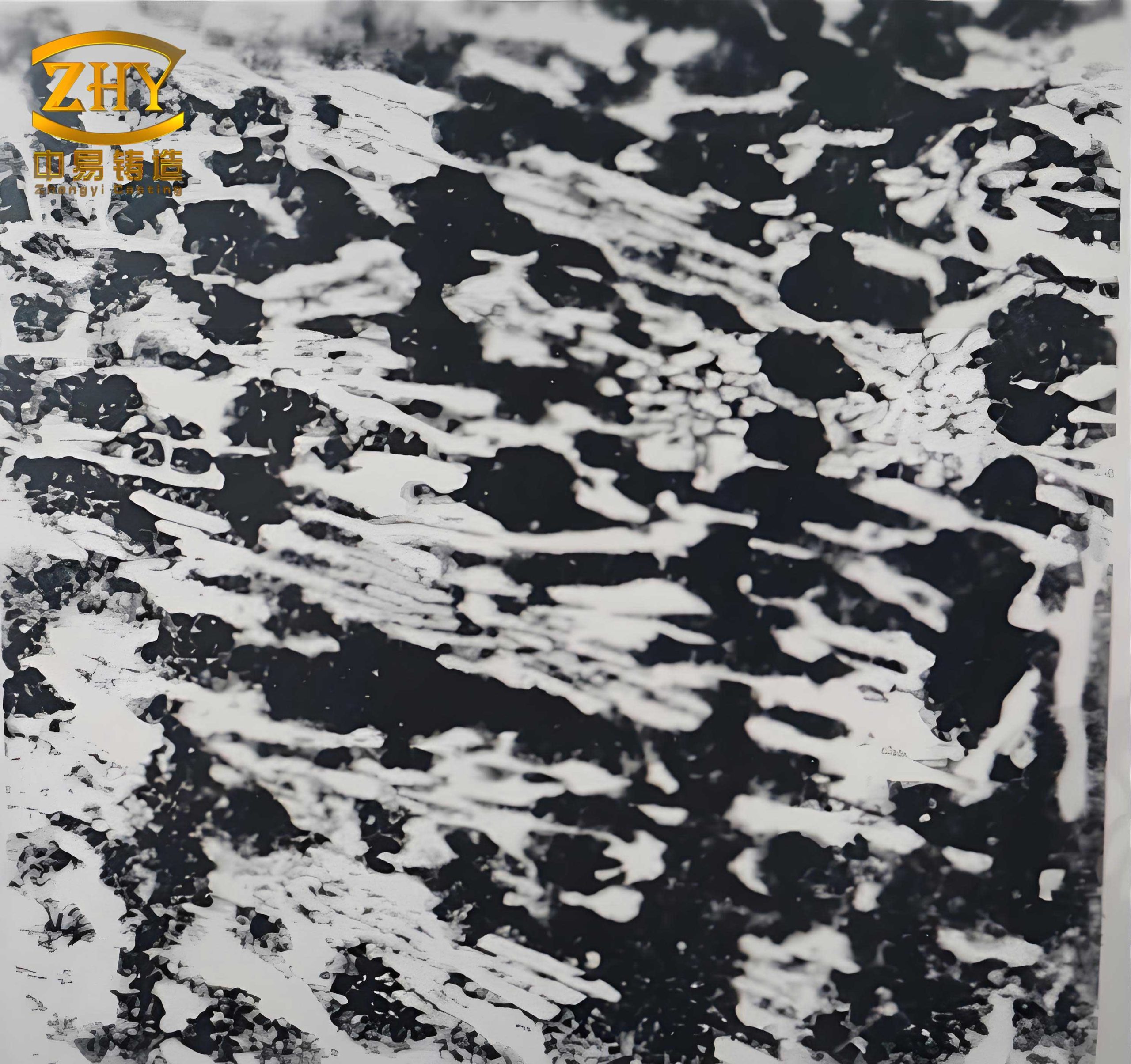
The volume fraction of retained carbides, primarily the hard M3C-type cementite, was measured and is presented in Table 3. As expected, the fraction decreases with increasing peak temperature due to dissolution. However, the correlation with hardness is not direct; the as-cast and 750°C samples have high carbide fractions but lower hardness than the high peak temperature samples. This confirms that the matrix hardness, not the carbide fraction, is the primary determinant of the overall hardness in these thermally cycled white cast iron samples.
| Condition (Peak Temperature, °C) | Carbide Volume Fraction (%) |
|---|---|
| As-Cast | 28.5 |
| 750 | 27.8 |
| 950 | 25.1 |
| 1150 | 22.4 |
| 1250 | 21.0 |
The fracture behavior provides crucial insight into the toughness differences. SEM analysis of impact fracture surfaces reveals two distinct modes. For low-hardness conditions like the 950°C peak temperature sample, the fracture is a mixture of cleavage and interphase boundary fracture. The cleavage facets are smooth, corresponding to the fracture of cementite particles. The interphase fracture occurs along the boundaries between the cementite and the pearlitic matrix. TEM replicas from these surfaces show fine particulate debris on the boundary surfaces. Energy-dispersive X-ray spectroscopy (EDS) identifies these particles as compounds containing elements like Cr, Mo, and Fe, likely carbides that precipitated during the thermal cycle. The presence of these precipitates, along with the smooth and rounded interface morphology, weakens the phase boundary. The effective interfacial energy for crack propagation, $\gamma_{eff}$, is reduced, making interphase cracking favorable. This can be modeled by considering the work of fracture: $$G_c = 2(\gamma_s + \gamma_p) – U,$$ where $\gamma_s$ is the surface energy of the matrix/carbide, $\gamma_p$ is the energy associated with plastic deformation, and $U$ is a reduction term due to precipitate weakening. A high $U$ leads to low $G_c$ and easy crack propagation along interfaces.
For high-hardness conditions, such as the 1150°C sample, the fracture mode is predominantly transgranular cleavage. The crack propagates through both the martensitic matrix and the cementite particles, resulting in relatively flat fracture surfaces with river patterns. The absence of preferential interphase failure suggests a stronger matrix-carbide interface in this condition, possibly due to different interfacial chemistry or stresses. The toughness, while better than the low-hardness condition, is still low due to the inherent brittleness of high-carbon twinned martensite. The fracture toughness, $K_{IC}$, for such a brittle material can be related to the hardness and microstructure scale, but empirical observations take precedence here.
The embrittlement at the 950°C peak temperature is particularly critical for welding white cast iron. This temperature corresponds to a region in the HAZ where full austenitization may not occur, or where slow transformation conditions prevail, leading to soft, coarse pearlite. The combined effect of a soft matrix and weakened interfaces creates a “soft zone” that is highly susceptible to crack initiation and propagation under impact or tensile loads. In contrast, the harder martensitic zones, while brittle, offer more resistance to crack initiation due to their higher strength and better interfacial cohesion, though they may be prone to rapid crack propagation once initiated.
To model the overall impact energy, $A_k$, one might consider a composite rule-of-mixtures approach, but it must account for the fracture mode: $$A_k \approx f_m A_k^m + f_c A_k^c + f_i A_k^i,$$ where $f_m$, $f_c$, and $f_i$ are the volume fractions of matrix, carbides, and interfaces participating in the fracture, and $A_k^m$, $A_k^c$, $A_k^i$ are their respective contributions to energy absorption. In the low-toughness condition, $f_i$ and the negative effect of $A_k^i$ (due to easy interfacial decohesion) dominate. In the high-hardness condition, $A_k^m$ for martensite, though low, and a smaller $f_i$ term lead to a slightly higher overall $A_k$.
Further analysis involves the kinetics of phase transformation. Using the Johnson-Mehl-Avrami-Kolmogorov (JMAK) equation for the austenite-to-pearlite transformation during cooling from 950°C: $$X(t) = 1 – \exp(-k t^n),$$ where $X$ is the transformed fraction, $k$ is a rate constant dependent on temperature and composition, and $n$ is the Avrami exponent. The coarse pearlite formed indicates a high transformation temperature where growth dominates, leading to large $\lambda$. For martensite formation, it is an athermal shear transformation described by the Koistinen-Marburger equation: $$f_m = 1 – \exp[-\alpha(M_s – T)],$$ where $f_m$ is the martensite fraction, $\alpha$ is a constant, and $T$ is the temperature below $M_s$. The high carbon content from the 1150°C cycle gives a low $M_s$ and promotes twinned martensite.
In conclusion, my investigation using thermal simulation has successfully replicated the HAZ microstructures of white cast iron and revealed the complex interplay between peak temperature, microstructure, and mechanical properties. The most detrimental condition for impact toughness in welded white cast iron is associated with a peak temperature around 950°C, which produces a soft matrix of coarse pearlite and weakened carbide-matrix interfaces. Higher peak temperatures, while producing hard and brittle martensitic matrices, result in slightly better toughness due to stronger interfaces and a different fracture mode. This understanding is pivotal for designing welding processes for white cast iron, such as employing pre-heat, post-heat, or specific energy inputs to avoid the critical temperature range that leads to the soft, low-toughness zone. Future work could focus on alloy modifications or interfacial engineering to mitigate the embrittlement in the HAZ of this valuable wear-resistant white cast iron.