
As a materials engineer focused on predictive modeling and performance optimization, I frequently investigate the fundamental links between processing parameters, resultant microstructure, and final mechanical properties. This pursuit is critical for designing manufacturing processes that yield components with reliable and superior performance. The ability to quantitatively predict strength from microstructural features, such as grain size, represents a powerful tool in this endeavor. This article explores this concept through two distinct yet complementary material systems: superplastically formed titanium alloys and alloyed white cast iron for grinding applications.
The analysis of superplastic forming (SPF) of Ti-6Al-4V provides a clear example of how deformation history governs final properties. Superplasticity enables the forming of complex shapes, but the associated high temperatures and significant strains inevitably alter the microstructure. Our research confirms that the post-forming mechanical properties are predominantly dictated by the magnitude of deformation. For instance, at a constant forming temperature, smaller deformations (e.g., <50%) can surprisingly lead to a slight increase in yield strength ($\sigma_{0.2}$), ultimate tensile strength ($\sigma_b$), and elastic modulus compared to the original stock. This phenomenon is potentially attributed to the formation of interface phases during limited deformation. Conversely, large deformations (>100%) result in substantial grain growth and a marked decrease in all key strength and ductility metrics.
The most significant outcome is the establishment of quantitative relationships between strength and the inverse square root of the grain size ($d^{-1/2}$), a classical Hall-Petch type relationship derived from regression analysis of experimental data. The governing formulas for yield strength and ultimate tensile strength are:
$$\sigma_{0.2} = 56.2 + 61 \cdot d^{-1/2}$$
$$\sigma_{b} = 66 + 70.5 \cdot d^{-1/2}$$
In these equations, strength is in $MN/m^2$ and $d^{-1/2}$ is in $mm^{-1/2}$. The regression precision for the ultimate tensile strength relationship was notably high, with a correlation coefficient $r = 0.97$. These equations allow for the quantitative prediction of component strength post-SPF through metallographic analysis of grain size, offering immense practical value for component design and integrity assessment. The derivation of the slope ($b$) and intercept ($a$) for these linear models follows the standard least-squares method:
$$b = \frac{\sum (x_i – \bar{x})(y_i – \bar{y})}{\sum (x_i – \bar{x})^2}$$
$$a = \bar{y} – b\bar{x}$$
Where, in our specific case for $\sigma_b$, $x_i$ represents $d_i^{-1/2}$ and $y_i$ represents $\sigma_{b_i}$. For our dataset, the calculation yielded $b = 4473.4 / 63.4 = 70.5$ and $a = 848.5 – (70.5 \times 11.1) = 66$.
The clear dependency of properties on deformation suggests that optimal SPF processes should utilize lower deformation magnitudes where feasible, employ temperatures at the lower end of the superplastic range, and higher strain rates to minimize grain growth and preserve mechanical performance.
Transitioning from titanium alloys to ferrous materials, the principles of microstructure control remain paramount. A classic material where microstructure dictates function is white cast iron, renowned for its high hardness and wear resistance due to its network of hard iron carbides. However, its inherent brittleness often limits applications. My work in developing a low-alloy white cast iron for grinding balls centers on balancing this wear resistance with sufficient toughness through strategic alloying, melt treatment, and heat treatment.
The design philosophy was to use a base white cast iron composition with approximately 3.0% C and introduce modest amounts of alloying elements to refine the carbide structure and modify the matrix. The charge materials and their calculated contributions are summarized below:
| Raw Material | Chemical Composition (wt%) | Charge Mass (kg) |
|---|---|---|
| Pig Iron | C: 4.3, Mn: 0.4, Cr: 1.7, Si: 0.06, S: 0.07, P: 0.07, Fe: Bal. | 13.25 |
| 45# Steel Scrap | C: 0.44, Mn: 0.5, Cr: 0.2, Si: 0.04, S: 0.04, P: 0.04, Fe: Bal. | 5.86 |
| Ferromanganese | Mn: 80, Fe: Bal. | 0.40 |
| Ferrochromium | Cr: 70, C: 1.0, Fe: Bal. | 0.43 |
| Ferrosilicon | Si: 75, Fe: Bal. | 0.06 |
Melting was conducted in a 50 kg medium-frequency induction furnace to minimize carbon and sulfur pickup and reduce alloy element oxidation. A critical step was the late addition of ferroalloys just before tapping at 1500-1550°C. The most crucial metallurgical intervention was a post-tapping inoculation treatment in the ladle using a custom modifier to refine the solidification structure of the white cast iron. The modifier composition and addition rate per 20 kg ladle were:
| Modifier | Chemical Composition (wt%) | Addition (kg) |
|---|---|---|
| Mixed Rare Earth (RE) | RE: 21, Fe: Bal. | 0.75 |
| Ferroniobium (Nb) | Nb: 30, Fe: Bal. | 0.08 |
| Zinc (Zn) | Zn: 99 | 0.05 |
This RE-Zn-Nb modifier plays a synergistic role. Rare earth elements are potent grain refiners and surface-active agents that adsorb on growing carbide faces, inhibiting their preferential growth and promoting a more dispersed, less-continuous carbide network. Zinc further contributes to finer, more isolated carbides. Niobium, as a strong carbide former, creates fine, dispersed NbC particles that act as additional nucleation sites, refining the overall microstructure. This treatment is fundamental to improving the toughness of the otherwise brittle white cast iron.
Casting produced Ø90 mm grinding balls. Test specimens were extracted from the core and near-surface regions of the as-cast balls. Some balls were subjected to subsequent heat treatments: one to a normalization process (900°C for 90 minutes, air cool) and another to a quench and temper process (900°C for 90 minutes, oil quench, followed by 300°C for 30 minutes temper). Mechanical testing and microstructural analysis were performed on specimens in the as-cast, normalized, and quenched & tempered conditions. For benchmarking, commercially available high-chromium (Cr15-type) cast iron balls were also tested in their as-cast state.
The mechanical properties are summarized in the following table. A key service requirement for grinding balls subjected to multi-impact wear is an impact toughness ($\alpha_k$) greater than approximately $4 J/cm^2$.
| Sample Condition | Hardness, HRC (Surface to Core) | Impact Toughness, $\alpha_k$ ($J/cm^2$) |
|---|---|---|
| Low-Alloy White Cast Iron (As-Cast) | 56, 53, 53, 52, 50 | 4.0, 4.0, 4.2 (Avg: 4.1) |
| Low-Alloy White Cast Iron (Normalized) | 49, 48, 48, 47, 47 | 7.4, 7.8, 7.6 (Avg: 7.6) |
| Low-Alloy White Cast Iron (Q&T) | 55, 55, 49, 52, 50 | 6.2, 6.6, 6.9 (Avg: 6.6) |
| High-Chromium Cast Iron (As-Cast) | 45, 48, 43, 30, 37 | 3.5, 3.6, 3.5 (Avg: 3.5) |
The results are promising. The as-cast low-alloy white cast iron already meets the toughness threshold with an average $\alpha_k$ of 4.1 $J/cm^2$, while maintaining high hardness (>50 HRC) from surface to core. More significantly, heat treatment dramatically improves toughness—by over 85% for normalization and 60% for quenching and tempering—with only a moderate adjustment in hardness. The developed white cast iron outperforms the benchmark high-chromium iron in both hardness uniformity and impact toughness.
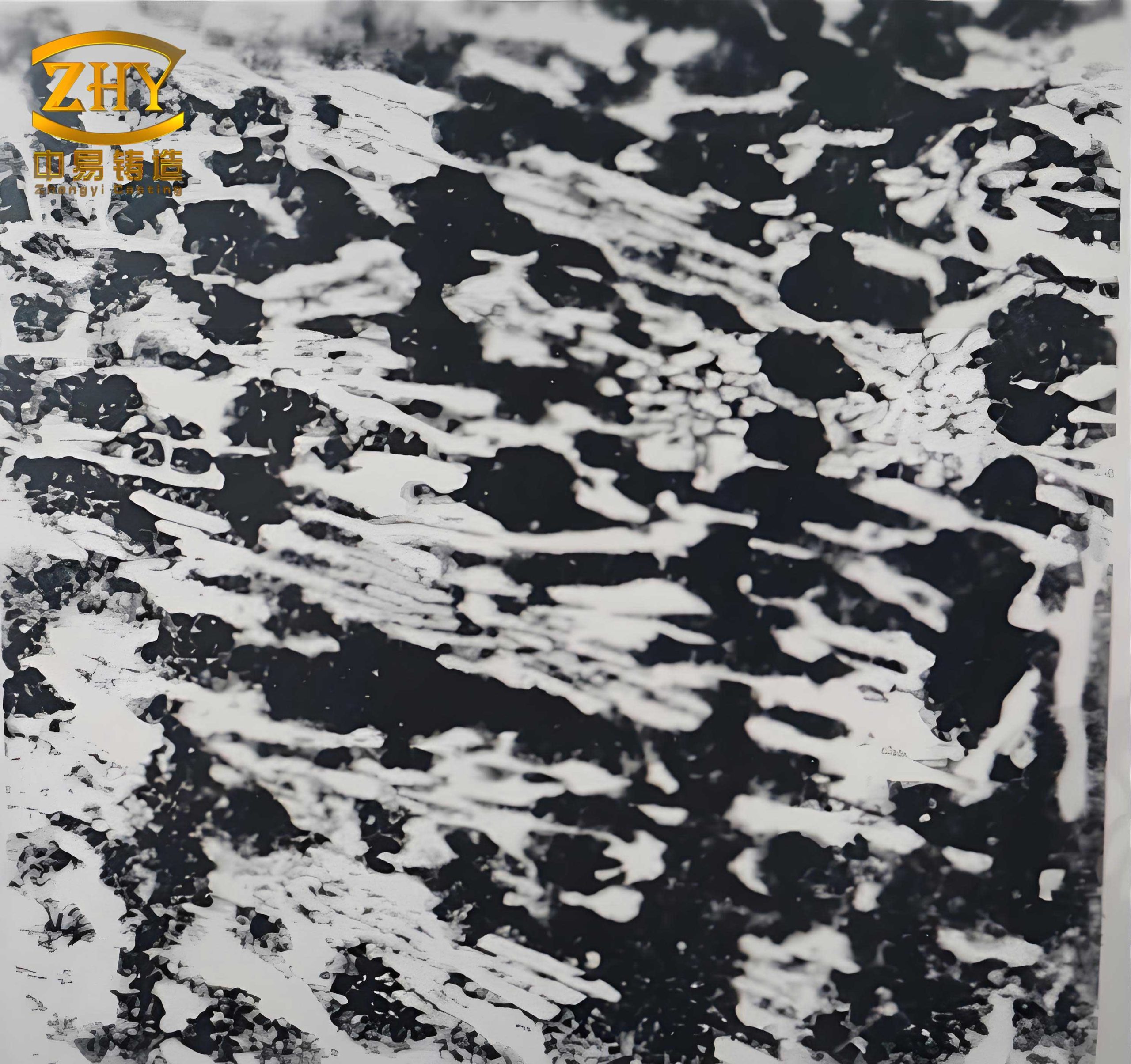
Microstructural analysis reveals the reasons behind this performance. The as-cast structure consists of a pearlitic matrix (from transformed primary austenite dendrites) surrounded by a ledeburite network (eutectic carbides with transformed austenite). The inoculation treatment successfully modifies the carbide morphology, making it less continuous and more rod-like, thereby reducing stress concentration points. Normalization produces a finer sorbitic/pearlitic matrix with spheroidized secondary carbides. Quenching and tempering results in a tempered martensitic or bainitic matrix, offering the best combination of hardness and toughness. The heat treatments also promote the spheroidization and coagulation of the eutectic carbides, further mitigating their crack-initiating potential.
The ultimate performance metric for a grinding ball is its wear resistance. We evaluate this using the inverse of the volumetric wear loss ($W^{-1}$), measured via a standardized laboratory wear test. Since hardness varies from surface to core, a more representative “Average Bulk Hardness” is calculated using a weighted formula based on measurements at different radii:
$$\text{Average Bulk Hardness} = 0.009H_{core} + 0.063H_{1/4R} + 0.203H_{1/2R} + 0.437H_{3/4R} + 0.289H_{surface}$$
The wear performance data is compiled below:
| Sample Condition | Average Bulk Hardness (HRC) | Wear Loss, W ($mm^3/1000$ rev) | Wear Resistance, $W^{-1}$ ($1/mm^3$) |
|---|---|---|---|
| Low-Alloy White Cast Iron (As-Cast) | 53.8 | 15.97 | 62.6 |
| Low-Alloy White Cast Iron (Normalized) | 49.1 | 12.53 | 79.8 |
| Low-Alloy White Cast Iron (Q&T) | 53.7 | 14.40 | 69.4 |
| High-Chromium Cast Iron (As-Cast) | 45.6 | 21.50 | 46.5 |
The developed low-alloy white cast iron in all conditions exhibits superior wear resistance compared to the high-chromium benchmark. The normalized version, despite a lower average hardness, shows the highest wear resistance, underscoring the importance of toughness and microstructural stability in abrasive wear conditions. This alloyed and treated white cast iron presents a cost-effective alternative to high-chromium irons, achieving an excellent balance of properties.
In conclusion, the journey from processing to performance in metallic materials is profoundly governed by microstructure. In Ti-6Al-4V, we established a precise quantitative link ($\sigma = a + b \cdot d^{-1/2}$) allowing strength prediction from grain size after superplastic forming. In white cast iron, we demonstrated how strategic alloying, innovative inoculation with RE-Zn-Nb, and tailored heat treatment can transform a traditionally brittle material into a tough, wear-resistant engineering solution. Both case studies reinforce the principle that mastering microstructure through intelligent process design is the key to unlocking and predicting material performance, whether for aerospace forming or industrial grinding. The low-alloy white cast iron system, in particular, proves that high performance does not necessarily require high-cost alloying, but rather a deep understanding and control of solidification and phase transformation phenomena inherent to white cast iron.