
In my extensive experience within the foundry, the choice of molding sand is a critical determinant of casting quality and worker safety. While silica sand has been the traditional mainstay, the adoption of limestone sand has presented a compelling alternative, particularly for steel castings. Compared to silica sand, limestone sand offers several distinct advantages: it undergoes no disruptive phase transformation upon heating, significantly reducing defects like veining and scabbing; it contains minimal free silica, thereby greatly mitigating the risk of silicosis; it exhibits excellent collapsibility, making shakeout and cleaning remarkably easier; and it tends to resist metal penetration, yielding castings with superior surface finish. Furthermore, its wide availability and cost-effectiveness make it an attractive option, suitable for a broad range of carbon and alloy steel castings. However, these benefits come with unique challenges. A primary and persistent issue is the propensity for defect formation, with porosity in casting being a particularly troublesome and prevalent cause of scrap, accounting for a significant portion of rejections. This article, drawn from my practical involvement, aims to provide a detailed, first-person analysis of the mechanisms behind porosity in casting when using limestone sand and to outline effective measures for its elimination.
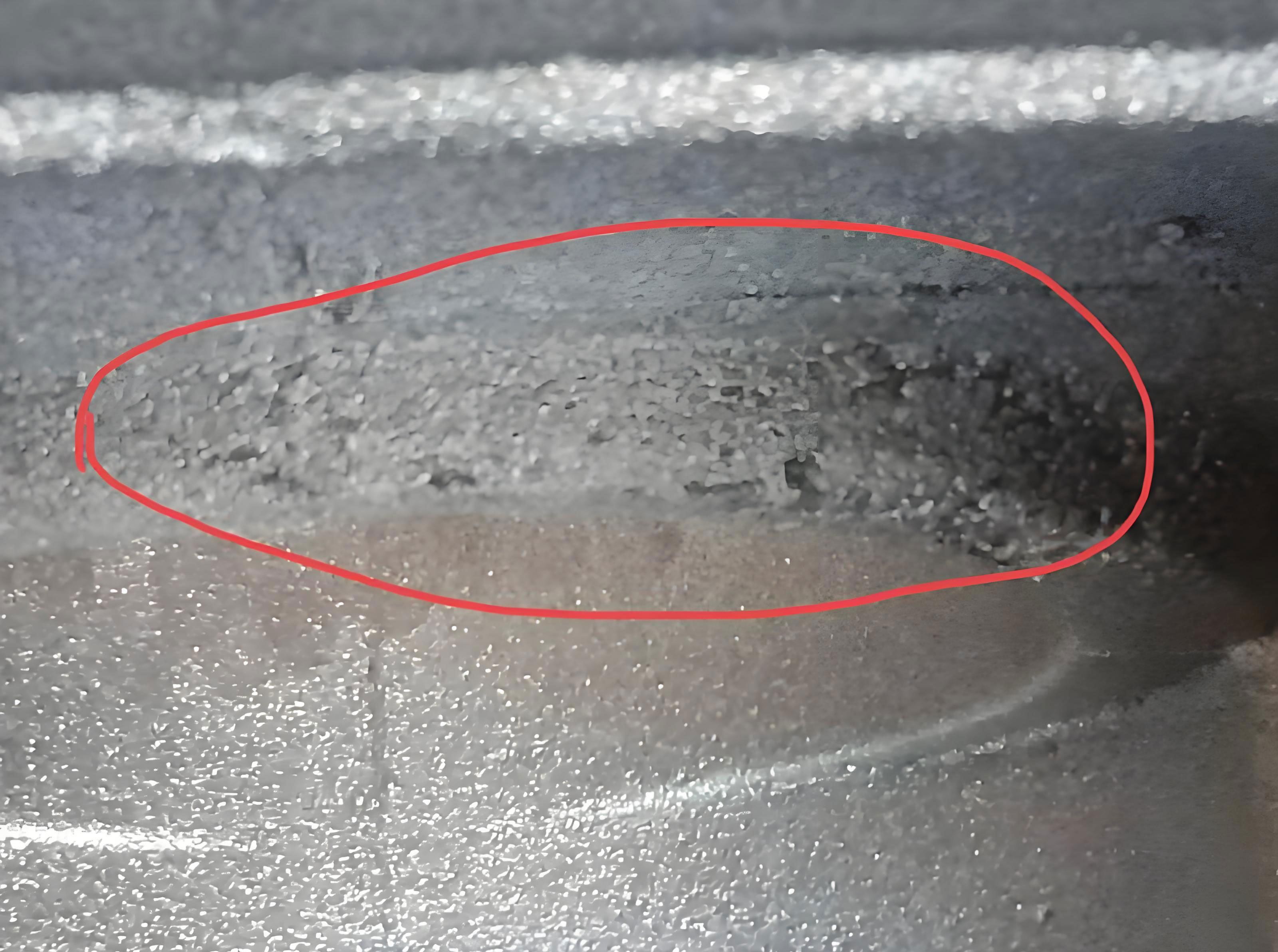
Fundamental Analysis of Porosity Formation
The genesis of porosity in casting is multifaceted. Generally, it can be classified into several categories: dissolved gas porosity, reaction-induced porosity, and entrapped or invasive gas porosity. While textbooks cover these in detail, the specific behavior of limestone sand necessitates a focused examination. Limestone sand is primarily composed of calcium carbonate (CaCO₃). Its defining characteristic is being a thermally decomposable, gas-evolving sand. Upon exposure to the extreme heat of molten metal, it undergoes a fundamental decomposition reaction:
$$ \text{CaCO}_3_{(s)} \xrightarrow{\Delta} \text{CaO}_{(s)} + \text{CO}_{2(g)} $$
The carbon dioxide (CO₂) gas generated at the metal-mold interface is not inert. At high temperatures, it acts as a strong oxidizing agent and can react with elements in the steel, particularly iron and carbon:
$$ \text{CO}_{2(g)} + \text{Fe}_{(l)} \rightleftharpoons \text{FeO}_{(l/s)} + \text{CO}_{(g)} $$
$$ \text{CO}_{2(g)} + \text{C}_{(in\ melt)} \rightleftharpoons 2\text{CO}_{(g)} $$
These reactions are central to understanding the unique modes of porosity in casting associated with limestone sand. From the perspective of the molding material itself, two primary types of gas-related defects are prevalent:
| Porosity Type | Formation Mechanism | Key Characteristics |
|---|---|---|
| Sand-Gas Porosity | Sand grains or clusters become entrapped in the metal stream due to mold erosion, washing, or loose sand. The entrapped CaCO₃ decomposes violently, generating gas bubbles within the solidifying metal. | Often associated with slag inclusions. Pores are typically large, irregular, and may contain residues of CaO or complex silicates. |
| Invasive Gas Porosity | Gas generated at the mold-metal interface (from decomposition and subsequent reactions) penetrates into the casting before or during solidification. | Two subtypes: subsurface spherical pores (if metal surface is liquid) or long, thin pores perpendicular to the surface (if a solid skin has formed). Pore walls often appear bluish, with possible oxides present. |
The mechanism of invasive gas porosity is particularly critical. For a gas bubble to invade the liquid metal and create porosity in casting, a specific pressure condition must be satisfied:
$$ P_{gas} > P_{metal} + P_{cavity} + P_{resistance} $$
Where:
- $P_{gas}$: Gas pressure at the mold-metal interface.
- $P_{metal}$: Static metallostatic pressure of the liquid metal.
- $P_{cavity}$: Pressure in the mold cavity (usually atmospheric).
- $P_{resistance}$: Resistance to bubble formation, primarily governed by metal surface tension.
The resistance $P_{resistance}$ is given by: $$ P_{resistance} = \frac{2\gamma}{r} $$ where $\gamma$ is the surface tension of the liquid metal and $r$ is the radius of the nascent gas bubble. This is where limestone sand poses a unique problem. Unlike relatively neutral silica sand, the CO₂ atmosphere is strongly oxidizing. This oxidizes the metal surface, lowering its surface tension ($\gamma$). Simultaneously, the decomposition of sand grains creates a porous interface ideal for bubble nucleation. This combination—a ready gas source, low surface tension, and nucleation sites—drastically lowers the threshold for gas invasion, making porosity in casting a frequent challenge. Even after a solid skin forms, intense interfacial reactions and uneven cooling can create weak intergranular boundaries, facilitating the formation of the characteristic fine, elongated surface pores.
Systematic Measures to Eliminate Porosity
Combating porosity in casting with limestone sand requires a holistic strategy targeting mold design, sand preparation, metal treatment, and pouring practice. The goal is to manage gas generation, facilitate its escape, and strengthen the metal’s resistance to gas invasion. Based on my practice, the following integrated measures have proven highly effective.
1. Optimized Mold and Sand System Design
The mold must be engineered to handle the high gas load. This involves creating a stratified sand system with distinct functions for the facing and backing sand.
| Component | Specification | Purpose |
|---|---|---|
| Facing Sand | Use fine sand (e.g., AFS 70-100 mesh). Increase bentonite content to 8-10%. Add 3-5% water glass (sodium silicate). Apply as a thin layer (~20 mm). | Creates a dense, sintered layer at the interface with low permeability, reducing gas influx and pore formation sites. |
| Backing Sand | Use coarse sand (e.g., AFS 30-50 mesh). Ensure adequate mold wall thickness (minimum 80-100mm). Install numerous vent rods/channels. | Provides high overall permeability, directing gas away from the casting and into the atmosphere efficiently. |
| General Mold Design | Increase overall mold rigidity. Use gating systems that minimize turbulence (e.g., stepped or bottom gating). Employ ceramic pouring cups/sprues. | Prevents mold wall movement, erosion, and sand inclusion, thereby eliminating sources of sand-gas porosity. |
The venting calculation is crucial. The required vent area ($A_v$) can be estimated based on the volume of gas generated from the decomposing sand layer in contact with the metal. An empirical relation is: $$ A_v = k \cdot V_g $$ where $V_g$ is the estimated gas volume from the facing sand, and $k$ is an empirical factor (typically 1.5-2.0 for limestone sand) to account for flow resistance.
2. Enhanced Metal Treatment and Pouring Practice
The susceptibility of the molten steel to gas invasion must be reduced. This focuses on minimizing oxygen content and increasing the metal’s surface tension.
- Deoxidation Practice: A full, balanced deoxidation sequence is non-negotiable. The final residual levels of strong deoxidizers are critical:
- Residual Silicon (Si): Maintain > 0.25%.
- Final Deoxidation: When using aluminum, a minimum addition of 0.08-0.10% is recommended to ensure sufficient residual aluminum (Al).
These residuals act as a buffer against secondary oxidation from CO₂, keeping the metal surface “clean” and maintaining a high surface tension ($\gamma$), thereby increasing $P_{resistance}$ in the invasion equation.
- Pouring and Mold Handling:
- Thoroughly blow/clean the assembled mold cavity of any loose sand before pouring.
- Cover open risers and pouring basins to prevent sand fall-in.
- Maintain a smooth, rapid pour to minimize exposure time and turbulence.
3. Quantitative Process Control Framework
To systematize the approach, key process parameters should be monitored and controlled. The following table summarizes the control points for preventing porosity in casting with limestone sand.
| Control Area | Parameter | Target Range / Action | Rationale |
|---|---|---|---|
| Sand System | Facing Sand Thickness | 15 – 25 mm | Manages gas generation zone and venting capacity. |
| Backing Sand Permeability | > 150 AFS | ||
| Vent Area / Mold Volume | > 2 cm²/1000 cm³ | ||
| Metal Chemistry | Residual [Si] | > 0.25 % | Increases metal surface tension and oxidation resistance. |
| Residual [Al] | 0.02 – 0.05 % | ||
| Pouring | Pouring Temperature | Lower end of normal range | Reduces intensity of sand-metal interfacial reactions. |
| Mold Design | Gating System Velocity | < 0.5 m/s in gates | Minimizes mold erosion and sand inclusion. |
The interaction of these factors can be conceptualized. The risk of severe porosity in casting ($R_p$) can be seen as a function: $$ R_p \propto \frac{(G_{rate} \cdot t_{exp})}{(\gamma_{metal} \cdot \phi_{mold})} $$ where $G_{rate}$ is the gas generation rate from the sand, $t_{exp}$ is the metal’s exposure time to the sand interface, $\gamma_{metal}$ is the effective surface tension of the treated metal, and $\phi_{mold}$ is the overall mold permeability/venting efficiency. Our preventive measures directly target each variable in this relationship: reducing $G_{rate}$ via a controlled facing layer, minimizing $t_{exp}$ via proper pouring, increasing $\gamma_{metal}$ via deoxidation, and maximizing $\phi_{mold}$ via backing sand and vents.
Conclusion and Future Perspectives
The challenge of porosity in casting when using limestone sand is significant but manageable. It stems from the fundamental thermochemistry of the sand itself—its decomposition and the oxidizing nature of the resulting gases. The problem is not merely one of excess gas, but more precisely one of interfacial conditions that favor gas invasion into the metal. Successful mitigation, therefore, cannot rely on a single solution but requires an integrated system approach. This system encompasses the design of a bi-layer mold with a dense, sinterable face and a highly permeable body; the rigorous deoxidation of steel to bolster its innate resistance to gas penetration; and the meticulous control of pouring and molding practices to prevent sand inclusion. When these principles are applied consistently, the substantial benefits of limestone sand—worker safety, casting cleanliness, and cost-effectiveness—can be fully realized without the debilitating scrap losses caused by porosity. Future work may explore the use of advanced binder systems with limestone sand or real-time monitoring of interfacial gas pressure to dynamically control pouring parameters, pushing the reliability of this valuable molding material even further.