
In my extensive experience within the foundry industry, addressing metal casting defects remains a paramount challenge for ensuring product integrity and cost-effectiveness. Among these, defects stemming from slag inclusion and reaction, particularly pinholing or gas porosity, are notoriously prevalent and detrimental. This article delves into the mechanisms through which slag contributes to these metal casting defects, analyzes the influencing factors, and synthesizes practical mitigation strategies. I will employ first-hand operational insights, supported by thermodynamic principles and empirical data, to elaborate on this critical issue. The goal is to provide a comprehensive guide that spans from fundamental reactions to daily foundry practices, all aimed at minimizing these pervasive metal casting defects.
The formation of gas porosity, a classic metal casting defect, is intrinsically linked to the behavior of slag during the solidification process. In iron castings, particularly ductile iron, the primary mechanism involves the reaction between mobile slag particles and precipitated graphite. The core reaction can be summarized by the following equation:
$$ \text{C (graphite)} + \text{O (from slag)} \rightarrow \text{CO (gas)} $$
This generation of carbon monoxide gas, trapped within the solidifying metal, manifests as pinholes or larger blowholes. The “O” in the equation typically originates from iron oxide (FeO) or other oxides present in the slag. A more detailed representation of the reaction in ductile iron melts, where slag fluidity is high, is:
$$ \text{(FeO)}_\text{slag} + \text{C} \rightarrow \text{Fe} + \text{CO} \uparrow $$
The driving force for this reaction increases with slag fluidity and the intimacy of contact between slag and graphite. It is crucial to understand that molten iron’s carbon is not inherently reactive; it requires the presence of a highly fluid slag medium to facilitate sufficient contact time and area for the reaction to proceed significantly.
Slag formation itself is a multi-source problem in metal casting operations. The primary origins, as I have consistently observed, are tabulated below:
| Source Location | Formation Mechanism | Typical Slag Composition | Contribution to Metal Casting Defect |
|---|---|---|---|
| Ladle & Runner Channels | Temperature drop during holding/transfer promotes oxidation and formation of iron-rich dross. | FeO, SiO₂, MnO | High. This is the major contributor as slag accumulates and is carried into the mold. |
| In-mold Treatment Process | Reaction products from inoculants or nodularizing agents, and entrained cupola slag. | MgO, SiO₂, CaO, Al₂O₃ | Moderate to High. Depends on treatment efficiency and slag removal. |
| Furnace (Cupola/Electric) | Primary slag from the smelting/refining process. | Complex silicates, FeO | Moderate. Can be minimized by proper skimming but may be entrained. |
| Oxidation from Sand Mold | Moisture and organic binders decompose, providing oxygen. | — | Indirect. Acts as an oxygen source for slag formation and direct gas reaction. |
The propensity for slag to cause this specific metal casting defect is not constant; it is modulated by several process variables. A lower pouring temperature is particularly deleterious. It reduces metal fluidity, allowing slag particles to separate less effectively and remain entrapped. Furthermore, cooler metal slows solidification, extending the time window for the slag-graphite reaction to occur. This explains why larger castings, with longer solidification times, often exhibit more severe porosity—a direct correlation with increased reaction time.
Chemical composition of the melt plays an equally critical role. In the context of element balance, increasing the concentration of certain elements that lower the slag’s melting point or increase its stability can exacerbate the problem. For instance, the dissolution of elements like sulfur (S) or phosphorus (P) into silicate-based slags can significantly reduce the slag’s liquidus temperature. This is represented by the thermodynamic activity relationship:
$$ a_{\text{SiO}_2} \cdot \gamma_{\text{SiO}_2} = f(T, X_{\text{S}}, X_{\text{P}}, …) $$
where \( a \) is activity, \( \gamma \) is the activity coefficient, \( T \) is temperature, and \( X \) represents mole fractions of slag components. A lower liquidus temperature means the slag remains fluid and reactive at lower metal temperatures, directly promoting the gas-forming reaction described earlier. Conversely, elements that increase slag viscosity or promote its early solidification can be beneficial.
The interaction is complex. Slag is not merely a passive inclusion; it is a dynamic phase. Oxides within the slag (e.g., FeO, MnO) can directly react with carbon crystallizing during the final stages of solidification. This localized reaction at the slag-metal interface is a potent source of gas bubbles. The kinetics can be approximated by a simplified rate equation:
$$ \frac{d[CO]}{dt} = k \cdot A \cdot (a_C \cdot a_O – P_{CO}/K_{eq}) $$
Here, \( k \) is the rate constant, \( A \) is the interfacial area between slag and graphite, \( a_C \) and \( a_O \) are the activities of carbon and oxygen, \( P_{CO} \) is the partial pressure of CO, and \( K_{eq} \) is the equilibrium constant for the reaction. This formula highlights why factors increasing interfacial area (finer slag dispersion) or activities (high carbon, high oxygen potential) accelerate defect formation.
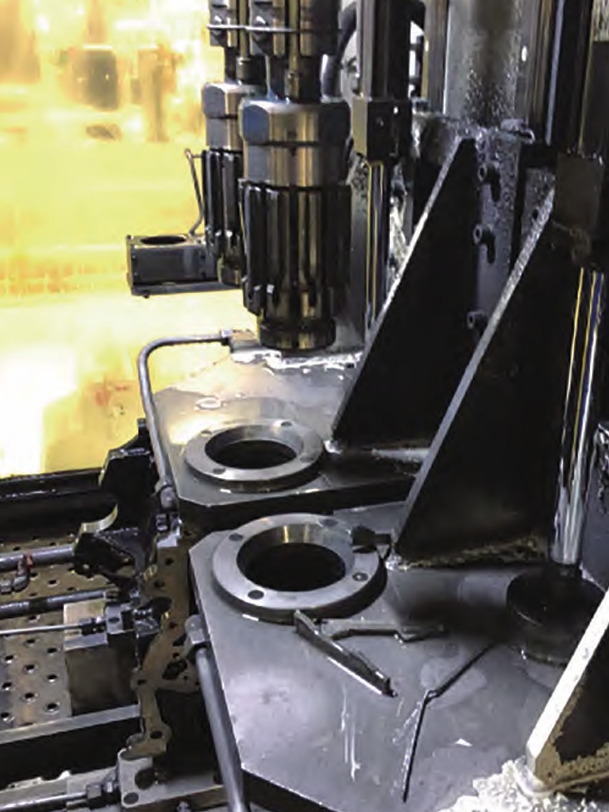
Consider a complex casting like an engine cylinder block, as shown in the image. Such components have varying section thicknesses, intricate cores, and high integrity requirements. Slag-related porosity in a critical area like a cylinder bore or water jacket passage can lead to catastrophic failure. The long solidification time of the bulkier sections provides ample opportunity for slag particles to react, making proactive slag management absolutely non-negotiable for preventing this metal casting defect.
Beyond the primary reaction, several ancillary factors aggravate the situation. These often stem from mold and sand-related issues, which can act as secondary oxygen sources, further fueling the slag-metal reaction. A summary of these aggravating factors is provided in the following table.
| Factor Category | Specific Example | Mechanism of Aggravation |
|---|---|---|
| Sand Mold Condition | Residual moisture & poorly distributed moisture (inadequate mulling). | Decomposes to release H₂ and O₂ at metal interface, oxidizing metal and providing oxygen for slag reaction. |
| Accumulation of fines/degraded binder (in recycled sand). | Increases gas evolution and may lower local permeability, trapping gases and reactive slag. | |
| Low permeability or inadequate venting. | Prevents evolved gases (including CO from slag reaction) from escaping the mold. | |
| Pouring Practice & Gating Design | Slow pouring rate. | Allows metal temperature to drop excessively in the gating system, promoting slag formation and entrapment. |
| Turbulent gating design (sharp bends, sudden expansions). | Entrains air and existing slag, increases oxide film formation, and disperses slag finely. | |
| Inadequate slag traps or skim gates. | Fails to remove slag before metal enters the mold cavity. | |
| Melt Handling | Slag accumulation in transfer ladles and runners. | Directly introduces large quantities of reactive slag into the mold during pouring. |
Given this multifaceted origin of the metal casting defect, a systematic approach to mitigation is required. It involves interventions at the stages of melt treatment, system design, and process control. From my practice, the following integrated set of measures has proven effective in significantly reducing the incidence of slag-related porosity.
1. Optimized Gating and Running System Design: The primary defense is to prevent slag from entering the mold cavity. This necessitates designing a gating system that promotes laminar flow and includes effective slag separation mechanisms. Principles include the use of tapered sprues, step gates, or whirl gates that utilize centrifugal force to separate slag. The design should ensure the first metal to enter the mold (which carries the most slag) is diverted away from critical casting areas. The goal is a “slag-free” metal stream entering the cavity.
2. Rigorous Pouring Practice: Personnel must be trained to pour rapidly and steadily to minimize temperature loss and metal surface exposure to air in the pouring basin and runners. However, the initial pour should not be so violent as to cause turbulence. A “press-pour” technique, where the pouring basin is kept full to create a positive pressure head, helps maintain a calm, upward fill in the sprue.
3. Strict Control of Mold Sand: The sand system must be managed to minimize its contribution as an oxygen source. This involves:
- Controlling moisture content meticulously using automated sensors. The target moisture level is a function of clay content and compactability, often expressed as: $$ \text{Optimal Moisture} \approx 0.5 \times (\text{Clay %}) + \text{Constant} $$ but must be determined empirically for each sand mix.
- Ensuring sufficient and consistent mulling time to distribute moisture and binders uniformly, preventing localized damp spots that cause violent steam explosions and local oxidation.
- Maintaining a proportion of new sand in the system (e.g., 5-15%) to limit the build-up of low-ignition-point fines, dead clay, and metallic oxides (e.g., Fe₂O₃ from previous castings) which accumulate in recycled sand and are potent oxidizers.
4. Proactive Slag Management in Melt Handling: This includes frequent and thorough skimming of the melt surface in the holding furnace, transfer ladle, and pouring ladle immediately before pouring. The use of slag-coating compounds or slag-detecting sensors on ladles can aid in this process. For ductile iron treated in-mold, the design of the reaction chamber must allow for slag separation before the metal enters the casting cavity.
5. Thermal and Compositional Control: Maintaining an optimal pouring temperature is a delicate balance. Too low promotes slag formation and entrapment; too high can increase erosion and gas solution. The target temperature \( T_{pour} \) for a given section thickness \( d \) can be guided by empirical relations like \( T_{pour} = A + B \cdot \log(d) \), where A and B are alloy-specific constants. Furthermore, melt chemistry should be adjusted to favor the formation of high-melting-point, viscous slags that solidify early. Small additions of elements like calcium or rare earths can sometimes modify slag properties favorably, though their use requires careful evaluation.
To encapsulate the interrelationship between causes, mechanisms, and solutions for this metal casting defect, I have constructed the following comprehensive flow diagram represented in a tabular logic format.
| Root Cause | Effect on Process | Resulting Mechanism | Recommended Mitigation Action |
|---|---|---|---|
| Temperature drop in ladle/runner | Formation of Fe-rich dross (FeO) | $$ \text{FeO} + \text{C} \rightarrow \text{Fe} + \text{CO} \uparrow $$ | Pre-heat ladles/runners; minimize transfer time; pour at higher temperature. |
| Entrainment of treatment slag | Introduction of MgO/CaO rich slag particles | Slag acts as carrier for oxides, reacting with C at interface. | Optimize in-mold treatment design with effective slag traps; use cleaner treatment alloys. |
| High S/P in melt | Lowers slag liquidus temperature (\( \Delta T_{liq} \)) | $$ \Delta T_{liq} \propto -\sum (k_i \cdot X_i) $$ for i=S, P | Control charge materials to limit S/P; use desulfurization practices. |
| Slow pouring rate | Increased metal oxidation & slag generation in gating | Increased \( a_O \) and slag volume for reaction. | Train for rapid, non-turbulent pour; use automated pouring where possible. |
| Poor sand moisture control | Localized steam generation & oxygen release | Provides oxygen source for both direct gas holes and slag reaction. | Implement real-time moisture control; ensure adequate mulling (Mulling Energy ∝ Time × Intensity). |
| Turbulent gating | Dispersion of slag into fine particles (increased A) | Kinetic rate \( \frac{d[CO]}{dt} \) increases with interfacial area A. | Design for laminar flow: use ceramic filters, larger sprue well, tapered sprue. |
The economic impact of these metal casting defects cannot be overstated. Scrap, rework, and downstream machining failures all erode profitability. Implementing the measures outlined above requires an upfront investment in process control, training, and possibly equipment, but the return in terms of reduced defect rates and improved quality consistency is substantial. It transforms the foundry’s approach from reactive troubleshooting to proactive defect prevention.
In conclusion, the battle against slag-induced porosity, a persistent and costly metal casting defect, is won through a deep understanding of the underlying metallurgical and thermodynamic principles coupled with disciplined daily practice. The key lies in recognizing that slag is not just waste to be removed; its generation, composition, and behavior are process outcomes that can be managed. By controlling melt chemistry, optimizing thermal regimes, designing intelligent gating systems, and maintaining impeccable mold sand conditions, the probability of the deleterious slag-graphite reaction leading to gas porosity is dramatically reduced. This holistic approach ensures that the final casting achieves the desired structural integrity, free from the voids that compromise performance, thereby enhancing the reliability and reputation of the metal casting process as a whole. Continuous monitoring and data analysis further refine these practices, creating a cycle of perpetual improvement in the quest to eliminate this category of metal casting defect.