
Porosity in casting remains one of the most pervasive and challenging defects affecting the integrity, pressure tightness, and mechanical properties of aluminum alloy components. In my extensive experience within foundry operations, particularly with high-volume die casting of structural parts like pump bodies and covers, addressing porosity is not a single-step fix but a comprehensive systems approach. The occurrence of porosity in casting is a symptom of imbalances in the entire process chain, from raw material handling to final solidification under pressure. This article delves into a detailed, first-principles analysis of the mechanisms behind pore formation in aluminum die castings and outlines a robust, multi-faceted strategy for its mitigation, incorporating thermodynamic principles, fluid dynamics, and practical process controls.
The Nature and Typology of Porosity in Aluminum Castings
Porosity in casting manifests primarily in two distinct forms, each with a unique genesis: gas porosity (often termed pinhole porosity) and shrinkage porosity. In high-pressure die casting, gas porosity is overwhelmingly the dominant concern due to the process’s inherent characteristics. It is crucial to distinguish between them, as the remedies differ fundamentally.
- Gas Porosity: This type of porosity in casting is caused by the entrapment or precipitation of gases within the molten metal. The pores are typically spherical or slightly elongated, with smooth, shiny interiors that may appear dark under optical examination due to oxide films. The gas involved is almost exclusively hydrogen, as it is the only gas with significant solubility in molten aluminum.
- Shrinkage Porosity: This form arises from the volume contraction during solidification when insufficient feed metal is available to compensate. The pores are irregular, jagged, and often interconnected, with a dendritic appearance that matches the surrounding solidified structure.
For the pump cover castings I have worked with, the defect analysis consistently points towards gas porosity. The spherical morphology and smooth walls observed are classic indicators.
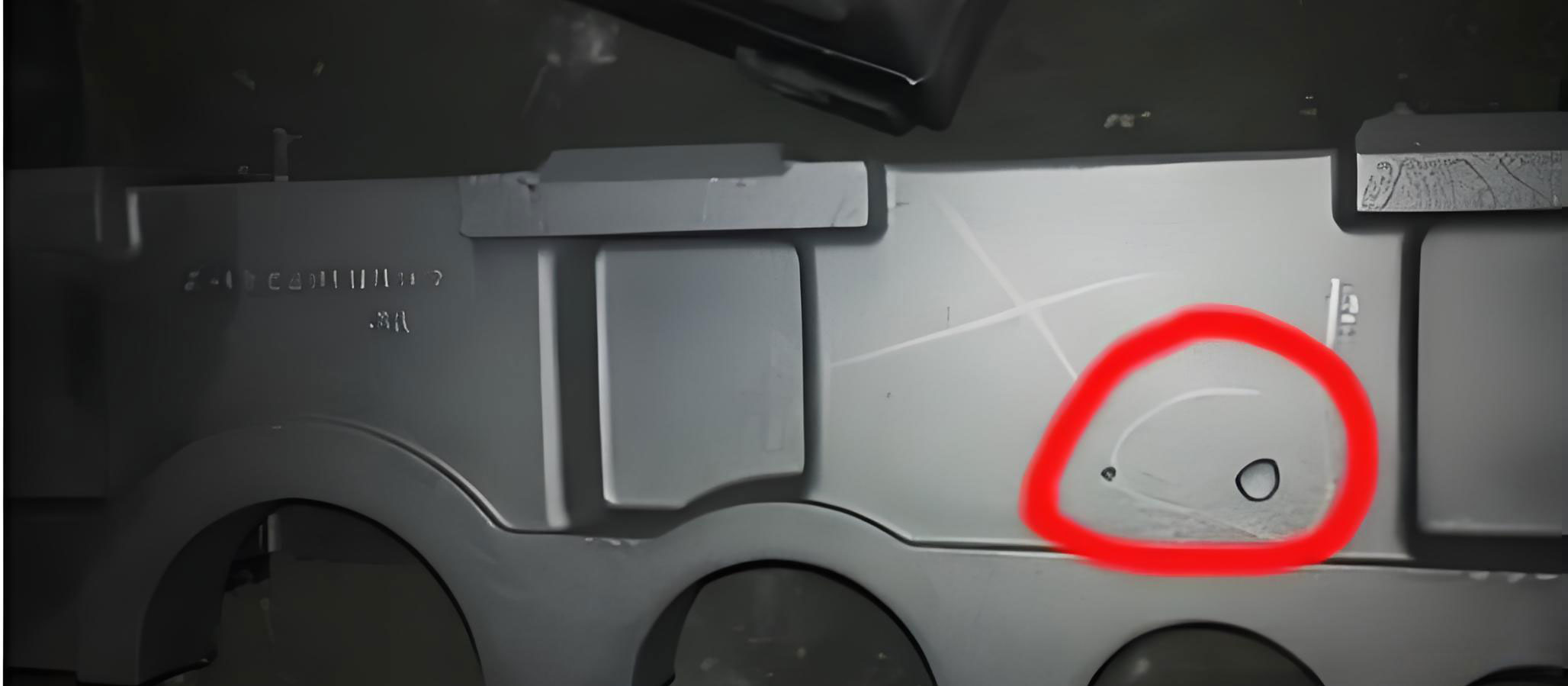
The following table summarizes the key characteristics and root causes of these porosity types:
| Porosity Type | Morphology | Pore Wall Appearance | Primary Cause | Typical Location |
|---|---|---|---|---|
| Gas Porosity (Hydrogen) | Spherical, rounded | Smooth, shiny, often dark | High hydrogen content in melt; gas entrapment during filling | Uniformly distributed, often in last-to-freeze areas |
| Shrinkage Porosity | Irregular, jagged, dendritic | Rough, dendritic | Inadequate feeding during solidification | Isolated in hot spots, thick sections, and thermal centers |
| Entrapped Air Porosity | Larger, irregular clusters | Oxidized, rough | Turbulent die filling, poor venting, shot sleeve air entrapment | Along fill paths, near gates, or in blind cavity areas |
Mechanism I: Hydrogen Solubility and Gas Porosity Formation
The primary chemical driver for gas-based porosity in casting aluminum alloys is hydrogen. Its behavior is governed by Sieverts’ law, which states that the solubility of a diatomic gas in a metal is proportional to the square root of its partial pressure in the surrounding atmosphere:
$$ S = k \sqrt{P_{H_2}} $$
Where \( S \) is the solubility of hydrogen in the melt (in ml/100g Al), \( k \) is the equilibrium constant specific to the alloy and temperature, and \( P_{H_2} \) is the partial pressure of hydrogen at the melt surface. The critical aspect for porosity formation is the drastic change in hydrogen solubility between the liquid and solid states. The solubility of hydrogen in liquid aluminum is nearly 20 times greater than in the solid. This relationship is highly temperature-dependent, as described by:
$$ \log S = A – \frac{B}{T} $$
Where \( A \) and \( B \) are constants for a given alloy, and \( T \) is the absolute temperature. As the alloy cools from the pouring temperature (\( T_{pour} \)) to the liquidus (\( T_L \)), and finally through the solidification range to the solidus (\( T_S \)), the maximum soluble hydrogen content plummets. The excess hydrogen is rejected at the solidification front. If the solidification rate is high enough to trap these hydrogen bubbles, they become permanent porosity in the casting. The driving force for pore nucleation and growth can be modeled by considering the pressure balance inside a nascent bubble:
$$ P_{H_2} = P_{atm} + P_{hyd} + P_{metal} + \frac{2\gamma}{r} $$
Where \( P_{H_2} \) is the internal hydrogen pressure, \( P_{atm} \) is atmospheric pressure, \( P_{hyd} \) is the hydrostatic pressure of the molten metal, \( P_{metal} \) is the metallostatic pressure, \( \gamma \) is the surface tension, and \( r \) is the pore radius. For a pore to nucleate and grow, the local hydrogen concentration must be high enough for \( P_{H_2} \) to overcome the sum of the external pressures and the significant capillary pressure term \( \frac{2\gamma}{r} \) (which is very large for small \( r \)). Once nucleated, growth is diffusion-controlled.
Hydrogen enters the melt primarily through the reaction of molten aluminum with water vapor:
$$ 2Al_{(l)} + 3H_2O_{(g)} \rightarrow Al_2O_{3(s)} + 6H_{(in Al)} $$
Sources of \( H_2O \) are ubiquitous in a foundry: humidity in the furnace atmosphere, moisture on charge materials (especially recycled returns), corroded ingots (Al(OH)3), and damp tools. Other contaminants like hydrocarbons (oils, greases) on charge materials decompose and introduce hydrogen.
Mechanism II: Turbulent Entrapment and Die Filling Dynamics
Even with a perfectly degassed melt, porosity in casting can be catastrophically introduced during the high-speed die filling stage of the die casting process. The filling of a die cavity in a matter of milliseconds is characterized by extremely high Reynolds numbers (\( Re \)), indicating highly turbulent flow:
$$ Re = \frac{\rho v L}{\mu} $$
Where \( \rho \) is the fluid density, \( v \) is the characteristic flow velocity, \( L \) is the characteristic length (e.g., gate thickness), and \( \mu \) is the dynamic viscosity. For aluminum die casting, \( Re \) regularly exceeds 20,000-50,000, far above the transitional threshold of ~2,300. This turbulence causes the melt to break up, fold over itself, and engulf pockets of air from the shot sleeve and the cavity itself.
To model this complex transient, turbulent, two-phase (melt-air) flow, the industry relies on Computational Fluid Dynamics (CFD) software employing models like the \( k-\epsilon \) turbulence model. The governing equations for the conservation of mass, momentum, and turbulent kinetic energy (\( k \)) and its dissipation rate (\( \epsilon \)) are solved. The Volume of Fluid (VOF) method is used to track the melt-air interface. The transport equations are:
Continuity: $$ \frac{\partial \rho}{\partial t} + \nabla \cdot (\rho \vec{v}) = 0 $$
Momentum (Navier-Stokes with turbulence): $$ \frac{\partial}{\partial t} (\rho \vec{v}) + \nabla \cdot (\rho \vec{v} \vec{v}) = -\nabla p + \nabla \cdot (\mu_{eff} (\nabla \vec{v} + (\nabla \vec{v})^T)) + \rho \vec{g} $$
Where \( \mu_{eff} = \mu + \mu_t \), and \( \mu_t \) is the turbulent viscosity.
Turbulent Kinetic Energy (\( k \)): $$ \frac{\partial}{\partial t} (\rho k) + \nabla \cdot (\rho \vec{v} k) = \nabla \cdot \left[ \left( \mu + \frac{\mu_t}{\sigma_k} \right) \nabla k \right] + P_k – \rho \epsilon $$
Dissipation Rate (\( \epsilon \)): $$ \frac{\partial}{\partial t} (\rho \epsilon) + \nabla \cdot (\rho \vec{v} \epsilon) = \nabla \cdot \left[ \left( \mu + \frac{\mu_t}{\sigma_{\epsilon}} \right) \nabla \epsilon \right] + C_{1\epsilon} \frac{\epsilon}{k} P_k – C_{2\epsilon} \rho \frac{\epsilon^2}{k} $$
VOF Equation (for interface tracking): $$ \frac{\partial F}{\partial t} + \nabla \cdot (\vec{v} F) = 0 $$
Where \( F \) is the volume fraction (1 for melt, 0 for air, 0<F<1 for the interface).
Simulations using these models vividly show how excessive first-phase (slow shot) or second-phase (fast shot) speeds create vortices that trap air. The key is to design a filling profile that promotes a “laminar wave” front, minimizing air entrainment. The gate velocity (\( v_{gate} \)) is a critical parameter. While necessary to ensure complete filling before premature freezing, excessively high gate velocities directly correlate with increased air entrapment and subsequent porosity in casting.
A Holistic Mitigation Strategy: The Four Pillars
Combating porosity in casting requires simultaneous action on multiple fronts. Based on operational practice and the underlying science, I advocate for a strategy built on four pillars.
Pillar 1: Rigorous Melt Preparation and Hydrogen Control
This is the first and most critical line of defense. The goal is to minimize hydrogen pickup and actively remove it from the melt.
- Charge Material Management: Implement strict protocols. Keep all ingots and returns dry and stored indoors. Pre-heat charge materials to 150-250°C to drive off surface moisture. Crucially, control the ratio of recycled material (returns, sprues, scrap) to virgin alloy. A high percentage of returns increases the surface area of oxidized material, which readily introduces hydrogen and oxides. A practical limit is a 50:50 ratio for critical castings.
- Active Degassing (Refining): This is a non-negotiable step. The most effective method is rotary degassing using an inert gas (Argon or Nitrogen). A graphite rotor shears the gas into fine bubbles, providing a vast surface area. Dissolved hydrogen diffuses into these bubbles (due to a partial pressure gradient) and is carried to the surface. The efficiency is governed by factors like gas flow rate, rotor speed, and treatment time. An empirical guideline is 5-10 minutes of treatment for a 500 kg melt, with an argon flow of 10-15 L/min. The use of solid tablet degassers (often based on hexachloroethane) is less common now due to environmental and fume concerns.
- Melt Temperature Control: Maintain the lowest practical pouring temperature. Higher temperatures exponentially increase hydrogen solubility (as per the \( \log S = A – B/T \) equation) and metal oxidation, both of which worsen porosity in casting.
Pillar 2: Optimization of the Die Casting Process Parameters
This pillar focuses on minimizing air entrapment during injection.
- Slow Shot Speed & Plunger Acceleration Profile: The initial slow shot phase must be optimized to fill the shot sleeve just to the sprue entrance without turbulence. The plunger should accelerate smoothly to prevent “dribbling” of metal ahead of the wave. The transition to the fast shot must be precisely timed. CFD simulation is indispensable for optimizing this profile.
- Fast Shot Speed (Gate Velocity): This must be balanced. Too low, and mist filling or cold shuts occur. Too high, and air entrapment soars. For thin-walled aluminum castings like pump covers, a gate velocity in the range of 30-50 m/s is typical. Every die and part geometry has an optimal range, which should be determined through simulation and DOE (Design of Experiments).
- Intensification Pressure: After cavity filling, the intensification (dwell) pressure is applied. This high pressure (500-1000 bar) compresses any entrapped gas bubbles, reducing their size, and forces metal into microscopic shrinkage areas. While it cannot eliminate large gas pockets, it significantly reduces the severity of porosity in casting.
Pillar 3: Die Design and Venting
The die must be an active partner in air evacuation.
- Runner and Gating Design: The system should be designed to reduce flow velocity before the gate and to fill the cavity in a sequential, controlled manner, avoiding jetting and impingement. Thicker runner sections can help reduce initial turbulence.
- Venting: Adequate venting at the end of fill paths is crucial. Vents are shallow channels (0.1-0.15 mm deep) that allow air to escape but freeze metal quickly. Their total cross-sectional area should be at least 20-30% of the gate area. Overflows (wells) are also used at the end of fill to collect cold, oxidized metal and entrapped air.
- Shot Sleeve Biscuit Design: The shot sleeve should not be over-filled. A general rule is that the volume of metal poured should be 40-70% of the shot sleeve volume. This “percent full” ensures a defined metal wave during the slow shot, reducing the “shooting from a puddle” effect that entraps large amounts of sleeve air. For a sleeve diameter \( D \) and effective length \( L_{eff} \), the percent fill is calculated as:
$$ \%_{fill} = \frac{V_{metal}}{V_{sleeve}} \times 100 = \frac{W_{metal} / \rho_{metal}}{(\pi D^2 / 4) \cdot L_{eff}} \times 100 $$
Where \( W_{metal} \) is the total poured weight (casting, runner, biscuit). A fill percentage below 40% is a prime suspect for severe air entrapment porosity.
Pillar 4: Process Monitoring and Data Analysis
Sustained control requires measurement and feedback.
- Melt Quality Checks: Regularly use Reduced Pressure Test (RPT) or Telegas®/Alspek® H analyzers to quantitatively measure hydrogen content. An RPT sample solidified under a partial vacuum (e.g., 80-100 mbar) exaggerates pore formation, providing a qualitative index of hydrogen levels.
- Process Stability Monitoring: Modern die casting machines can record and analyze the plunger displacement-time (or velocity-time) profile for every shot. Deviations from the established “golden curve” indicate issues with lubrication, shot end wear, or hydraulic performance that can affect filling and promote porosity in casting.
- Statistical Process Control (SPC): Track key parameters (melt temperature, slow shot speed, fast shot speed, intensification pressure, biscuit thickness) and correlate them with quality metrics (leak test yield, X-ray porosity rating).
Quantitative Case Analysis: The Pump Cover Revisited
Applying the four-pillar strategy to a generic pump cover scenario illustrates the quantitative decisions involved. Assume a part with a thin wall of ~1.5 mm.
Problem Identification: Excessive porosity in casting after machining, with spherical pores indicative of gas (H2 or entrapped air).
Analysis & Corrective Actions:
- Melt Practice Audit: Found a 70:30 (returns:virgin) charge ratio. Action: Enforce a 50:50 maximum ratio. Implement mandatory pre-heating of all charge to 200°C. Increase rotary degassing time by 30% and verify with RPT samples.
- Process Parameter Review: The fast shot speed was set at 5.5 m/s, leading to a calculated gate velocity of 65 m/s. Action: Use CFD to simulate filling. Reduce fast shot speed to achieve a gate velocity of 40 m/s. This reduces dynamic pressure and turbulence energy, decreasing air entrainment. The relationship between plunger speed (\( v_{pl} \)) and gate velocity (\( v_{gate} \)) is:
$$ v_{gate} = v_{pl} \times \frac{A_{plunger}}{A_{gate}} = v_{pl} \times \left( \frac{D_{sleeve}}{W_{gate} \cdot H_{gate}} \right)^2 $$
Where \( A \) represents area, \( D \) is sleeve diameter, \( W \) is gate width, and \( H \) is gate height. - Shot Sleeve Fill Percentage Check:
- Total metal weight (2 cavities + runner/biscuit): 0.115 kg.
- Sleeve diameter: 60 mm, effective length: 300 mm.
- Sleeve volume: \( V_{sleeve} = \pi \times (0.03)^2 \times 0.3 = 8.48 \times 10^{-4} \, m^3 \).
- Aluminum density (\( \rho \)): ~2700 kg/m³.
- Metal volume: \( V_{metal} = 0.115 / 2700 = 4.26 \times 10^{-5} \, m^3 \).
- Percent fill: \( (4.26 \times 10^{-5}) / (8.48 \times 10^{-4}) \times 100 \approx 5\% \).
This extremely low fill percentage is catastrophic for air entrapment. Action: This is the root cause. Options: (a) Reduce sleeve diameter to 45 mm, which increases percent fill to ~9% (still poor), or better, (b) increase the number of cavities per shot to utilize more sleeve volume. With a 4-cavity die, metal weight doubles, and percent fill rises to ~10%. The ideal solution is to select a machine with a properly sized sleeve from the outset, targeting a 40-70% fill.
- Die Venting Inspection: Found vents partially blocked with carbonized lubricant. Action: Implement stricter die maintenance schedule to clean vents every shift.
The integrated application of these measures—adjusting charge, refining the melt, optimizing shot profile, and ensuring proper shot sleeve fill—systematically attacks the various sources of porosity in casting. It transforms the approach from reactive troubleshooting to proactive process control.
Conclusion: A Systems View on Porosity Elimination
Porosity in casting, especially in the demanding environment of aluminum die casting, is a complex defect born from the interaction of chemistry, physics, and engineering. A superficial fix focused on a single parameter is destined to fail. The successful strategy, as detailed from a foundry practitioner’s viewpoint, is holistic:
- It begins with metallurgical control, rigorously managing hydrogen from charge to crucible.
- It is executed through precision engineering of the filling dynamics, leveraging simulation to tame turbulence.
- It is enabled by intelligent tooling design that prioritizes air evacuation and correct machine sizing.
- It is sustained by data-driven monitoring that provides feedback for continuous improvement.
The fight against porosity in casting is a continuous one, demanding vigilance, understanding, and a commitment to mastering every link in the process chain. By viewing the casting system as an interconnected whole and applying the four-pillar strategy—Melt Preparation, Process Optimization, Die Design, and Process Monitoring—foundries can consistently produce high-integrity, pore-reduced aluminum die castings that meet the ever-increasing performance demands of industries like automotive and aerospace.