
The pursuit of high-integrity, complex thin-wall aluminum alloy components drives the adoption of specialized foundry techniques. Among these, the gypsum mould investment casting process stands out for its exceptional capability to replicate fine details, produce excellent surface finish, and maintain tight dimensional tolerances, particularly for sections under 2mm in thickness. This advantage stems from the superb fluidity and replication capacity of the gypsum slurry, coupled with the mould’s excellent insulating properties. However, this very strength—the superior thermal insulation of the gypsum mould—introduces a significant challenge: a pronounced susceptibility to shrinkage porosity. In thin-wall castings, even minute, isolated pores can lead to catastrophic failure under pressure testing or result in unsatisfactory mechanical properties from separately cast test bars. Therefore, controlling internal defects, especially shrinkage porosity, becomes paramount, demanding a more refined approach than standard sand or permanent mould casting. This article, based on extensive foundry experience, analyzes the root causes of shrinkage in this specific investment casting process and details effective process countermeasures.
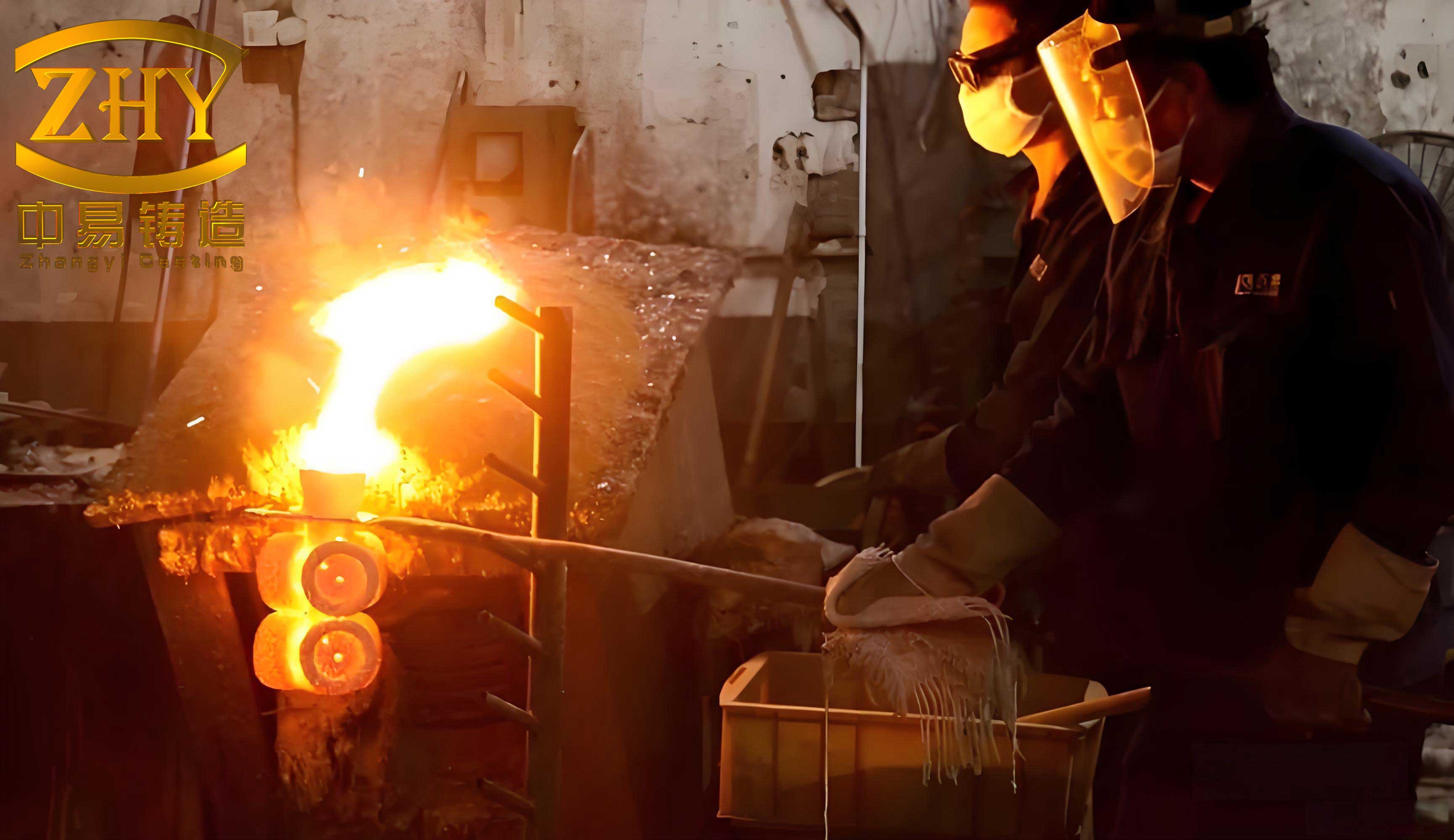
The foundational step in any investment casting process is melting and treatment. For our trials, ZLD101D (a common Al-Si-Mg casting alloy similar to A356) pre-alloyed ingots were melted in a resistance furnace. Grain refinement was achieved using an Al-5Ti-1B master alloy, and modification was performed with a strontium and sodium salt mixture, added via a bell plunger at 1.5–2.0% of the melt weight. After careful slag removal, the melt was subjected to argon rotary degassing at 350–400 rpm for 10–20 minutes, followed by a 5–10 minute holding period. Casting was conducted at a pouring temperature of 720°C into gypsum moulds preheated to 150°C. Despite this rigorous melt treatment, component evaluation revealed that defect formation was predominantly governed by the fluid dynamics and solidification conditions intrinsic to the investment casting process itself.
The primary defect encountered was shrinkage porosity, typically localized in specific regions of the castings. Common sites include the top sections of thin-wall cylinders and junction areas (hot spots) where walls meet. In the investment casting process utilizing vacuum-assisted pouring and pressure-augmented solidification, the opportunity for new oxide film formation during the pour is minimal. Consequently, when starting with a clean melt, the defects often originate from the turbulent flow of metal during mould filling. The phenomenon of liquid flow convergence is a critical, yet frequently overlooked, factor in defect genesis within the investment casting process. This convergence can be categorized into three distinct types, as summarized in the table below.
| Type of Convergence | Schematic Description | Mechanism & Consequence | Typical Defect Location |
|---|---|---|---|
| 1. Structural Convergence | Two liquid fronts rising along parallel thin walls meet at the top. | The merging fronts can trap air or existing oxide films present on the liquid meniscus, creating a localized gas pocket or bifilm that evolves into shrinkage porosity during slow solidification. | Top edges of thin-walled enclosures, box sections, or cored passages. |
| 2. Gating-Induced Convergence | Metal from an ingate impinges on or merges with an advancing bulk liquid front. | Creates localized turbulence. If the ingate stream contains oxides or is turbulent itself, it can fold surface films into the bulk, creating potential sites for pore nucleation. | Areas adjacent to improperly oriented ingates, especially on vertical surfaces. |
| 3. Meniscus Lag Convergence | Differential filling speeds in adjacent sections of varying thickness cause the liquid front in a thicker section to “lap over” into a thinner, slower-filling section. | The leading edge of the faster front can fold over the slower, stationary meniscus of the thin section, encapsulating the surface oxide film. Surface tension effects exacerbate this meniscus lag in thin sections. | Junctions between thick and thin walls, where the thin section acts as a “pocket.” |
The physics of flow convergence often involves a rapid change in momentum and can be related to pressure differentials. A simplified Bernoulli-based perspective can illustrate the risk. Consider two liquid fronts meeting. The local pressure at the convergence point \( P_{conv} \) can be disturbed. If the flow is turbulent, the dynamic pressure component fluctuates:
$$ P_{conv} = P_{atm} – \rho g h – \frac{1}{2}\rho v^2 + \Delta P_{turb} $$
Where \( \Delta P_{turb} \) represents a transient, potentially negative pressure fluctuation that can aspirate gas from the mould surface or open existing bifilms. Furthermore, the propensity for a converged region to form shrinkage is linked to the local solidification time and thermal gradient. An idealized susceptibility factor \( S_p \) might be expressed as:
$$ S_p \propto \frac{V_{hotspot}}{G \cdot \sqrt{t_{local}}} $$
Where \( V_{hotspot} \) is the volume of the thermally isolated region, \( G \) is the thermal gradient, and \( t_{local} \) is the local solidification time. The insulating gypsum mould directly reduces \( G \) and increases \( t_{local} \), thereby maximizing \( S_p \) at convergence zones.
While liquid flow convergence creates the initial defect nuclei (entrapped air or bifilms), the investment casting process’s gating system design is the principal tool for managing metal flow to prevent their formation. A crucial, often neglected aspect is the connection between the sprue and the runner. Two common configurations are used: a sharp right-angle junction and a junction incorporating a sprue well (pouring basin at the base of the sprue). The choice has profound implications.
If the runner’s cross-sectional area \( A_{runner} \) is larger than the sprue exit area \( A_{sprue} \), the first metal stream hitting the base experiences a sudden expansion. This leads to severe splashing and a phenomenon known as “vena contracta” or aspiration, where a low-pressure zone forms behind the rapidly turning jet. This zone can draw in air and any loose particles from the runner. The relationship for the pressure drop \( \Delta P_{asp} \) in such a sudden expansion can be approximated using a momentum balance, leading to significant energy dissipation and turbulence generation. X-ray studies of the filling process confirm that even with a sprue well, if \( A_{runner} > A_{sprue} \), aspiration and bubble entrainment into the runner are often observed.
The effective solution, validated through experimentation, is to use a sprue well and ensure the total ingate area \( A_{ingates} \) is less than the sprue exit area \( A_{sprue} \). This relationship is fundamental:
$$ A_{ingates} < A_{sprue\_exit} $$
This configuration forces the sprue well to always remain full during pouring, eliminating the free fall and impact at the base. The metal rises smoothly into the runner, and the positive pressure in the sprue well prevents air aspiration. The well also acts as a primary slag trap. For the runner and ingates, a similar principle applies: the runner should have a larger cross-section than the ingates, and its end should feature a slag collection chamber. This system creates a pressurized, non-turbulent flow path that effectively filters the initial, often dross-laden, metal surge and prevents it from entering the cavity. The metal that finally enters the mould through the ingates is drawn from the cleaner, central portion of the flowing stream.
Beyond the sprue-runner connection, other gating strategies within the investment casting process are vital for managing convergence:
1. Venting: Strategic placement of vent pins in the mould at the highest points, particularly where structural convergence is predicted, allows trapped air to escape before the metal front seals it in. This is a direct countermeasure to “air banging.”
2. Ingate Orientation and Size: Ingates should be designed to promote laminar, progressive filling from the bottom up (bottom gating is often preferred). They should be attached to the thickest sections of the casting where possible and oriented to minimize direct impingement on core faces or thin walls. Their cross-sectional area should be small enough to allow them to freeze quickly and act as an effective filter but large enough to permit complete fill before freeze-off.
3. Chills and Insulation: While the entire mould is insulating, selective application of copper chills on external thick sections or hot spots can locally increase the thermal gradient \( G \), promoting directional solidification towards the ingates and reducing \( S_p \).
4. Filters: Ceramic foam filters placed in the runner system or at the base of the sprue provide a final, mechanical barrier to oxide inclusions, preventing them from reaching the casting cavity and becoming nuclei for shrinkage pores.
The practical application of these principles in the investment casting process is best illustrated with a production case. The component was a shock absorber mounting bracket (ZL114A alloy), a classic complex thin-wall part weighing ~12 kg with a minimum wall thickness of 1.5 mm and a maximum of 6 mm. The investment casting process for this part was designed with a multi-ingate, stepped gating system featuring ten ingates in total—four on the side and six at the bottom. The key design rules were strictly followed:
• A substantial sprue well was incorporated.
• The total ingate area was calculated to be less than the sprue exit area.
• The runner terminated in an enlarged slag trap.
• Computer solidification simulation was used to verify that the ingates and feeders remained liquid longest, ensuring adequate feeding to the heavy sections.
The simulation results confirmed sound thermal management, with critical areas identified as last-to-freeze. The cast components, after shell removal, cleaning, and non-destructive X-ray inspection, showed a significant reduction in shrinkage porosity and inclusion-related defects, meeting all customer specifications for leak-tightness and mechanical properties. This success underscores that in the aluminum alloy investment casting process, meticulous control over fluid dynamics through gating design is as critical as melt quality in achieving defect-free thin-wall castings.
In conclusion, the gypsum mould investment casting process offers unparalleled capabilities for producing intricate aluminum alloy components. However, its inherent characteristics magnify the risk of shrinkage porosity. The analysis confirms that the dominant failure mechanisms are intrinsically linked to turbulent flow convergence and improper gating design, which introduce defect nuclei that expand due to the slow, isolated solidification inherent to the process. The effective countermeasures are not merely additive but involve a systemic re-engineering of the metal delivery system: enforcing the area relationship \( A_{ingates} < A_{sprue} \) with a sprue well, strategic venting, careful ingate placement to minimize adverse convergence, and the use of filters. By fundamentally altering the initial conditions of solidification—specifically, by preventing the introduction of gas and oxide nuclei during filling—the subsequent insulating action of the gypsum mould can be harnessed for favorable feeding without incurring the penalty of dispersed shrinkage. Therefore, mastering the fluid dynamics of mould filling is the cornerstone of optimizing the investment casting process for high-integrity aluminum alloy thin-wall castings.