
In the intricate world of metal forming, the investment casting process stands out for its ability to produce components of exceptional dimensional accuracy and complex geometry. As a practitioner deeply involved in this field, I have dedicated significant effort to understanding and resolving one of its most persistent challenges: shrinkage porosity. This defect, arising from inadequate liquid metal feeding during solidification, can manifest from visibly porous surfaces to insidious internal voids only revealed during subsequent machining or testing. Its presence is particularly unacceptable for pressure-containing components where it compromises integrity. This article consolidates my experiential and analytical insights into a systematic approach for mitigating shrinkage defects within the stainless steel investment casting process.
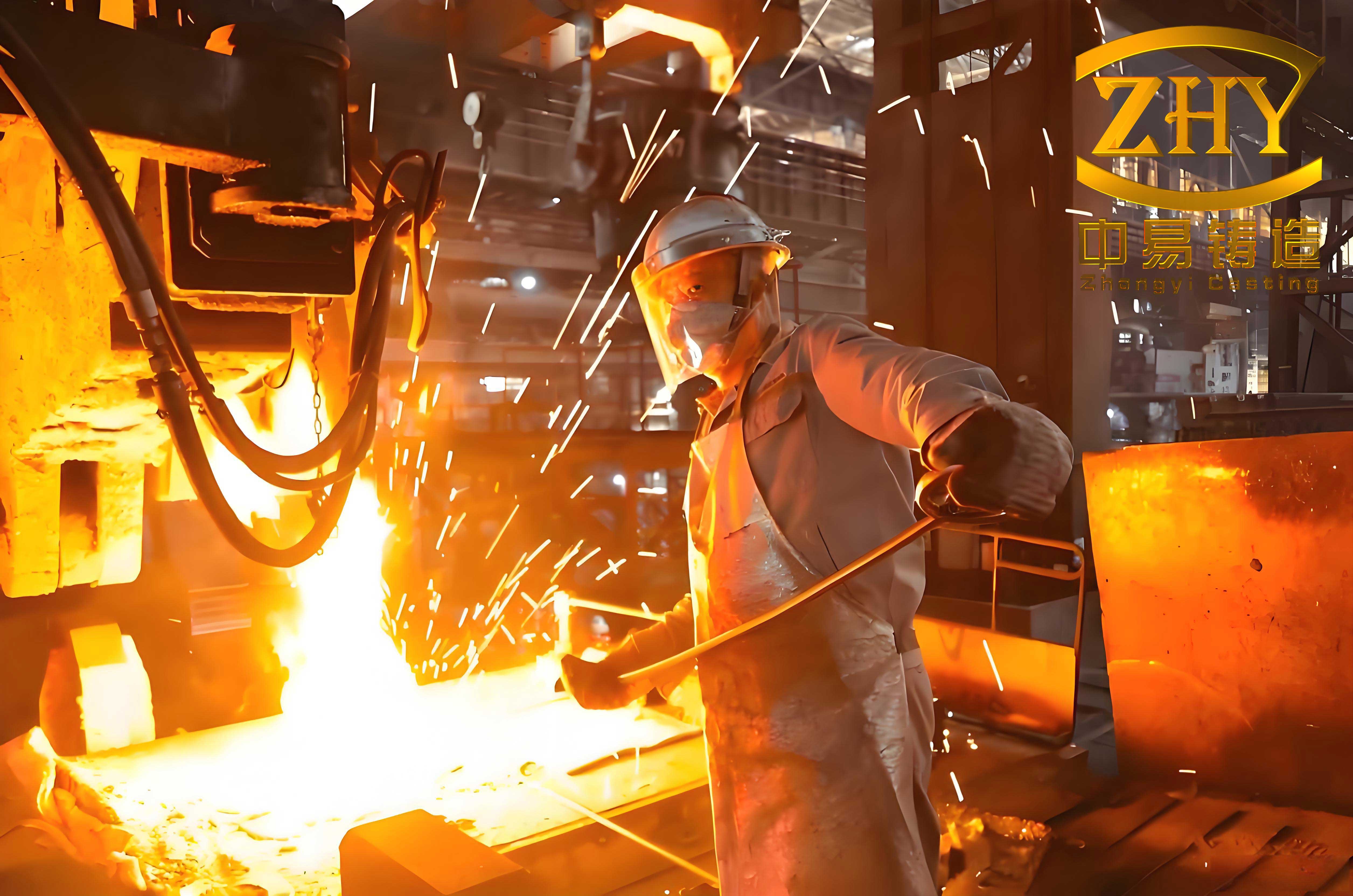
The fundamental physical principle underlying shrinkage porosity is the volumetric contraction of metal as it transitions from liquid to solid. If this contraction is not continuously compensated by a reservoir of molten metal—a process known as feeding—microscopic or macroscopic pores form. The effectiveness of this feeding, or补缩, is governed by thermal gradients and the accessibility of liquid metal to the solidifying regions. In the investment casting process, we manipulate numerous variables to establish and maintain favorable conditions for directional solidification, where feed metal flows from the gating system toward the isolated sections of the casting. The governing heat transfer can be conceptualized by Fourier’s law, while the solidification progression is time-dependent:
$$ q = -k \nabla T $$
$$ \frac{\partial T}{\partial t} = \alpha \nabla^2 T $$
where \(q\) is the heat flux, \(k\) is the thermal conductivity, \(T\) is temperature, \(t\) is time, and \(\alpha\) is the thermal diffusivity. The goal is to design the process such that the thermal gradient \(\nabla T\) directs solidification front toward the feeders, ensuring a sound casting.
Based on extensive observation and systematic trials, the root causes for poor feeding in the stainless steel investment casting process can be categorized and prioritized. The following table summarizes the primary and secondary factors influencing shrinkage formation:
| Factor Category | Specific Elements | Relative Impact on Shrinkage | Permanence of Solution |
|---|---|---|---|
| Primary Design Factors | 1. Number, Size, and Location of In-Gates 2. Design of the Pouring Cup & Runner System (Gating System) 3. Casting Geometry (especially wall thickness differentials) |
High – Fundamental to feeding path | Permanent once validated |
| Secondary Process Factors | 4. Pouring Temperature and Pouring Speed 5. Shell Temperature at Pouring (Hot vs. Cold Shell) |
Moderate to Low – Influence thermal dynamics | Requires consistent operational control |
The first three factors constitute the foundational design of the investment casting process. Once optimized for a specific part geometry, they provide a robust and repeatable solution. The latter two are process parameters that, while less dominant, require vigilant control as deviations in daily operations can reintroduce minor defects.
1. Strategic Gating: The First Line of Defense
The design of the in-gates is arguably the most critical element in controlling solidification within the investment casting process. They act as the conduits through which feed metal is supplied. A single, undersized gate placed in a non-optimal location often fails to support regions of varying thickness. Consider a common scenario: a casting featuring two thick sections connected by a thin web or rib. If only one gate feeds a thick section, the thin intermediate section solidifies rapidly, isolating the other thick section and creating a “hot spot” at the junction where shrinkage forms. The solution lies in implementing multiple gates to establish concurrent feeding paths.
The effectiveness of multiple gates can be evaluated by considering the solidification time of different sections, approximated by Chvorinov’s Rule:
$$ t_s = B \left( \frac{V}{A} \right)^n $$
where \(t_s\) is the solidification time, \(V\) is the volume of the section, \(A\) is its surface area, \(B\) is a mold constant, and \(n\) is an exponent (typically ~2). By placing gates on both thick sections, we effectively increase the feeding volume \(V\) and modify the cooling surface area \(A\) for the critical junction, extending its solidification time and allowing it to be fed.
| Scenario | Gating Design | Thermal/Feading Dynamics | Expected Outcome |
|---|---|---|---|
| Complex part with thick-thin-thick sections | Single gate on one thick section | Thin section solidifies first, isolating second thick section. Junction becomes a thermal center. | High probability of shrinkage at the junction. |
| Same part as above | Dual gates, one on each thick section | Both thick sections feed the central junction simultaneously. Thermal center is elevated to the gates/runner. | Significant reduction or elimination of shrinkage. |
| Simplified geometry (uniform or gradually changing wall) | Single, adequately sized gate | Directional solidification achievable from the farthest point toward the gate. | Sound casting with efficient yield. |
In one practical application involving a component with a 2mm annular channel flanked by 10mm thick walls, the shift from a single gate to a dual-gate configuration increased the yield from 9% to 100% for non-pressure applications, and to 94% for dimensions with only minor, acceptable imperfections. This underscores how a strategic gating design within the investment casting process can be transformative.
2. The Role of the Gating System (Runner and Pouring Cup)
The gating system, often called the “tree” or “cluster,” serves as the central reservoir and distribution network in the investment casting process. Its thermal mass is crucial. If the cross-sectional area of the main runner or sprue is too small relative to the casting section, it solidifies before feeding is complete, leading to shrinkage at the gate roots. Up-sizing the runner system increases its thermal capacity, acting as a more effective “feeder” or “riser” by remaining molten longer.
The pressure head \(P\) provided by the metal in the gating system to overcome flow resistance and feed shrinkage is given by:
$$ P = \rho g h $$
where \(\rho\) is the metal density, \(g\) is gravity, and \(h\) is the effective metal height in the system. A larger volume maintains a higher effective head for a longer duration. In an experiment, increasing the runner cross-section from 30mm x 30mm to 40mm x 40mm reduced gate-root shrinkage from 35% to a negligible 2%, demonstrating that a robustly dimensioned gating system is a cornerstone of reliable feeding in the investment casting process.
| Gating System Design | Thermal Mass | Solidification Time Relative to Casting | Feeding Efficiency |
|---|---|---|---|
| Small cross-section runner | Low | Runner solidifies before or concurrently with casting thick sections. | Poor. Shrinkage forms at gate junctions. |
| Large cross-section runner | High | Runner solidifies after casting sections, maintaining a liquid feed path. | High. Casting sections are fed until solidification is complete. |
3. Casting Geometry Modification: Collaboration for Success
Sometimes, even optimized gating within the standard investment casting process is insufficient for inherently problematic geometries. When shrinkage consistently appears in an isolated, heavy section remote from any feasible gate location, the geometry itself must be addressed. This involves proactive communication with the component designer. Two principal strategies exist: process allowances (padding) and design modifications.
Process Allowances (Padding): This involves adding temporary extra material to the wax pattern in a strategic location to create a natural feeding path. This “padding” acts as an internal riser. After casting and initial cleaning, this extra material is machined off. For instance, adding mass to ribs or walls adjacent to a thick, shrinkage-prone boss can channel feed metal effectively, as the pad solidifies last.
Design Modifications for Uniformity: A more elegant, permanent solution is to revise the component design to promote more uniform wall thickness or smoother transitions. A classic example is a thick base with a thin central feature. Redesigning the feature with a flange or rib not only adds structural stiffness but also reduces the drastic thickness differential, mitigating the isolated thermal center.
| Problem Geometry | Proposed Solution | Mechanism | Implementation Note |
|---|---|---|---|
| Isolated heavy section (e.g., boss, pad) | Add a process allowance/padding on connecting walls. | Creates a designed thermal channel to feed the isolated section. | Requires post-casting machining. Needs client approval. |
| Sharp transition from thick to thin section | Redesign to incorporate a fillet, flange, or tapered transition. | Reduces stress concentration and promotes more directional heat extraction. | Permanent design improvement. Often enhances part performance. |
| Large flat surfaces with varying thickness | Add reinforcing ribs to break up mass and create more uniform cooling. | Ribs increase surface area for cooling and can act as feeding channels. | Must be balanced against casting distortion and pattern complexity. |
4. Fine-Tuning with Process Parameters: Pouring Temperature & Speed
Once the geometry and gating for the investment casting process are fixed, the final control levers are the operational parameters. Pouring temperature and speed directly influence the thermal gradient within the mold cavity. A higher superheat (increased pouring temperature) extends the fluidity of the metal and delays the start of solidification, which can help in feeding more distant sections. However, excessive temperature can lead to grain growth, metal-mold reaction, and distortion. Conversely, a slower pouring speed minimizes turbulence but, more importantly, creates a deliberate temperature gradient from the first metal in to the last.
The principle is to have the initial metal entering the mold begin cooling immediately, while the metal entering later remains hotter, thereby establishing a strong thermal gradient from the extremities of the mold back toward the gating system. This promotes directional solidification. For complex, thin-walled investment castings, a moderately high temperature coupled with a slow, steady pour is typically most effective. Simpler, uniform sections can be cast at lower temperatures.
| Parameter | Increase/Decrease | Effect on Thermal Gradient & Feeding | Associated Risk |
|---|---|---|---|
| Pouring Temperature | Increase | Enhances fluidity, extends feeding range, reduces early solidification blocking. | Increased grain size, potential for hot tears, shell metal reaction. |
| Pouring Temperature | Decrease | Promotes faster skin formation, can reduce feeding if too low. | Misruns, cold shuts, premature freezing of gates. |
| Pouring Speed | Slower | Maximizes temperature differential between first and last metal in, strengthens directional solidification. | Potential for mistuns in thin sections if too slow. |
| Pouring Speed | Faster | Fills mold quickly, minimizes early freezing. | Increased turbulence (entrapment of gas, slag), flatter thermal gradient. |
5. Shell Temperature Management: The “Cold Shell” Technique
A more subtle but effective technique within the investment casting process is controlling the temperature of the ceramic shell at the moment of pour. Standard practice is to pour into a hot shell (often around 800-1000°C) to ensure fluidity and complete filling. However, for large or complex castings prone to minor, dispersed shrinkage, pouring into a “cold shell”—one that has been allowed to cool to a dull red or even ambient temperature after firing—can be beneficial.
The mechanism is again rooted in thermal management. A cold shell extracts heat from the incoming metal extremely rapidly, causing the metal touching the shell wall to solidify almost instantly. This establishes a very steep initial thermal gradient, pushing the solidification front and the associated liquid “mushy zone” decisively inward toward the hotter interior and, ultimately, toward the gating system. This technique, while requiring careful control to avoid mistuns, often yields castings with superior surface finish and reduced micro-porosity. It is a powerful tool for addressing the elusive, minor shrinkage that can escape primary design solutions.
A Systematic Framework for Defect Mitigation
Success in eliminating shrinkage from the stainless steel investment casting process is not about applying a single fix but implementing a hierarchical, systematic approach. The following flowchart-table summarizes the integrated strategy:
| Step | Action | Objective | |
|---|---|---|---|
| 1. Foundational Analysis | Analyze casting 3D model for thermal centers. Identify thick sections, junctions, and isolated masses. | Solidification simulation software (e.g., MAGMA, ProCAST), Chvorinov’s Rule analysis. | Predict potential shrinkage locations based on geometry alone. |
| 2. Primary Design Solution | Design gating system (gate number, location, size) and runner to feed predicted hot spots. Consider multiple gates or chill plates. | Simulation of different gating scenarios. Experience-based rules for feeding distance. | Establish a robust thermal profile that promotes directional solidification toward the gates. |
| 3. Geometric Collaboration | If design solutions are insufficient or impractical, propose process allowances (pads) or permanent design modifications to the client. | Highlight problem areas with simulation results. Propose alternative geometries. | Modify the component to be more “castable” within the investment casting process. |
| 4. Process Optimization | Determine optimal pouring temperature and speed for the specific geometry and gating design. | Thermal analysis, trial pours, and historical data for similar castings. | Fine-tune the thermal gradient during the pour itself. |
| 5. Advanced Technique | For persistent minor porosity, especially in large castings, evaluate the “cold shell” pouring technique. | Controlled cooling experiments and comparative analysis of defect rates. | Maximize the initial thermal gradient to enhance feeding dynamics. |
| 6. Validation & Control | Implement the finalized process. Use non-destructive testing (X-ray, dye penetrant) on initial samples. Document all parameters. | NDT inspection, dimensional checks, and metallographic analysis. | Verify the solution and establish a controlled, repeatable production process. |
In conclusion, the battle against shrinkage porosity in the stainless steel investment casting process is won through a blend of scientific principle, strategic design, and meticulous process control. The core philosophy is universal: establish and maintain a controlled thermal gradient that drives solidification from the extremities of the casting back toward a dedicated source of liquid feed metal. By methodically addressing the factors—from the foundational gating design and component geometry down to the finer points of pouring practice and shell temperature—we transform the investment casting process from an art into a predictable, engineering-driven discipline capable of producing high-integrity, defect-free components.