
In the field of spatial structures, steel castings in tubular joints have gained significant attention due to their superior integrity and reduced stress concentration compared to welded joints. These steel castings are typically manufactured through casting processes, which allow for complex geometries and smooth transitions, enhancing structural performance. However, the design of such steel castings faces challenges, as current codes lack specific verification formulas, necessitating finite element analysis and iterative trial-and-error approaches. This not only increases design time and cost but may also lead to suboptimal solutions. To address this, I propose a novel shape optimization method tailored for steel castings in tubular joints under multiple load cases, aiming to improve design efficiency and quality. This method integrates parametric geometry modeling, automated structural analysis, and evolutionary algorithms, with a focus on minimizing peak Mises stress across various loading scenarios. By leveraging advanced geometric representations and optimization techniques, this approach enables the automatic generation of optimized shapes for steel castings, ensuring material efficiency and structural safety. The significance of this work lies in its potential to streamline the design process for steel castings, which are critical components in modern infrastructure like grid shells and space frames, where load conditions are often multi-faceted and dynamic.
The core of the proposed method revolves around three interconnected modules: geometric modeling, structural analysis, and optimization algorithm. These modules work in tandem to iteratively refine the shape of steel castings based on mechanical performance metrics. The geometric modeling module utilizes subdivision surfaces, a mesh-based technique, to create parametric models of steel castings. Subdivision surfaces start from a control mesh and apply refinement rules to generate smooth surfaces, making them ideal for representing the complex topologies of tubular joints in steel castings. The control mesh vertices are adjusted along their normal directions using shape control parameters, denoted as \(d_i\), which serve as design variables in the optimization. By fixing boundary vertices to maintain connectivity with adjacent members and moving internal vertices, the geometry of steel castings can be flexibly modified without altering the overall topology. This parametric approach ensures that the optimized steel castings remain manufacturable through conventional casting processes, avoiding the pitfalls of topology optimization that often yield intricate designs requiring additive manufacturing. The structural analysis module is implemented via secondary development in ABAQUS, automating finite element analysis for steel castings. The model uses shell elements with a mesh size determined through sensitivity analysis, material properties of steel castings (elastic modulus \(E = 2.06 \times 10^5\) MPa and Poisson’s ratio \(\nu = 0.3\)), and appropriate boundary conditions and loads. This automation eliminates manual intervention, allowing for rapid evaluation of stress distributions in steel castings under various load cases. The optimization module employs a genetic algorithm to adjust the shape control parameters \(d_i\), targeting the minimization of peak Mises stress in steel castings. Genetic algorithms are chosen due to their gradient-free nature, making them suitable for problems where objective functions are non-linear and discontinuous. The algorithm parameters include a population size of 100, 50 generations, tournament selection, uniform crossover with a rate of 0.5, and uniform mutation with a rate of 0.3. To handle multiple load cases, which inherently represent a multi-objective optimization problem, I explore four objective merging methods: linear weighted method, compromise programming method, ε-constraint method, and minimax method. These methods transform the multi-objective problem into a single-objective one, facilitating the use of genetic algorithms for steel castings.
In geometric modeling for steel castings, the subdivision surface technique is key. Given a set of axes and tube diameters for tubular joints, an initial control mesh is constructed using tools like MultiPipe in Rhino Grasshopper. The shape control parameters \(d_i\) define the displacement of vertices along their normals, with the total shape fully determined by these parameters. For a control mesh with \(N\) vertices, the design variable vector is \(\mathbf{d} = [d_1, d_2, \dots, d_N]\). The subdivision process, often based on Catmull-Clark rules, yields a smooth surface \(S(\mathbf{d})\) representing the steel casting geometry. This can be summarized as:
$$ S(\mathbf{d}) = \text{Subdivide}(\mathbf{M}_0 + \sum_{i=1}^N d_i \mathbf{n}_i) $$
where \(\mathbf{M}_0\) is the initial control mesh, and \(\mathbf{n}_i\) is the normal vector at vertex \(i\). This formulation allows for efficient manipulation of steel casting shapes during optimization. The structural analysis module computes the peak Mises stress \(\sigma_k\) for each load case \(k\), derived from finite element results. For steel castings, the Mises stress at a point is given by:
$$ \sigma_{\text{Mises}} = \sqrt{\frac{(\sigma_1 – \sigma_2)^2 + (\sigma_2 – \sigma_3)^2 + (\sigma_3 – \sigma_1)^2}{2}} $$
where \(\sigma_1, \sigma_2, \sigma_3\) are principal stresses. The objective function for a single load case \(k\) incorporates a penalty on volume increase to prevent excessive material usage in steel castings:
$$ f_k(\mathbf{d}) = \frac{\sigma_k(\mathbf{d})}{\sigma_{\text{ref}}} + \lambda \cdot \max\left(0, \frac{V(\mathbf{d})}{V_0}\right) $$
Here, \(\sigma_{\text{ref}} = 235\) MPa is the yield stress of steel castings, \(V(\mathbf{d})\) is the volume of the optimized steel casting, \(V_0\) is the initial volume, and \(\lambda = 5\) is a penalty coefficient. This encourages stress reduction in steel castings without significant volume growth. For multiple load cases, let \(n\) be the number of cases, and \(f_k(\mathbf{d})\) be the objective for case \(k\). The four merging methods are defined as follows. The linear weighted method combines objectives with equal weights \(\omega_k = 1/n\):
$$ f_{\text{ws}}(\mathbf{d}) = \sum_{k=1}^n \omega_k f_k(\mathbf{d}) = \frac{1}{n} \sum_{k=1}^n f_k(\mathbf{d}) $$
The compromise programming method uses ideal points \(f_k^*\), taken as the minimum \(f_k\) from single-case optimizations for steel castings:
$$ f_{\text{cp}}(\mathbf{d}) = \sqrt{\sum_{k=1}^n \omega_k^2 (f_k(\mathbf{d}) – f_k^*)^2} = \sqrt{\frac{1}{n} \sum_{k=1}^n (f_k(\mathbf{d}) – f_k^*)^2} $$
The ε-constraint method selects a primary objective, say for load case \(m\), and constraints others with limits \(\varepsilon_k = 1.3 f_k^*\):
$$ \min f_{\text{ec}}(\mathbf{d}) = f_m(\mathbf{d}) + \lambda \sum_{k \neq m} \max(f_k(\mathbf{d}) – \varepsilon_k, 0) $$
For steel castings, I set \(m = 4\) (the most critical case) based on preliminary analysis. The minimax method focuses on the worst-case performance:
$$ f_{\text{mm}}(\mathbf{d}) = \max_{1 \leq k \leq n} f_k(\mathbf{d}) $$
These methods enable a comprehensive optimization of steel castings across diverse loading conditions, ensuring robustness in practical applications. To illustrate the effectiveness of the proposed approach, I apply it to a steel casting in a cylindrical grid shell, a common spatial structure. The shell has a span of 40 m, length of 40 m, rise of 8 m, with tubular members of diameters 219 mm and 245 mm, thickness 12 mm. The steel casting joint connects six members, and five critical load cases are derived from combinations of dead, live, wind, and snow loads, as shown in Table 1. Each case involves axial forces \(F\) and bending moments \(M\) applied to the member ends, with other internal forces negligible.
| Load Case | Member 1: \(F_1\) (kN), \(M_1\) (kN·m) | Member 2: \(F_2\) (kN), \(M_2\) (kN·m) | Member 3: \(F_3\) (kN), \(M_3\) (kN·m) | Member 4: \(F_4\) (kN), \(M_4\) (kN·m) | Member 5: \(F_5\) (kN), \(M_5\) (kN·m) | Member 6: \(F_6\) (kN), \(M_6\) (kN·m) |
|---|---|---|---|---|---|---|
| Case 1 | 60.38, 1.23 | -132.47, 34.63 | -135.00, 33.92 | 49.64, 1.09 | -123.78, 33.09 | -148.00, 32.63 |
| Case 2 | 47.89, 0.48 | 97.48, -17.07 | 180.10, -45.27 | 44.14, 0.50 | 104.70, -19.05 | 176.50, -46.96 |
| Case 3 | 87.59, 1.22 | -147.92, 20.69 | -209.54, -53.71 | 90.78, 1.17 | -144.21, 23.94 | -213.26, -56.50 |
| Case 4 | 35.74, 0.36 | -85.35, -54.74 | -64.40, -20.48 | 34.34, 0.37 | -83.57, -56.22 | -63.22, -21.05 |
| Case 5 | 69.50, 1.47 | 96.64, 32.48 | 98.45, 31.66 | 56.82, 1.28 | 93.21, 30.86 | 99.69, 30.30 |
The initial steel casting shape, obtained by setting all \(d_i = 0\), has a volume \(V_0\) and peak Mises stresses as listed in Table 2. Finite element analysis uses shell elements with size 12 mm, boundary conditions constraining appropriate degrees of freedom at member ends, and the loads from Table 1. The stress distributions vary significantly across cases, highlighting the need for multi-case optimization for steel castings. For single-load case optimization, I apply the genetic algorithm separately to each case, minimizing \(f_k(\mathbf{d})\). The results, after five runs per case, show optimized shapes with distinct geometries, as the control mesh vertices adjust to reduce stress in steel castings for specific loads. The peak Mises stresses for these optimized steel castings are summarized in Table 2, indicating reductions of 44% to 60% in the target case but higher stresses in others, underscoring the limitation of single-case approaches.
| Steel Casting Design | Case 1 | Case 2 | Case 3 | Case 4 | Case 5 | Average | Maximum |
|---|---|---|---|---|---|---|---|
| Initial | 290.66 | 285.25 | 279.97 | 307.55 | 281.32 | 288.95 | 307.55 |
| Optimized for Case 1 | 130.93 | 204.85 | 213.90 | 248.26 | 266.09 | 212.81 | 266.09 |
| Optimized for Case 2 | 177.06 | 148.31 | 219.09 | 276.50 | 219.99 | 208.19 | 276.50 |
| Optimized for Case 3 | 213.48 | 222.21 | 156.37 | 215.40 | 226.70 | 206.83 | 226.70 |
| Optimized for Case 4 | 175.15 | 228.88 | 236.82 | 157.88 | 162.36 | 192.22 | 236.82 |
| Optimized for Case 5 | 217.23 | 236.97 | 211.23 | 173.08 | 112.40 | 190.18 | 236.97 |
For multi-load case optimization of steel castings, I implement the four merging methods using the genetic algorithm with 10 independent runs each. The optimized shapes differ visually: linear weighted and compromise programming yield flatter profiles, while minimax results in a more pronounced central bulge in steel castings. The peak Mises stresses are presented in Table 3, showing that all methods reduce stresses compared to the initial steel casting, with decrements of 25% to 55%. The minimax method achieves the lowest maximum stress (192.03 MPa), indicating balanced performance across cases for steel castings, whereas ε-constraint gives the lowest average (169.28 MPa) but higher maximum. This aligns with the goal of ensuring steel castings perform adequately under worst-case scenarios, making minimax preferable for practical designs. To quantify the improvements, the stress reduction ratio \(R_k\) for case \(k\) is defined as:
$$ R_k = \frac{\sigma_{\text{initial}, k} – \sigma_{\text{optimized}, k}}{\sigma_{\text{initial}, k}} \times 100\% $$
For the minimax-optimized steel casting, \(R_k\) ranges from 25% to 60%, demonstrating effectiveness. The volume changes are modest, with increases below 10%, affirming that the penalty term in the objective function controls material usage in steel castings. The geometric flexibility of subdivision surfaces allows these optimizations without compromising manufacturability of steel castings, as shapes remain smooth and compatible with casting processes. In discussing the results, the minimax method’s superiority stems from its direct minimization of the maximum \(f_k\), which correlates with peak Mises stress in steel castings. This ensures no single load case dominates, leading to more uniform stress distributions in steel castings. In contrast, linear weighted and compromise programming may sacrifice performance in some cases for better averages, which could be risky for steel castings under unpredictable loads. The ε-constraint method heavily depends on the chosen primary case and constraint limits; if set improperly, it may yield suboptimal steel castings. Therefore, for steel castings in tubular joints, where safety under all envisaged loads is paramount, the minimax approach is recommended. Additionally, the parametric model based on subdivision surfaces proves efficient, enabling rapid shape adjustments for steel castings without manual remodeling. The integration with ABAQUS via scripting automates analysis, reducing human error and time. Future work could extend this to variable-thickness steel castings or incorporate fatigue considerations, further enhancing the design of steel castings.
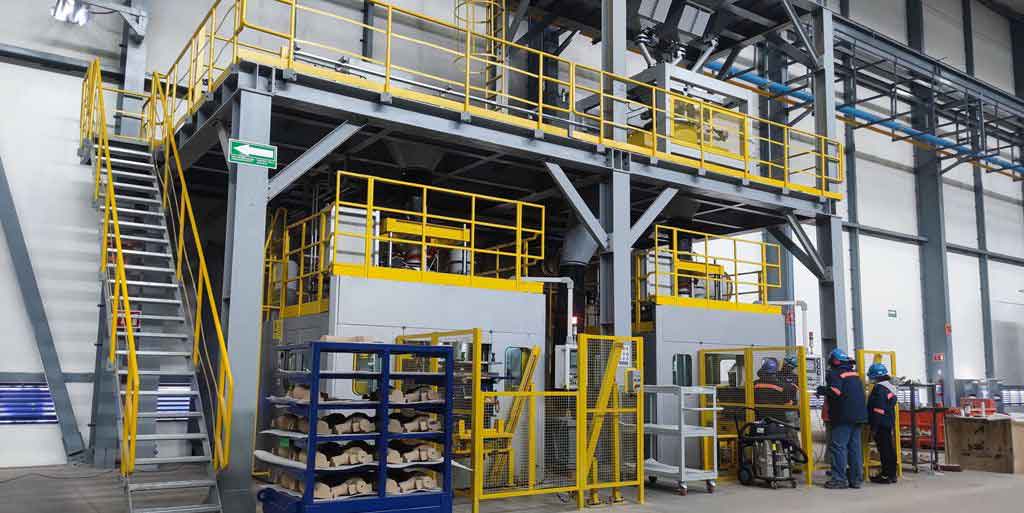
The image above illustrates typical equipment used in the manufacturing of steel castings, highlighting the industrial context where optimized designs are produced. This connection underscores the practicality of the proposed method for real-world steel castings. In conclusion, the proposed shape optimization method offers a robust framework for designing steel castings in tubular joints under multiple load cases. By combining subdivision surface-based geometry, automated finite element analysis, and genetic algorithms with objective merging techniques, it achieves significant stress reductions in steel castings without substantial volume increases. Among the merging methods, the minimax method is most effective for balancing diverse load conditions in steel castings, ensuring reliable performance. This work advances the design paradigm for steel castings, promoting efficiency and safety in spatial structures. Future research could explore multi-disciplinary optimizations for steel castings, considering factors like cost and durability, to further innovate in the field of steel castings.