
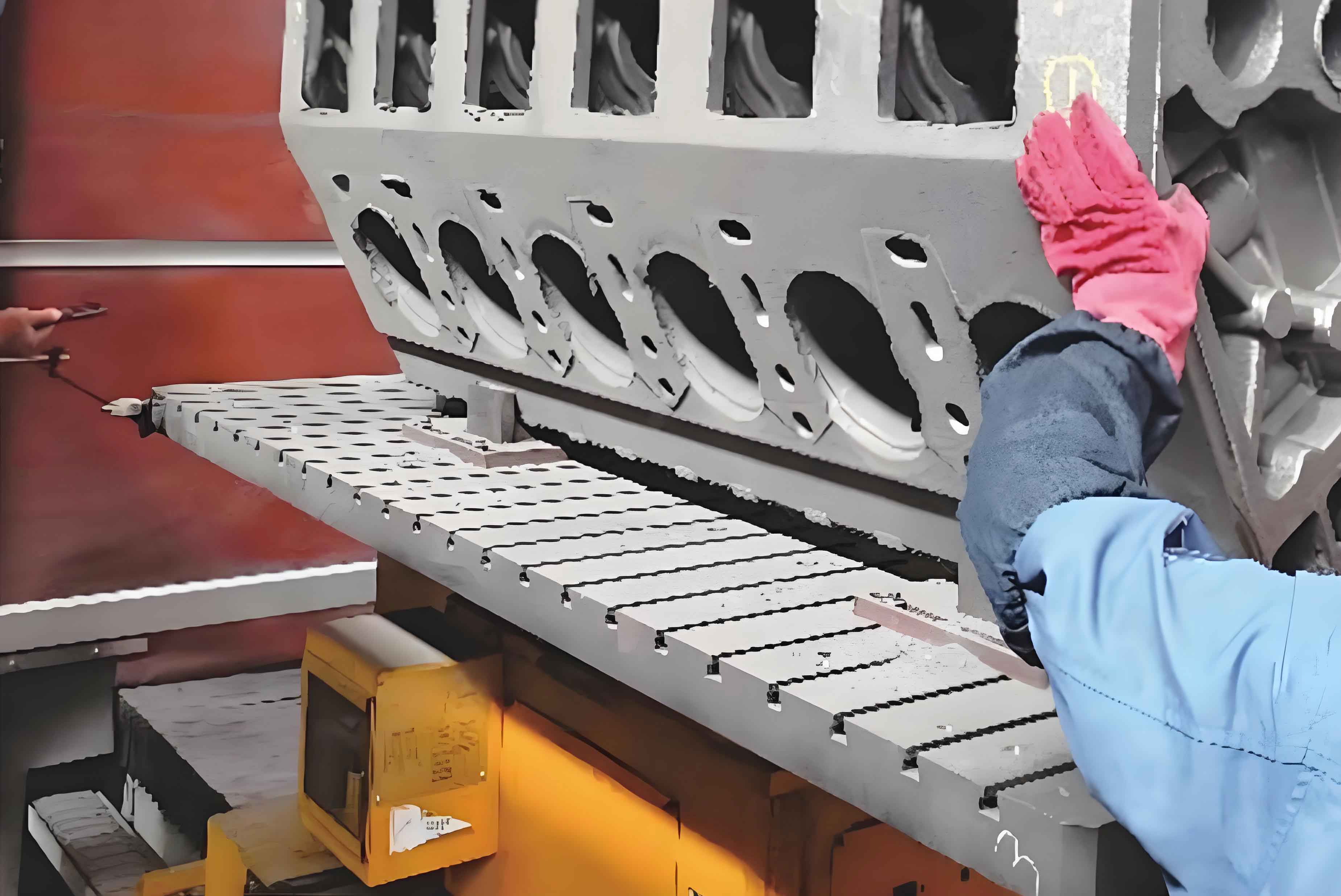
In the production of engine cylinder blocks for commercial vehicles, achieving high-quality castings with minimal defects and optimal mechanical properties remains a significant challenge. This study focuses on an 11-liter, 6-cylinder engine cylinder block casting produced using horizontal pouring in green sand molds. The original gating system design led to two critical issues: localized porosity defects in the upper crankcase area and suboptimal mechanical properties in the bearing cap (tile seat) regions. Through systematic analysis of the molten metal flow field, temperature distribution, and defect characteristics, a redesigned gating system was developed and validated. This article details the methodology, improvements, and outcomes of the study, emphasizing the role of optimized gating systems in enhancing the integrity and performance of engine cylinder block castings.
1. Introduction
The engine cylinder block is a critical component in internal combustion engines, requiring high dimensional accuracy, structural integrity, and resistance to thermal and mechanical stresses. Cast iron, particularly grade HT250, is widely used due to its excellent castability, wear resistance, and damping capacity. However, defects such as porosity and inconsistent mechanical properties often arise during casting, compromising the reliability of engine cylinder blocks.
This research addresses these challenges by re-engineering the gating system for an 11L engine cylinder block. The original design, featuring a horizontal gating layout with seven branch runners and three layers of ingates, resulted in porosity defects in thin-walled upper crankcase regions and reduced strength in bearing cap areas. By leveraging computational fluid dynamics (CFD) simulations and experimental validation, a revised gating system was implemented to optimize metal flow, temperature distribution, and solidification behavior.
2. Problem Analysis
2.1 Porosity Defects in the Upper Crankcase
Porosity defects were predominantly observed in thin-walled sections (5 mm thickness) at the highest points of the upper crankcase (Figure 1). These defects exhibited spherical morphology with smooth walls, as confirmed by scanning electron microscopy (SEM) and energy-dispersive X-ray spectroscopy (EDS). EDS analysis revealed high oxygen content (30.48 wt%), confirming gas entrapment during solidification.
Key contributing factors:
- Cold metal accumulation: Initial molten iron (1,440°C ± 10°C) solidified prematurely in thin sections, trapping gases.
- Inadequate venting: Restricted gas escape paths due to the original gating layout.
- Temperature gradient: Rapid cooling in the crankcase region exacerbated gas entrapment.
2.2 Suboptimal Mechanical Properties in Bearing Cap Regions
The bearing cap regions exhibited lower tensile strength (206.6–238.7 MPa) and hardness (173–190 HBW) compared to specifications (≥195 MPa, 170–230 HBW). Metallographic analysis identified coarse flake graphite (Type A95+B), attributed to prolonged thermal exposure from ingates positioned near the bearing caps.
Root cause:
- Thermal segregation (hot spots): Continuous metal flow through bearing cap ingates delayed solidification, promoting coarse graphite formation.
3. Gating System Redesign
3.1 Original Gating System Limitations
The original system (Figure 2) comprised:
- Horizontal runner with seven vertical branch runners.
- Three ingate layers located at the bearing caps and oil pan flange.
Issues identified via CFD simulations:
- Cold metal stagnation: Initial metal flow congregated in the upper crankcase, forming isolated pools that solidified prematurely.
- Gas entrapment: Trapped gases in stagnant regions led to porosity.
- Thermal imbalance: Prolonged heat retention in bearing cap areas caused coarse graphite.
3.2 Revised Gating System Design
The redesigned system (Figure 3) incorporated the following changes:
- Relocation of ingates: Upper crankcase ingates were added to direct metal flow away from thin-walled regions.
- Reduction of oil pan flange ingate area: Adjusted to prioritize early filling of upper sections.
- Elimination of bearing cap ingates: Mitigated thermal segregation and graphite coarsening.
Key equations governing flow optimization:
The velocity vv and pressure PP of molten metal were modeled using the Navier-Stokes equations:ρ(∂v∂t+v⋅∇v)=−∇P+μ∇2v+fρ(∂t∂v+v⋅∇v)=−∇P+μ∇2v+f
where ρρ = density, μμ = dynamic viscosity, and ff = body forces.
Thermal analysis employed Fourier’s heat conduction law:q=−k∇Tq=−k∇T
where qq = heat flux, kk = thermal conductivity, and ∇T∇T = temperature gradient.
4. Validation of Improvements
4.1 Porosity Reduction
Post-implementation data (Table 1) confirmed a drastic reduction in porosity rates:
| Batch Size | Defective Castings | Porosity Rate (%) |
|---|---|---|
| 5,000 | 150 | 3.0 |
| 10,000 | 200 | 2.0 |
| 15,000 | 60 | 0.4 |
| 20,000 | 20 | 0.1 |
CFD results (Figure 4) demonstrated uniform temperature distribution and minimized cold metal accumulation.
4.2 Enhanced Mechanical Properties
Revised bearing cap regions exhibited finer graphite (Type A95 + DE) and improved mechanical metrics (Table 2):
| Batch | Tensile Strength (MPa) | Hardness (HBW) |
|---|---|---|
| 23W417 | 253.8 | 207 |
| 23W418 | 248.9 | 201 |
| … | … | … |
| Mean | 251.6 | 206.1 |
The elimination of thermal segregation reduced graphite coarsening, aligning hardness and strength with specifications.
5. Discussion
5.1 Role of Gating Design in Engine Cylinder Block Quality
The engine cylinder block’s structural integrity hinges on controlled solidification and gas venting. The revised gating system addressed these by:
- Prioritizing upper section filling to prevent cold metal stagnation.
- Enhancing venting efficiency through strategic ingate placement.
- Balancing thermal gradients to minimize residual stresses.
5.2 Economic and Operational Impact
Reducing porosity rates from 11% to 0.1% lowered scrap costs by approximately 90%. Improved mechanical properties extended the engine cylinder block’s service life, benefiting end-users in commercial vehicle applications.
6. Conclusion
This study demonstrates that optimizing the gating system is pivotal for enhancing the quality of engine cylinder block castings. Key outcomes include:
- Porosity mitigation through redesigned metal flow paths and venting.
- Mechanical property enhancement via elimination of thermal segregation.
- Process stability validated through large-scale production.
Future work will explore advanced simulation techniques and material innovations to further refine engine cylinder block casting processes.