
With the advancement of the casting industry, there is an increasing demand for castings with superior comprehensive properties, higher precision, reduced machining allowances, and smoother surfaces, all while adhering to energy-saving, emission-reduction, and green casting requirements. Numerical simulation of solidification can predict defects such as shrinkage porosity and cavities, while the filling process simulation effectively forecasts defects caused by fluid flow, including misruns, cold shuts, and slag inclusions. The casting process involves complex phenomena of fluid flow, temperature drop, and solidification. During mold filling, the liquid metal is assumed to be a continuous and steady incompressible Newtonian fluid at high temperatures. In this study, I focus on the numerical simulation of aluminum alloy shell castings, utilizing AnyCasting software to analyze and optimize the casting process to minimize defects. The term ‘shell castings’ is central to this work, as it refers to the specific geometry and challenges associated with such components.
Shell castings, particularly those made from aluminum alloys like ZL111, are widely used in various industries due to their lightweight and good mechanical properties. However, the complex geometry of shell castings often leads to defects during casting, such as shrinkage, porosity, gas entrapment, and cold shuts. To address these issues, numerical simulation has become an indispensable tool for predicting and mitigating defects before actual production. In this article, I present a comprehensive analysis of the numerical simulation for shell castings, incorporating mathematical models, simulation setup, and optimization strategies. The goal is to provide insights into improving the quality of shell castings through computational methods.
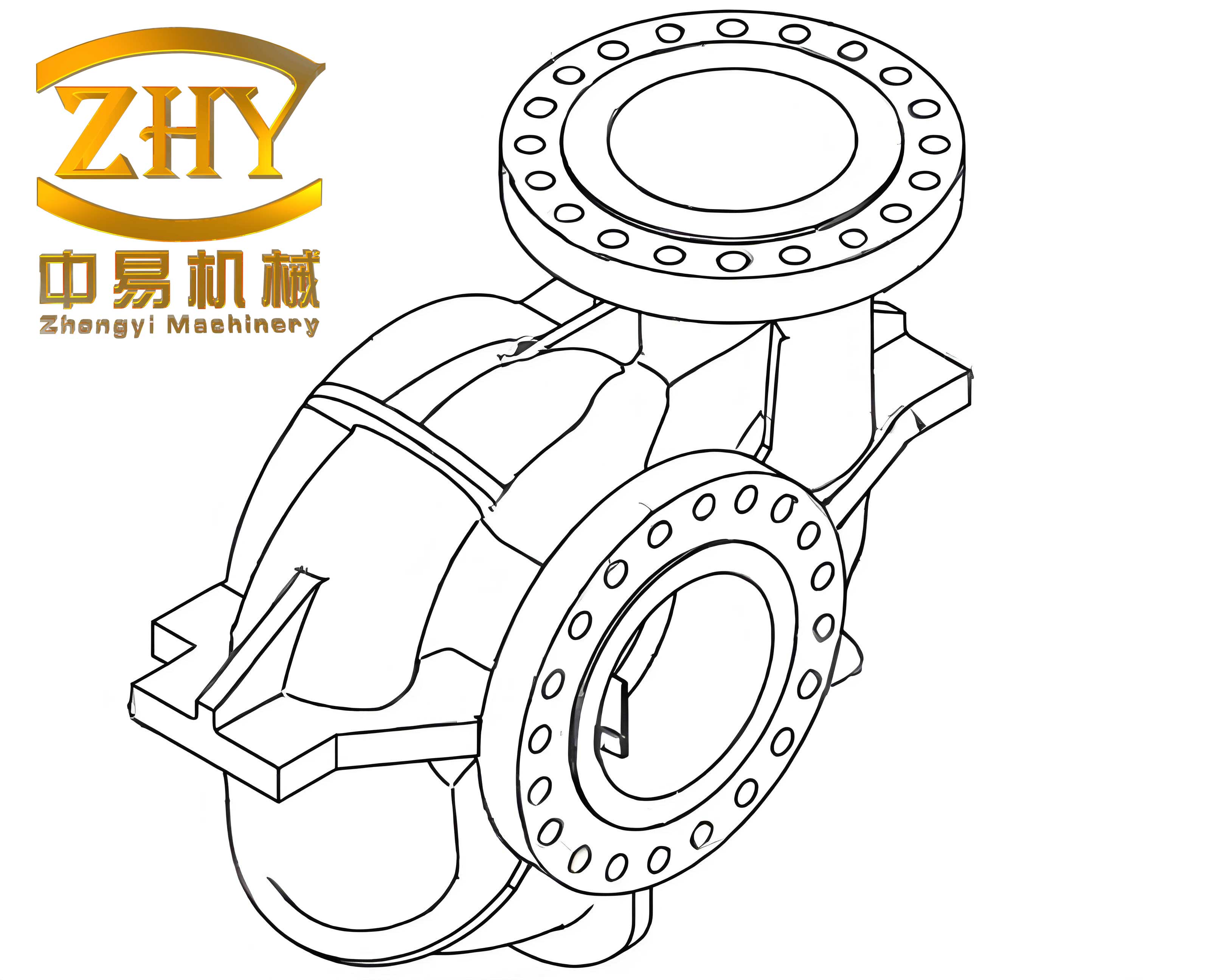
The numerical simulation of casting processes is based on fundamental equations governing fluid flow, heat transfer, and solidification. For shell castings, the fluid dynamics during mold filling are modeled using the SOLA-VOF (Solution Algorithm-Volume of Fluid) method. The key equations include the continuity equation and the energy equation. The continuity equation for an incompressible fluid is expressed as:
$$ \nabla \cdot \mathbf{u} = \frac{\partial u_x}{\partial x} + \frac{\partial u_y}{\partial y} + \frac{\partial u_z}{\partial z} = 0 $$
where $\mathbf{u}$ is the velocity vector with components $u_x$, $u_y$, and $u_z$ in the $x$, $y$, and $z$ directions, respectively. This equation ensures mass conservation during the filling of shell castings. The energy equation, which accounts for heat transfer during casting, is given by:
$$ \rho c \frac{\partial T}{\partial t} + \rho c \left( u \frac{\partial T}{\partial x} + v \frac{\partial T}{\partial y} + w \frac{\partial T}{\partial z} \right) = \frac{\partial}{\partial x} \left( \lambda \frac{\partial T}{\partial x} \right) + \frac{\partial}{\partial y} \left( \lambda \frac{\partial T}{\partial y} \right) + \frac{\partial}{\partial z} \left( \lambda \frac{\partial T}{\partial z} \right) + S $$
where $\rho$ is the density, $c$ is the specific heat capacity, $T$ is the temperature, $t$ is time, $\lambda$ is the thermal conductivity, and $S$ is the internal heat source term, which is zero for most casting simulations. This equation is crucial for predicting temperature distributions in shell castings during solidification.
To predict shrinkage defects in shell castings, the contraction volume calculation is employed. The total volume shrinkage $\Delta V^m$ is computed as the sum of solidification shrinkage and liquid shrinkage over all elements in an isolated hot spot region:
$$ \Delta V^m = \sum_{i=1}^{n} \left( \Delta V^{m}_{si} + \Delta V^{m}_{li} \right) $$
where $\Delta V^{m}_{si}$ is the solidification shrinkage of element $i$, $\Delta V^{m}_{li}$ is the liquid shrinkage of element $i$, and $n$ is the total number of unsolidified elements in the isolated hot spot. The solidification shrinkage is given by:
$$ \Delta V^{m}_{si} = \beta \Delta f^{m}_{si} V_i $$
and the liquid shrinkage is:
$$ \Delta V^{m}_{li} = \alpha_{sl} (1 – f^{m-1}_{si}) (T^{m-1}_{i} – T^{m}_{i}) V_i $$
Here, $\beta$ is the solidification shrinkage coefficient, $\Delta f^{m}_{si}$ is the change in solid fraction, $V_i$ is the volume of element $i$, $\alpha_{sl}$ is the liquid shrinkage coefficient, $f^{m-1}_{si}$ is the solid fraction at the previous time step, and $T^{m-1}_{i}$ and $T^{m}_{i}$ are temperatures at previous and current time steps. These equations are essential for accurately predicting defects in shell castings.
In addition to these equations, defect prediction criteria are used for shell castings. The Niyama criterion is commonly applied, with a critical value typically between 0.8 and 1.0. However, in AnyCasting, the Probabilistic Defect Parameter model is employed, and for this study, I use the Retained Melt Modulus (RM) as a defect prediction criterion. The RM is defined as:
$$ \text{RM} = \frac{R_V}{R_A} $$
where $R_V$ is the retained melt volume and $R_A$ is the retained melt surface area. A higher RM indicates a larger isolated melt pool, while a lower $R_A$ suggests that the melt is more concentrated, leading to a higher probability of shrinkage defects in shell castings. This criterion helps in identifying potential defect zones in shell castings.
To facilitate the simulation of shell castings, material properties and process parameters must be defined. Below is a table summarizing the key properties for the aluminum alloy ZL111 used in this study:
| Property | Value | Unit |
|---|---|---|
| Density ($\rho$) | 2.68 | g/cm³ |
| Specific Heat Capacity ($c$) | 0.96 | J/g·°C |
| Thermal Conductivity ($\lambda$) | 0.2 | cal/cm·s·°C |
| Solidification Shrinkage Coefficient ($\beta$) | 0.06 | – |
| Liquid Shrinkage Coefficient ($\alpha_{sl}$) | 1.2 × 10⁻⁴ | 1/°C |
For the simulation setup, the 3D model of the shell casting is created using CAD software and imported into AnyCasting in STL format. The mesh generation is critical for accuracy; in this case, approximately 2 million grids are used to discretize the domain, ensuring sufficient resolution for complex regions of the shell castings. The solver employs the Successive Over-Relaxation (SOR) method to compute time steps, enabling efficient simulation of mold filling and solidification for shell castings.
The initial casting process scheme for the shell castings involved a gating system with ingates located at the edges of the shell and a riser at the bottom. This design was simulated to analyze temperature gradients and defect probabilities. The results indicated a relatively small temperature gradient during solidification, which promoted coarse dendrite growth with a secondary dendrite arm spacing of 0.0210 mm. The Retained Melt Modulus was calculated as 5.197, suggesting a high probability of defects, particularly at the edges of the shell castings where inadequate feeding from the riser occurred. The defect prediction model highlighted these areas as bright zones, indicating potential shrinkage porosity. This underscores the importance of optimizing the gating system for shell castings to improve temperature gradients and feeding efficiency.
To address these issues, an improved casting scheme was developed for the shell castings. In this design, the ingates are positioned at the bottom of the shell, and four risers are placed at the top. This bottom-gating approach promotes a more favorable temperature gradient, as shown in the simulation results. The temperature gradient increased significantly, leading to finer dendrites with a secondary dendrite arm spacing of 0.0104 mm. The Retained Melt Modulus decreased to 3.943, indicating a reduced likelihood of defects. The bottom filling also ensured smoother metal flow, minimizing gas entrapment and improving venting through the risers. Consequently, the optimized design for shell castings demonstrated enhanced casting quality with fewer defects.
A comparative analysis of the two schemes for shell castings is presented in the table below, summarizing key simulation outcomes:
| Parameter | Initial Scheme | Improved Scheme |
|---|---|---|
| Temperature Gradient | Low | High |
| Secondary Dendrite Arm Spacing | 0.0210 mm | 0.0104 mm |
| Retained Melt Modulus (RM) | 5.197 | 3.943 |
| Defect Probability | High (edges of shell castings) | Low (uniform distribution) |
| Filling Behavior | Turbulent, potential for cold shuts | Smooth, minimal gas entrapment |
The improvement in shell castings quality can be further explained through mathematical analysis. The temperature gradient $G$ is a critical factor in solidification, influencing dendrite morphology and defect formation. For shell castings, a higher $G$ promotes directional solidification, which reduces isolated melt pools. The relationship between temperature gradient and solidification rate $R$ can be expressed using the Fourier number for heat transfer:
$$ \text{Fo} = \frac{\alpha t}{L^2} $$
where $\alpha$ is the thermal diffusivity, $t$ is time, and $L$ is a characteristic length. For shell castings, optimizing the gating system to increase $G$ involves adjusting the geometry and placement of ingates and risers. The Chvorinov’s rule can also be applied to estimate solidification time $t_s$:
$$ t_s = C \left( \frac{V}{A} \right)^2 $$
where $C$ is a constant dependent on mold material, $V$ is volume, and $A$ is surface area. For shell castings, a higher $V/A$ ratio in risers ensures longer feeding times, reducing shrinkage defects.
Moreover, the fluid flow during filling of shell castings is analyzed using the Navier-Stokes equations for incompressible flow:
$$ \rho \left( \frac{\partial \mathbf{u}}{\partial t} + \mathbf{u} \cdot \nabla \mathbf{u} \right) = -\nabla p + \mu \nabla^2 \mathbf{u} + \mathbf{f} $$
where $p$ is pressure, $\mu$ is dynamic viscosity, and $\mathbf{f}$ represents body forces such as gravity. In shell castings, minimizing turbulence is essential to prevent oxide inclusion and gas defects. The Reynolds number $\text{Re}$ is used to assess flow regime:
$$ \text{Re} = \frac{\rho u L}{\mu} $$
where $u$ is velocity and $L$ is characteristic length. For the improved scheme in shell castings, bottom gating reduces $\text{Re}$, promoting laminar flow and better defect control.
To further enhance the quality of shell castings, additional measures can be implemented. For instance, incorporating choke sleeves in the ingates can improve feeding efficiency, ensuring that areas near risers receive adequate molten metal. This is particularly important for complex shell castings with varying wall thicknesses. The optimization process for shell castings should also consider environmental factors, such as reducing energy consumption and emissions, aligning with green casting initiatives. Simulation tools like AnyCasting enable iterative design improvements for shell castings without physical trials, saving time and resources.
In conclusion, numerical simulation is a powerful technique for optimizing the casting process of aluminum alloy shell castings. Through this study, I have demonstrated that bottom-gating systems with top risers significantly improve temperature gradients, promote finer dendritic structures, and reduce defect probabilities in shell castings. The use of mathematical models, including continuity, energy, and shrinkage equations, along with defect criteria like the Retained Melt Modulus, provides a comprehensive framework for analyzing shell castings. The findings highlight the importance of design optimization in achieving high-quality shell castings with minimal defects. Future work could explore advanced materials or multi-scale simulations for further enhancement of shell castings performance. Overall, this approach contributes to the advancement of casting technology for shell castings, meeting the demands for better performance, precision, and sustainability.
The simulation of shell castings involves complex interactions between fluid dynamics, heat transfer, and solidification phenomena. By leveraging computational methods, manufacturers can predict and mitigate defects in shell castings early in the design phase. This not only improves product quality but also reduces waste and energy consumption. As the casting industry evolves, continued research into numerical simulation for shell castings will play a vital role in developing innovative and efficient casting processes. The insights gained from this study on shell castings can be extended to other casting geometries, fostering broader applications in automotive, aerospace, and machinery sectors. Ultimately, the goal is to achieve defect-free shell castings that meet stringent performance and environmental standards.