
As a researcher in the field of advanced manufacturing, I have extensively studied the application of lost wax casting for complex automotive components, particularly the exhaust manifold. The lost wax casting process, also known as investment casting, is pivotal for producing parts with intricate geometries and thin walls, such as the exhaust manifold, which collects exhaust gases from engine cylinders and directs them to the exhaust pipe. This component is critical for engine efficiency, but its complex structure—with varying wall thicknesses from 4 mm to 54 mm and isolated hot spots—poses significant challenges in casting. Defects like shrinkage porosity and low casting yield are common, leading to increased costs and reduced productivity. In this article, I will detail my work using numerical simulation to analyze and optimize the lost wax casting process for an auto exhaust manifold, aiming to eliminate defects and improve casting yield.
The lost wax casting method involves creating a wax pattern, coating it with ceramic slurry to form a mold, melting out the wax, and pouring molten metal into the cavity. This process is ideal for the exhaust manifold due to its ability to achieve high dimensional accuracy and smooth surface finish. However, the inherent complexities often result in shrinkage defects, especially in thick sections like flanges and pipe junctions. To address this, I employed ProCAST, a commercial finite element analysis software, to simulate the mold filling and solidification stages. Numerical simulation in lost wax casting allows for predictive analysis of defect formation, enabling process optimization without costly trial-and-error in physical production. My goal was to enhance the casting yield—the ratio of casting weight to total metal poured—while ensuring defect-free surfaces, as per technical requirements.
In the following sections, I will describe the methodology, including model setup and simulation parameters, present results from the initial lost wax casting design, and discuss optimized strategies. I will incorporate tables to summarize material properties and process data, and equations to explain underlying physical principles. Throughout, the term “lost wax casting” will be emphasized to highlight its relevance. Additionally, a visual aid is included to illustrate the process:
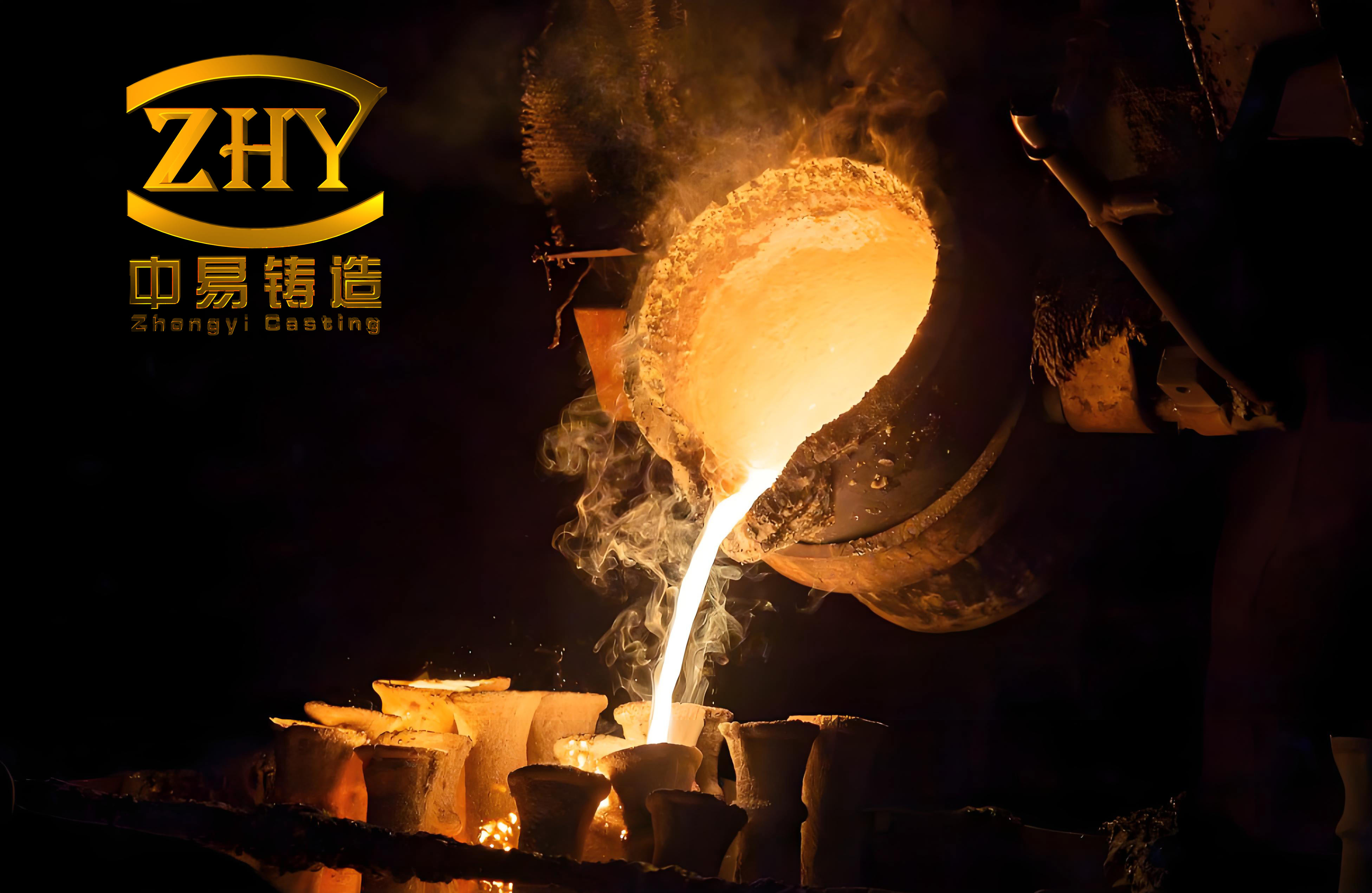
. This image depicts a typical lost wax casting setup, showcasing the intricate patterns and molds used in such processes.
Methodology: Numerical Simulation Approach for Lost Wax Casting
To simulate the lost wax casting process for the exhaust manifold, I first created a 3D geometric model of the part using CAD software, based on its complex structure with multiple pipes and a base flange. The model was then imported into ProCAST for meshing, where I generated a tetrahedral mesh with 182,805 nodes and 870,382 elements. The mesh was refined in critical areas like thin walls and thick sections to ensure accuracy. A ceramic shell mold, typical in lost wax casting, was modeled with a thickness of 8 mm to account for heat transfer effects. The material for the casting was a heat-resistant austenitic steel, HERCUNETE_S A3N, with chemical composition as shown in Table 1. This alloy is commonly used in lost wax casting for high-temperature applications due to its corrosion resistance and mechanical strength.
| Element | C | Si | Mn | S | Cr | Ni | W | Mo | Nb | Fe |
|---|---|---|---|---|---|---|---|---|---|---|
| Weight (%) | 0.45 | 0.50 | 1.00 | 0.15 | 20.00 | 10.00 | 3.00 | – | 2.00 | Balance |
The simulation parameters were set to replicate real-world lost wax casting conditions. The pouring temperature was 1620°C, with a mold preheat temperature of 1000°C to reduce thermal shock. The pouring time was approximately 10 seconds, and gravity was accounted for with an acceleration of 980 cm/s². Heat transfer coefficients were defined: 800 W/(m²·K) at the metal-mold interface, and 10 W/(m²·K) for air interactions. Radiation was considered with an emissivity of 0.7 W/(m²·K). The environmental temperature was 25°C. These parameters are critical in lost wax casting simulations to accurately predict temperature gradients and solidification behavior.
The governing equations for the simulation include the Navier-Stokes equations for fluid flow during filling and the heat conduction equation for solidification. For fluid flow, the momentum equation is:
$$ \rho \left( \frac{\partial \mathbf{u}}{\partial t} + \mathbf{u} \cdot \nabla \mathbf{u} \right) = -\nabla p + \mu \nabla^2 \mathbf{u} + \rho \mathbf{g} $$
where $\rho$ is density, $\mathbf{u}$ is velocity, $t$ is time, $p$ is pressure, $\mu$ is dynamic viscosity, and $\mathbf{g}$ is gravity. For heat transfer, the equation is:
$$ \frac{\partial T}{\partial t} = \alpha \nabla^2 T + \frac{L}{c_p} \frac{\partial f_s}{\partial t} $$
where $T$ is temperature, $\alpha$ is thermal diffusivity, $L$ is latent heat, $c_p$ is specific heat, and $f_s$ is solid fraction. In lost wax casting, these equations help model the phase change and shrinkage effects. ProCAST uses these principles to predict defects like porosity through criteria such as the Niyama criterion, expressed as:
$$ G / \sqrt{V} \leq C $$
where $G$ is temperature gradient, $V$ is cooling rate, and $C$ is a constant. This criterion is vital for identifying shrinkage porosity in lost wax casting simulations.
Initial Lost Wax Casting Design and Simulation Results
The initial lost wax casting design for the exhaust manifold, as shown in the geometric model, featured three risers placed at the base flange and a gating system with vents connected to the central sprue. The casting yield was calculated at 38.8%, indicating inefficiency due to excessive metal in the gating system. In lost wax casting, achieving high yield is essential for cost reduction, but this design prioritized defect prevention over yield. The simulation of mold filling revealed that metal flow was generally stable, with no significant turbulence. However, as shown in velocity field plots at different times, the filling of multiple pipes was uneven due to varying lengths, leading to potential cold shuts. The vents, positioned midway along the sprue, acted as additional ingates, which hindered gas escape and could cause back-pressure during filling—a common issue in lost wax casting if not properly designed.
Temperature distribution at the end of filling indicated minimal variation across the casting, but thinner pipe walls cooled faster, creating thermal disparities. During solidification, as simulated over time, the thin walls solidified first, while thicker sections like pipe junctions and flange areas remained liquid longer, forming isolated hot spots. These regions, with delayed solidification, became prone to shrinkage defects due to lack of feeding from surrounding liquid metal. The solid fraction plots confirmed that liquid metal pockets persisted in these areas, leading to porosity. Using ProCAST’s shrinkage porosity prediction model, defects were identified at the flange-riser interfaces, pipe junctions, and the sprue, as summarized in Table 2. This aligns with real-world lost wax casting challenges where thick sections often suffer from shrinkage.
| Location | Defect Type | Severity | Probable Cause |
|---|---|---|---|
| Base Flange-Riser Interface | Shrinkage Porosity | High | Insufficient Riser Feeding |
| Pipe Junctions | Shrinkage Porosity | Medium | Isolated Hot Spots |
| Sprue Center | Shrinkage Porosity | Low | Excessive Metal Volume |
Cross-sectional views of the riser areas showed porosity at the contact surface with the flange, which could manifest as surface defects in the final casting—a critical concern in lost wax casting where surface quality is paramount. Additionally, the sprue contained significant liquid metal even after 265 seconds of solidification, indicating poor feeding efficiency and extended cooling times. This not only reduced yield but also increased energy consumption in lost wax casting operations. The simulation results validated actual production issues, underscoring the need for optimization in the lost wax casting process.
Optimized Lost Wax Casting Design and Simulation Analysis
Based on the simulation insights, I proposed an optimized lost wax casting design to address the defects and improve yield. The key modifications included: increasing riser sizes to enhance feeding distance, reducing sprue dimensions to minimize excess metal, and relocating vents to the top of the sprue to facilitate better gas evacuation. These changes are grounded in lost wax casting principles, where riser design is crucial for directional solidification and vent placement affects mold filling dynamics. The optimized geometry, as modeled, resulted in a casting yield of 49.1%, a significant improvement from 38.8%. This demonstrates how lost wax casting processes can be fine-tuned through simulation to achieve both quality and efficiency.
The filling simulation for the optimized lost wax casting design showed smoother metal flow, with vents now filling after the main cavity, allowing gases to escape upward. Velocity fields indicated reduced flow resistance, minimizing potential defects. Temperature fields at the end of filling were more uniform, with risers and sprue maintaining higher temperatures to promote sequential solidification. This is essential in lost wax casting to ensure that risers feed the casting adequately until complete solidification. The solidification process, as simulated, revealed that isolated hot spots were eliminated, with thick sections now solidifying in a controlled manner. Defect prediction using the shrinkage porosity model showed that porosity was concentrated solely in the risers, with no defects on the flange surface or pipe junctions, as summarized in Table 3.
| Parameter | Initial Design | Optimized Design | Improvement |
|---|---|---|---|
| Casting Yield | 38.8% | 49.1% | +10.3% |
| Defects on Flange | Present | Absent | Eliminated |
| Riser Feeding Efficiency | Low | High | Enhanced |
| Solidification Time | Longer | Reduced | Faster Cooling |
To quantify the thermal behavior, I used the Fourier number for heat transfer in lost wax casting, defined as:
$$ Fo = \frac{\alpha t}{L^2} $$
where $\alpha$ is thermal diffusivity, $t$ is time, and $L$ is characteristic length. In the optimized design, $Fo$ values indicated faster heat dissipation in critical areas, reducing shrinkage risk. Additionally, the Chvorinov’s rule for solidification time in casting can be expressed as:
$$ t_s = C \left( \frac{V}{A} \right)^n $$
where $t_s$ is solidification time, $V$ is volume, $A$ is surface area, $C$ is a constant, and $n$ is an exponent. For the lost wax casting process, optimizing riser dimensions altered the $V/A$ ratio, shortening $t_s$ in the casting while extending it in risers for better feeding. Cross-sectional analysis confirmed that porosity was confined to risers, which are typically removed post-casting, thus ensuring defect-free final parts. This optimization highlights the effectiveness of numerical simulation in refining lost wax casting techniques.
Discussion and Implications for Lost Wax Casting Industry
The results from this study have broad implications for the lost wax casting industry, particularly in automotive applications. By leveraging numerical simulation, I demonstrated that lost wax casting processes can be optimized to reduce defects and increase yield, leading to cost savings and improved product quality. The key factors—riser design, gating system layout, and vent placement—are critical in lost wax casting and should be analyzed computationally before physical trials. My work shows that even small modifications, such as increasing riser size or relocating vents, can have significant impacts in lost wax casting outcomes.
Moreover, the use of advanced software like ProCAST enables detailed analysis of complex phenomena in lost wax casting, such as fluid flow, heat transfer, and phase change. Integrating mathematical models, like the Niyama criterion for porosity prediction, enhances the reliability of simulations. For future lost wax casting projects, I recommend adopting a simulation-driven approach to iterate designs rapidly. This aligns with industry trends towards digital twins and smart manufacturing, where lost wax casting processes are optimized in virtual environments to minimize waste and energy use.
In terms of limitations, this study focused on a specific exhaust manifold geometry and material. However, the methodology can be extended to other components in lost wax casting, such as turbine blades or medical implants. Further research could explore multi-objective optimization in lost wax casting, balancing yield, defect minimization, and mechanical properties. Additionally, experimental validation of simulated results would strengthen the findings, though the congruence with production data in this case supports the simulation’s accuracy.
Conclusion
In conclusion, my numerical simulation and optimization of the lost wax casting process for an auto exhaust manifold successfully addressed shrinkage defects and improved casting yield from 38.8% to 49.1%. Through ProCAST software, I analyzed filling and solidification stages, identifying issues in the initial design such as insufficient riser feeding and improper vent placement. The optimized lost wax casting design, with larger risers, reduced sprue, and relocated vents, eliminated surface defects and concentrated porosity in removable risers. This work underscores the value of simulation in enhancing lost wax casting practices, offering a pathway to more efficient and reliable production. As lost wax casting continues to evolve for complex parts, integrating numerical tools will be essential for achieving high-quality outcomes in competitive manufacturing sectors.