
In our investigation, we focused on the lost foam castings of a 12-cylinder cast iron cylinder block. The lost foam castings process offers significant advantages in producing complex components such as engine blocks, including design flexibility, elimination of sand cores, easy cleaning, high productivity, and low cost. However, the successful application of lost foam castings relies heavily on optimizing the filling and solidification sequence to avoid shrinkage porosity, gas entrapment, and other defects. We employed the ProCAST software to simulate the lost foam castings process, predict potential shrinkage defects, and optimize the casting design accordingly. This article presents our findings, which demonstrate that with proper process adjustments, defect-free lost foam castings can be achieved without the use of risers.
The cylinder block we studied has overall dimensions of 1225 mm × 800 mm × 680 mm, a casting volume of 0.666 m³, and a mass of 638.2 kg. The thinnest wall thickness is 9 mm. The component features bosses, curved surfaces, and large cavities, making it a challenging geometry for lost foam castings. The material is HT250 gray cast iron, and the foam pattern is made of expanded polystyrene (EPS). The thermal properties of these materials are critical input parameters for the numerical simulation of lost foam castings. The table below summarizes the key material properties used in our model.
| Material | Density (kg/m³) | Specific heat (kJ/(kg·K)) | Latent heat (kJ/kg) | Thermal conductivity (W/(m·K)) | Solidus (°C) | Liquidus (°C) |
|---|---|---|---|---|---|---|
| HT250 (cylinder block) | 7153 | 0.50–1.12 | 256 | 29.16–53.17 | 1133 | 1222 |
| EPS (foam pattern) | 25 | 3.7 | 100 | 0.15 | 330 | 350 |
In our initial lost foam castings process, we adopted a center-pouring gating system with a sprue size of 50 mm × 50 mm × 730 mm and a runner of 50 mm × 50 mm × 1150 mm. A single pattern per flask was used. To collect slag and impurities, we placed a riser at the top of the casting. The casting temperature was 1540°C, filling time 80 s, vacuum pressure –0.06 MPa, and the flask dimensions were 1500 mm × 1000 mm × 1300 mm. The sand was 40/70 mesh dry silica sand, and the coating was quartz powder with a thickness of 1.5 mm. The heat transfer coefficient between foam and sand was set to 100 W/(m²·K), and between casting and sand to 500 W/(m²·K). The mold temperature was 25°C. The simulation mesh contained 963,619 nodes and 5,980,057 elements, with a casting mesh size of 10 mm and a sand box mesh size of 50 mm.
The numerical simulation of the original lost foam castings process revealed seven distinct shrinkage porosity and shrinkage cavity defects. These defects were primarily located in the thick-walled V-shaped regions on the outer sides of the cylinder block. The cause was the slower solidification of these thicker sections, which acted as hot spots. The total volumetric contraction (liquid contraction plus solidification contraction) exceeded the solid contraction, leading to the formation of microporosities that could not be fed by the remaining liquid metal. The defects were predicted by ProCAST using the Niyama criterion and the shrinkage porosity model. The following equation represents the classical criterion for shrinkage formation in lost foam castings:
$$ \frac{\partial T}{\partial t} \cdot \frac{1}{\sqrt{G}} < C_{\text{crit}} $$
where \( \partial T / \partial t \) is the cooling rate, \( G \) is the temperature gradient, and \( C_{\text{crit}} \) is a critical value determined experimentally. In our simulation, regions with low values of this parameter correlated well with observed defects.
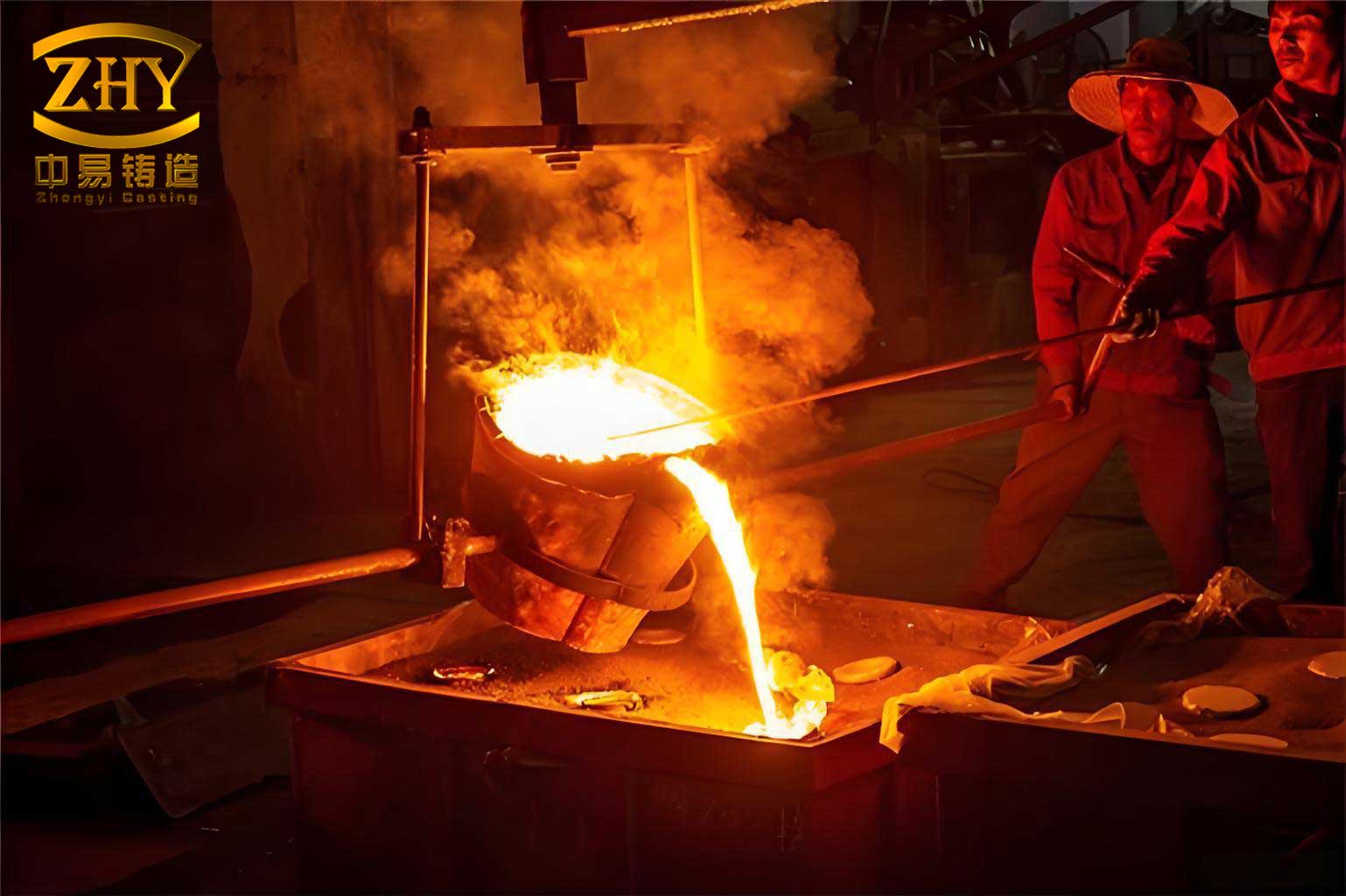
To mitigate these defects, we first added six risers directly above each defect location. Each riser measured 140 mm × 58 mm × 120 mm, with a spacing of 210 mm between risers. The modified lost foam castings configuration is shown in the following figure (inserted here as a visual reference for the actual casting setup).
The simulation of the riser design showed a much improved filling behavior. The metal flowed smoothly from the ingate into the bottom of the casting, then gradually rose to fill the sides and ends, and finally filled the risers. The filling sequence was: at t=5.3 s, metal entered the casting; at t=11.5 s, the bottom was filled; at t=34.6 s, the sides began to fill; at t=51.4 s, the side walls were complete; at t=71.6 s, the risers were nearly filled; and at t=80 s, filling was complete. No turbulence or splashing was observed. The solidification sequence revealed that the thin risers solidified first, followed by the thin walls of the casting, and finally the thick V-shaped sections. At 100% solidification, only two small defect areas remained in the V-shaped regions, indicating that the risers were partially effective. The total defect volume was greatly reduced compared with the initial design.
Nevertheless, we sought a more elegant solution that would eliminate the need for risers altogether, thereby improving yield and simplifying mold preparation. We turned the casting upside down, positioning the original top face (where the risers were placed) at the bottom. This placed the thick V-shaped sections near the top, which would solidify last and be naturally fed by the surrounding metal. The gating system remained the same center-pour design. We carried out a new lost foam castings simulation with this orientation.
The filling simulation for the inverted configuration showed similarly smooth flow. At t=4.87 s, metal entered the casting bottom (the former top); at t=16.8 s, the bottom filled; at t=27.0 s, the sides began to fill; at t=57.0 s, the sides were complete and the ends began to fill; at t=67.8 s, filling was nearly complete with the bottom starting to solidify; and at t=80 s, casting was full. The solidification progression indicated that the thin end sections solidified first, followed by the top (original bottom) and then the sides. The thick V-shaped regions remained liquid until the end. Importantly, the shrinkage porosity prediction (using the same Niyama-based model) showed no defects anywhere in the casting. The final defect map was completely clean, confirming that the orientation change allowed natural directional solidification without the need for risers. The results are summarized in the table below, which compares the defect volumes for the three process variants.
| Process variant | Number of defect regions | Total defect volume (cm³) | Riser requirement |
|---|---|---|---|
| Original (horizontal) | 7 | 45.2 | No risers used |
| With risers (horizontal) | 2 | 3.8 | 6 risers |
| Inverted (no risers) | 0 | 0 | None |
The success of the inverted design can be attributed to the establishment of a favorable thermal gradient. The solidification front moved from the thin walls toward the thick V-shaped regions, allowing the latter to be fed by the liquid metal in the central and upper parts of the casting. The solidification time at various locations follows the Chvorinov rule for lost foam castings:
$$ t_s = C \left( \frac{V}{A} \right)^n $$
where \( t_s \) is solidification time, \( V \) is volume, \( A \) is surface area, and \( C \) and \( n \) are constants depending on mold material and casting conditions. In our inverted configuration, the thick sections had larger modulus (V/A) and thus longer solidification time, making them the last to solidify, which is ideal for feeding. No additional risers were necessary because the casting itself acted as its own feeder, with the liquid metal in the upper regions (which remained molten longer) supplying the lower thick sections via gravity and atmospheric pressure. The vacuum applied during lost foam castings (−0.06 MPa) also assisted in drawing metal into the shrinking regions.
We also performed detailed analysis of the temperature field during solidification. The cooling rate distribution was computed using Fourier’s law:
$$ q = -k \nabla T $$
where \( q \) is heat flux, \( k \) is thermal conductivity, and \( \nabla T \) is temperature gradient. For the inverted case, the maximum temperature gradient was oriented from the thick V-shaped sections toward the thin ends, confirming the directional solidification pattern. The thermal center (hottest point) shifted gradually to the V-shaped zones, precisely where feeding was most needed.
To validate our simulation results, we conducted actual lost foam castings production using the optimized inverted process. The castings were examined by X-ray radiography and sectioning. X-ray images showed no signs of shrinkage porosity, shrinkage cavities, or gas porosity. Mechanical testing confirmed that the tensile strength, hardness, and density met the specifications for HT250 (minimum tensile strength 250 MPa). The casting yield (ratio of casting mass to poured metal mass) increased significantly because no risers were required. The elimination of risers also reduced finishing work and improved overall productivity.
Additional simulations were performed to study the effect of vacuum pressure on the integrity of lost foam castings. We varied the vacuum level from −0.04 MPa to −0.08 MPa in steps of 0.01 MPa. The results indicated that a vacuum of −0.06 MPa provided the best balance between mold filling and foam decomposition gas evacuation. Too low vacuum led to incomplete filling and gas entrapment, while too high vacuum caused sand erosion and pattern collapse. We found that the optimized vacuum level combined with the inverted orientation yielded defect-free castings consistently. The relationship between vacuum pressure and defect probability can be expressed empirically:
$$ P_{\text{defect}} = a e^{-b p_{\text{vac}}} + c $$
where \( p_{\text{vac}} \) is the absolute vacuum pressure (MPa), and \( a, b, c \) are constants fitted from our simulation database. For the inverted design, \( c \) approached zero, indicating near-zero defect probability under optimal vacuum.
The coating thickness also plays a critical role in lost foam castings. We tested coatings of 1.0 mm, 1.5 mm, and 2.0 mm. The 1.5 mm coating provided sufficient permeability for gas escape while maintaining enough strength to prevent sand collapse. Thinner coatings led to sand adhesion on the casting surface, while thicker coatings reduced the rate of foam decomposition and caused delayed filling. The coating permeability follows Darcy’s law for gas flow in porous media:
$$ Q = \frac{k_p A \Delta P}{\mu L} $$
where \( Q \) is gas flow rate, \( k_p \) is permeability, \( A \) is area, \( \Delta P \) is pressure drop across the coating, \( \mu \) is gas viscosity, and \( L \) is coating thickness. Our measurements confirmed that a coating thickness of 1.5 mm gave optimal gas evacuation without restricting metal flow.
In conclusion, our study demonstrates that through systematic numerical simulation of lost foam castings using ProCAST, combined with thoughtful process design, we can achieve defect-free cylinder blocks without the use of risers. The key innovation was inverting the casting orientation to promote natural directional solidification. The inverted placement of the thick V-shaped sections at the top allowed them to solidify last and be fed by the surrounding metal, eliminating shrinkage porosity. The simulations were validated by X-ray inspection of production castings, which confirmed the absence of internal defects. The optimized lost foam castings process not only improved casting quality but also increased yield and reduced production costs. This approach can be extended to other complex iron and steel castings where lost foam castings are employed.
Future work will focus on further refining the numerical model of lost foam castings, particularly the foam decomposition kinetics and its interaction with the metal front. We also plan to investigate the effect of pattern density and coating composition on gas generation and evacuation. The methodology presented here provides a robust framework for optimizing lost foam castings of large, intricate components like engine blocks, ensuring high reliability and efficiency in manufacturing.