
This research investigates the precision investment casting process optimization for rod-shaped titanium alloy components through advanced numerical simulation techniques. By integrating equilibrium solidification theory with thermal-stress coupling analysis, we establish a methodology to address shrinkage defects and residual stress challenges in complex geometries.
1. Process Design Principles
For rod-shaped titanium components with length-to-width ratios exceeding 9:1 and wall thickness variations up to 10.5:1, two gating system design strategies were evaluated:
| Design Parameter | Sequential Solidification | Equilibrium Solidification |
|---|---|---|
| Gating Orientation | Vertical top-feeding | Horizontal side-feeding |
| Section Ratio | 1:1.02:2.06 | 1:1.02:1.5 |
| Feeding Distance | ≥150 mm | ≤80 mm |
| Solidification Front | Unidirectional | Multidirectional |
The heat transfer during solidification follows Fourier’s law:
$$ \rho c_p \frac{\partial T}{\partial t} = \nabla \cdot (k \nabla T) + Q_{latent} $$
where \( Q_{latent} = L_f \frac{\partial f_s}{\partial t} \), with \( f_s \) representing solid fraction and \( L_f \) latent heat.
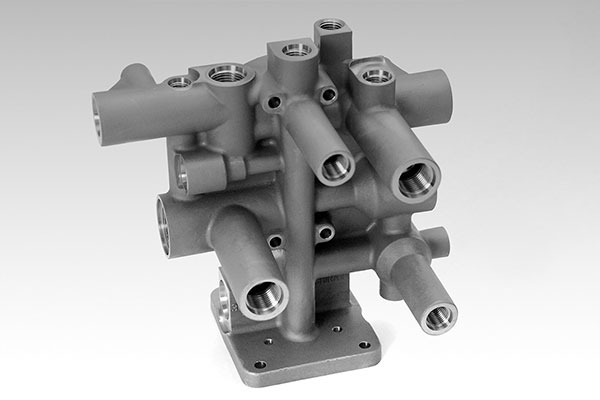
2. Numerical Simulation Methodology
Using ProCAST software, we established a coupled thermal-mechanical model incorporating:
- Fluid flow dynamics: $$ \frac{\partial \vec{v}}{\partial t} + (\vec{v} \cdot \nabla)\vec{v} = -\frac{1}{\rho}\nabla p + \nu\nabla^2\vec{v} + \vec{g} $$
- Stress evolution: $$ \sigma_{ij} = C_{ijkl}(\epsilon_{kl} – \alpha \Delta T \delta_{kl}) $$
Key simulation parameters for ZTC4 alloy:
| Property | Value |
|---|---|
| Liquidus Temp. | 1,660°C |
| Solidus Temp. | 1,610°C |
| Thermal Conductivity | 7.1 W/m·K |
| Elastic Modulus | 110 GPa |
3. Process Optimization Strategy
The optimized precision investment casting process incorporates three critical improvements:
- Gating system redesign with reduced thermal nodes
- Controlled solidification gradient: $$ G = \frac{T_{mold} – T_{liquidus}}{t_{solidification}} $$
- Residual stress management through directional cooling
Optimization results comparison:
| Metric | Initial Design | Optimized Design |
|---|---|---|
| Max Stress (MPa) | 312 | 189 |
| Shrinkage Volume (mm³) | 8.7 | 0.9 |
| Solidification Time (s) | 143 | 118 |
4. Industrial Validation
The optimized precision investment casting process demonstrated:
- 98% first-pass qualification rate
- Fluorescent penetrant inspection (FPI) compliance: 100%
- Dimensional accuracy: CT6 per GB/T 6414-2017
Critical quality metrics achieved:
$$ \text{Defect Density} = \frac{\sum V_{shrinkage}}{V_{total}} \leq 0.015\% $$
$$ \text{Stress Uniformity} = \frac{\sigma_{max} – \sigma_{min}}{\sigma_{avg}} \leq 27\% $$
This study confirms that numerical simulation-driven process design significantly enhances the reliability and efficiency of precision investment casting for complex titanium components, particularly for applications requiring high structural integrity and dimensional precision.