
The pursuit of high-integrity, complex-geometry castings consistently drives innovation within foundry practices. Among these, the investment casting process stands out for its ability to produce components with exceptional surface finish, dimensional accuracy, and geometric complexity that would be challenging or impossible to achieve with other methods. However, this capability comes with inherent challenges. The multi-step nature of the investment casting process, involving wax pattern assembly, ceramic shell building, dewaxing, firing, and finally pouring, introduces numerous variables that can influence the final quality. Defects such as shrinkage porosity and cavities remain prevalent issues, particularly in sections with varying wall thickness or complex junctions, leading to costly scrap rates and extended development cycles when relying solely on traditional trial-and-error methods.
This is where computational numerical simulation emerges as a transformative tool. By virtually recreating the investment casting process, simulation allows for the prediction of mold filling, solidification patterns, and the subsequent formation of defects before any metal is poured. This digital prototyping capability enables a systematic investigation into how different gating designs, pouring temperatures, and mold preheat conditions affect the thermal history of the casting. The core principle is to solve the fundamental equations governing fluid flow and heat transfer during the process. The governing equations for fluid flow (Navier-Stokes) and energy conservation during solidification are summarized below:
$$ \rho \left( \frac{\partial \vec{v}}{\partial t} + \vec{v} \cdot \nabla \vec{v} \right) = -\nabla p + \mu \nabla^2 \vec{v} + \rho \vec{g} + \vec{S} $$
$$ \rho C_p \frac{\partial T}{\partial t} + \rho C_p \vec{v} \cdot \nabla T = \nabla \cdot (k \nabla T) + \dot{Q}_{latent} $$
Where \( \rho \) is density, \( \vec{v} \) is velocity, \( p \) is pressure, \( \mu \) is dynamic viscosity, \( \vec{g} \) is gravity, \( \vec{S} \) is momentum source term (e.g., for modeling mushy zone), \( C_p \) is specific heat, \( T \) is temperature, \( k \) is thermal conductivity, and \( \dot{Q}_{latent} \) is the latent heat release rate during phase change. Accurately modeling the investment casting process requires careful definition of boundary conditions, especially the interfacial heat transfer coefficient (IHTC) between the metal and the ceramic shell, which evolves with temperature and the formation of an air gap.
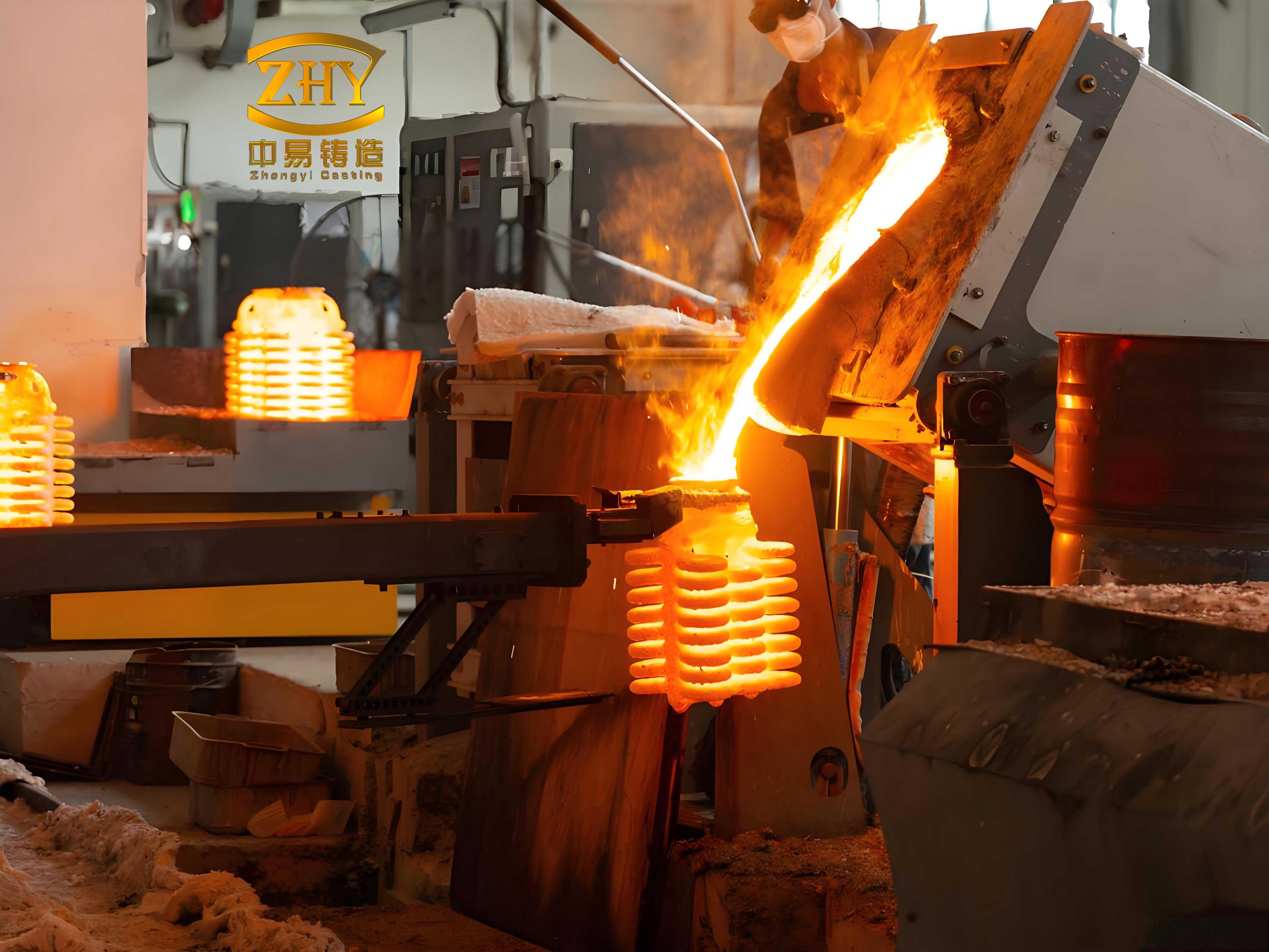
The successful application of an investment casting process simulation hinges on accurate input data. This encompasses the thermophysical properties of the alloy and shell materials across the relevant temperature range, as well as the process parameters. The following table outlines typical critical parameters required for a simulation of a steel investment casting:
| Parameter Category | Specific Parameter | Typical Value/Range (Example for Steel) |
|---|---|---|
| Material Properties (Alloy) | Liquidus Temperature | ~1500 – 1520 °C |
| Solidus Temperature | ~1450 – 1480 °C | |
| Latent Heat of Fusion | ~260 kJ/kg | |
| Material Properties (Shell) | Thermal Conductivity | Function of Temperature (~0.5 – 2.0 W/m·K) |
| Heat Capacity | Function of Temperature | |
| Process Parameters | Pouring Temperature | Liquidus + Superheat (e.g., 1550 – 1650 °C) |
| Shell Preheat Temperature | 800 – 1100 °C | |
| Interfacial Heat Transfer | Temperature-dependent curve |
In this study, the focus was on a specific valve cover (bonnet) component, known to exhibit significant shrinkage defects in production. The initial, or baseline, investment casting process utilized a bottom-gating system. The three-dimensional model of the component, complete with its gating and feeding system, was prepared and discretized into a computational mesh. The simulation was configured to model the transient filling and subsequent solidification of the component.
The analysis of the filling stage for the initial process showed a relatively tranquil fill with minimal turbulence, indicating a low risk for surface defects like mistruns or cold shuts typically associated with poor filling. The critical insights, however, came from the solidification analysis. The sequence of solidification is paramount in controlling shrinkage. Ideal solidification progresses directionally from the extremities of the casting (farthest from the feeder) towards the feeder itself, ensuring a continuous liquid metal path for feeding shrinkage until the final point solidifies. The simulation results for the initial bottom-gated process revealed a non-ideal pattern.
The solidification contours showed that while thin sections and the upper regions of the casting solidified rapidly, two critical areas became thermally isolated: 1) A complex junction or corner in the upper structure, where a narrow section froze off, isolating a thicker adjoining volume, and 2) The thickest section of the valve body located at the bottom of the casting in this orientation. This lower thick section was the last to solidify, but due to the long and tortuous path back to the feeder in a bottom-gated system, effective liquid feeding was impeded. The Niyama criterion, a widely used index for predicting shrinkage porosity in steel castings, can be related to this condition. It is often expressed as:
$$ G / \sqrt{\dot{R}} \leq \text{Constant} $$
Where \( G \) is the temperature gradient and \( \dot{R} \) is the cooling rate at the solidus front. Low values of this ratio indicate regions prone to microporosity formation, which correlates with areas of poor thermal gradient and slow cooling—precisely the conditions found in the isolated thick sections of the initial design. The software’s defect prediction module, based on such thermal criteria and a mass-balance method for macroshrinkage, clearly highlighted these isolated hot spots as high-risk zones for shrinkage cavities and porosity. This virtual prediction was later confirmed by the presence of actual defects in castings produced with the baseline investment casting process.
The root cause of the problem in the initial investment casting process was attributed to an unfavorable thermal and feeding geometry created by the bottom-gating and component orientation. To optimize the process, a fundamental change was proposed: switching from a bottom-gating to a top-gating system and reorienting the casting so that its thickest section was positioned at the top, directly adjacent to and beneath the main feeder. The logic for this optimization is grounded in solidification principles. A top-gating system promotes a more favorable temperature gradient, with hotter metal at the top near the feeder. Placing the heaviest (and highest thermal mass) section at the top leverages gravitational force to enhance feeding pressure and makes it the last point to solidify, now with a direct, short path for feeder metal to compensate for solidification shrinkage.
The modified investment casting process was simulated under identical material property and boundary condition settings. The comparative results were striking. The solidification sequence now showed a clear directional progression from the bottom of the casting upwards toward the feeder. The previously problematic thick section, now at the top, remained hot and liquid longer, with the feeder acting effectively as a liquid reservoir. The predicted shrinkage volume in this critical area was drastically reduced. The effectiveness of the design change can be quantified by comparing key thermal parameters at the critical section. The table below provides a conceptual comparison based on simulation outputs:
| Thermal/Feeding Metric | Initial (Bottom-Gated) Process | Optimized (Top-Gated) Process |
|---|---|---|
| Solidification Time of Critical Thick Section (Relative) | Long (Last to solidify, isolated) | Long (Last to solidify, but fed) |
| Temperature Gradient (G) at Section | Low (Isothermal) | High (Directed towards feeder) |
| Feeding Path Length & Accessibility | Long, Tortuous | Short, Direct |
| Predicted Shrinkage Volume | High | Negligible/Low |
| Niyama Criterion Value | Below Critical Threshold | Above Critical Threshold |
The implementation of this optimized investment casting process in actual production validated the simulation findings. The physical castings exhibited a marked improvement, with the severe shrinkage cavity eliminated and only acceptable levels of micro-porosity, if any, in the thick section. This case underscores the power of numerical simulation to de-risk the development of a robust investment casting process. It enables engineers to test radical design changes virtually, understand the underlying physics through parameters like thermal gradients and solidification fronts, and arrive at an optimal solution with minimal physical trials. The iterative process of simulation-led design can be generalized as:
1. Define component geometry and quality requirements.
2. Propose an initial investment casting process (gating, orientation).
3. Construct a virtual model with accurate materials and boundaries.
4. Solve for fill and solidification to predict defects.
5. Analyze results to identify root causes (e.g., poor thermal gradient, isolated hot spots).
6. Formulate and test process modifications digitally.
7. Validate the optimized investment casting process with physical prototyping.
Beyond shrinkage, modern simulation tools for the investment casting process can model a wider range of phenomena, including mold filling dynamics (turbulence, air entrapment), prediction of residual stresses and distortion, and even microstructural evolution. The integration of simulation into the workflow transforms the investment casting process from an art reliant on experience to a more predictable, engineering-driven discipline. It significantly shortens lead times, reduces material and energy waste from scrap, and enhances the reliability of producing high-value, complex castings for demanding applications in aerospace, power generation, and medical industries. The continuous improvement of material databases, interfacial condition models, and computational efficiency will only deepen the utility of simulation, making it an indispensable pillar of advanced investment casting process design and optimization.