
In the production of large steel castings, such as rolling mill frames, achieving high material utilization has always been a critical focus for foundry engineers. These castings often have net weights exceeding hundreds of tons, with total poured steel weight nearly double the net weight, leading to significant economic and technical challenges. Traditional riser designs, particularly direct risers, form thermal junctions with the casting body, often resulting in defects like coarse grains or cracks at the riser base, detected through ultrasonic testing. To address these issues, riser feeding—a process where additional molten steel is poured into the riser after initial casting—has been explored as a method to enhance riser efficiency and reduce segregation. However, the effectiveness of feeding depends heavily on timing and parameters, which were previously assessed only through empirical observation. In this study, I utilize ProCAST simulation software to analyze the impact of feeding timing on large steel castings, aiming to optimize process schemes and improve yield rates. Through numerical modeling, I demonstrate how controlled feeding can shift shrinkage defects away from the casting body, thereby enhancing the integrity and economy of steel castings production.
The inherent challenges in manufacturing large steel castings stem from their massive size and complex geometries. Steel castings, especially those used in heavy machinery like rolling mills, require meticulous design to ensure soundness and mechanical properties. The riser, essential for compensating solidification shrinkage, often constitutes a large portion of the total weight, reducing material utilization. For instance, in a typical rolling mill frame, the riser weight might reach 14.5 tons for a casting section with a total steel weight of 34.4 tons, yielding a process yield of only 55%. This inefficiency is exacerbated by the “T-junction” effect at the riser base, where heat concentration leads to prolonged solidification and potential defects. To mitigate this, feeding involves introducing additional molten steel into the riser after the initial pour, theoretically extending the feeding range and improving thermal conditions. However, determining the optimal feeding time—neither too early nor too late—is crucial. If feeding occurs too soon, the added steel mixes uniformly with the existing pool, offering minimal benefit; if too late, it only fills the upper shrinkage cavity without affecting the critical riser-base region. This study leverages numerical simulation to quantify these effects and propose refined feeding strategies for steel castings.
Numerical simulation with ProCAST provides a powerful tool for visualizing and analyzing the thermal and fluid dynamics during casting and feeding processes. ProCAST employs finite element methods to solve governing equations for heat transfer, fluid flow, and solidification, enabling detailed predictions of temperature fields, solidification rates, and defect formation. For this investigation, I focus on a representative section of a rolling mill frame—the crossbeam area—which features a large riser and exhibits typical challenges in steel castings production. The simulation setup involves creating a 3D model, meshing it appropriately, and defining material properties and boundary conditions. Key parameters include the initial pouring temperature, feeding temperature, feeding weight, and time intervals. By simulating different feeding scenarios, I assess how the temperature distribution and shrinkage porosity evolve, providing insights into optimizing feeding schedules for enhanced performance in steel castings.
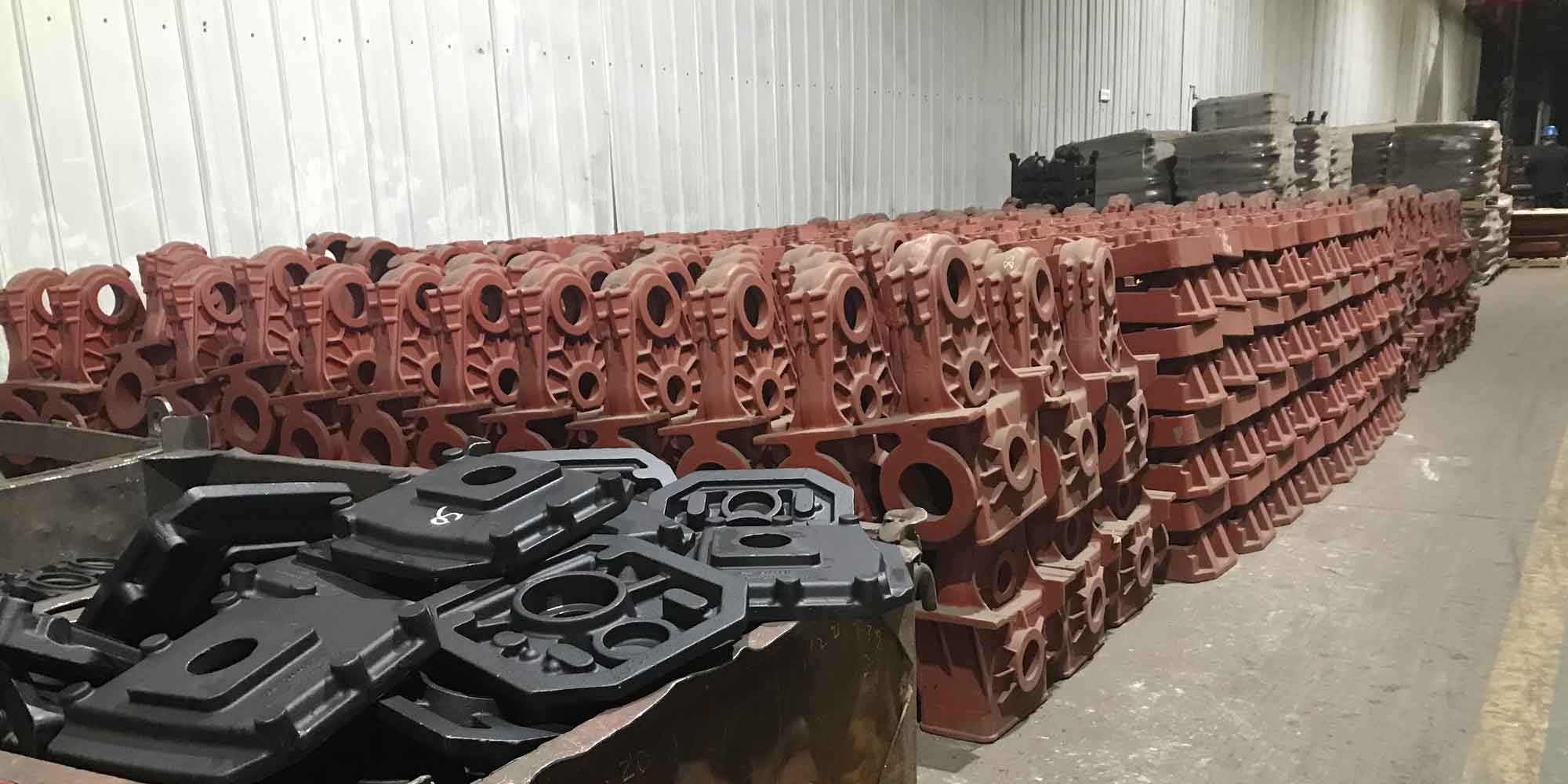
The experimental product is a crossbeam section of a rolling mill frame, with a rough casting geometry as illustrated below. The symmetry of the casting allows for modeling a quarter-section to reduce computational complexity while maintaining accuracy. The riser in the original design has a base diameter of 1300 mm and a height corresponding to a weight of 14.5 tons, with the total steel weight for this section being 34.4 tons. The material is G20Mn5+N steel, commonly used for such steel castings due to its balanced mechanical properties. The chemical composition and mechanical requirements are critical for ensuring the casting’s performance, as summarized in the following tables.
| Element | Composition (wt.%) |
|---|---|
| C | 0.17–0.23 |
| Si | ≤0.6 |
| Mn | 1.0–1.6 |
| Ni | ≤0.8 |
| S | ≤0.02 |
| P | ≤0.02 |
Table 1: Chemical composition requirements for G20Mn5+N steel castings.
| Property | Requirement |
|---|---|
| Yield Strength (Rp0.2) | ≥300 MPa |
| Tensile Strength (Rm) | ≥480 MPa |
| Elongation (A) | ≥20% |
| Impact Energy (AKV) at 20°C | ≥50 J |
Table 2: Mechanical property requirements for the steel castings.
The casting process involves initial pouring to fill the mold, followed by natural cooling. External chills are used to create end zones and control solidification direction. For feeding trials, the riser is initially filled to 3/5 of its height, with subsequent feeding after a specified delay. The feeding steel has the same composition but a temperature of 1590°C, and the feeding weight is set to 2/5 of the riser height’s corresponding weight. The primary variable is the feeding time interval, which I vary to observe effects on thermal fields and shrinkage. In practice, feeding too early (e.g., 2 hours after initial pour) results in rapid mixing, negating benefits, as shown in simulations. To quantify this, I employ mathematical models for heat transfer and solidification.
The fundamental heat transfer during solidification of steel castings is governed by the Fourier equation, combined with latent heat release. The energy balance can be expressed as:
$$\rho C_p \frac{\partial T}{\partial t} = \nabla \cdot (k \nabla T) + \rho L \frac{\partial f_s}{\partial t}$$
where $\rho$ is density, $C_p$ is specific heat, $T$ is temperature, $t$ is time, $k$ is thermal conductivity, $L$ is latent heat of fusion, and $f_s$ is solid fraction. This equation is solved numerically in ProCAST to predict temperature evolution. For feeding simulations, the initial condition includes the temperature field at the feeding moment, and the feeding event is modeled as a source term adding mass and heat. The shrinkage porosity criterion, often based on the Niyama criterion, is used to predict defect locations:
$$N_y = \frac{G}{\sqrt{\dot{T}}}$$
where $G$ is temperature gradient and $\dot{T}$ is cooling rate. Regions with $N_y$ below a threshold indicate potential shrinkage porosity. In steel castings, optimizing feeding aims to shift these regions away from critical areas.
For the initial trial, feeding is conducted once, 2 hours after the initial pour. The simulation results show that at this interval, the solidification fraction is only about 18%, and the fed steel mixes quickly, leading to negligible improvement in riser efficiency. The shrinkage porosity prediction indicates defects still at the riser base, similar to no feeding. This underscores the importance of timing in feeding processes for steel castings. To better understand, I analyze the temperature distribution over time using ProCAST outputs, which reveal that the thermal center remains near the riser base due to premature feeding.
Based on these insights, I propose an optimized scheme involving two feeding events with extended intervals. Additionally, the riser design is modified: the base diameter is reduced to 1100 mm, with a 1:10 taper, and the height is adjusted to lower the total riser weight. This redesign aims to improve material utilization while maintaining feeding effectiveness. The first feeding occurs after a longer delay, allowing partial solidification at the riser top to form a shell, and the second feeding further supplements the liquid pool. The simulation of this scheme shows a more favorable temperature field, with the thermal center shifting upward, and shrinkage porosity predicted only in the upper riser, away from the casting body. The total steel weight for the riser reduces to 11 tons, increasing the process yield to 62% for this section of steel castings.
To summarize the effects, I compile key simulation data in the table below, comparing different feeding strategies for steel castings.
| Feeding Scheme | Feeding Interval(s) | Riser Weight (tons) | Total Steel Weight (tons) | Process Yield (%) | Shrinkage Location |
|---|---|---|---|---|---|
| No Feeding | N/A | 14.5 | 34.4 | 55 | Riser base |
| Single Feeding (2h) | 2 hours | 14.5 | 34.4 | 55 | Riser base |
| Double Feeding (optimized) | Extended intervals | 11.0 | 29.9 | 62 | Upper riser |
Table 3: Comparison of feeding schemes for steel castings based on simulation results.
The improvement in yield is significant, demonstrating the potential of optimized feeding for large steel castings. Furthermore, the reduction in riser size decreases the thermal mass, potentially reducing residual stresses and improving mechanical properties. The mathematical rationale for multiple feedings can be derived from solidification kinetics. The solidification time $t_s$ for a riser can be approximated using Chvorinov’s rule:
$$t_s = B \left( \frac{V}{A} \right)^2$$
where $B$ is a mold constant, $V$ is volume, and $A$ is surface area. For a tapered riser, the modulus $M = V/A$ changes, affecting $t_s$. Feeding at strategic times, when $f_s$ is between 0.2 and 0.6 in the riser, can extend the feeding range. The optimal feeding time $t_f$ can be estimated from:
$$t_f = t_s \cdot (1 – f_{s,\text{target}})$$
where $f_{s,\text{target}}$ is the desired solid fraction at feeding. In the double-feeding scheme, the first feeding targets $f_{s,\text{target}} \approx 0.3$, and the second targets $f_{s,\text{target}} \approx 0.5$, ensuring gradual compensation without mixing.
In conclusion, numerical simulation with ProCAST offers a robust approach to optimize riser feeding for large steel castings. By analyzing temperature fields and solidification patterns, I demonstrate that traditional single feeding at short intervals is ineffective, while multiple feedings with delayed timing can significantly enhance riser efficiency and material yield. This study highlights the importance of precise process control in the production of steel castings, where small adjustments can lead to substantial economic and quality benefits. Future work could explore automated feeding systems based on real-time simulation feedback, further advancing the reliability of steel castings in heavy industry applications. The integration of such simulations into routine foundry practice promises to elevate the standards for large steel castings, ensuring soundness and efficiency in manufacturing.
The implications of this research extend beyond rolling mill frames to other large steel castings used in sectors like energy, mining, and transportation. For instance, turbine housings, ship propellers, and press frames share similar challenges with riser design and feeding. By applying the same numerical methodology, foundries can tailor feeding schedules to specific geometries and material properties, reducing trial-and-error costs. Additionally, the use of advanced materials like high-alloy steels in castings necessitates even tighter control over solidification, making simulation tools indispensable. As computational power grows, high-fidelity models incorporating fluid flow, microstructure evolution, and stress analysis will become standard, further optimizing steel castings production. Ultimately, the goal is to achieve near-net-shape castings with minimal riser remnants, pushing material utilization toward theoretical limits for steel castings.
In summary, this investigation into riser feeding via ProCAST simulation provides a clear pathway for improving large steel castings. The key takeaways are: (1) Feeding timing is critical; too early or too late feeding fails to alter defect locations. (2) Multiple feedings with extended intervals can shift shrinkage porosity upward, away from critical zones. (3) Riser redesign, including tapering and size reduction, complements feeding to boost yield. (4) Numerical simulation enables precise planning, reducing reliance on empirical methods. For foundries specializing in steel castings, adopting such simulation-driven approaches can lead to consistent quality, lower costs, and enhanced competitiveness. As I continue to explore this field, I aim to integrate machine learning with simulation to predict optimal parameters dynamically, fostering innovation in steel castings manufacturing.