
White cast iron, particularly high-chromium varieties, has long been recognized for its exceptional wear resistance, making it ideal for components subjected to abrasive and corrosive environments, such as dredging pump impellers. However, traditional high-chromium white cast iron often suffers from inadequate toughness and strength, leading to premature failure through cracking or spalling. This study focuses on the development of an optimized ultra-high chromium white cast iron, designated as JX alloy, through compositional adjustment, microstructural refinement using a novel modifier, and tailored heat treatment. The goal is to achieve a balanced combination of hardness, tensile strength, and impact toughness, thereby extending service life in demanding applications like large-scale dredging pumps.
The fundamental challenge in enhancing white cast iron lies in managing the inherent trade-off between hardness (governed largely by carbide volume) and toughness (influenced by carbide morphology and matrix properties). In hypereutectic white cast iron, excessive carbides can embrittle the material, while in hypoeutectic compositions, a finer microstructure can be promoted. The JX alloy is thus designed within a hypoeutectic composition range to allow for microstructural control. The initial chemical composition was derived from BTMCr26 but with precise adjustments to carbon, chromium, and alloying elements like molybdenum and nickel. The target mechanical properties were set at a hardness of 54–60 HRC, tensile strength Rm ≥ 650 MPa, and impact toughness Ak ≥ 8–10 J/cm².
| Element | Target Range | Role in White Cast Iron |
|---|---|---|
| C | 2.0–2.5 | Controls carbide formation and matrix hardness; kept hypoeutectic to limit brittle carbides. |
| Si | ≤0.70 | Deoxidizer; excessive Si can promote graphitization, undesirable in white cast iron. |
| Mn | 1.2–2.0 | Enhances hardenability and stabilizes austenite. |
| Cr | 20.0–25.0 | Primary carbide former (M7C3); improves corrosion and oxidation resistance. |
| Mo | ≤0.50 | Refines carbides and enhances hardenability through solid solution strengthening. |
| Ni | ≤0.50 | Austenite stabilizer; improves toughness and corrosion resistance. |
| Cu | 0.8–1.0 | Promotes pearlite suppression and aids in hardness retention. |
| P, S | ≤0.06 each | Impurities minimized to reduce embrittlement. |
The strengthening of this white cast iron was approached through three principal mechanisms: grain refinement, solid solution strengthening, and grain boundary reinforcement. Grain refinement is critical for improving both strength and toughness. In hypoeutectic white cast iron, solidification begins with the precipitation of primary austenite dendrites. If these dendrites are coarse, they partition the remaining liquid into large domains, leading to coarse eutectic carbides upon final solidification. Refining the primary austenite thus directly refines the eutectic carbide network. This was achieved using a proprietary modifier, JX-11, which contains elements such as Al, Mg, Ce, Nb, V, and B. These elements form high-melting-point compounds that act as heterogeneous nucleation sites, increasing the nucleation rate of austenite. The modifier also getters impurities like sulfur and phosphorus, cleansing the grain boundaries and reducing intergranular weakness—a key aspect of grain boundary strengthening.
The effectiveness of grain refinement can be related to the undercooling required for nucleation. The addition of inoculants reduces the critical undercooling, ΔT, leading to a finer grain size, d, as approximated by:
$$ d = k \cdot (\Delta T)^{-n} $$
where k and n are material constants. For white cast iron, a finer grain size enhances toughness by impeding crack propagation, as described by the Hall-Petch relationship for yield strength:
$$ \sigma_y = \sigma_0 + k_y \cdot d^{-1/2} $$
where σ0 is the friction stress and ky is the strengthening coefficient. While originally for yield strength, similar principles apply to fracture toughness in brittle materials like white cast iron.
Solid solution strengthening in the austenitic/martensitic matrix is contributed by elements like Cr, Mo, and Mn dissolved in the iron lattice. The increase in strength, Δσss, can be estimated using:
$$ \Delta\sigma_{ss} = \sum_i K_i \cdot c_i^{m_i} $$
where Ki and mi are constants for each alloying element i, and ci is its concentration. In high-chromium white cast iron, chromium predominantly forms carbides, but a portion remains in solution, enhancing corrosion and oxidation resistance.
The volume fraction of carbides, fcarbide, significantly influences the hardness and wear resistance of white cast iron. For M7C3 carbides in a high-chromium system, fcarbide can be approximated from the carbon and chromium content using empirical relations. One simplified model is:
$$ f_{carbide} \approx \frac{C – C_{sol}}{C_{carbide}} $$
where C is the total carbon, Csol is the carbon soluble in the matrix, and Ccarbide is the carbon content in the carbide phase. For JX alloy targeting 25–27 vol% carbides, the carbon content was carefully calibrated. The overall hardness, HV, can be modeled as a rule-of-mixtures:
$$ HV = f_{carbide} \cdot HV_{carbide} + (1 – f_{carbide}) \cdot HV_{matrix} $$
where HVcarbide for M7C3 is around 1500–1800 HV and HVmatrix for martensite is 500–800 HV depending on tempering.
Melting and casting trials were conducted using a 150 kg medium-frequency induction furnace. Raw materials included steel scrap, ferrochromium, and ferromanganese, preheated to remove moisture. The melt was superheated to 1480–1500°C, deoxidized with pure aluminum, and then treated with JX-11 modifier. Pouring temperature was maintained at 1360–1380°C to ensure fluidity while minimizing casting defects. The heat treatment protocol involved austenitizing at 1030°C followed by air cooling to approximately 300°C, then immediate tempering. This cycle aims to transform retained austenite to tempered martensite, reduce internal stresses, and achieve uniform hardness.
To evaluate the modifier’s impact, three sets of samples were prepared: without modifier, with 0.015 wt% JX-11, and with 0.030 wt% JX-11. Each set underwent identical melting, casting, and heat treatment processes. Mechanical testing included hardness (Rockwell C), tensile strength, and Charpy impact toughness.
| JX-11 Addition (wt%) | Hardness (HRC) | Tensile Strength, Rm (MPa) | Impact Toughness, Ak (J/cm²) | Notes |
|---|---|---|---|---|
| 0 (None) | 50–52 | 400–450 | 3–5 | Below target; coarse microstructure. |
| 0.015 | 56–59 | 645–700 | 7–9 | Marginal for toughness and strength. |
| 0.030 | 54–56 | 740–800 | 8–10 | All targets met; optimal balance. |
The data clearly indicate that the addition of 0.030 wt% JX-11 yields the best combination of properties, meeting all specified targets. The hardness range is slightly lower than with 0.015 wt% but more uniform, suggesting lower internal stresses. The tensile strength and impact toughness show significant improvement, underscoring the role of refinement in enhancing the ductility and strength of this white cast iron.
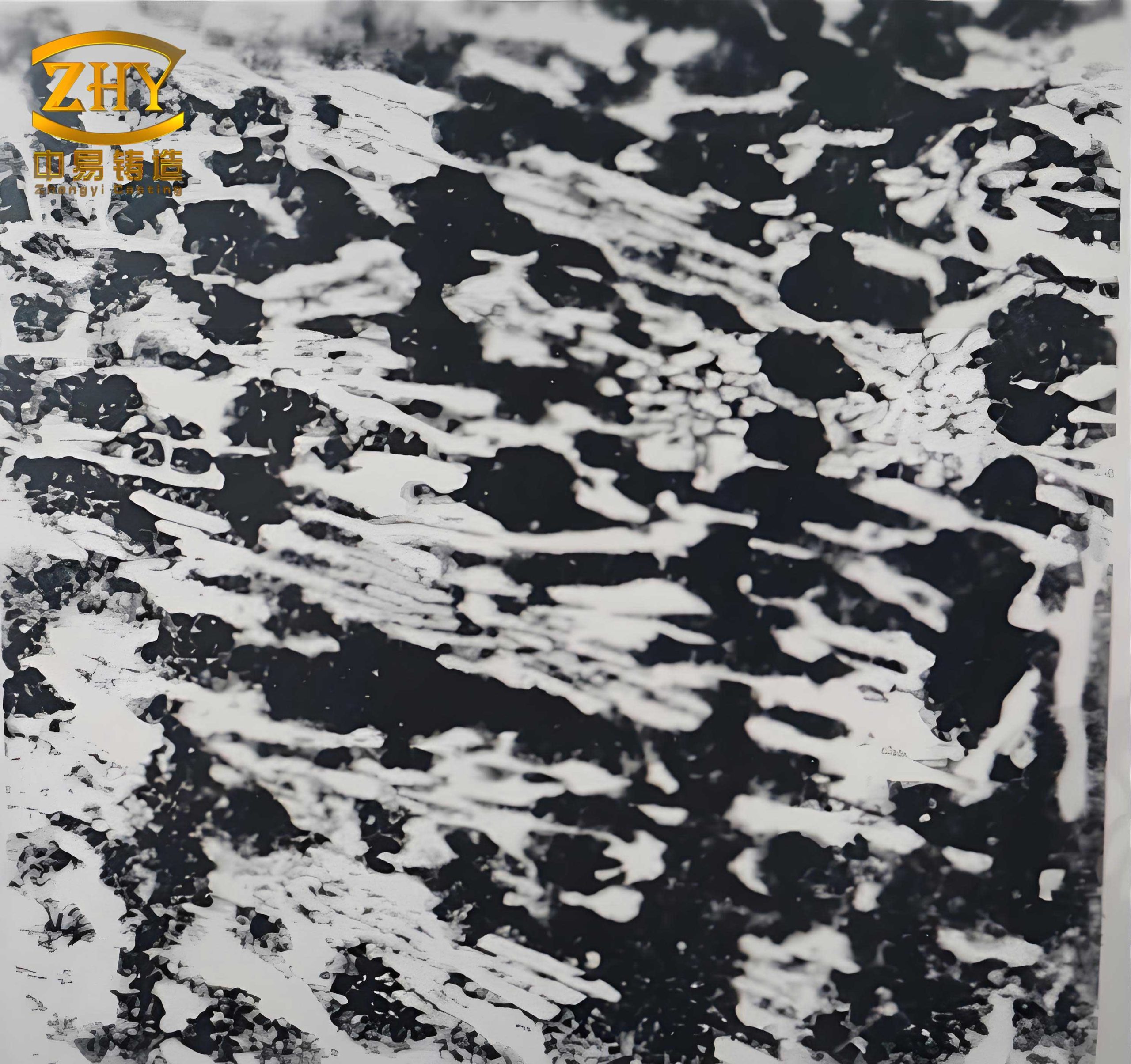
Microstructural analysis revealed profound differences. Unmodified white cast iron exhibited coarse dendritic austenite with large, blocky eutectic carbides. With 0.015 wt% modifier, carbides appeared as blocks, rods, and chrysanthemum clusters; the matrix consisted of martensite with some retained austenite. At 0.030 wt% addition, carbides were further refined into blocks, rods, and fish-bone shapes, embedded in a predominantly martensitic matrix with finely dispersed secondary carbides. The matrix microhardness varied from 420 HV in austenitic regions to 520 HV in martensitic areas. The refinement is attributed to enhanced nucleation, as illustrated by the presence of exogenous nuclei in the matrix, likely from modifier particles.
The successful laboratory-scale development led to full-scale trials for large dredging pump impellers. Impeller geometry—comprising front and back shrouds, blades, and a hub—poses significant casting challenges due to uneven wall thickness, hot spots at intersections, and risks of shrinkage porosity. The casting process was optimized with multiple risers placed at thermal junctions (shroud-blade and hub-shroud intersections) to ensure directional solidification and feed metal to hot spots. A gating system with two sprue gates and three ingates was designed: the first fills the shrouds and blades, and the second, activated later, feeds the risers and hub. Pouring temperature was tightly controlled at 1400–1410°C to maintain fluidity for feeding while avoiding cold shuts. Molds were dried thoroughly, and the castings were allowed to cool in the mold for approximately 20 days to below 200°C before shakeout to minimize thermal stresses.
Heat treatment of the large impellers required careful control of heating and cooling rates to prevent distortion or cracking. Based on the JX alloy protocol, a slow heating rate was employed to ensure temperature uniformity, followed by austenitizing at 1030°C and air cooling. Tempering was conducted immediately after the component reached around 300°C. Hardness measurements across various impeller locations demonstrated consistency:
| Location | Hardness Readings | Average Range |
|---|---|---|
| Front Shroud | 55.8, 55.9, 56.2, 55.3, 53.9, 54.4 | 54–56 |
| Back Shroud | 53.8, 54.2, 55.8, 56.1, 55.0, 54.5 | 54–56 |
| Blade-Shroud Junction | 60.2, 60.5, 59.8 | ~60 |
| Mid-Blade | 55.5, 54.3, 55.6, 56.9, 55.9, 57.3 | 54–57 |
| Hub | 52.5, 51.9, 52.1 | ~52 |
The uniformity in hardness, except at the hub (where wear resistance is less critical) and blade-shroud junctions (slightly higher due to geometric effects), confirms low internal stresses and effective heat treatment. Metallographic samples from riser sections of the impeller showed refined grains, with carbides in blocky and rod forms embedded in a martensitic matrix, and increased precipitation of secondary carbides—consistent with laboratory findings.
Field performance of seven impellers manufactured from JX alloy white cast iron was monitored in dredging operations. These components demonstrated reliable operation with no incidence of cracking or spalling over a service period exceeding 14 months, more than double the lifespan of conventional high-chromium white cast iron impellers (typically 2–6 months). This improvement is attributed to the superior toughness-strength balance, which withstands the combined abrasive, corrosive, and impact loads in slurry transport.
In summary, this research underscores the potential of microstructural engineering in advancing white cast iron technology. The JX alloy, through optimized hypoeutectic composition and JX-11 modifier addition, achieves a harmonious property profile: hardness 54–56 HRC, tensile strength 740–800 MPa, and impact toughness 8–10 J/cm². The successful scale-up to large impellers highlights the robustness of the developed casting and heat treatment protocols. Future work could explore further alloying variations or advanced processing techniques like centrifugal casting to enhance performance. The principles established here—grain refinement, impurity control, and tailored heat treatment—are broadly applicable to other grades of white cast iron for wear-resistant applications, promising extended component life and reduced maintenance costs in industries ranging from mining to mineral processing.
The evolution of white cast iron continues to be driven by the need for materials that can endure extreme environments. This study contributes to that lineage by demonstrating that even traditional materials like high-chromium white cast iron can be significantly upgraded through systematic optimization. The integration of modifiers to refine microstructure, coupled with precise thermal processing, opens new avenues for designing white cast iron with customized properties. As industrial demands grow for efficiency and durability, such advancements in white cast iron will play a pivotal role in developing next-generation wear parts.