
As a researcher focused on advanced manufacturing techniques for titanium alloys, I have undertaken a comprehensive study to address the significant challenges associated with producing high-integrity, complex structural components via the investment casting process. Components with variable cross-sections, common in aerospace applications, present unique difficulties. The abrupt changes in wall thickness disrupt uniform solidification, creating preferential sites for defect formation such as shrinkage porosity and stress concentrations. These defects severely compromise the mechanical performance and service reliability of the final part. Therefore, the objective of my work was to systematically optimize the centrifugal investment casting process for a representative TC4 (Ti-6Al-4V) alloy variable cross-section component, with the primary goals of minimizing internal defects and controlling stress-related issues to meet stringent performance requirements.
The cornerstone of my methodology was the integration of numerical simulation with structured experimental design. I began by creating a detailed three-dimensional model of the target component, which featured a length of approximately 580 mm and a minimum wall thickness of 6.5 mm, with significant cross-sectional variations from top to bottom. The entire casting system, including the gating and feeding system, was discretized for analysis using ProCAST software. The thermal-physical properties of the TC4 alloy and the ZrO2 ceramic mold were defined based on established data, with the alloy’s liquidus and solidus temperatures set at 1660 °C and 1604 °C, respectively. The interfacial heat transfer coefficient was set to 800 W/(m²·K).
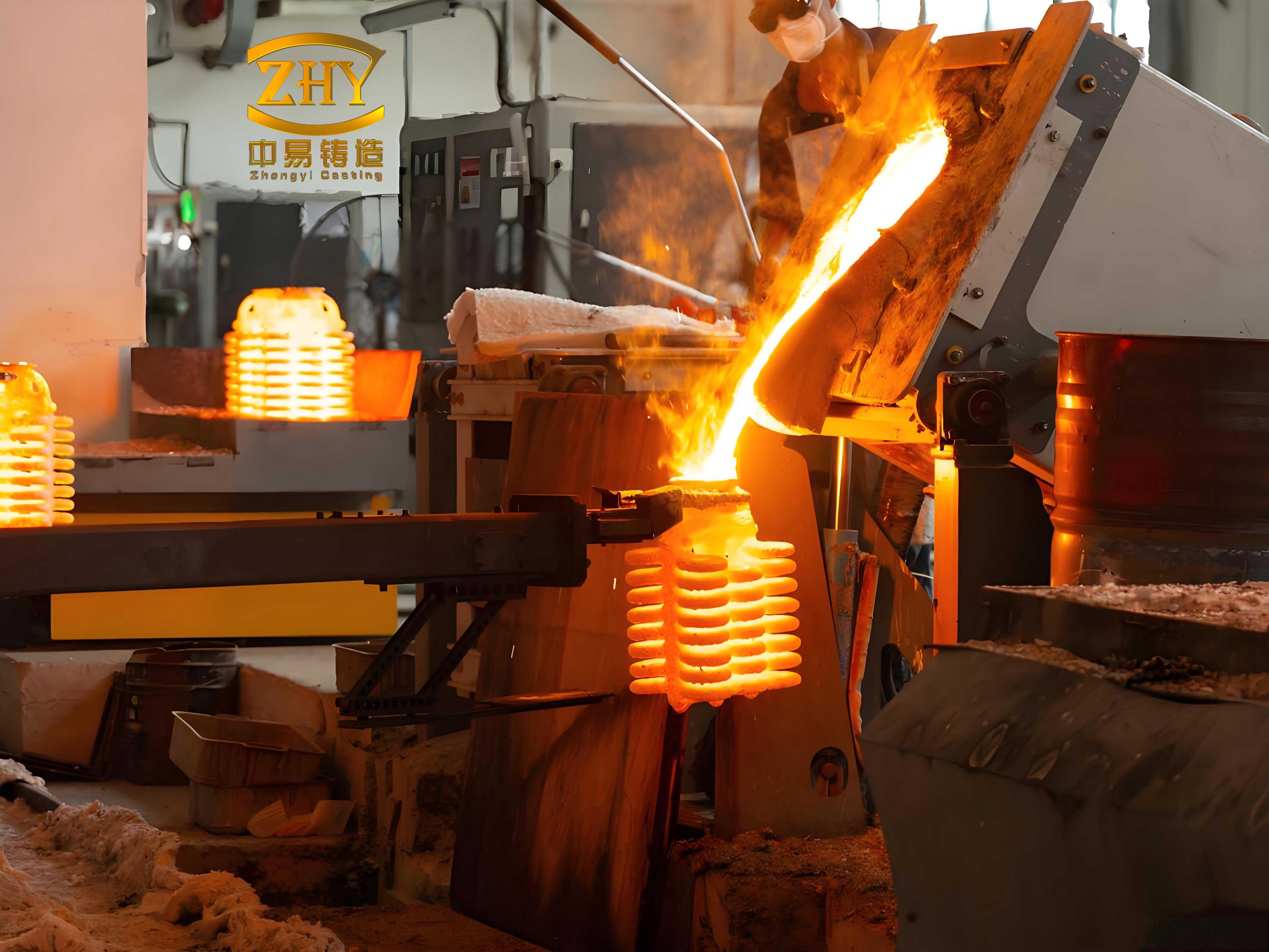
To efficiently navigate the multi-variable parameter space of the investment casting process, I employed an orthogonal experimental design (L9(3^4)). This approach allowed me to evaluate the individual and interactive effects of four key process parameters at three different levels, as summarized in the table below. The primary criterion for optimization was the total volume of shrinkage porosity predicted within the casting body.
| Factor | Level 1 | Level 2 | Level 3 | Description |
|---|---|---|---|---|
| A | 1680 °C | 1700 °C | 1750 °C | Pouring Temperature |
| B | 300 °C | 350 °C | 400 °C | Mold Preheating Temperature |
| C | 3 kg/s | 5 kg/s | 7 kg/s | Pouring Rate |
| D | 350 rpm | 450 rpm | 550 rpm | Centrifugal Rotational Speed |
The nine simulation runs based on this orthogonal array yielded predictions for shrinkage distribution and volume. The analysis of the results was guided by the Niyama criterion, a widely used metric for predicting shrinkage porosity in castings, which relates the local temperature gradient (G) and cooling rate (√R):
$$Niyama\ Criterion = \frac{G}{\sqrt{R}}$$
Lower values of this criterion indicate a higher propensity for shrinkage formation. The simulation results consistently showed that a majority of the predicted shrinkage was concentrated in the top, thicker section of the component, with minor, dispersed porosity predicted in the middle and bottom regions. The statistical analysis of the orthogonal experiment, focusing on the K-values (sum of shrinkage volume for each factor level), led to the identification of the optimal parameter set: A1B3C1D1 (Pouring Temperature: 1680 °C, Mold Preheating Temperature: 400 °C, Pouring Rate: 3 kg/s, Centrifugal Speed: 350 rpm). The ranking of factor influence, determined by the range (R) of K-values, was: Pouring Temperature > Pouring Rate > Mold Preheating Temperature > Centrifugal Speed. A final simulation with this optimized parameter set confirmed a reduction in predicted shrinkage volume, validating the optimization outcome.
With the optimized investment casting process parameters defined, I conducted a detailed numerical analysis of the mold filling and solidification behavior. The simulated filling sequence revealed that after entering the casting cavity at approximately 2.37 seconds, the molten metal preferentially filled the thicker top section under centrifugal force before progressing downwards. The maximum fluid velocity reached 19.09 m/s, with the top region consistently exhibiting higher and less stable flow compared to other sections. The complete filling was achieved at 5.20 seconds.
The solidification analysis was particularly insightful. At the end of filling, the top and bottom extremities of the casting had already begun to solidify due to significant heat loss to the mold. The subsequent solidification sequence followed the pattern: casting bottom → casting top → casting middle → gating system. This sequence is crucial as it allows the gating system, which remains liquid longest, to effectively feed and compensate for the solidification shrinkage occurring in the casting body, a fundamental principle in designing a robust investment casting process.
A deep dive into the defect formation mechanisms was conducted. The concentrated shrinkage in the top section was directly correlated with the formation of isolated liquid pools, as visualized in the solidification fraction simulations. These pools develop in the last-to-freeze regions, often where a large thermal mass exists (like the thick top section), and become entrapped by a surrounding network of interlocking dendrites, preventing adequate feed metal from reaching them. The solidification microstructure simulation showed the development of columnar grains growing from the mold walls, with some equiaxed grains in the casting interior. The cessation of melt flow exhibited characteristics typical of alloys with a narrow freezing range, where a coherent dendritic network forms rapidly towards the end of solidification, trapping isolated liquid.
The stress and deformation analysis provided another critical layer of understanding. The simulation of effective stress (von Mises stress) indicated that stress concentrations were primarily located at the junctions between the ingates and the casting body, with a maximum predicted value of 414.0 MPa. This is attributed to the geometric constraint imposed by the abrupt change in section at these connections, which hinders free thermal contraction during cooling. In contrast, the stress within the main body of the variable cross-section component was significantly lower due to its more uniform geometry. The predicted deformation was minimal, with a maximum displacement of only 0.4734 cm, confirming that the optimized investment casting process would not lead to significant shape distortion.
To validate the numerical findings, physical castings were produced using the optimized investment casting process parameters. High-quality ZrO2 ceramic molds were fabricated, and castings were poured under a centrifugal field. Visual inspection confirmed that the castings were complete, free from gross defects like mis-runs, cracks, or fins. Non-destructive X-ray inspection (XRI) was performed on sectioned parts of the casting. Remarkably, the radiographs showed no detectable shrinkage porosity, a result that surpassed the simulation predictions and underscored the effectiveness of the optimized process. This was further confirmed by physical sectioning of the casting along its central axis, where the macro-etched surfaces revealed a sound internal structure without cavities.
Dimensional verification was carried out using a handheld 3D laser scanner. The point cloud data from the scanned casting was compared to the original digital CAD model. The results showed an excellent match, with the as-cast dimensions slightly larger than the nominal design to allow for minimal subsequent machining. The profile comparison indicated no significant warping or distortion, aligning perfectly with the low-stress and low-deformation predictions from the simulation stage of the investment casting process analysis.
The microstructure and mechanical properties of the cast material were then characterized. Specimens were excised from the casting and subjected to a Hot Isostatic Pressing (HIP) treatment to further enhance integrity. The HIPed microstructure exhibited a typical Widmanstätten morphology, consisting of grain boundary α phase and α/β colonies within prior β grains. Quantitative analysis measured an average prior β grain size of 1.12 mm, α colony width of 121.89 µm, and α lath thickness of 0.76 µm.
Room-temperature tensile tests were conducted on the HIPed specimens. The results, averaged from multiple tests, demonstrated excellent mechanical properties:
| Property | Average Value |
|---|---|
| Ultimate Tensile Strength (UTS) | 953.5 MPa |
| Yield Strength (YS) | 835.0 MPa |
| Elongation (EL) | 10.0 % |
These values comfortably meet the typical performance requirements for such components in demanding applications. Fractography of the tensile specimens revealed a mixed-mode failure. The fracture surface exhibited necking, numerous dimples indicating ductile tearing, and some smooth cleavage facets. The cleavage facets are associated with the size of the α/β colonies, where cracks can propagate along colony boundaries. The predominance of dimples, however, confirms the overall good ductility achieved through the optimized investment casting process and subsequent HIP treatment.
In conclusion, this integrated study successfully demonstrates a methodology for the optimization and defect control in the investment casting of complex TC4 alloy components. By combining orthogonal experimental design with high-fidelity numerical simulation, an optimal set of process parameters for the centrifugal investment casting process was identified: a pouring temperature of 1680 °C, a mold preheating temperature of 400 °C, a pouring rate of 3 kg/s, and a centrifugal speed of 350 rpm. The simulation provided profound insights into the underlying mechanisms, revealing that shrinkage porosity is primarily driven by the formation of isolated liquid pools in heavy sections, while stress concentration is a geometric consequence of abrupt changes in section at connections. The practical validation confirmed the simulation’s predictive power, yielding castings with excellent internal soundness, dimensional accuracy, and mechanical properties that satisfy rigorous service demands. This work underscores the critical role of a scientifically guided investment casting process in manufacturing high-performance titanium alloy components with complex geometries.