
In the realm of aerospace engineering, the demand for high-performance, reliable components is paramount. Among these, fuel system attachments, such as gear pump housings, play a critical role in ensuring precise fuel delivery to engine combustion chambers. These housings are typically manufactured as complex aluminum alloy castings, characterized by intricate internal oil passages, varying wall thicknesses, and stringent performance requirements, including pressure testing up to 10 MPa. The production of such components via aerospace casting processes presents significant challenges, particularly when dealing with large, thin-walled sections that are prone to defects like cold shuts and, more critically, underpouring. In my research and practical experience, I have encountered a specific aerospace casting issue involving an aluminum gear pump housing where underpouring defects at the oil filter tank section led to a low qualification rate of only 22.2%, severely impacting production schedules and quality assurance. This article details my comprehensive investigation and optimization of the aerospace casting process using simulation-driven methodologies, aiming to enhance casting integrity and yield for such critical aerospace components.
The gear pump housing in question, a representative example of advanced aerospace casting, features a complex geometry with wall thicknesses ranging from 4.5 mm at the thin-walled oil filter tank to 40 mm at thicker sections like the “8-shaped” cavity. This substantial variation, coupled with the part’s overall dimensions, makes it susceptible to thermal imbalances during solidification. The existing production utilized a permanent mold tilt-pouring process, a common technique in aerospace casting for minimizing turbulence and gas entrapment. However, despite this controlled approach, the oil filter tank area consistently exhibited underpouring defects, accounting for 45.3% of all rejections. My initial analysis suggested that the defect stemmed from premature solidification in this isolated, thin-walled region due to rapid heat loss to the metal mold (H13 steel) and the absence of a feeding riser above it. To systematically address this, I employed AnyCasting simulation software to model the filling and solidification sequences, providing a quantitative basis for process optimization in aerospace casting applications.
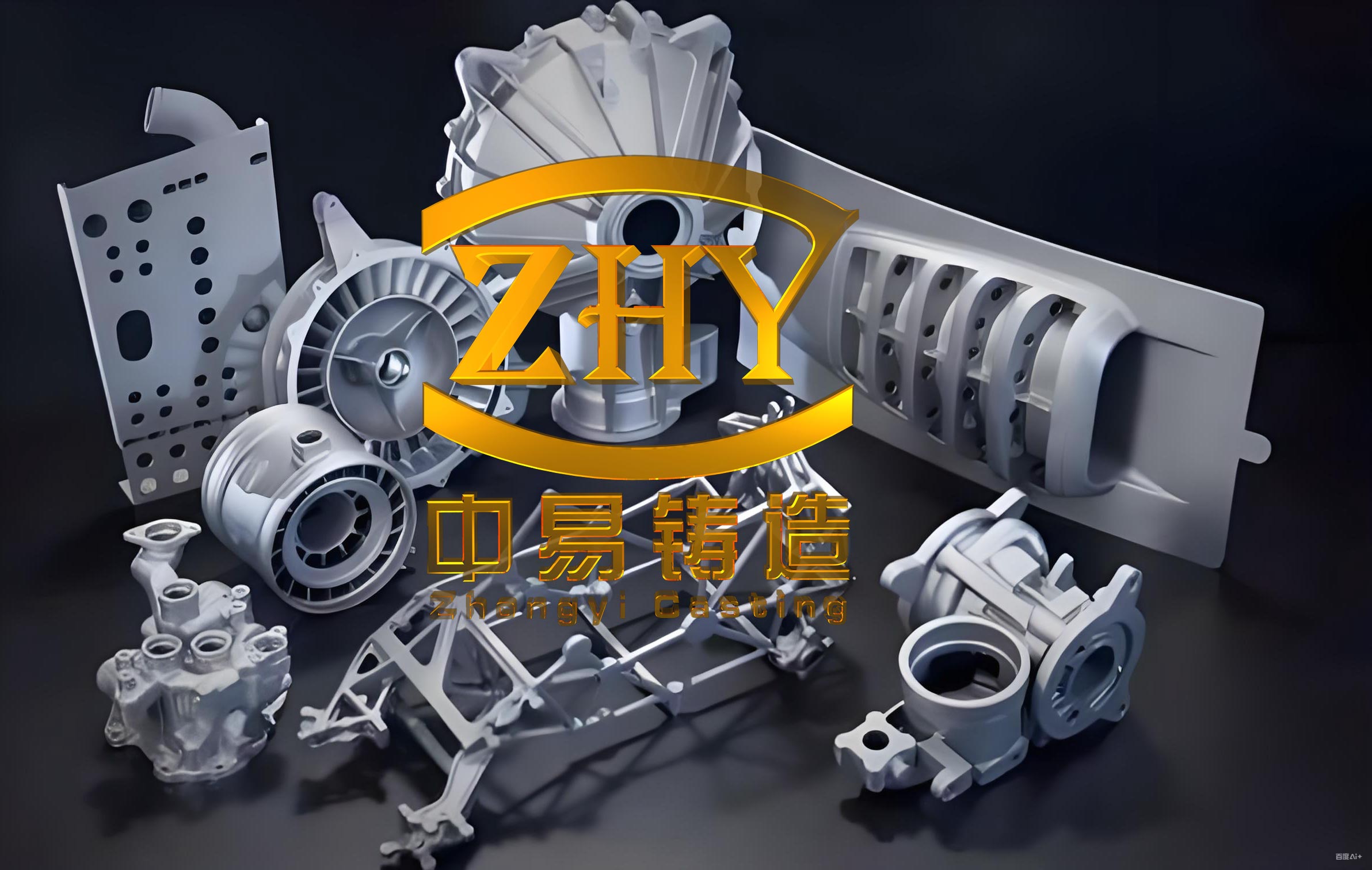
My methodology centered on a multi-physics simulation of the aerospace casting process. I constructed a detailed 3D model of the housing, its mold assembly comprising a permanent metal mold and seven sand cores, and the gating system. The mesh was generated with approximately 9 million uniform cells to ensure accuracy. Key material properties and process parameters were defined as follows, crucial for replicating real-world aerospace casting conditions:
| Parameter | Value/Specification | Remarks |
|---|---|---|
| Alloy Material | ZL101A Aluminum | Standard aerospace casting alloy |
| Mold Material | H13 Tool Steel | High thermal conductivity (~40 W/m·°C) |
| Pouring Temperature | 720 °C | Initial baseline |
| Mold Preheat Temperature | 280 °C | Overall preheat |
| Mold Coating | Zinc Oxide (ZnO) | Thickness: 200 µm |
| Sand Core Material | Resin-Coated Sand |
The tilt-pouring sequence was divided into seven stages to mirror the actual aerospace casting operation. The angular velocity at each stage was carefully programmed to ensure laminar flow, as excessive velocity can lead to turbulence and defect formation. The parameters are summarized below:
| Stage | Tilt Angle (°) | Rotation Speed (1/400 L·min⁻¹) |
|---|---|---|
| 1 | 85 | 50 |
| 2 | 65 | 65 |
| 3 | 45 | 80 |
| 4 | 30 | 90 |
| 5 | 15 | 75 |
| 6 | 1 | 45 |
| 7 | -2 | 10 |
The simulation of the filling process confirmed that the tilt parameters were well-designed for aerospace casting, as the molten metal velocity remained below the critical threshold of 50 cm/s throughout, minimizing the risk of oxide entrapment. However, the temperature field analysis revealed the core of the problem. As filling progressed, the molten aluminum reached the remote oil filter tank section last. At approximately 70% fill, the temperature in this region had already dropped to around 590 °C. Given that the ZL101A alloy has a solidification range between 555 °C and 615 °C, this indicated that the metal began to solidify prematurely upon arrival, severely hampering its fluidity and leading to underpouring. The subsequent solidification simulation starkly showed that this thin-walled section was the first to completely solidify, isolated from any thermal mass that could feed it, confirming it as a thermal “hot spot” for defect formation in this aerospace casting component.
The underlying physics can be partly described by the fundamental heat transfer equation. The rate of heat loss from the molten aluminum to the mold is governed by:
$$ q = h \cdot A \cdot (T_{melt} – T_{mold}) $$
where \( q \) is the heat flow rate, \( h \) is the interfacial heat transfer coefficient, \( A \) is the contact area, \( T_{melt} \) is the melt temperature, and \( T_{mold} \) is the mold temperature. For the thin-walled oil filter tank, the large surface area-to-volume ratio \( (A/V) \) leads to a very high \( q \), causing rapid cooling. Furthermore, the local solidification time \( t_f \) can be approximated using Chvorinov’s rule:
$$ t_f = B \cdot \left( \frac{V}{A} \right)^n $$
where \( B \) is a mold constant and \( n \) is an exponent (typically ~2). For a thin section with a low \( V/A \) ratio, \( t_f \) is very short, explaining why this area solidified first. The inability to place a riser due to geometric constraints exacerbated the problem, as there was no source of liquid metal or heat to compensate for the shrinkage and cooling in this critical aerospace casting region.
Based on this diagnosis, I formulated a three-pronged optimization strategy specifically tailored for aerospace casting processes. The goal was to increase the superheat of the metal arriving at the defect zone and retard the heat extraction rate. The measures were:
- Increase Pouring Temperature: Raising the temperature from 720°C to the upper limit of 740°C for ZL101A to provide more thermal energy.
- Enhance Local Mold Preheating: In addition to the overall mold preheat of 300-350°C, I specifically targeted the steel core and the corresponding mold cavity forming the oil filter tank, preheating them to 380-400°C to reduce the initial thermal gradient.
- Implement Aggressive Insulating Coating Management: For the steel core, the application and maintenance of the ZnO insulating coating were intensified. The coating was stripped and reapplied every 5 castings to ensure a consistent and effective thickness of 0.2-0.3 mm, rather than only at the start of a production batch.
The efficacy of the coating improvement was validated experimentally. I measured the cooling curves of the core with and without the insulating coating. The results demonstrated a dramatic improvement in insulation performance, which is vital for successful aerospace casting of thin sections.
| Condition | Average Cooling Rate (°C/min) | Relative Improvement |
|---|---|---|
| Core without Insulating Coating | 30 | Baseline |
| Core with Insulating Coating (0.25 mm) | 10 | 3x slower (67% reduction) |
This reduction in cooling rate directly translates to a longer time available for the metal to fill the cavity before solidification begins, a key principle in optimizing aerospace casting for complex geometries. The modified thermal boundary condition can be incorporated into the heat transfer model by effectively reducing the interfacial heat transfer coefficient \( h \) in the equation mentioned earlier.
I then simulated the optimized aerospace casting process with the new parameters. The results were markedly different. At 67% fill, the temperature in the oil filter tank region was now approximately 700°C, well above the alloy’s liquidus temperature. The solidification sequence, while still starting from this thin section, was delayed. The time to reach 5% solidification fraction increased from 42.5 seconds (original process) to 46.6 seconds (optimized process). This 4.1-second extension, though seemingly small, is crucial in aerospace casting as it represents a significantly extended “feeding window” where the metal remains fluid, allowing the cavity to be fully filled and minimizing the risk of defects. The predicted percentage of solid fraction \( f_s \) over time \( t \) in the critical region can be modeled using a simplified relationship like:
$$ f_s(t) = 1 – \exp\left(-k \cdot (t – t_{nucleation})^m\right) $$
where \( k \) and \( m \) are material-dependent constants. The optimization effectively increased \( t_{nucleation} \), delaying the onset of rapid solidification.
The implementation of these optimized parameters in the actual aerospace casting production line yielded significant improvements. The defect rate for underpouring at the oil filter tank plummeted from 45.3% to 8.4%. Consequently, the overall casting qualification rate for the gear pump housing jumped from a mere 22.2% to 68.7%. This substantial enhancement underscores the power of simulation-guided process optimization in aerospace casting. It not only solved an immediate production bottleneck but also provided a deeper understanding of the thermal dynamics specific to this component. The methodology demonstrates a repeatable framework for tackling similar challenges in aerospace casting, where complex, high-integrity aluminum parts are required. By systematically analyzing the filling and solidification behavior, identifying thermal bottlenecks, and implementing targeted countermeasures—such as adjusted temperatures and enhanced insulation—the robustness and yield of the aerospace casting process can be dramatically improved.
In conclusion, my work on this aerospace gear pump housing exemplifies a data-driven approach to advanced manufacturing. The integration of computational simulation tools like AnyCasting into the development cycle of aerospace casting processes is indispensable for predicting defects, reducing costly trial-and-error iterations, and ensuring the reliability of mission-critical components. The successful resolution of the underpouring defect through targeted thermal management strategies highlights a fundamental principle in aerospace casting: controlling the thermal history is key to controlling quality. The lessons learned and the methodology developed are directly transferable to other complex thin-walled castings in the aerospace sector, contributing to more efficient and reliable production systems. Future work in this domain of aerospace casting could involve exploring advanced coating materials with even lower thermal conductivity or integrating real-time thermal monitoring with closed-loop process control to further push the boundaries of quality and yield in precision foundry operations for the aerospace industry.