
In the field of wear-resistant materials, high manganese steel casting has long been recognized for its exceptional toughness and work-hardening capabilities under impact conditions. Traditional production methods involve reheating castings for water toughening treatment, which consumes significant energy and time. This study explores an innovative approach utilizing the residual heat from the casting process to perform water toughening, aiming to enhance efficiency and reduce costs while maintaining the desired mechanical properties. We focus on optimizing the process parameters to address challenges such as crack formation and carbide precipitation, which can compromise the performance of high manganese steel casting components.
The fundamental principle behind high manganese steel casting lies in its unique microstructure, which transforms under impact to provide high surface hardness while retaining core toughness. Conventional water toughening involves heating castings to 1050–1100°C to dissolve carbides into the austenite matrix, followed by rapid quenching to preserve a single-phase austenitic structure. However, this method requires additional heating, leading to increased energy consumption and potential surface decarburization. By leveraging the inherent heat from casting, we can eliminate the reheating step, streamlining production and improving economic viability. Our research systematically investigates the effects of variables like opening time and water temperature on the microstructure and properties of high manganese steel casting, providing a comprehensive framework for industrial application.
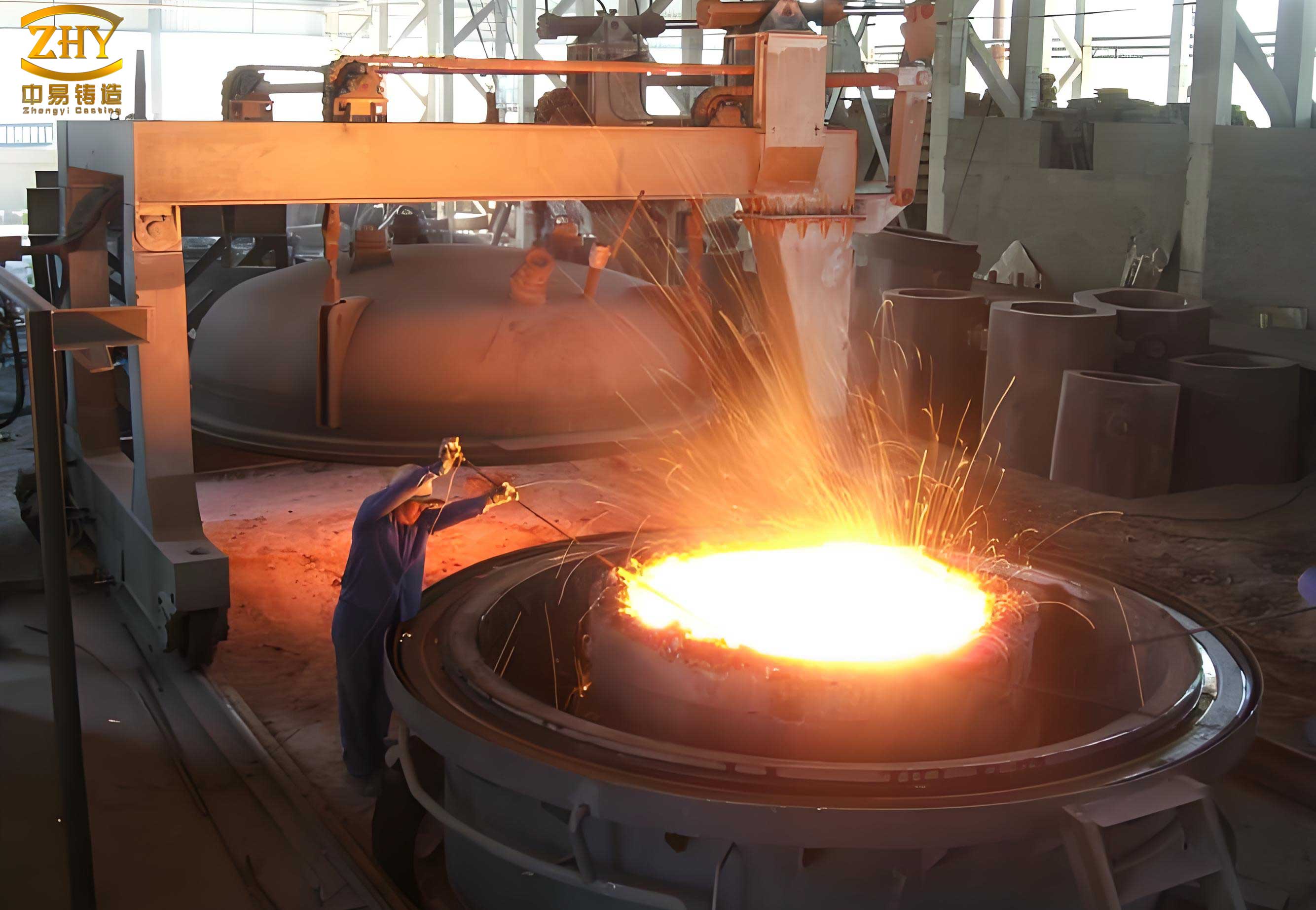
High manganese steel casting typically contains carbon and manganese as primary alloying elements, with compositions tailored to achieve optimal performance. The chemical composition plays a critical role in determining the stability of austenite and the propensity for carbide formation. For instance, the carbon content influences the work-hardening behavior and impact toughness, while manganese enhances austenite stability at elevated temperatures. We employ a standard melt practice using a 250 kg basic medium-frequency induction furnace, with the target composition summarized in Table 1. The ratio of manganese to carbon is maintained at approximately 10 to ensure a balanced microstructure, and rare earth elements are added to refine grains and improve toughness.
| Element | Range | Role |
|---|---|---|
| C | 0.90–1.05% | Enhances work-hardening and hardness |
| Mn | 11.0–12.0% | Stabilizes austenite and suppresses carbides |
| Si | 0.3–0.8% | Improves fluidity and deoxidation |
| RE | 0.2–0.3% | Refines grain structure |
| S | ≤0.04% | Minimizes hot tearing |
| P | ≤0.07% | Reduces embrittlement |
The conventional water toughening process for high manganese steel casting involves two-stage heating: initial holding at 700–750°C to reduce thermal stresses, followed by solution treatment at 1050–1080°C for 2–3 hours to dissolve carbides. Quenching in water below 40°C then locks in the austenitic structure. The kinetics of carbide dissolution can be described by the equation: $$ C(t) = C_0 \left(1 – e^{-kt}\right) $$ where \( C(t) \) is the carbide concentration at time \( t \), \( C_0 \) is the initial concentration, and \( k \) is the rate constant dependent on temperature. This process, while effective, is energy-intensive and prone to quality variations if temperature control is inadequate.
In contrast, the as-cast residual heat water toughening method utilizes the thermal energy retained after solidification, typically above 980°C, to perform direct quenching after sand removal. This approach reduces oxidation and decarburization, shortens production cycles, and lowers energy consumption. However, the key challenge lies in controlling the opening time—the interval between casting and quenching—to prevent cracking and excessive carbide precipitation. We conducted extensive experiments on various high manganese steel casting components, categorizing them by size and geometry, as detailed in Table 2. The opening time, water entry time, and transfer time were varied to assess their impact on microstructure and mechanical properties.
| Component Category | Opening Time (min) | Water Entry Time (min) | Transfer Time (min) | Microstructure Observations |
|---|---|---|---|---|
| Plates <20 mm thickness | 5 | ≤10 | 1 | Austenite, no cracks |
| Simple parts <30 kg | 10 | ≤15 | 1 | Austenite, minor carbides |
| Complex parts <30 kg | 20 | ≤25 | 1 | Austenite with carbides |
| 30–45 kg liners | 30 | ≤35 | 1 | Austenite, no cracks |
| 45–60 kg liners | 40 | ≤45 | 1.5 | Austenite, minimal carbides |
| 1.5–2.5 m diameter parts | 40 | ≤45 | 1.5 | Austenite, stable structure |
| 60–90 kg toothed plates | 50 | ≤55 | 1.5 | Austenite, no cracks |
Microstructural analysis revealed that premature opening (e.g., less than 5 minutes for thin plates) often led to cracking due to thermal stresses, despite achieving a uniform austenitic matrix. Conversely, delayed opening resulted in excessive carbide precipitation, which degraded impact toughness. The optimal opening time balanced these factors, yielding a crack-free, single-phase austenite structure. We quantified the impact toughness using standard Charpy tests, with results comparing conventional and as-cast methods shown in Table 3. The as-cast process with optimized parameters achieved impact values comparable to conventional treatment, whereas prolonged opening times caused a significant drop in toughness.
| Treatment Method | Impact Toughness Sample 1 (J/cm²) | Impact Toughness Sample 2 (J/cm²) | Average Impact Toughness (J/cm²) |
|---|---|---|---|
| Conventional Water Toughening | 19.1 | 18.8 | 18.95 |
| As-Cast Residual Heat (Optimized) | 18.3 | 18.9 | 18.60 |
| As-Cast Residual Heat (Prolonged) | 16.2 | 15.3 | 15.75 |
The service life of high manganese steel casting components, such as liners and toothed plates, was evaluated under real-world conditions, with operational data summarized in Table 4. Components treated using the optimized as-cast method exhibited lifetimes equivalent to those from conventional processing, while those with suboptimal parameters showed reduced durability. This underscores the importance of precise parameter control in residual heat treatment to ensure consistent performance in high manganese steel casting applications.
| Component Type | Conventional Treatment Life (months) | As-Cast Optimized Life (months) | As-Cast Prolonged Life (months) |
|---|---|---|---|
| Small Step Liners | 10–12 | 10–12 | 8–10 |
| Small Flat Liners | 10–12 | 10–12 | 8–10 |
To model the effects of temperature and time on carbide dissolution during water toughening, we applied the Arrhenius equation: $$ k = A e^{-E_a / RT} $$ where \( k \) is the dissolution rate constant, \( A \) is the pre-exponential factor, \( E_a \) is the activation energy, \( R \) is the gas constant, and \( T \) is the absolute temperature. For high manganese steel casting, this relationship helps predict the minimum holding time required at a given temperature to achieve full carbide solution. In the as-cast process, the initial temperature is higher, reducing the time needed compared to conventional reheating. Additionally, the work-hardening behavior can be expressed as: $$ H = H_0 + K \epsilon^n $$ where \( H \) is the hardness, \( H_0 \) is the initial hardness, \( K \) is the strengthening coefficient, \( \epsilon \) is the strain, and \( n \) is the work-hardening exponent. This formula illustrates how high manganese steel casting develops surface hardness under impact, a key advantage in wear-resistant applications.
Based on our experimental findings, we optimized the as-cast residual heat water toughening process for high manganese steel casting, as detailed in Table 5. The parameters are tailored to component categories, ensuring reproducible quality and performance. For instance, thinner sections require shorter opening times to avoid cracking, while heavier parts need longer intervals to achieve uniform heating. Water temperature is strictly controlled below 40°C, and sand content in the quenching medium is limited to 6% to prevent contamination and uneven cooling.
| Sequence | Opening Time (min) | Water Entry Time (min) | Transfer Time (min) | Applicable Components |
|---|---|---|---|---|
| 1 | 5 | ≤10 | 1 | Plates under 20 mm, e.g., guard plates |
| 2 | 10 | ≤15 | 1 | Simple parts under 30 kg, e.g., small step liners |
| 3 | 20 | ≤25 | 1 | Complex parts under 30 kg, e.g., small flat liners |
| 4 | 30 | ≤35 | 1 | 30–45 kg liners, e.g., large step liners |
| 5 | 40 | ≤45 | 1 | 45–60 kg liners, e.g., manhole covers |
| 6 | 48 | ≤50 | 1.5 | Toothed plates |
| 7 | 58 | ≤50 | 1.5 | Toothed plates |
| 8 | 15 | 20 | 1 | Fixed rings and semi-fixed rings |
The economic benefits of adopting the as-cast residual heat method for high manganese steel casting are substantial. Conventional water toughening incurs costs of approximately $7,600 per ton, including energy for reheating, labor, and equipment maintenance. In contrast, the as-cast process reduces expenses by about 30%, lowering the cost to around $5,410 per ton. This saving stems from eliminated reheating steps, reduced processing time, and decreased labor intensity. Moreover, the minimized oxidation and decarburization enhance the surface quality of high manganese steel casting components, extending their service life and reducing replacement frequency. The overall production cycle is shortened, increasing throughput and competitiveness in markets such as mining and cement industries.
In conclusion, the as-cast residual heat water toughening process for high manganese steel casting offers a viable and efficient alternative to conventional methods. By optimizing opening times and quenching parameters, we achieve microstructures and mechanical properties equivalent to those from traditional treatment, while overcoming issues like temperature control instability. The method significantly reduces energy consumption and production costs, making it highly attractive for industrial adoption. Future work could explore the integration of real-time monitoring systems to further refine process control for high manganese steel casting, ensuring consistent quality across diverse component geometries. This approach not only advances the sustainability of wear-resistant material production but also reinforces the critical role of high manganese steel casting in demanding applications.