
In the realm of aerospace engineering, the fuel and control system serves as the core of an aircraft engine, demanding exceptionally high-quality components. Among these, the aluminum alloy shell castings that act as fuel carriers must exhibit superior structural integrity. My focus is on designing and optimizing the casting process for a specific type of thin-walled aviation aluminum alloy shell, leveraging advanced simulation tools to achieve defect-free production. The inherent challenges in such shell castings include minimizing porosity and shrinkage defects, which are critical for ensuring pressure resistance and leak-tightness. This work delves into a comparative analysis of casting methodologies, ultimately presenting an optimized tilt casting process validated through both simulation and practical production.
The shell castings under consideration are characterized by their complex geometry and thin walls. With a mass of approximately 3.9 kg and made from ZL101 aluminum alloy (composition: 7% Si, 0.4% Mg, balance Al), the component features an internal cavity that necessitates the use of a sand core. The dimensional profile is 254 mm in length, 147 mm in width, and 45 mm in height, with a minimum wall thickness of 5 mm spanning an area of about 5,924 mm². The performance requirements are stringent: the shell castings must withstand a pressure test of 0.3 MPa for 5 minutes without leakage in the T6 heat-treated condition. Such specifications underscore the need for a casting process that ensures dense microstructure and absence of internal flaws.
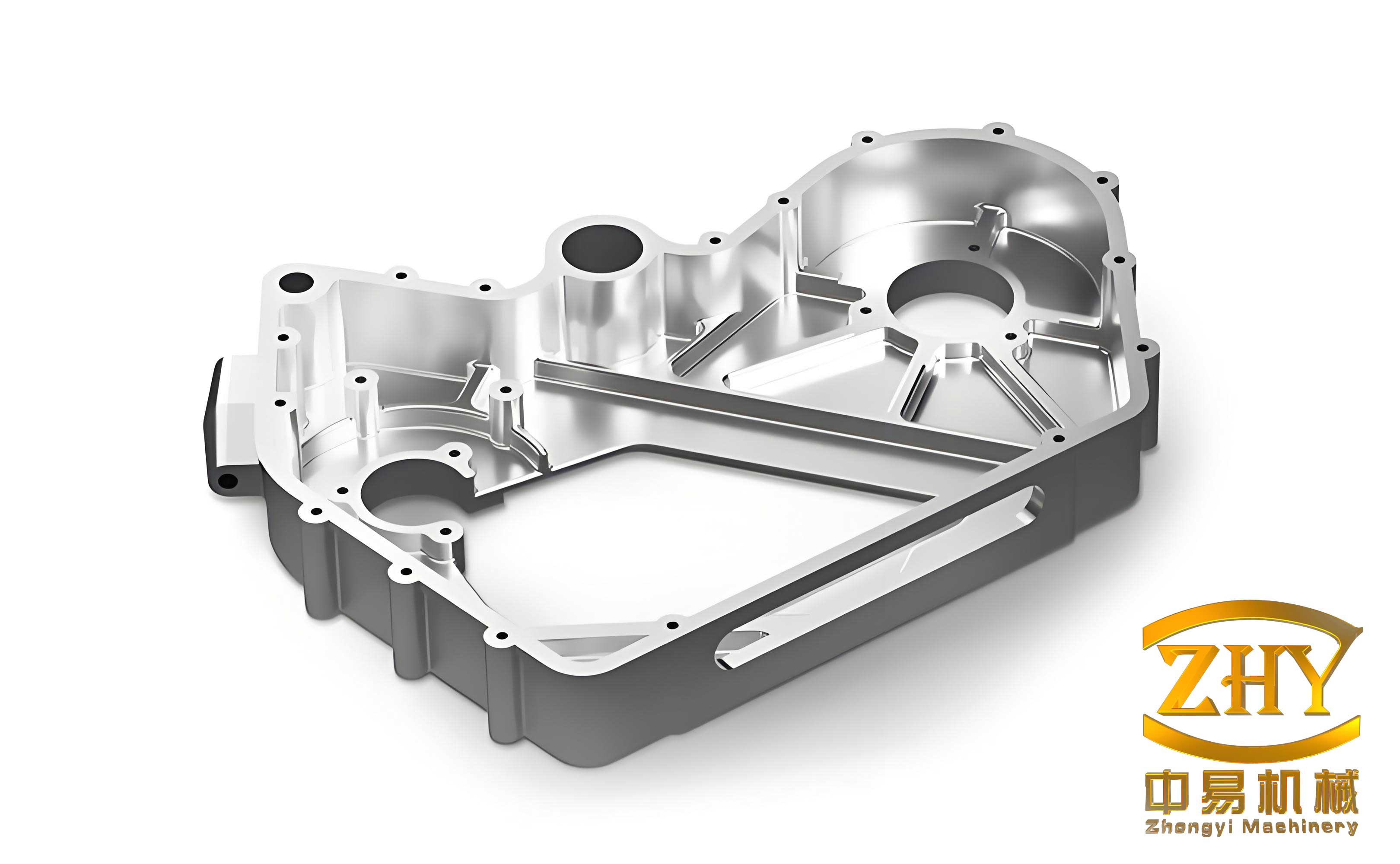
To address these requirements, I designed two distinct gating systems for the shell castings. The first scheme employs conventional gravity pouring with a top-gated system, utilizing a horn-shaped sprue. This approach benefits from simplified mold design and enhanced feeding due to thermal gradients. However, it risks high turbulence during filling, which can lead to gas entrapment and oxidation. The second scheme implements a tilt casting process, where the mold rotates from a horizontal to a vertical position at controlled speeds. This method promotes laminar flow, reducing the likelihood of defect formation in the shell castings. The key parameters for these schemes are summarized in Table 1, highlighting their operational differences.
| Scheme | Type | Advantages | Disadvantages |
|---|---|---|---|
| 1 | Gravity Pouring | Simple design, good feeding | High turbulence, risk of gas porosity |
| 2 | Tilt Casting | Laminar flow, reduced defects | Complex control, potential cold shuts |
For the core design, I selected RCS9101 resin-coated sand due to its high strength, low gas evolution, and excellent collapsibility, ensuring smooth internal surfaces in the shell castings. The core geometry includes positioning features to align accurately within the metal mold, crucial for maintaining dimensional precision.
Numerical simulation using AnyCasting software was pivotal in evaluating the two schemes. I established consistent thermophysical parameters to ensure unbiased comparisons, as detailed in Table 2. The pouring temperature for ZL101 was set at 720°C, with mold and core preheated to 300°C and 150°C, respectively. A coating thickness of 200 μm was applied to the mold cavity to regulate heat transfer.
| Parameter | Value | Unit |
|---|---|---|
| Alloy Material | ZL101 | – |
| Mold Material | H13 Steel | – |
| Pouring Temperature | 720 | °C |
| Mold Preheat Temperature | 300 | °C |
| Core Preheat Temperature | 150 | °C |
| Coating Thickness | 200 | μm |
The filling time for gravity pouring was set to 8 seconds with a sprue diameter of 20 mm, based on empirical data from similar shell castings. For tilt casting, the rotation speed was segmented into phases to optimize flow behavior. The angular velocity $\omega$ (in degrees per minute) was defined as a function of tilt angle $\theta$:
$$ \omega(\theta) = \begin{cases}
-350 & \text{for } 70^\circ \leq \theta < 90^\circ \\
-450 & \text{for } 55^\circ \leq \theta < 70^\circ \\
-350 & \text{for } 35^\circ \leq \theta < 55^\circ
\end{cases} $$
This profile ensures slow entry during initial filling to minimize turbulence, accelerated flow for bulk cavity filling, and a gentle deceleration to prevent core disturbance. The total filling time $t_f$ can be approximated by integrating the inverse of angular speed over the angular range, but in practice, it is controlled to match simulation settings.
Simulation results for filling velocity revealed significant differences. In gravity pouring, the metal velocity $v$ exceeded 100 cm/s in multiple regions, leading to high turbulence. According to Campbell’s criterion, velocities above 50 cm/s promote vortex formation and gas entrainment, increasing porosity risk in shell castings. The velocity field $v(x,y,z,t)$ was analyzed using the Navier-Stokes equations for incompressible flow:
$$ \frac{\partial \mathbf{v}}{\partial t} + (\mathbf{v} \cdot \nabla) \mathbf{v} = -\frac{1}{\rho} \nabla p + \nu \nabla^2 \mathbf{v} + \mathbf{g} $$
where $\rho$ is density, $p$ pressure, $\nu$ kinematic viscosity, and $\mathbf{g}$ gravity. For tilt casting, velocities remained below 60 cm/s throughout, with a gradual decrease as filling progressed, indicating laminar conditions conducive to defect-free shell castings.
Temperature field simulations further informed the solidification behavior. The thermal gradient $\nabla T$ is critical for directional solidification and feeding. In both schemes, the temperature distribution showed a top-down gradient, favoring sequential solidification toward the risers. The heat transfer during solidification of shell castings can be modeled using Fourier’s law:
$$ q = -k \nabla T $$
where $q$ is heat flux and $k$ thermal conductivity. The solidification fraction $f_s$ as a function of time $t$ was derived from the energy equation:
$$ \rho c_p \frac{\partial T}{\partial t} = \nabla \cdot (k \nabla T) + \rho L \frac{\partial f_s}{\partial t} $$
Here, $c_p$ is specific heat and $L$ latent heat. Simulations confirmed that isolated hot spots were absent, and residual liquid pooled in the risers, minimizing shrinkage defects in the shell castings.
Defect prediction focused on shrinkage porosity, quantified using the Niyama criterion $N_y$, which combines thermal gradient $G$ and cooling rate $\dot{T}$:
$$ N_y = \frac{G}{\sqrt{\dot{T}}} $$
Values below a threshold indicate susceptibility to microporosity. For both schemes, $N_y$ exceeded critical levels in the casting body, affirming proper riser design. However, gas porosity could not be directly simulated; instead, I inferred risk from velocity fields. The results are summarized in Table 3, emphasizing the superiority of tilt casting for shell castings.
| Defect Type | Gravity Pouring Risk | Tilt Casting Risk | Remarks |
|---|---|---|---|
| Shrinkage Porosity | Low | Low | Effective riser placement |
| Gas Porosity | High | Low | Based on velocity analysis |
| Cold Shuts | Moderate | Low | Controlled filling in tilt casting |
Based on these insights, I selected the tilt casting scheme for actual production. The mold design incorporated a riser positioned to facilitate feeding, and the tilt mechanism was calibrated to the simulated parameters. The production of shell castings involved pouring ZL101 alloy into preheated metal molds, with the rotation sequence ensuring smooth cavity fill. Post-casting, the shell castings were subjected to heat treatment (T6) and non-destructive testing.
Validation through production yielded excellent results. X-ray inspection revealed no internal defects such as porosity or shrinkage in the shell castings. The average yield for rough castings was 91%, with machining raising the合格率 to 96%. After machining, 100% of the shell castings passed pressure and leak tests, confirming their structural integrity. Minor rejections were due to handling damage rather than casting flaws, underscoring the efficacy of the optimized process for shell castings.
To generalize the findings, the optimal tilt parameters can be expressed as a function of casting geometry. For thin-walled shell castings with height $h$ and width $w$, the tilt speed $\omega$ should scale inversely with the aspect ratio $h/w$ to maintain laminar flow. A proposed empirical relation is:
$$ \omega_{\text{opt}} = \alpha \cdot \frac{1}{(h/w)^\beta} $$
where $\alpha$ and $\beta$ are constants derived from simulation data. For this study, $\alpha \approx 400$ and $\beta \approx 0.5$ provided optimal results. Additionally, the riser volume $V_r$ for shell castings can be estimated using Chvorinov’s rule to ensure adequate feeding:
$$ V_r = \gamma \cdot A_c^{3/2} $$
where $A_c$ is the casting surface area and $\gamma$ a material-dependent factor. For ZL101, $\gamma \approx 0.05$ yielded sound shell castings.
In conclusion, the integration of numerical simulation with process design proved instrumental in optimizing the production of aviation thin-walled aluminum alloy shell castings. Tilt casting emerged as the preferred method, offering controlled filling that reduces gas entrapment while maintaining favorable thermal gradients for feeding. The iterative use of AnyCasting software allowed for precise parameter tuning, minimizing trial-and-error costs. Key takeaways include the importance of velocity control below 50 cm/s to prevent porosity, and the need for tailored tilt sequences based on casting geometry. This approach not only enhances the quality of shell castings but also provides a framework for similar applications, contributing to advancements in aerospace manufacturing. Future work could explore real-time monitoring during tilt casting to further refine process stability for shell castings.