
In the manufacturing of explosion-proof motors, the integrity of the shell castings is paramount. These shell castings form the critical barrier that contains internal explosions, preventing ignition of external hazardous atmospheres. With the update of national standards in June 2012, which raised the static pressure test requirement for explosion-proof motor shell castings from 1.0 MPa to 1.5 MPa, our company faced a significant challenge: enhancing the strength of these shell castings without altering the material grade from HT250. This article details our first-person journey in optimizing the casting process through a modified inoculation technique, leading to improved mechanical properties and compliance with new regulations. Throughout this process, we focused on refining the microstructure of shell castings to achieve higher performance.
The explosion-proof capability of motors relies heavily on the strength, stiffness, and precision of the shell castings. According to the principles of explosion containment, the shell castings must withstand internal pressures without deformation or failure, ensuring that explosive gases do not leak through joints or gaps. The revised standards necessitated a reassessment of our casting methodologies. Initially, we used HT250 gray iron, a high-strength inoculated iron, but found that the standard single inoculation process yielded insufficient strength for the new pressure tests. Specifically, the tensile strength of attached test specimens from shell castings was only around 190 N/mm², whereas the requirement for passing 1.5 MPa tests demanded higher values. This discrepancy prompted us to investigate the root causes and develop an optimized process.
Our analysis revealed that the primary issue was inoculation fading. Inoculation, a process where elements like ferrosilicon (FeSi75) are added to molten iron to promote graphite formation and refine microstructure, has a limited effective time—typically 10 to 12 minutes. For shell castings with complex geometries, such as those with cooling fins, the molten iron needed to cool from 1420°C to 1280°C before pouring, taking about 20 minutes. This delay caused the inoculation effect to diminish, leading to coarse graphite and reduced strength. The microstructure before optimization showed uneven graphite distribution, which compromised the integrity of shell castings. To address this, we hypothesized that extending the inoculation time through a double inoculation method could enhance graphite refinement and boost strength.
The double inoculation process involves two stages: first, adding 50% of the inoculant to the molten iron during tapping from the furnace, and second, adding the remaining 50% during pouring into the mold. This approach prolongs the effective inoculation period, ensuring that nucleation sites are available during solidification. The theoretical basis for this lies in the kinetics of graphite formation. Inoculation increases the number of crystallization nuclei, reducing undercooling and promoting finer eutectic cells. The relationship between undercooling ($\Delta T$) and nucleation rate ($N$) can be expressed as:
$$ N = N_0 \exp\left(-\frac{\Delta G^*}{k_B T}\right) $$
where $N_0$ is a pre-exponential factor, $\Delta G^*$ is the activation energy for nucleation, $k_B$ is Boltzmann’s constant, and $T$ is temperature. By adding inoculants at two stages, we effectively increase $N$, leading to finer graphite and improved mechanical properties. The goal was to transform graphite from an undercooled type to a more uniform Type A distribution, as per metallurgical standards for shell castings.
To validate this, we conducted a series of experiments. We compared the traditional single inoculation process with the new double inoculation process for producing shell castings. The key parameters are summarized in the table below:
| Parameter | Single Inoculation | Double Inoculation |
|---|---|---|
| Inoculation Time | At tapping only | At tapping and during pouring |
| Effective Inoculation Duration | 10-12 minutes | Extended to 20+ minutes |
| Molten Iron Temperature at Pouring | ~1280°C | ~1280°C |
| Inoculant (FeSi75) Usage | 100% at tapping | 50% at tapping, 50% at pouring |
| Graphite Morphology | Coarse, uneven | Fine, Type A distribution |
| Tensile Strength (Attached Specimen) | 190 N/mm² | 250 N/mm² |
The improvement in tensile strength is critical for shell castings, as it directly correlates with pressure resistance. The stress ($\sigma$) experienced by a shell casting under internal pressure can be approximated by the thin-wall pressure vessel formula:
$$ \sigma = \frac{P \cdot r}{t} $$
where $P$ is the internal pressure, $r$ is the radius, and $t$ is the wall thickness. For a given geometry, higher material strength allows the shell castings to withstand higher pressures. Our target was to achieve a tensile strength above 210 N/mm² for HT250 material, and the double inoculation process exceeded this, reaching 250 N/mm². This enabled the shell castings to pass not only the 1.5 MPa test but also additional tests up to 2 MPa.
The microstructural changes were profound. Prior to optimization, the graphite in shell castings appeared as elongated flakes with sharp edges, which act as stress concentrators. After double inoculation, the graphite became finer and rounded, reducing its cutting effect on the metallic matrix. The matrix itself transitioned to a more refined pearlitic or sorbitic structure, enhancing overall durability. These modifications are essential for shell castings used in explosion-proof applications, where any weakness could lead to catastrophic failure. Below is a summary of the metallurgical properties before and after optimization:
| Aspect | Before Optimization | After Optimization |
|---|---|---|
| Graphite Type | Undercooled (D-type) | Type A (uniform) |
| Graphite Size | Coarse (≥100 µm) | Fine (≤50 µm) |
| Matrix Structure | Coarse pearlite | Fine pearlite/sorbite |
| Eutectic Cell Count | Low | High |
| Hardness (HB) | 180-200 | 200-220 |
The effectiveness of double inoculation can be further explained through solidification kinetics. The growth rate of graphite ($v_g$) is influenced by the undercooling and nucleation density. With increased nucleation sites, the growth is constrained, leading to finer grains. The relationship can be modeled as:
$$ v_g = k \cdot (\Delta T)^n $$
where $k$ is a rate constant and $n$ is an exponent. By reducing $\Delta T$ through inoculation, $v_g$ decreases, promoting a finer microstructure. This principle is universally applicable to shell castings, regardless of specific dimensions or shapes.
In our practice, the double inoculation process was implemented for various sizes of shell castings. We monitored the quality through non-destructive testing and destructive tests on specimens. The results consistently showed that shell castings produced with double inoculation met the new standards. For instance, nine motor shell castings submitted for certification passed the 1.5 MPa static pressure test on the first attempt, and subsequent tests confirmed their capability up to 2 MPa. This success underscores the reliability of the optimized process for shell castings in explosion-proof motors.
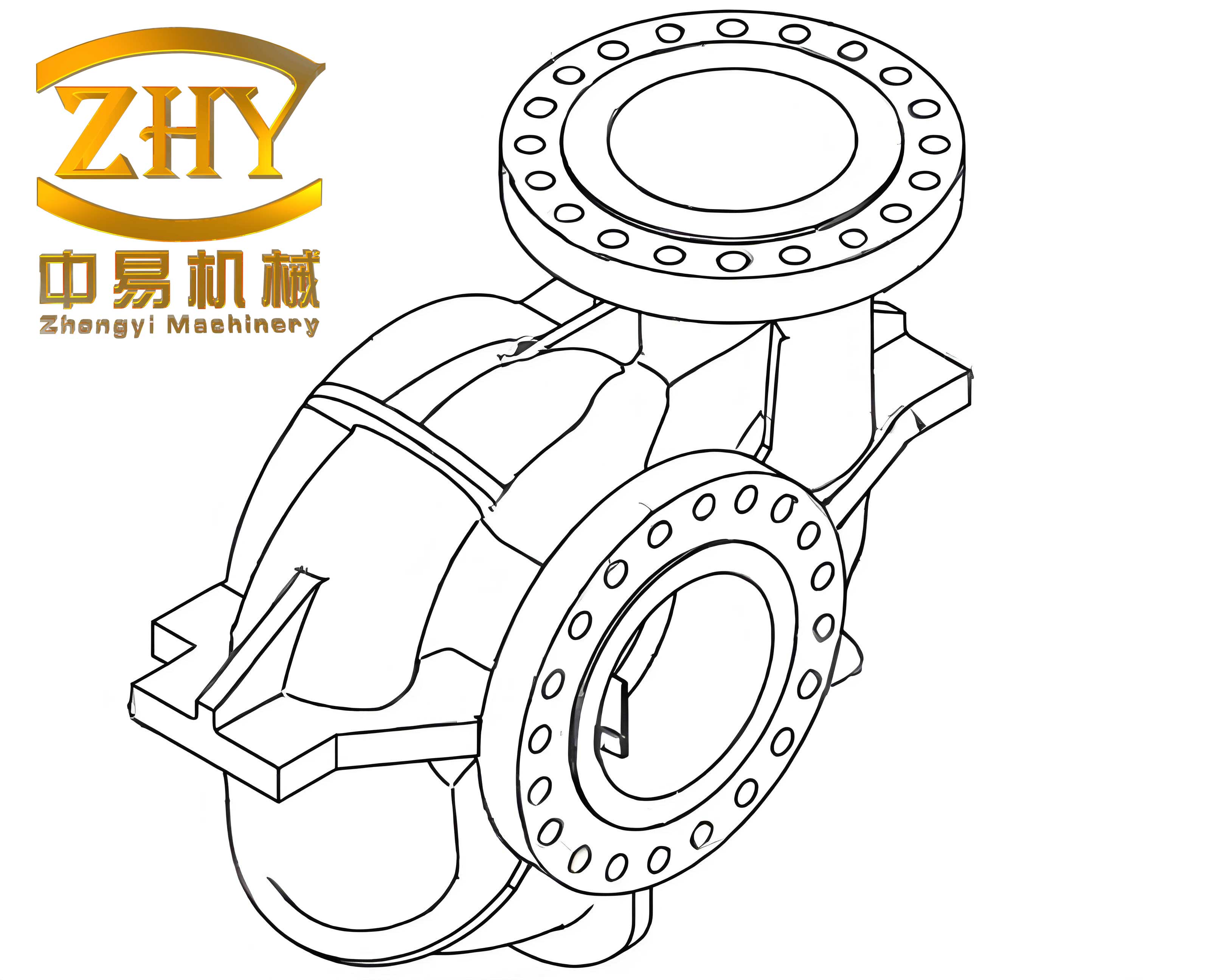
To illustrate the typical appearance of such shell castings, consider the following image, which showcases the intricate geometry often involved in these components. The design features like cooling fins and thick walls are critical for heat dissipation and strength, but they also pose challenges in casting, making process optimization essential.
The economic and operational benefits of this optimization are significant. By avoiding a material grade upgrade from HT250 to higher grades like HT300, we maintained good fluidity of molten iron, reduced brittleness, and controlled costs. Higher-grade materials often lead to casting defects such as shrinkage porosity or increased hardness, which can compromise the machinability of shell castings. Our approach ensured that shell castings remained competitive in the market while meeting stringent safety requirements. The cost savings can be quantified using a simple formula:
$$ C_{\text{savings}} = (C_{\text{higher grade}} – C_{\text{HT250}}) \cdot V \cdot \rho $$
where $C_{\text{higher grade}}$ is the cost per unit mass of a higher-grade iron, $C_{\text{HT250}}$ is the cost for HT250, $V$ is the volume of shell castings, and $\rho$ is the density. For large-scale production, this amounts to substantial savings, making shell castings more affordable for explosion-proof motor applications.
Furthermore, the double inoculation process has implications for other properties of shell castings. For example, fatigue resistance and thermal conductivity are enhanced due to the refined microstructure. In explosion-proof motors, shell castings are subjected to cyclic thermal and mechanical loads, so improved fatigue life is crucial. The fatigue strength ($\sigma_f$) can be estimated using the relationship:
$$ \sigma_f = \sigma_u \cdot (1 – R)^{m} $$
where $\sigma_u$ is the ultimate tensile strength, $R$ is the stress ratio, and $m$ is a material constant. With higher $\sigma_u$ from optimization, $\sigma_f$ increases, extending the service life of shell castings. Additionally, finer graphite improves thermal conductivity by providing more continuous metallic matrix paths, aiding in heat dissipation from the motor.
We also explored the effects of inoculant composition and addition rates. While FeSi75 is standard, variations with other elements like calcium or aluminum could further enhance inoculation. However, for shell castings, we found that FeSi75 at 0.3-0.5% of the molten iron weight, split equally between the two stages, yielded optimal results. The table below summarizes the recommended parameters for double inoculation in shell castings production:
| Parameter | Recommended Value |
|---|---|
| Total Inoculant (FeSi75) | 0.4% of molten iron weight |
| First Inoculation (at tapping) | 0.2% added at 1420°C |
| Second Inoculation (at pouring) | 0.2% added at 1280°C |
| Holding Time After First Inoculation | ≤10 minutes |
| Pouring Temperature | 1280-1300°C |
| Cooling Rate for Shell Castings | Controlled at 10-20°C/min |
Implementing this process required adjustments in our foundry operations. We trained personnel on timing and techniques for inoculation, and we modified ladles and pouring systems to facilitate the second addition. Quality control measures included regular spectrochemical analysis to monitor carbon equivalent (CE) and silicon content, ensuring consistency in shell castings. The CE is calculated as:
$$ \text{CE} = \%C + 0.33(\%Si + \%P) $$
For HT250 shell castings, we maintained CE between 3.8 and 4.1 to balance strength and castability. Through statistical process control, we reduced variability in the mechanical properties of shell castings, achieving a standard deviation in tensile strength of less than 10 N/mm² across batches.
The success of this optimization is evident in the widespread adoption across our product line. Shell castings for various motor sizes, from small industrial units to large mining equipment, now routinely pass the 1.5 MPa pressure test. In some cases, we have designed shell castings with thinner walls to reduce weight, relying on the enhanced strength from double inoculation. This aligns with trends toward lightweighting in motor manufacturing, without compromising safety. The durability of shell castings is paramount, and our process ensures they can withstand not only static pressures but also dynamic loads during operation.
Looking ahead, we continue to refine the process for shell castings. Research into automated inoculation systems and real-time monitoring of molten iron properties could further improve consistency. Additionally, we are investigating the use of computer simulations to model solidification and predict microstructure in shell castings. These efforts aim to push the boundaries of what shell castings can achieve in explosion-proof applications, potentially enabling even higher pressure ratings or more complex geometries.
In conclusion, the optimization of casting process for explosion-proof motor shell castings through double inoculation has proven to be a highly effective solution. By addressing the issue of inoculation fading, we significantly improved the tensile strength and pressure resistance of shell castings, allowing them to meet updated national standards. This approach underscores the importance of microstructure control in enhancing the performance of shell castings. As demand for safer and more efficient explosion-proof motors grows, such process innovations will remain vital. Our experience demonstrates that with careful工艺 tuning, shell castings can achieve superior properties without costly material changes, ensuring reliability and competitiveness in the market.