
In the mining industry, the scraper conveyor is a critical component of the coal mining system, responsible for transporting coal and bearing the weight and impact of the shearer. The slot casting, particularly the middle slot’s pushing ear, is a key load-bearing part. Failure in this area, such as fracture, can halt the conveyor’s movement, severely impacting mining productivity. Therefore, achieving optimal comprehensive mechanical properties through appropriate heat treatment is essential. Traditionally, the slot castings, made of ZG30MnSi steel, underwent normalizing followed by high-temperature tempering to meet hardness specifications of 207-241 HB. However, this process often resulted in inconsistent hardness and suboptimal plasticity and toughness. To address these issues, we explored replacing the normalizing and tempering process with quenching and tempering (quenching and tempering), which not only saves time but also enhances production efficiency while mitigating common heat treatment defects.
The material under investigation is ZG30MnSi cast steel. Its chemical composition, crucial for determining heat treatment parameters, is presented in Table 1.
| Element | C | Si | Mn | S | P |
|---|---|---|---|---|---|
| Content | 0.25 – 0.35 | 0.60 – 0.80 | 1.10 – 1.40 | ≤ 0.03 | ≤ 0.03 |
To systematically evaluate the quenching and tempering process, we designed two distinct heat treatment cycles, designated as Process 1 and Process 2. The primary variables were the quenching temperature and the tempering temperature/time, as these are key factors influencing the final microstructure and properties, and improper selection can lead to various heat treatment defects. The detailed parameters are summarized in Table 2.
| Process | Quenching Temperature (°C) | Holding Time (h) | Cooling Method | Tempering Temperature (°C) | Tempering Time (h) |
|---|---|---|---|---|---|
| Process 1 | 880 | 4.5 | Water quench to below 400°C, then oil cool | 600 | 4 |
| Process 2 | 900 | 4.5 | Water quench to below 400°C, then oil cool | 550 | 3 |
The selection of the quenching temperature is based on the principle for hypoeutectoid steels, which is typically 30-50°C above the Ac3 point. For ZG30MnSi, due to its higher Mn and Si content which affects phase transformation temperatures, we adjusted this range to 40-60°C above Ac3. Process 1 uses 880°C, while Process 2 uses 900°C. The heating and holding time is critical to ensure uniform austenitization and is calculated to prevent defects like incomplete transformation or excessive grain growth. The total time (t) can be estimated using the formula:
$$ t = f \cdot K \cdot D $$
Where \( f \) is a factor related to furnace loading (typically 1-1.5), \( K \) is the heating coefficient (0.9-1.0 min/mm for alloy steels), and \( D \) is the effective thickness of the part in mm. For our castings with significant section size, a holding time of 4.5 hours was determined to ensure complete transformation and homogeneous austenite, minimizing one source of potential heat treatment defects.
The cooling strategy is paramount for successful quenching. To obtain martensite while minimizing distortion and cracking—classic heat treatment defects—we employ a controlled cooling sequence. According to the Continuous Cooling Transformation (CCT) diagram, rapid cooling is essential only in the nose region (approximately 650-550°C) to avoid pearlitic transformation. Below 400°C, especially during martensite formation (Ms ~300-200°C), slow cooling is preferable to reduce thermal stresses. Therefore, our process involves water quenching until the temperature drops below 400°C, followed by oil cooling. Special fixtures are used to ensure vertical immersion of the large castings to prevent distortion, another critical aspect of avoiding heat treatment defects during quenching.
Tempering is then conducted to relieve internal stresses and transform the brittle martensite into a tough microstructure. The tempering temperature directly controls the final balance of strength and toughness. Lower temperatures may retain higher hardness but insufficient toughness, while excessively high temperatures can over-soften the material. The tempering time must ensure uniform heating throughout the cross-section to prevent inconsistent microstructures, a subtle but significant heat treatment defect.
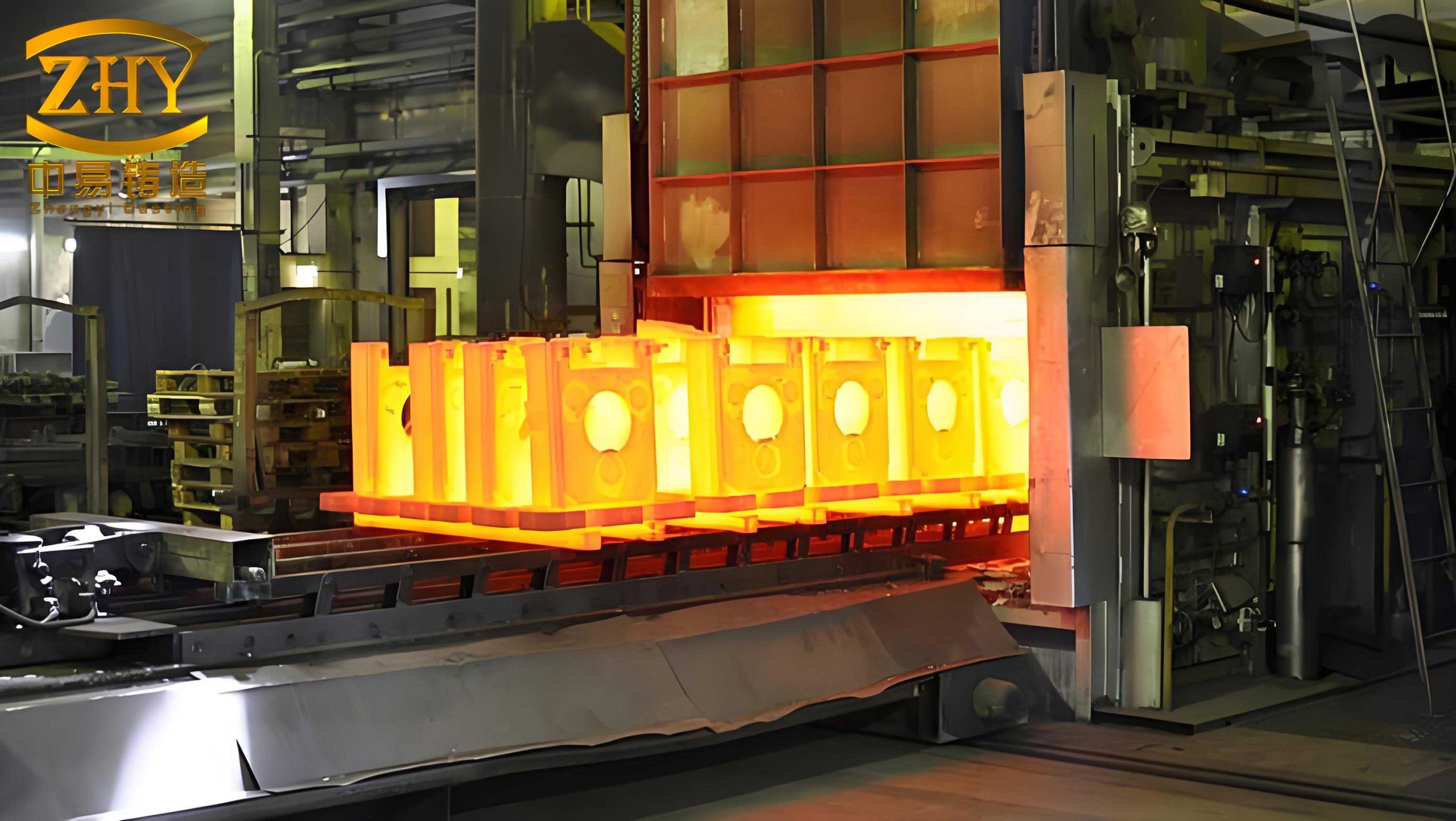
After applying the two processes, samples were taken from identical locations of the slot castings for metallographic examination and mechanical testing. The microstructural analysis revealed stark differences. Process 1 yielded a fine, uniform microstructure of tempered sorbitte with minimal ferrite, indicative of proper quenching and tempering. In contrast, Process 2 resulted in a coarse, non-uniform mixture of grade 3 tempered sorbitte, tempered troostite, and some ferrite. This inhomogeneity is a direct consequence of heat treatment defects, primarily excessive austenite grain growth during quenching and insufficient tempering. The relationship between grain growth rate (v), temperature (T), and activation energy (Q) can be expressed as:
$$ v = K \cdot \frac{\sigma}{\rho} \cdot \exp\left(-\frac{Q}{RT}\right) $$
Where \( K \) is a constant, \( \sigma \) is the interfacial energy, \( \rho \) is the grain boundary curvature, and \( R \) is the gas constant. This equation shows that the growth rate increases exponentially with temperature. The 20°C higher quenching temperature in Process 2 significantly accelerated austenite grain coarsening. Since martensite inherits the prior austenite grain boundaries, this leads to coarse martensite plates. Subsequently, the lower tempering temperature (550°C vs. 600°C) and shorter time (3h vs. 4h) in Process 2 were inadequate to fully transform and homogenize the microstructure throughout the thick casting section, leaving a mix of transformation products and preserving the coarse prior structure. This combination of defects—coarse grains and non-uniform tempering—severely impacts mechanical properties.
The mechanical property data, presented in Table 3, quantitatively confirm the microstructural observations. While yield strength (σs), tensile strength (σb), and hardness (HBS) are similar for both processes, the plasticity and toughness metrics—elongation (δ), reduction of area (ψ), and impact energy (AKU)—are markedly superior for Process 1. The lower toughness in Process 2 is a direct manifestation of the heat treatment defects described above. Coarse grains and mixed microstructures provide easier paths for crack propagation, reducing impact resistance and ductility.
| Process | Yield Strength, σs (MPa) | Tensile Strength, σb (MPa) | Elongation, δ (%) | Reduction of Area, ψ (%) | Impact Energy, AKU (J) | Hardness, HBS |
|---|---|---|---|---|---|---|
| Process 1 | 375 | 623 | 17 | 31 | 52 | 234 |
| Process 2 | 381 | 627 | 11 | 20 | 37 | 236 |
A deeper analysis of the hardness results is insightful. Although both meet the specified range (207-241 HB), the underlying microstructure differs. Hardness is a complex function of microstructural features. For tempered martensitic structures, it can be related to the tempering parameter (TP) which incorporates temperature and time:
$$ TP = T \cdot (\log t + C) $$
Where \( T \) is the absolute tempering temperature, \( t \) is time in hours, and \( C \) is a constant. A higher TP generally corresponds to greater softening. Process 2, with lower T and t, has a lower TP than Process 1, which might explain its slightly higher hardness despite its defective structure. However, this hardness comes at the expense of toughness, highlighting that hardness alone is an insufficient indicator of quality and can mask serious heat treatment defects like brittleness.
The success of Process 1 lies in its careful balance of parameters to avoid common heat treatment defects. The quenching temperature of 880°C is sufficiently above Ac3 to ensure full austenitization without causing excessive grain growth. The subsequent water-oil quenching effectively bypasses the pearlite nose while mitigating quench cracks. The 600°C tempering for 4 hours allows sufficient diffusion for complete transformation to tempered sorbitte throughout the section, ensuring homogeneity and excellent stress relief. This process effectively eliminates the defects associated with the old normalizing and tempering route, such as low and unstable hardness, and those introduced by the suboptimal Process 2.
To further generalize the learning, we can model the relationship between process parameters and key mechanical properties like yield strength. For quenched and tempered steels, yield strength (σy) often follows a Hall-Petch type relationship influenced by tempering:
$$ \sigma_y = \sigma_0 + k_y \cdot d^{-1/2} + \Delta\sigma_{temp} $$
Here, \( \sigma_0 \) is the lattice friction stress, \( k_y \) is the strengthening coefficient, \( d \) is the prior austenite grain diameter, and \( \Delta\sigma_{temp} \) is the strengthening contribution from tempering (e.g., precipitation hardening). In Process 2, the coarse grain size (large \( d \)) decreases the \( d^{-1/2} \) term, weakening grain boundary strengthening. Simultaneously, insufficient tempering might lead to an unbalanced \( \Delta\sigma_{temp} \), potentially retaining brittle, high-carbon martensite zones. This interplay underscores how deviations in temperature and time create synergistic heat treatment defects that degrade overall performance.
In conclusion, through comparative experimentation and analysis of microstructure and properties, we have determined the optimal quenching and tempering process for ZG30MnSi scraper conveyor slot castings: austenitizing at 880°C for 4.5 hours, quenching in water to below 400°C followed by oil cooling, and tempering at 600°C for 4 hours followed by air cooling. This process reliably produces a fine, uniform tempered sorbitte microstructure, delivering an excellent combination of strength, hardness, plasticity, and toughness that consistently meets technical specifications. Most importantly, it systematically avoids the heat treatment defects—such as coarse grains, mixed microstructures, insufficient toughness, and distortion risks—associated with both the conventional process and the alternative quenching and tempering parameters tested. The implementation of this optimized quenching and tempering cycle has significantly enhanced the quality and service reliability of the slot castings, leading to a notable reduction in failures like pushing ear fractures and a decrease in overall scraper conveyor downtime. This case study emphasizes that a deep understanding of the principles behind heat treatment, careful control of parameters, and rigorous evaluation of microstructure are all essential to prevent costly heat treatment defects and achieve superior component performance in demanding industrial applications.