
In the field of precision casting, investment casting is widely utilized for producing complex and high-integrity components, such as protective parts for oil drilling equipment. These parts play a critical role in ensuring operational safety, and their quality is paramount. This study focuses on optimizing the investment casting process for ductile iron protective components to mitigate defects like shrinkage porosity and voids. Using a combination of Pro/E for 3D modeling and ProCAST for numerical simulation, I analyzed the initial casting process, identified root causes of defects, and implemented improvements through gating system modifications and parameter adjustments. The objective was to enhance casting quality by reducing shrinkage defects, which are common challenges in precision casting of ductile iron.
The protective component, designed for oil drilling machinery, features a hollow cylindrical structure with an average wall thickness of 20 mm. Its dimensions are 148.49 mm in outer轮廓 and 71.1 mm in height, incorporating asymmetrical slots at one end and eight through-holes between end faces. The material used is QT600 ductile iron, with a chemical composition including 3.0–3.5% C, 2.4–2.8% Si, 0.3–0.5% Mn, 0.03–0.035% S, P less than 0.1%, and 0.045–0.050% Mg. Key properties include a tensile strength of at least 600 MPa, hardness of HB 190–270, a solidification temperature range of 1,129–1,194°C, and a density of 7,300 kg/m³. These characteristics make it suitable for investment casting, but the process requires careful optimization to prevent defects.
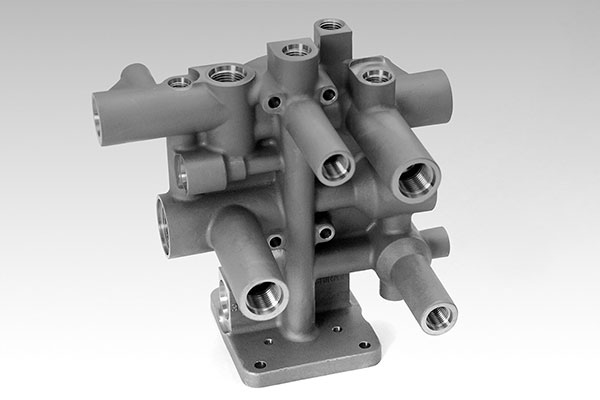
In investment casting, the gating system is crucial for ensuring smooth metal flow and effective feeding during solidification. For this study, I designed an initial gating system with a sprue, runner, ingates, and vents to accommodate four castings per mold, aiming for directional solidification to minimize shrinkage. The filling velocity was determined using the empirical formula derived from casting principles, which accounts for component geometry and alloy properties. The formula for calculating the minimum allowable metal rise velocity in the mold cavity is given by:
$$ v_{\text{fill}} = \frac{h}{\delta \cdot T} $$
where \( v_{\text{fill}} \) is the filling velocity in cm/s, \( h \) is the casting height in cm, \( \delta \) is the wall thickness in cm, and \( T \) is the pouring temperature in °C. Based on this, the computed filling velocity was approximately 0.4577 m/s, rounded to 0.458 m/s for simulation purposes. Other initial parameters included a pouring temperature of 1,300°C, a mold shell preheat temperature of 900°C, and natural cooling in air. The shell consisted of six layers with a total thickness of 6 mm, made of refractory quartz sand bonded with silica sol.
To simulate the investment casting process, I developed a 3D model of the protective component and gating system using Pro/E software. The mesh was generated with 67,010 nodes, focusing on finer elements in critical areas like the ingates and casting body. In ProCAST, I set material properties and boundary conditions, including heat transfer coefficients: 1,000 W/(m²·K) between the shell and casting, 1,000 W/(m²·K) between the casting and air, and 50 W/(m²·K) between the shell and air. Gravity was defined along the negative X-axis at 9.8 m/s² to replicate actual pouring conditions. The simulation aimed to analyze filling patterns, solidification behavior, and defect formation in precision casting applications.
The initial simulation results revealed a gradual filling process, with the sprue fully filled in 0.7 seconds and the first set of two castings completed by 2.5 seconds. By 7.2 seconds, the entire mold was filled, indicating a stable flow without significant turbulence. However, the solidification analysis showed that shrinkage defects concentrated in the sprue, runner, and ingate connections, with a shrinkage porosity rate of 13.2603%. This was attributed to premature solidification in these areas, blocking feeding paths and leading to volumetric contraction in the casting body. Such defects are detrimental in investment casting, as they compromise component integrity and performance.
To address these issues, I optimized the gating system by proposing two modified schemes. Scheme A involved adding side ingates along the rectangular sections, while Scheme B incorporated additional ingates in the pipeline regions of the casting. Both schemes were modeled and simulated under the same conditions as the initial setup. The results, summarized in the table below, showed that Scheme B significantly reduced shrinkage porosity to 1.3675%, compared to 6.9025% for Scheme A and 13.2603% for the initial design. This improvement highlights the importance of gating design in investment casting for enhancing feeding efficiency and reducing defects.
| Scheme | Shrinkage Porosity Rate (%) | Remarks |
|---|---|---|
| Initial | 13.2603 | High defects in sprue and ingates |
| Scheme A | 6.9025 | Moderate improvement |
| Scheme B | 1.3675 | Significant reduction, no defects in casting body |
Further optimization involved studying key process parameters—pouring temperature, filling velocity, and mold shell preheat temperature—through an orthogonal experimental design. This approach is efficient for investment casting optimization, as it reduces the number of trials while capturing parameter interactions. The factors and levels are listed in the table below, with shrinkage porosity as the evaluation metric. Lower values indicate better casting quality in precision casting.
| Level | A: Pouring Temperature (°C) | B: Filling Velocity (m/s) | C: Shell Preheat Temperature (°C) |
|---|---|---|---|
| 1 | 1,250 | 0.450 | 800 |
| 2 | 1,280 | 0.455 | 900 |
| 3 | 1,300 | 0.460 | 1,000 |
I conducted nine simulation trials based on the orthogonal array, recording filling times and shrinkage porosity rates. The results, presented in the table below, showed that Trial L9 (A3B3C1) achieved the lowest shrinkage porosity of 1.321%, with a filling time of 3.858 seconds. This corresponds to a pouring temperature of 1,300°C, filling velocity of 0.460 m/s, and shell preheat temperature of 800°C. The optimal combination was determined through range analysis, emphasizing the critical role of parameter tuning in investment casting to minimize defects.
| Trial | A: Pouring Temperature (°C) | B: Filling Velocity (m/s) | C: Shell Preheat Temperature (°C) | Filling Time (s) | Shrinkage Porosity Rate (%) |
|---|---|---|---|---|---|
| L1 | 1,250 | 0.450 | 800 | 4.881 | 1.451 |
| L2 | 1,250 | 0.455 | 900 | 3.925 | 1.433 |
| L3 | 1,250 | 0.460 | 1,000 | 3.869 | 1.442 |
| L4 | 1,280 | 0.450 | 900 | 3.961 | 1.551 |
| L5 | 1,280 | 0.455 | 1,000 | 3.918 | 1.452 |
| L6 | 1,280 | 0.460 | 800 | 3.869 | 1.402 |
| L7 | 1,300 | 0.450 | 1,000 | 3.820 | 1.589 |
| L8 | 1,300 | 0.455 | 800 | 3.771 | 1.370 |
| L9 | 1,300 | 0.460 | 800 | 3.858 | 1.321 |
The optimal parameters were validated through numerical simulation, showing a substantial reduction in shrinkage defects. The shrinkage porosity distribution for the optimized process confirmed that defects were minimized to acceptable levels, with no significant issues in the casting body. Practical production trials aligned with these findings, demonstrating improved yield and quality in the investment casting of ductile iron protective parts. This underscores the effectiveness of simulation-driven optimization in precision casting to achieve reliable and efficient manufacturing.
In conclusion, this study successfully optimized the investment casting process for ductile iron protective components by integrating 3D modeling and numerical simulation. The initial gating system was refined to enhance feeding, and key parameters were tuned through orthogonal experiments, resulting in a significant reduction in shrinkage porosity. The best combination—pouring temperature of 1,300°C, filling velocity of 0.460 m/s, and shell preheat temperature of 800°C—proved effective in practical applications. These findings highlight the value of precision casting techniques in overcoming common defects, providing a robust framework for similar investment casting projects. Future work could explore additional factors like alloy composition variations or advanced cooling strategies to further enhance quality in investment casting processes.