
In the realm of turbomachinery, components such as impellers play a pivotal role in converting mechanical energy into fluid kinetic and pressure energy. The production of these complex-shaped parts, especially closed impellers with intricate blade geometries, demands manufacturing techniques that can achieve near-net shape while maintaining mechanical integrity. Among various methods, the investment casting process stands out due to its ability to fabricate intricate structures without the stress concentrations often introduced by machining. This article delves into the optimization of the investment casting process for a duplex stainless steel closed impeller, leveraging numerical simulation to enhance quality and yield. The focus is on addressing shrinkage defects through systematic design improvements, validated by actual production.
The investment casting process, often referred to as lost-wax casting, involves creating a wax pattern, coating it with ceramic slurry to form a mold, melting out the wax, and pouring molten metal. For critical components like impellers, this process must be meticulously controlled to avoid defects such as shrinkage porosity and gas holes, which are common challenges in steel castings. In this study, I explore how numerical simulation tools, specifically ProCAST, can be employed to optimize the gating and feeding systems, as well as the pouring methodology, thereby refining the investment casting process for a duplex stainless steel closed impeller. The goal is to eliminate shrinkage cavities in critical areas like the hub and the caliber ring, ensuring high-quality castings with improved production efficiency.
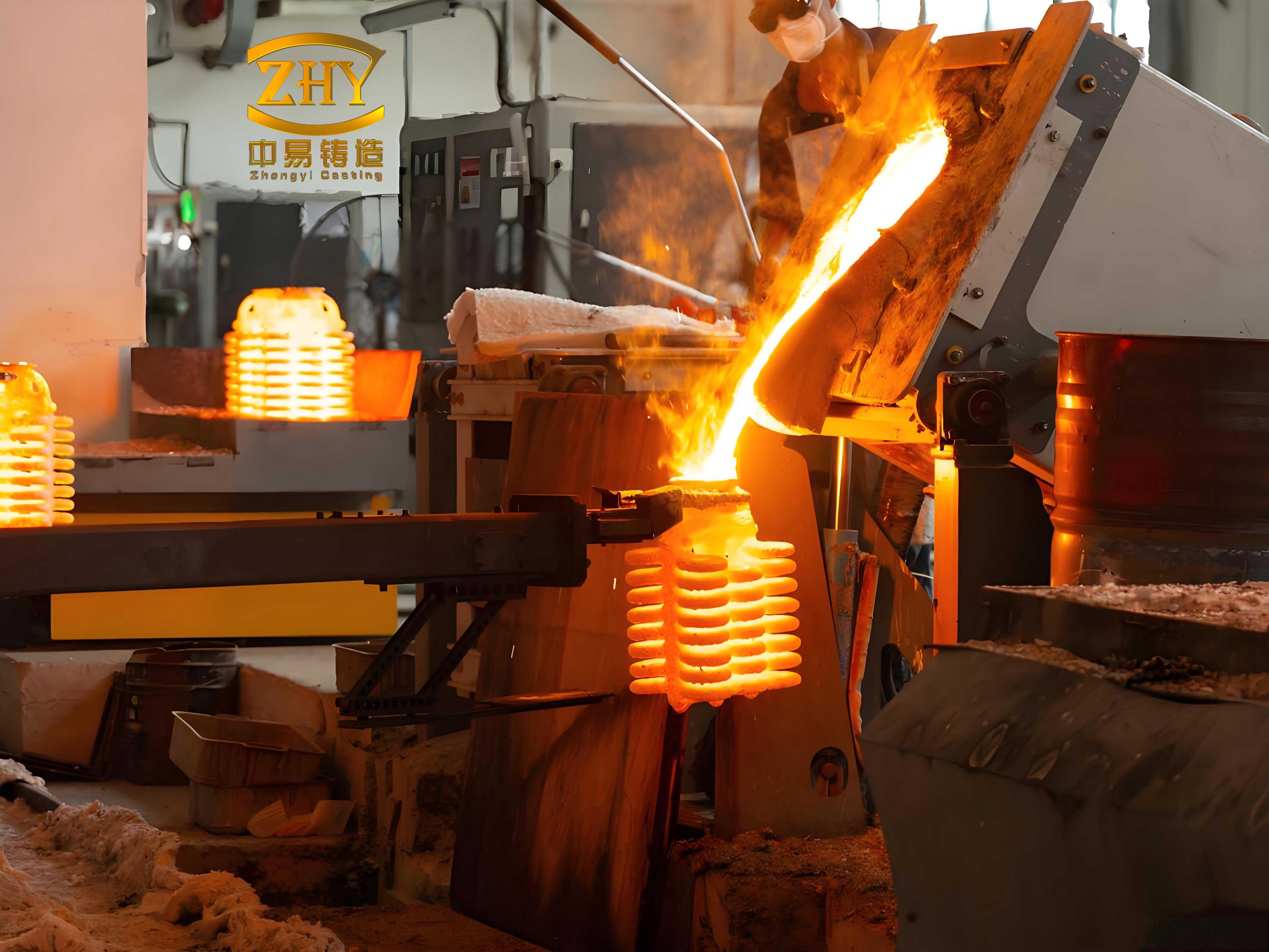
To begin, let’s consider the fundamental principles governing solidification in castings. The occurrence of shrinkage defects is often tied to the thermal gradients and feeding mechanisms during cooling. A key parameter in assessing this is the modulus, defined as the volume-to-surface area ratio of a casting section, which influences the solidification time. In the investment casting process, optimizing the modulus through design changes can promote directional solidification, where thinner sections solidify first, feeding thicker sections. Mathematically, the solidification time \( t_s \) can be estimated using Chvorinov’s rule:
$$ t_s = C \left( \frac{V}{A} \right)^2 $$
where \( V \) is the volume, \( A \) is the surface area, and \( C \) is a constant dependent on material and mold properties. For duplex stainless steels, which exhibit a two-phase microstructure of austenite and ferrite, the solidification behavior is complex, requiring careful thermal management. The investment casting process must account for this by ensuring adequate feeding paths.
The impeller in question is a single-suction, six-channel closed type, weighing 122 kg and made from A890 3A duplex stainless steel. Its dimensions include a hub diameter of 110 mm, a caliber ring diameter of 495 mm, and an overall diameter of 611 mm, with blade thicknesses ranging from 8.5 to 10 mm. The thick sections at the hub and caliber ring are prone to shrinkage, necessitating an optimized investment casting process. Below is a summary of the basic dimensions:
| Feature | Dimension (mm) |
|---|---|
| Hub Diameter | 110 |
| Caliber Ring Diameter | 495 |
| Overall Impeller Diameter | 611 |
| Blade Thickness Range | 8.5–10 |
| Channel Width | 110 |
Initial investment casting process designs often follow traditional rules, such as placing thicker sections upward to facilitate feeding. In the first iteration, the impeller was oriented with the caliber ring facing upward, and a top-pouring system was used. The gating system included a main ingate at the spherical hub and three side ingates with padding at the caliber ring, intended for feeding, venting, and wax removal. However, numerical simulation revealed shortcomings. The ProCAST software was utilized to model the solidification, with meshing parameters set to 10 mm for the casting and 20 mm for the shell, resulting in 706,712 volume elements. Key process parameters included a pouring temperature of 1,620°C, shell preheat temperature of 650°C, pouring rate of 7 kg/s, and heat transfer coefficients of 500 W/(m²·K) for metal-shell interface and 100 W/(m²·K) for riser-top air interface.
The simulation outcomes indicated shrinkage defects at both the hub and caliber ring. The critical shrinkage porosity criterion was set at 2.3%, based on the material’s contraction rate. Analysis showed that the three side ingates provided limited feeding distance, insufficient to compensate for the thermal hotspots at the caliber ring. Moreover, the riser’s root, due to excessive heat loss to air, solidified prematurely compared to the hub, creating a blockage in the feeding path. This can be described by the thermal gradient \( \nabla T \), which drives liquid metal flow. The feeding efficiency \( \eta_f \) depends on the pressure drop \( \Delta P \) along the path:
$$ \Delta P = \rho g h + \frac{12 \mu L Q}{\pi D^4} $$
where \( \rho \) is density, \( g \) is gravity, \( h \) is height, \( \mu \) is viscosity, \( L \) is length, \( Q \) is flow rate, and \( D \) is diameter. In the initial investment casting process, the premature solidification increased \( L \) effectively, reducing \( Q \) and leading to defects.
To address these issues, the investment casting process was optimized in two stages. First, the gating and feeding systems were modified: the number of side ingates was increased from three to six, ensuring each hotspot at the caliber ring-blade junction received direct feeding, and the riser size was enlarged to a bottom diameter of 170 mm, with a hexagonal top for easier pattern assembly. This enhanced the modulus at the riser root, delaying solidification. The revised design promoted better thermal distribution, as quantified by the improved Niyama criterion \( G/\sqrt{\dot{T}} \), where \( G \) is temperature gradient and \( \dot{T} \) is cooling rate. For defect-free regions, this value should exceed a threshold, often around 1 K1/2·min1/2/cm. The optimization aimed to achieve this in critical areas.
Second, the pouring method was altered from central pouring to side pouring. In the initial scheme, metal impingement on the hub bottom created a hot spot, slowing solidification and fostering shrinkage. By introducing metal along the side wall of the pouring cup, the thermal impact was mitigated, and the flow was gentler, preserving shell integrity. This change can be analyzed using fluid dynamics principles, where the Reynolds number \( Re \) indicates flow regime:
$$ Re = \frac{\rho v D}{\mu} $$
For laminar flow (\( Re < 2300 \)), turbulence-induced erosion is minimized, which is crucial in the investment casting process to avoid mold damage. Side pouring helped maintain lower \( v \), thus controlling \( Re \).
The optimized investment casting process was simulated again, showing significant improvement. Defects at the caliber ring were fully eliminated, and hub shrinkage was reduced. However, minor porosity persisted at the hub due to unfavorable solidification patterns. Further analysis revealed that the “V”-type feeding from the riser still posed risks, as the hub bottom remained a thermal mass. The temperature field evolution indicated that side pouring effectively dissipated heat, leading to more uniform cooling. The final simulation confirmed defect-free status across the casting, validating the investment casting process adjustments.
For clarity, the key parameters and changes are summarized in the table below:
| Aspect | Initial Design | Optimized Design |
|---|---|---|
| Number of Side Ingates | 3 | 6 |
| Riser Bottom Diameter | Smaller (not specified) | 170 mm |
| Pouring Method | Central Pouring | Side Pouring |
| Shell Preheat Temperature | 650°C | 650°C |
| Pouring Temperature | 1,620°C | 1,620°C |
| Heat Transfer Coefficient (Metal-Shell) | 500 W/(m²·K) | 500 W/(m²·K) |
The practical implementation of this optimized investment casting process involved several steps: pattern assembly, shell building, pouring, and post-casting operations. The actual production yielded high-quality impellers, with machining verification confirming the absence of defects in hub and caliber ring areas. This demonstrates the efficacy of numerical simulation in refining the investment casting process, leading to higher yield and productivity.
In conclusion, the investment casting process for duplex stainless steel closed impellers can be significantly enhanced through systematic optimization. By increasing side ingates and riser size, and adopting side pouring, shrinkage defects were eliminated. The investment casting process benefits greatly from tools like ProCAST, which enable predictive analysis and reduce trial-and-error. For similar components, this approach offers a reliable framework, ensuring that the investment casting process delivers robust, defect-free castings. Future work could explore advanced materials or more complex geometries, further pushing the boundaries of the investment casting process.
Throughout this discussion, the term “investment casting process” has been emphasized to underscore its centrality in achieving precision and quality. The integration of numerical simulation into the investment casting process not only solves immediate defects but also paves the way for smarter manufacturing paradigms. As industries demand higher performance from turbomachinery components, continuous refinement of the investment casting process will remain crucial, leveraging both empirical insights and computational advancements.