
In my extensive experience within the precision casting industry, I have consistently encountered the critical challenge of manufacturing complex components like pump impellers and turbine wheels. These parts are fundamental to key power station equipment such as boiler feed pump units and hydraulic couplings, where their integrity directly dictates operational safety and efficiency. The investment casting process is the preferred method for such intricate geometries, yet it presents significant hurdles. Specifically, the structural complexity of these components often leads to a high incidence of shell mold fractures during production, particularly in the slender sections near the shaft end of the blade channels. This issue historically resulted in scrap rates exceeding 40%, which was economically and technically unsustainable. This article details a comprehensive, first-hand account of the systematic improvements we implemented to the entire investment casting process, transforming yield and quality.
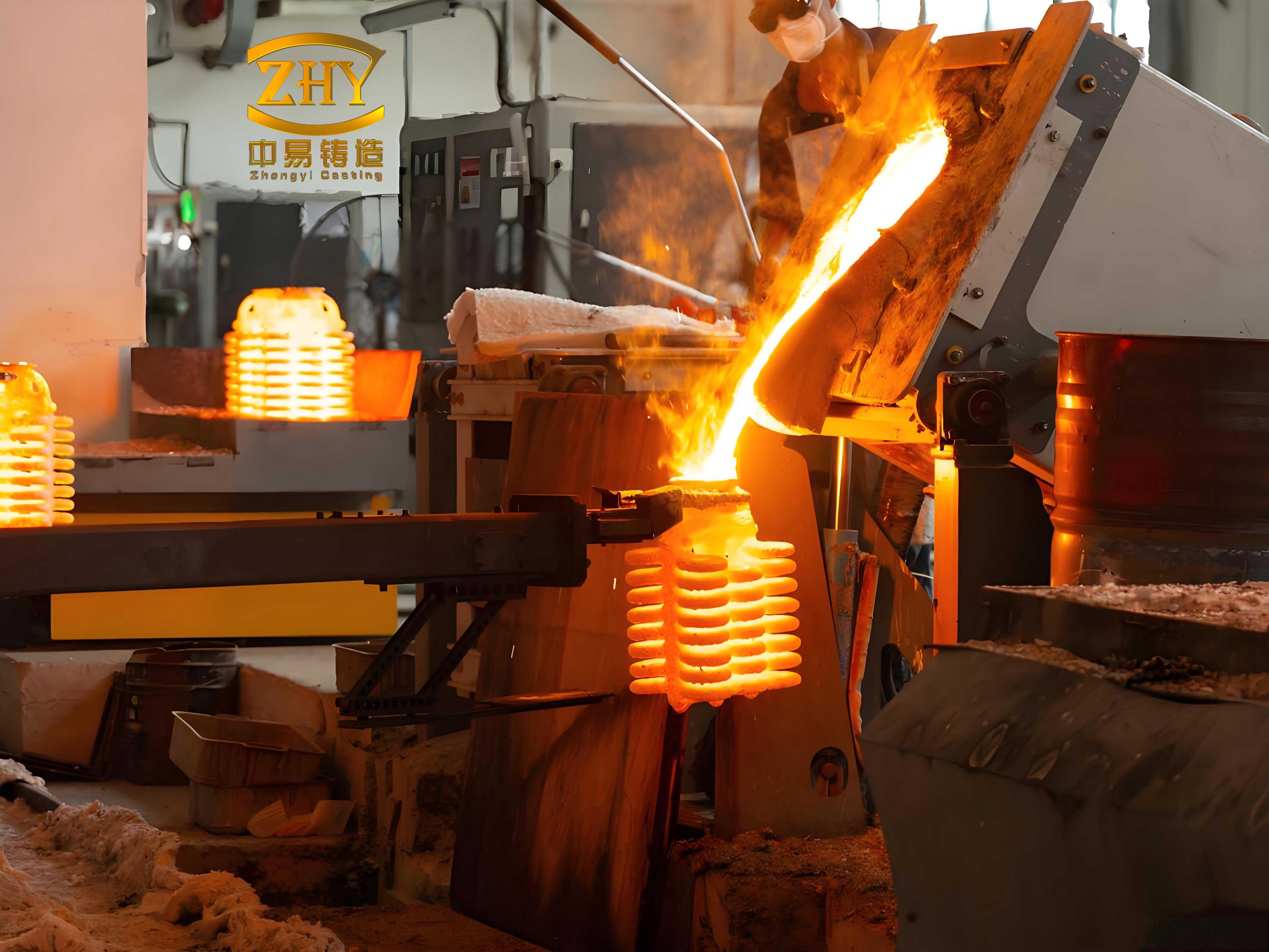
The core of the problem lies in the fundamental mechanics of the investment casting process. When crafting a component with numerous thin blades—for instance, a wheel with 48 blades, each 6 mm thick, separated by channels that taper from 10 mm to 20 mm—the ceramic shell built around the wax pattern becomes exceptionally vulnerable at the narrowest points. During dewaxing, firing, and pouring, thermal and mechanical stresses concentrate in these regions. If the stress imposed on the shell exceeds its inherent strength, fracture is inevitable. Our analysis revealed that over 87% of all shell failures originated precisely at the root of these blade channels. This prompted a deep re-evaluation of every stage in our investment casting process.
Structural Stress Analysis and Failure Mechanism
To scientifically address the fracture problem, we first analyzed the stress state. The stress (σ) in the shell at the critical point can be conceptually described by the relation between applied force and cross-sectional area, but more critically, it is amplified by geometric discontinuities. The stress concentration factor (Kt) for a notch or sharp corner is a key parameter. A simplified model for the stress at the root of a channel can be expressed as:
$$ \sigma_{max} = K_t \cdot \sigma_{nom} $$
where the nominal stress σnom arises from thermal gradients and metalostatic pressure. For a semi-elliptical surface flaw or a sharp inner corner, the stress concentration factor is heavily influenced by the radius of curvature (ρ). An approximate formula highlighting this dependence is:
$$ K_t \approx 1 + 2\sqrt{\frac{a}{\rho}} $$
Here, a represents a characteristic defect or notch depth. This relationship clearly shows that a small radius (e.g., R2) leads to a very high Kt, causing localized stress to far exceed the shell’s tensile strength (σTS). The failure criterion is simply:
$$ \sigma_{max} \geq \sigma_{TS} $$
Therefore, our strategy for optimizing the investment casting process focused on two parallel paths: reducing the maximum operational stress through design, and increasing the shell’s effective strength through material and process modifications.
| Parameter | Original Design | Optimized Design | Impact on Investment Casting Process |
|---|---|---|---|
| Blade Channel Root Radius (ρ) | 2 mm | 3 mm | Decreases stress concentration factor Kt significantly. |
| Theoretical Stress Concentration Factor (Kt)* | ~3.5 | ~2.8 | Directly lowers σmax for same nominal load. |
| Shell Thickness at Channel Root | Variable, often thin | More uniform due to better slurry flow | Increases cross-sectional area resisting stress. |
| Primary Failure Location Incidence | 87.6% | < 5% | Direct result of holistic investment casting process improvements. |
*Note: Values are estimated based on geometric models for illustration.
Stage 1: Foundational Enhancement – Mold and Pattern Design
The first logical step in refining the investment casting process was to address the geometric stress riser. In the original wax pattern die, the fillet radius at the junction where the blade meets the hub (the root of the channel) was specified as R2. Based on the stress concentration principle, we mandated an increase to R3 across all similar profiles. This modification, though seemingly minor, had a profound effect on the resulting wax pattern and, consequently, the ceramic shell. The larger radius promotes a more favorable stress flow in the shell during subsequent stages, effectively reducing the peak stress during the investment casting process’s thermal cycles. This change is a preventive measure that costs little but yields substantial benefits in shell integrity.
Stage 2: Core Advancements – Shell Building (Investing) Process
The shell-building phase is the heart of the investment casting process, where the ceramic mold’s properties are defined. We implemented a multi-faceted overhaul of this stage.
2.1 Refining the Binder System: Slurry Composition
The binder, typically a waterglass (sodium silicate) solution, is the glue of the shell. Its modulus (M) is a critical metric defining the ratio of silica to sodium oxide, directly influencing the amount of silicate gel formed during hardening. The modulus is given by:
$$ M = \frac{\text{moles of } SiO_2}{\text{moles of } Na_2O} $$
Originally, our investment casting process used a waterglass with a modulus ranging from 3.2 to 3.5. To enhance the high-temperature strength of the shell, particularly in the thin sections, we shifted to a higher modulus range of 3.4 to 3.65. The relationship between gel formation and modulus can be conceptualized as a driver for strength development. The gel formation reaction during hardening with an ammonium salt can be simplified as:
$$ Na_2O \cdot mSiO_2 + 2NH_4Cl \rightarrow 2NaCl + 2NH_3 \uparrow + mSiO_2 \cdot (H_2O) $$
The colloidal silica gel (mSiO_2 \cdot (H_2O)) provides bonding. A higher initial modulus means a higher SiO2 content, leading to more gel and thus higher shell strength. However, an excessive modulus harms collapsibility. Our selected range optimized this trade-off for our specific investment casting process.
| Slurry Parameter | Original Specification | Optimized Specification | Rationale for Investment Casting Process |
|---|---|---|---|
| Waterglass Modulus (M) | 3.2 – 3.5 | 3.4 – 3.65 | Increases SiO2 gel content, boosting green and fired strength. |
| Binder Viscosity | Standard dip coating | Adjusted for better flowability | Prevents slurry pooling in narrow channels. |
| Refractory Flour Type & Ratio | Fixed blend | Optimized particle size distribution | Improves packing density and sinterability of the shell. |
2.2 Advanced Application Techniques: Slurry and Stucco Application
In the investment casting process, simply dipping the wax assembly often leads to slurry accumulation in deep, narrow channels due to surface tension—a phenomenon called “bridging” or “pooling.” This creates a weak, thick, and poorly consolidated area that is prone to cracking. To counteract this, we enhanced the manual intervention protocol. After dipping, technicians now employ a combined technique of controlled rotation to throw off excess slurry (manual slinging) followed by targeted brushing with soft tools into the blade channel roots. This ensures a uniform, thin, and well-adhered primary coat, establishing a strong foundation for subsequent layers. This step is crucial for the integrity of the entire shell building sequence in the investment casting process.
2.3 Precision Drying and Hardening Cycle
Drying is not merely water removal; it is the period for complete gelation and diffusion of hardening agents. Inadequate drying between coats creates weak interlayer bonds. For the challenging geometry of pump wheels, we modified the standard cycle. Instead of a single block of forced hot-air drying (∼45 min), we introduced an intermediate “sweating” period. The new cycle for each coat is: 20 minutes of hot-air drying → 10 minutes of natural, ambient air drying (fans off) → 25 minutes of resumed hot-air drying. This allows internal moisture to migrate to the surface gradually, preventing case-hardening and ensuring thorough, uniform drying through the shell’s thickness. The kinetics of drying can be modeled by diffusion equations, but practically, this tri-phasic approach proved essential for robust shell construction in this demanding investment casting process.
2.4 Optimized Firing (Pre-heat) Cycle
The final thermal preparation of the shell before pouring is vital. Large shells for these components are often embedded in insulating sand in a flask. To ensure the entire shell mass reaches a uniformly high temperature and achieves maximum fired strength, we extended the high-temperature soak time by 2 hours and increased the peak firing temperature by 40°C within safe limits to avoid sintering issues. The fired shell strength is a function of temperature (T) and time (t), following an Arrhenius-type relationship for ceramic bonding development:
$$ \text{Strength Development} \propto A \cdot \exp\left(-\frac{E_a}{RT}\right) \cdot f(t) $$
where Ea is an activation energy, R is the gas constant, and A is a pre-exponential factor. The adjusted parameters ensured that the thermochemical reactions within the shell material proceeded to completion, yielding a mold with high hot strength capable of withstanding the thermal shock and metallostatic pressure of the subsequent investment casting process step—pouring.
| Process Stage | Original Parameters | Optimized Parameters | Goal in Investment Casting Process |
|---|---|---|---|
| Heating Rate to 600°C | Standard furnace rate | Moderated rate | Prevents thermal shock from residual organics. |
| High-Temperature Soak | ~2 hours at 950°C | ~4 hours at 990°C | Ensures complete burnout, sintering, and uniform temperature. |
| Cooling to Pouring Temp | Furnace cooling | Controlled cooling in holding zone | Maintains shell temperature for optimal fluidity. |
Stage 3: Controlled Metal Introduction – Pouring Practice
Even with a perfect shell, the pouring operation in the investment casting process can induce failure. The rapid filling required for thin sections generates significant dynamic pressure. We instituted two key procedural changes. First, pouring technique: The ladle stream is deliberately directed against the side of the pouring cup or a runner wall, allowing metal to flow smoothly into the mold cavity with minimal turbulent impact directly onto the vulnerable blade channels. This reduces the impulsive force (F) on the shell walls, which is related to fluid density (ρ), velocity (v), and area (A):
$$ F \propto \frac{1}{2} \rho v^2 A $$
By reducing the effective impact velocity (v) on the critical areas, we lower the stress. Second, we substantially increased the in-mold solidification time after pouring. Instead of a quick transfer, the flask is now left undisturbed for 35-45 minutes. This allows the metal to progress well into the mushy zone and develop a solid skeleton, preventing liquid metal surge and associated stresses on the softened ceramic during handling. The solidification time (t_s) for a simple shape can be estimated by Chvorinov’s rule:
$$ t_s = B \cdot \left( \frac{V}{A} \right)^n $$
where V is volume, A is surface area, B is a mold constant, and n is an exponent (often ~2). For our complex geometry, a conservative, extended time was empirically determined to be critical for the success of this investment casting process.
Integrated Results and Process Validation
The culmination of these targeted improvements across the entire investment casting process yielded transformative results. The fracture rate at the blade channel roots plummeted from over 40% to a consistent level below 5%. This was not the outcome of a single change but of a synergistic optimization of every link in the chain: design, slurry chemistry, application mechanics, thermal management, and pouring dynamics. The table below summarizes the holistic impact on the key metrics of the investment casting process for these components.
| Performance Metric | Pre-Optimization Baseline | Post-Optimization Result | Improvement Driver |
|---|---|---|---|
| Overall Casting Yield (Quality Parts) | < 60% | > 95% | Holistic investment casting process refinement. |
| Shell Fracture Incidence (Channel Root) | ~40% (87.6% of all defects) | < 5% | Combined stress reduction & strength increase. |
| Dimensional Consistency of Blade Channels | Variable due to repairs/breakage | High, within tight specification | Robust shell surviving process stresses intact. |
| Post-Casting Cleaning & Finishing Effort | High (removing fractured shell fragments) | Significantly Reduced | Intact shells yield clean, well-defined castings. |
In conclusion, the journey to perfect the investment casting process for demanding pump and turbine components taught us that high scrap rates are not an inherent cost of complexity. They are a solvable engineering challenge. By adopting a first-principles approach—analyzing stress concentrations, understanding slurry rheology and gelation chemistry, controlling thermal profiles with precision, and meticulously managing fluid dynamics during pouring—we transformed a problematic production line into a model of reliability. Every adjustment, from the radius on a die to the timing of a drying fan, contributed to building a shell robust enough to faithfully reproduce the most intricate geometries. This case stands as a testament to the fact that continuous, detailed refinement of the investment casting process is the key to unlocking the full potential of this versatile manufacturing method for critical, life-cycle-sensitive components. The principles established here—root cause stress analysis, binder system optimization, and controlled thermal and kinetic management—are universally applicable to enhancing the investment casting process for a wide array of complex industrial parts.