
The investment casting process, renowned for its ability to produce complex, near-net-shape components with excellent surface finish and dimensional accuracy, is frequently challenged by parts exhibiting significant variation in wall thickness. This article details a first-person perspective on the design, analysis, and optimization of the investment casting process for a specific shell casting, where a critical thin section adjacent to a thick feature led to persistent shrinkage porosity. The systematic approach undertaken to resolve this defect highlights key principles in gating design, shell-building strategy, and thermal management that are broadly applicable within the investment casting process.
The subject component is a small steel (ZG35CrMnSi)壳体铸件 with an envelope dimension of approximately 28 mm x 38 mm x 14 mm and a mass of 6 grams. Its geometry is characterized by a drastic wall thickness variation, ranging from a nominal 2 mm at a critical thin-wall plate to a localized thick section of 12 mm. The primary area of concern was a 2-mm thick wall featuring an internal recess or groove. This geometry inherently creates two challenges: first, it acts as a thermal hotspot during solidification due to the adjacent thick mass; second, the recess complicates the shell-building stage of the investment casting process, often leading to non-uniform shell thickness that further exacerbates thermal issues. Initial production attempts, under rigorous inspection requirements including magnetic particle and X-ray, revealed a consistent shrinkage defect within this thin-walled section, precisely at the junction influenced by the groove and the thicker body.
1. Foundational Principles and Initial Process Design
The core objective in designing any robust investment casting process is to control the direction and rate of solidification to ensure soundness. This is governed by Chvorinov’s Rule, which states that the solidification time $t_s$ for a simple shape is proportional to the square of its volume-to-surface area ratio $(\frac{V}{A})^2$ and a mold constant $C_m$:
$$ t_s = C_m \left( \frac{V}{A} \right)^2 $$
For complex castings, we consider thermal modules, where areas with a high $V/A$ ratio (like the 12-mm thick section) are thermal centers that solidify last and require feeding. The thin 2-mm wall, while having a low $V/A$ ratio itself, becomes problematic when it is attached to a thermal center without a dedicated feeding path. Its solidification is rapid, but if the adjacent heavier section is still liquid and contracting, it can draw metal back from the already solidifying thin section, causing interdendritic shrinkage (shrinkage porosity).
The initial investment casting process design followed standard practice by placing ingates at identified thermal centers for feeding. The gating system was designed to provide a thermal gradient, with the sprue and runners solidifying after the casting. However, the geometry of the recess meant that during the dipping and stuccoing stages of shell building, slurry and sand particles could accumulate within the groove. This created a localized thickening of the ceramic shell in that specific area. In effect, this altered the effective $V/A$ ratio of the thin wall from the mold side, acting as an insulator and slowing down heat extraction locally. Consequently, this thin area, sandwiched between the insulating ceramic plug in the recess and the hot metal of the thicker section, became a micro-thermal center itself—a “hot spot” isolated from the designed feeding paths.
The initial tree assembly, while efficient in terms of part count, did not account for this shell-building difficulty. The recess was sometimes oriented inwards, making it difficult to ensure uniform slurry drainage and stucco application, and more critically, impairing the drying efficiency of the shell in that confined area. Non-uniform drying can lead to shell weaknesses or cracks.
The key parameters of the initial shell-building sequence are summarized below:
| Layer | Slurry Binder/Flour | Slurry Viscosity (s) | Stucco Material & Grade |
|---|---|---|---|
| 1 (Face Coat) | Zircon Flour (320 mesh) | 36 | Zircon Sand (120 mesh) |
| 2 | Mullite Flour (200 mesh) | 15 | Mullite Sand (30-60 mesh) |
| 3 | Mullite Flour (200 mesh) | 12 | Mullite Sand (16-30 mesh) |
| 4 | Mullite Flour (200 mesh) | 12 | Mullite Sand (16-30 mesh) |
| 5 | Mullite Flour (200 mesh) | 12 | Mullite Sand (16-30 mesh) |
| 6 (Seal Coat) | Mullite Flour (200 mesh) | 10 | N/A |
2. Systemic Optimization of the Investment Casting Process
The failure analysis pointed to two interdependent root causes within the investment casting process: an inadequate feeding mechanism for the problematic thin wall and a shell-building practice that created unfavorable thermal conditions. The optimization, therefore, had to address both.
2.1. Redesign of the Gating and Feeding System
The fundamental change was to recognize the thin-wall/recess area as a feeding zone requiring direct liquid metal access. Instead of relying on lateral feeding from gates attached to the heavier sections, a new, dedicated ingate was designed to feed the thin wall directly at the location of the recess. To prevent excessive cleanup difficulty, this gate was kept compact with a cross-section of 4 mm x 12 mm and was positioned on a flat surface adjacent to, but not on, the critical wall itself. This allowed for easy removal by grinding post-casting.
This redesign fundamentally alters the solidification sequence. The new gate acts as a thermal link, connecting the thin-wall section to the larger thermal mass of the runner and sprue. During solidification, this gate remains liquid longer than the thin wall, providing a source of molten metal to compensate for solidification shrinkage. The effectiveness of this can be conceptually modeled by ensuring the modulus of the feeder (gate) at that point, $M_f$, is greater than the modulus of the casting section it feeds, $M_c$, modified by a feeding efficiency factor $\eta$ and shrinkage factor $\epsilon$:
$$ M_f \geq \frac{M_c \cdot \epsilon}{\eta} $$
While a full numerical calculation is complex for such a small gate, the principle guides the design: the added gate section provides the necessary supplementary volume and prolonged liquid state.
2.2. Strategic Tree Assembly for Shell-Building
The tree assembly strategy was optimized in conjunction with the gating redesign. A primary rule was established: orient parts so that complex internal features or recesses face outward from the central sprue. This orientation offers multiple critical advantages in the investment casting process:
- Improved Shell Application: Operators can visually inspect the recess during dipping and stuccoing to ensure complete coating without excessive slurry pooling. Compressed air or brushes can be used more effectively to remove loose stucco between layers, preventing “bridging.”
- Enhanced Drying: With the recess open to the drying environment, air circulation is maximized. This promotes uniform and faster drying of all shell layers, critical for preventing shell cracks from differential drying stresses. The drying rate can be related to the diffusivity of moisture $\alpha$ and the characteristic drying length $L$. For outward-facing geometry, $L$ is minimized compared to an inward-facing cavity, leading to a higher drying rate coefficient.
- Facilitated Cleaning: Post-casting, any residual ceramic material in the recess is more accessible for mechanical or chemical cleaning processes.
The tree was assembled using a 30-mm diameter wax sprue, with a density of 12 parts per tree. A minimum distance of 25 mm was maintained between the castings and the main sprue to reduce radiative heat transfer during pouring that could alter the intended thermal gradient.
2.3. Refinement of Shell-Building and Dewaxing Parameters
With the geometric orientation optimized, the shell-building parameters were fine-tuned with a focus on consistency. Strict control of slurry viscosity, stucco size distribution, and drying environment (temperature, humidity, and air velocity maintained at 3-5 m/s) was enforced. The dewaxing process, a critical stage where the wax pattern is removed to form the ceramic mold cavity, was also standardized to prevent shell cracks. The parameters were locked as follows:
| Parameter | Target Value |
|---|---|
| Autoclave Internal Temperature | 180 ± 5 °C |
| Steam Boiler Pressure Range | 0.76 – 0.81 MPa |
| Pressurization Time | 1000 ± 20 s |
| High-Pressure Hold Time | 20 ± 5 s |
The rapid transfer of shells to the autoclave (within 60 seconds) and controlled pressure cycles ensured complete wax removal without subjecting the delicate shell to undue thermal shock.
2.4. Controlled Melting and Pouring Practice
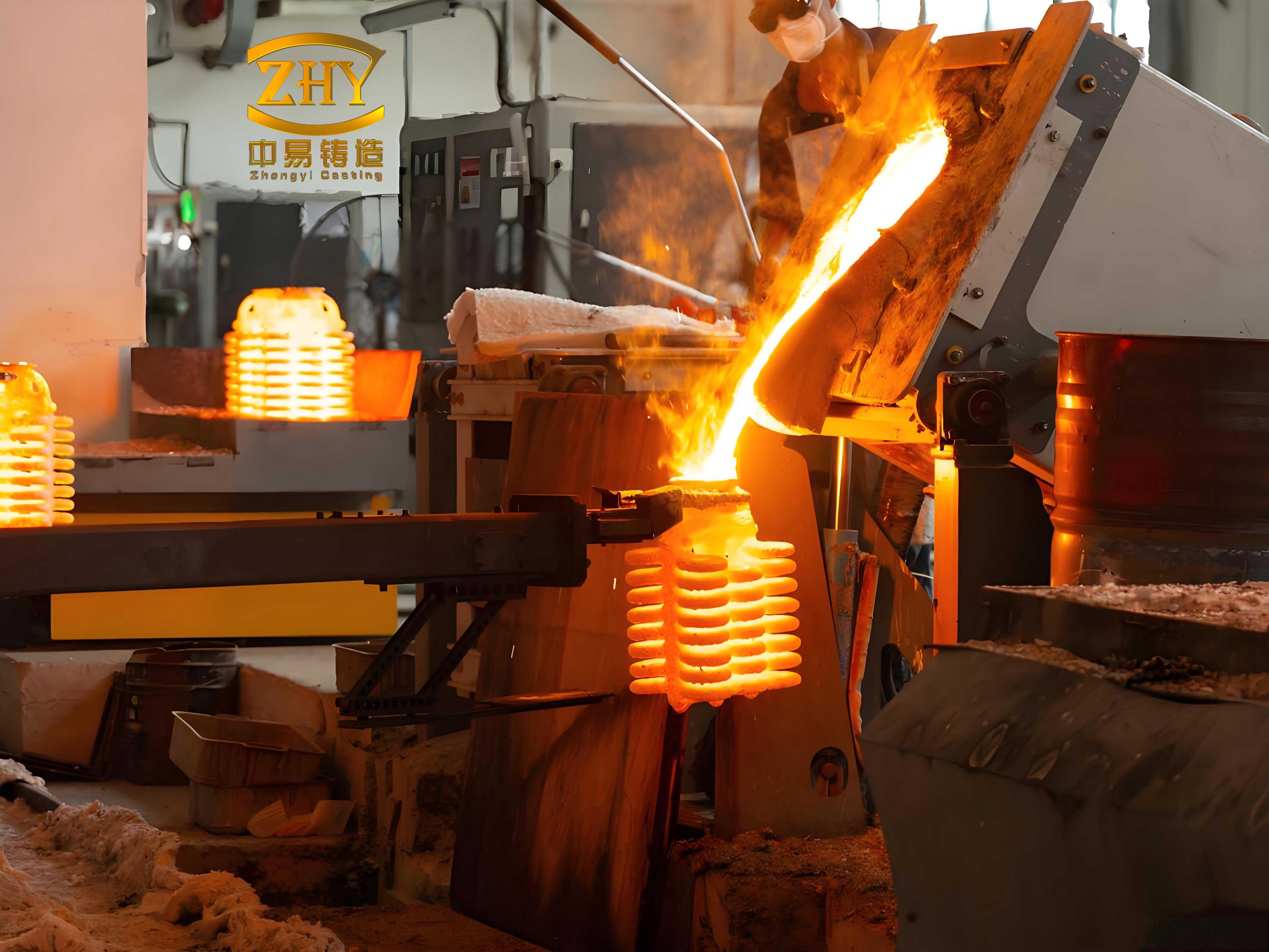
The final metallurgical stage of the investment casting process was governed to support the optimized thermal gradients. The alloy (ZG35CrMnSi) was melted using a medium-frequency induction furnace charged with master alloy bars. The pouring temperature was carefully selected based on the thin section and shell thickness:
$$ T_{pour} = T_{liquidus} + \Delta T_{superheat} $$
where $T_{liquidus}$ for the alloy is approximately 1510°C. A $\Delta T_{superheat}$ of 120±10°C was chosen, resulting in a target pouring temperature of 1630±10°C. This provides sufficient fluidity to fill the thin section without excessive superheat that could promote grain growth or react with the shell.
The shell was pre-fired at 1050±10°C for 50±5 minutes to fully develop ceramic strength and remove volatiles. Pouring occurred promptly after shell removal from the furnace to capitalize on the mold’s heat, which slows initial solidification and aids feeding. After pouring, the entire assembly was placed on a sand bed and insulating exothermic powder was applied to the pour cup. This practice significantly enhances the thermal efficiency of the feeding system by keeping the sprue liquid for an extended period, described by improving the feeding efficiency factor $\eta$ in our earlier modulus equation.
3. Results, Validation, and Broader Implications for the Investment Casting Process
The efficacy of the optimized investment casting process was quantitatively validated through controlled production trials. Two batches of 60 parts each were produced—one using the initial process and one using the fully optimized process (redesigned gating, oriented tree, and refined parameters).
| Metric | Initial Investment Casting Process | Optimized Investment Casting Process |
|---|---|---|
| Total Parts Produced | 60 | 60 |
| Sound Parts (X-Ray Approved) | 6 | 52 |
| Process Yield | 10% | 86.7% |
The results are stark. The initial process, suffering from isolated thermal hotspots and poor feeding, yielded only 10% acceptable castings. The optimized investment casting process, which provided a direct thermal and feeding path to the problematic area while ensuring uniform shell properties, increased the yield to 86.7%. In subsequent high-volume production, with sustained attention to the refined shell-building and pouring parameters, first-pass yield consistently exceeded 95%. This demonstrates the profound impact of a holistic, physics-based approach to the investment casting process.
The principles derived from this case study are widely applicable. They underscore that the investment casting process is not merely a sequence of steps but an integrated system where design, pattern assembly, shell engineering, and metallurgy are deeply interconnected. The key takeaways for engineers designing the investment casting process for complex geometries include:
- Feed the Problem, Not Just the Mass: Gating must be designed to address specific thermal isolation issues, not just the largest obvious hot spots. Direct feeding into thin sections attached to heavier masses is often essential.
- Geometry Dictates Orientation: Tree assembly should always facilitate shell building. Cavities, recesses, and deep pockets must face outward to ensure coating uniformity, proper drying, and inspectability. This is a non-negotiable best practice in a robust investment casting process.
- Shell Thickness is a Critical Process Variable: Uncontrolled local thickening of the shell acts as an insulator, creating unintended thermal profiles that can defeat the best gating design. Process control during dipping and stuccoing is paramount.
- Thermal Management is Holistic: The thermal gradient is controlled from the pattern tree through shell preheat, pouring temperature, and post-pour insulation. Every stage of the investment casting process contributes to the final solidification structure.
In conclusion, overcoming defects in the investment casting process requires moving beyond symptomatic fixes to a systemic analysis of heat flow and mass transfer. By applying fundamental solidification principles—Chvorinov’s Rule, modulus-based feeding, and controlled directional solidification—and coupling them with pragmatic shop-floor practices in tree assembly and shell building, the investment casting process can be optimized to reliably produce sound castings, even for components with challenging geometries and severe wall thickness variations. The success of this optimization hinges on viewing the investment casting process as a unified system where mechanical design and foundry engineering are in constant dialogue.