
In the automotive industry, the exhaust manifold is a critical component of the engine, directly influencing exhaust system efficiency. Traditional materials like cast iron often fail under high temperatures due to oxidation, thermal deformation, and cracking. To address this, advanced austenitic heat-resistant steels, such as those with additions of tungsten and niobium, have been developed, offering superior high-temperature strength, oxidation resistance, and thermal fatigue resistance. Producing complex geometries like exhaust manifolds requires precision manufacturing, and lost wax casting—also known as investment casting—has emerged as a preferred method due to its ability to yield high-dimensional accuracy and low surface roughness. However, in my experience with lost wax casting of heat-resistant steel exhaust manifolds, challenges such as shrinkage defects and low casting yield have persisted, driving the need for process optimization. This article details my first-person investigation into optimizing the lost wax casting process, leveraging simulation and design modifications to enhance quality and efficiency.
The lost wax casting process involves creating a wax pattern, coating it with ceramic shell, dewaxing, and pouring molten metal. For heat-resistant steel exhaust manifolds, the intricate structure—featuring varying wall thicknesses and isolated hot spots—complicates solidification and feeding. Initially, the process design followed a conventional approach: three risers were placed at the bottom flange, and a gating system was set at the convergence of four branch pipes, with vent pipes connecting to the central sprue. The riser volume was 78 cm³, and the sprue volume was 958 cm³. Upon production, defects like shrinkage porosity and cavities were observed at the riser-flange interface, as shown in visual inspections. Moreover, the casting yield—calculated as the ratio of casting weight to total poured weight—was only 38.8%, indicating significant material waste and high costs. Through analysis, I identified that the small riser size limited feeding distance, while the oversized sprue contributed to low yield. This underscored the necessity for a systematic optimization in the lost wax casting process.
To quantify the issues, I analyzed the solidification behavior using fundamental casting principles. The feeding distance in lost wax casting can be estimated using the formula for riser effectiveness: $$ L_f = k \cdot \sqrt{V_r} $$ where \( L_f \) is the feeding distance, \( V_r \) is the riser volume, and \( k \) is a material-dependent constant. For the heat-resistant steel used, with a composition as shown in Table 1, the initial riser volume of 78 cm³ resulted in insufficient \( L_f \), leading to isolated liquid zones in thick sections. Additionally, the solidification time \( t_s \) can be expressed by Chvorinov’s rule: $$ t_s = C \left( \frac{V}{A} \right)^2 $$ where \( V \) is volume, \( A \) is surface area, and \( C \) is a mold constant. In lost wax casting, the ceramic shell properties affect \( C \), but the large sprue volume prolonged cooling in non-critical areas, reducing yield. Table 1 summarizes the material composition, while Table 2 compares initial and optimized parameters.
| Element | C | Si | Mn | S | Cr | Ni | W | Mo | Nb | Fe |
|---|---|---|---|---|---|---|---|---|---|---|
| Weight % | 0.45 | 0.5 | 1.0 | 0.15 | 20.0 | 10.0 | 3.0 | – | 2.0 | Balance |
| Parameter | Initial Design | Optimized Design | Change |
|---|---|---|---|
| Riser Volume (cm³) | 78 | 126 | +61.5% |
| Sprue Volume (cm³) | 958 | 370 | -61.4% |
| Feeding Distance | Limited | Enhanced | Improved |
| Casting Yield | 38.8% | 49.1% | +10.3% |
| Defect Occurrence | High (shrinkage) | Low | Reduced |
The optimization strategy focused on modifying the lost wax casting process to improve feeding and reduce waste. First, I increased the riser volume from 78 cm³ to 126 cm³, which expanded the feeding distance based on the formula \( L_f = k \cdot \sqrt{V_r} \). For instance, if \( k \) is approximately 1.5 for this steel in lost wax casting, the feeding distance increased from about 13.2 cm to 16.8 cm, better covering the flange areas. Second, I reduced the sprue volume from 958 cm³ to 370 cm³ by downsizing its diameter and relocating it to the top of the exhaust pipe, as illustrated in the design schematic. This minimized unnecessary metal usage while maintaining adequate filling. The vent pipes were eliminated to streamline flow. These changes aimed to create a positive temperature gradient, ensuring risers solidify last and effectively feed shrinkage. The lost wax casting process benefits from such adjustments due to its precision nature, where even small geometry tweaks can significantly impact outcomes.
To validate the optimized lost wax casting design, I employed ProCAST simulation software, which models fluid flow, heat transfer, and solidification. The simulation parameters included an interfacial heat transfer coefficient of 800 W/(m²·K) between the casting and ceramic shell, typical for lost wax casting, and radiation effects. The initial design simulation revealed isolated liquid zones at the flange-riser junction, confirming shrinkage defects. As solidification progressed, the temperature distribution showed a negative gradient due to the sprue placement, hindering feeding. The optimized design simulation demonstrated a more uniform cooling pattern, with risers remaining liquid longest, thus acting as effective feeders. The solidification fraction over time can be modeled using the equation: $$ f_s = 1 – e^{-K t} $$ where \( f_s \) is solid fraction, \( K \) is a cooling rate constant, and \( t \) is time. In the optimized lost wax casting process, \( K \) was higher in the sprue area, reducing waste. Visual outputs from ProCAST aligned with experimental findings, providing a virtual confirmation of defect reduction.
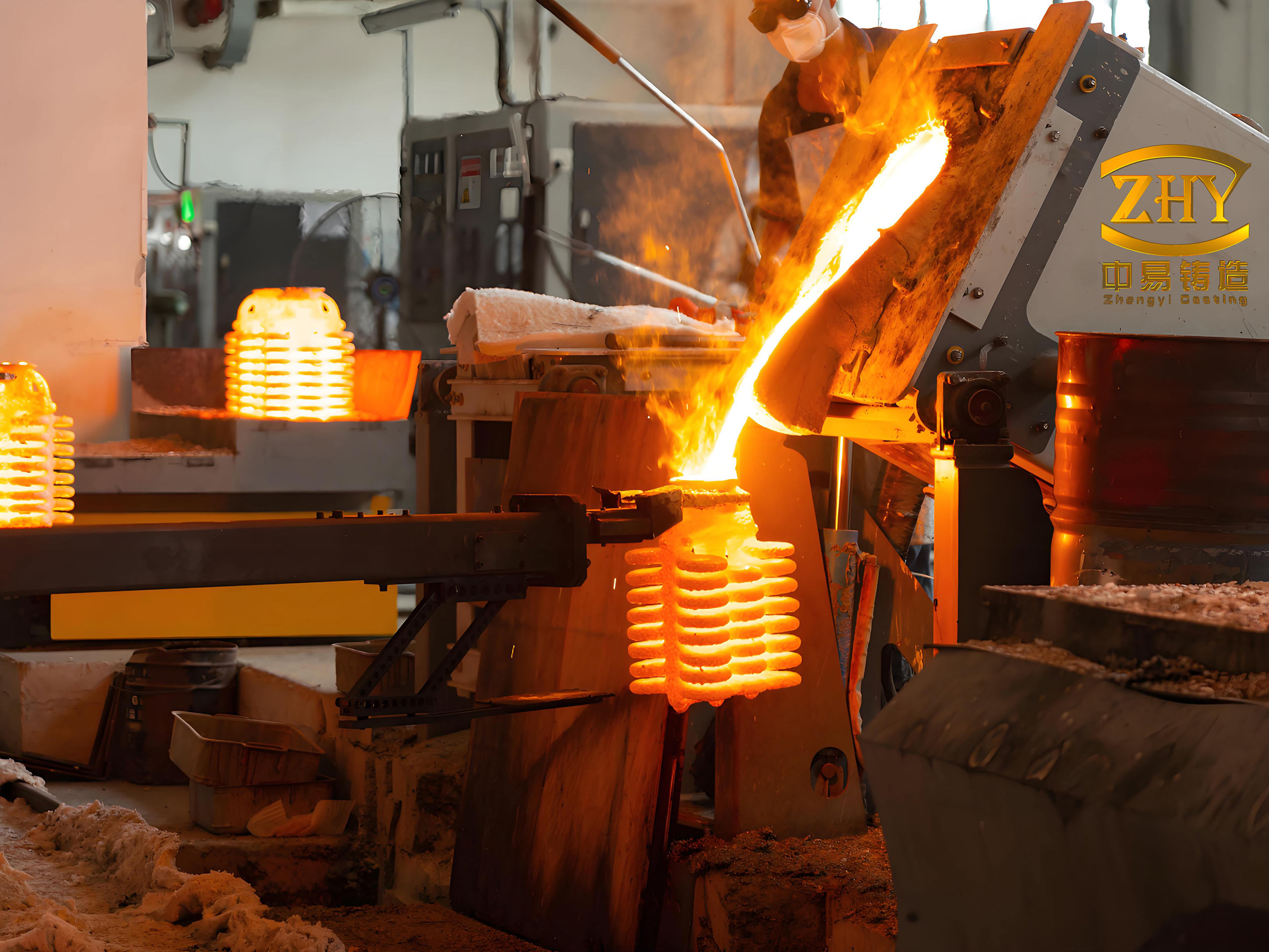
The experimental trial of the optimized lost wax casting process was conducted using standard investment casting techniques. The heat-resistant steel was melted in a medium-frequency induction furnace at 1,620°C, with a ceramic shell preheated to 1,000°C. Pouring time was controlled within 10–15 seconds. After casting and removal of the shell, the manifolds were inspected. The results showed no visible shrinkage pores or cavities at the flange regions, indicating sound casting quality. The casting yield improved from 38.8% to 49.1%, as calculated by: $$ \text{Yield} = \frac{\text{Casting Weight}}{\text{Total Poured Weight}} \times 100\% $$ This increase translates to substantial cost savings in lost wax casting production. Moreover, the surface quality met technical specifications, demonstrating that lost wax casting can achieve high integrity for complex parts when properly optimized. The success underscores the importance of iterative design in lost wax casting, where simulation and practical tweaks converge.
Further analysis involved evaluating the thermal dynamics during lost wax casting. The heat flux \( q \) across the ceramic shell can be expressed as: $$ q = h \cdot (T_m – T_s) $$ where \( h \) is the heat transfer coefficient, \( T_m \) is molten metal temperature, and \( T_s \) is shell temperature. In the optimized design, the reduced sprue volume decreased overall heat content, accelerating solidification in non-critical areas. Additionally, the feeding efficiency \( E_f \) of risers in lost wax casting can be approximated by: $$ E_f = \frac{V_{\text{feed}}}{V_{\text{riser}}} $$ where \( V_{\text{feed}} \) is volume fed to the casting. With larger risers, \( E_f \) improved, minimizing defects. Table 3 summarizes key thermal and feeding parameters for both designs, highlighting how lost wax casting optimization enhances performance.
| Parameter | Initial Design | Optimized Design | Impact on Lost Wax Casting |
|---|---|---|---|
| Heat Transfer Coefficient (W/(m²·K)) | 800 | 800 | Consistent shell interaction |
| Solidification Time (s) | Longer in sprue | Shorter in sprue | Improved yield |
| Feeding Efficiency | Low (≈0.6) | High (≈0.8) | Reduced shrinkage |
| Temperature Gradient (°C/cm) | Negative | Positive | Better feeding direction |
In discussing the broader implications, lost wax casting for heat-resistant components like exhaust manifolds requires balancing geometry constraints with metallurgical needs. The optimization here increased riser size by 61.5% and decreased sprue volume by 61.4%, which are significant changes achievable only through precise lost wax casting techniques. The use of ProCAST simulation was instrumental, allowing visualization of defects without physical trials. This aligns with industry trends where lost wax casting integrates digital tools for efficiency. Moreover, the material savings from higher yield contribute to sustainable manufacturing, a key advantage of lost wax casting. The formula for economic impact can be sketched as: $$ \text{Cost Savings} = (Y_{\text{opt}} – Y_{\text{init}}) \times M \times P $$ where \( Y \) is yield, \( M \) is metal mass per casting, and \( P \) is material price. For large-scale production in lost wax casting, this optimization could lead to substantial financial benefits.
To conclude, this first-person exploration into optimizing lost wax casting for heat-resistant steel exhaust manifolds demonstrates that strategic design modifications—enlarging risers, reducing sprue size, and relocating gating—can resolve shrinkage defects and boost casting yield from 38.8% to 49.1%. The lost wax casting process, with its inherent precision, is highly responsive to such tweaks, especially when supported by simulation software like ProCAST. The findings emphasize that in lost wax casting, feeding distance and thermal management are critical; the derived formulas and tabulated data provide a framework for similar applications. Future work could explore advanced alloys or faster cooling shells in lost wax casting. Overall, lost wax casting remains a vital method for complex parts, and continuous optimization, as detailed here, ensures its competitiveness in high-performance industries.