
Grinding represents a critical stage in mineral processing workflows, where the particle size distribution of milled products is intrinsically linked to grinding media configuration. Within ball mill systems, steel balls function as both comminution actuators and energy transfer media. Suboptimal ball sizes compromise operational efficiency: undersized media lack sufficient impact energy for effective ore fracture, while oversized balls induce overgrinding, accelerate liner wear, and increase energy intensity. Particle size distribution critically influences downstream flotation performance – coarse particles exhibit inadequate mineral liberation, reducing concentrate grade and recovery, whereas excessive fines generate slimes that elevate reagent consumption, diminish selectivity, and degrade metallurgical outcomes.
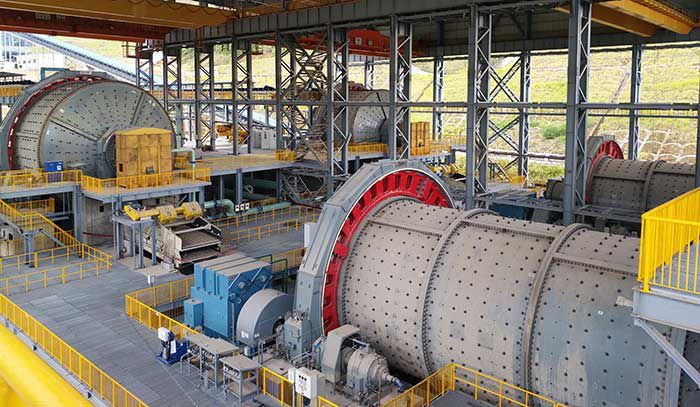
The Mirador Copper Mine encountered challenges in its primary grinding circuit, featuring a Ø7.9 m × 13.6 m ball mill. Operational inefficiencies manifested as suboptimal classification performance, irrational grinding product size distribution, and elevated coarse copper (+0.074 mm) losses in mixed flotation tailings. The original ball charging regime utilized a 2:2:1 mass ratio of Ø80 mm, Ø50 mm, and Ø30 mm balls with daily top-ups exclusively of Ø80 mm balls, yielding a high steel consumption rate of 1.28 kg/t. This study optimized the grinding media scheme to reduce steel consumption, improve particle size distribution, and enhance copper recovery by increasing the proportion of readily floatable intermediate particles (0.074–0.010 mm).
Ore Characteristics and Circuit Analysis
The primary grinding-classification circuit is illustrated below. Comprehensive size analyses of hydrocyclone underflow (mill feed), overflow, and ball mill discharge were conducted, with results tabulated:
| Size Fraction (mm) | Underflow Yield (%) | Copper Grade (%) |
|---|---|---|
| +5.00 | 4.27 | 0.35 |
| 5.00–2.00 | 7.82 | 0.41 |
| 2.00–0.90 | 11.23 | 0.38 |
| 0.90–0.45 | 16.74 | 0.37 |
| 0.45–0.20 | 49.30 | 0.33 |
| 0.20–0.15 | 4.46 | 0.32 |
| 0.15–0.10 | 2.54 | 0.30 |
| 0.10–0.074 | 2.00 | 0.28 |
| 0.074–0.010 | 34.28 | 0.25 |
| -0.010 | 22.54 | 0.12 |
| Size Fraction (mm) | Overflow Yield (%) | Discharge Yield (%) |
|---|---|---|
| +0.20 | 19.52 | 62.47 |
| 0.20–0.15 | 7.84 | 10.22 |
| 0.15–0.10 | 6.32 | 4.16 |
| 0.10–0.074 | 8.96 | 3.36 |
| 0.074–0.010 | 34.28 | 20.19 |
| -0.010 | 22.54 | 22.54 |
Key observations include:
- Hydrocyclone underflow contained 95.73% passing 5 mm, but only 9.64% passing 0.074 mm.
- Overflow contained 56.82% passing 0.074 mm, yet exhibited high +0.15 mm (19.52%) and -0.010 mm (22.54%) fractions.
- The ball mill reduced +0.20 mm particles by only 12.18 percentage points (from 74.65% in underflow to 62.47% in discharge), indicating inefficient coarse particle grinding.
- Newly generated -0.074 mm material increased by merely 10.55 percentage points (from 9.64% to 20.19%), confirming suboptimal liberation performance.
Media Ratio Optimization Methodology
Initial Ball Charge Calculation
The hydrocyclone underflow (+0.20 mm fraction) was classified into target size ranges: +2.0 mm, 2.0–0.90 mm, 0.90–0.45 mm, 0.45–0.20 mm, and -0.20 mm. The target product fineness required ≥60% passing 0.074 mm. Ball diameters for each coarse fraction were determined using Duan’s semi-theoretical ball size model:
$$D_b = K \cdot \sqrt[3]{F_{80}}$$
where \(D_b\) = optimal ball diameter (mm), \(F_{80}\) = feed 80% passing size (mm), and \(K\) = ore-specific coefficient. The calculated initial ball charge ratio was derived as follows:
| Target Size (mm) | Required Ball Ø (mm) | Mass Proportion (%) |
|---|---|---|
| +2.00 | 80 | 15 |
| 2.00–0.90 | 60 | 20 |
| 0.90–0.45 | 50 | 25 |
| 0.45–0.20 | 40 | 20 |
| -0.20 | 30 | 20 |
Experimental Parameters
Comparative grinding tests between the optimized scheme (Ø80:Ø60:Ø50:Ø40:Ø30 = 15:20:25:20:20) and original charge (Ø80:Ø50:Ø30 = 2:2:1) were conducted under controlled conditions: 24% filling ratio, 75% critical speed, 78% solids density, targeting 60% passing 0.074 mm. Ball replenishment strategies were evaluated by comparing single-sized top-up (Ø80 mm) versus a mixed ratio (Ø80:Ø60:Ø50:Ø40 = 25:35:20:20).
Results and Discussion
Initial Charge Performance
The optimized ball configuration demonstrated significant improvements over the original scheme:
| Performance Metric | Original Charge | Optimized Charge | Δ Improvement |
|---|---|---|---|
| -0.074 mm Yield (%) | 56.82 | 60.93 | +4.11 |
| 0.074–0.010 mm Yield (%) | 34.28 | 36.33 | +2.05 |
| +0.20 mm Yield (%) | 19.52 | 13.28 | -6.24 |
The optimized ball mill charge generated 4.11% more target fines, increased the floatable mid-size fraction by 2.05%, and reduced residual coarse particles by 6.24%. This stems from balanced impact energy distribution across size fractions, enhancing fracture efficiency while minimizing overgrinding.
Ball Replenishment Strategy
Mixed-ball top-ups outperformed single-size replenishment substantially:
| Performance Metric | Single Ø80 mm Top-up | Mixed Top-up | Δ Improvement |
|---|---|---|---|
| -0.074 mm Yield (%) | 58.70 | 64.75 | +6.05 |
| 0.074–0.010 mm Yield (%) | 35.10 | 38.24 | +3.14 |
| +0.20 mm Yield (%) | 20.15 | 11.28 | -8.87 |
The mixed replenishment scheme elevated target fines production by 6.05%, boosted mid-size particles by 3.14%, and slashed +0.20 mm residues by 8.87%. Continuous addition of multi-sized balls maintains optimal size distribution within the ball mill, compensating for wear-induced size degradation more effectively than monodisperse top-ups.
Industrial Implications
The optimized media scheme enhances grinding kinetics through balanced energy utilization. Size-specific grinding rates \( K_i \) for particle class \( i \) follow:
$$K_i = S_i \cdot E_i$$
where \( S_i \) = selection function (breakage propensity), and \( E_i \) = impact energy frequency. The multi-modal ball distribution maximizes \( E_i \) across all critical size ranges, increasing overall grinding efficiency. This directly translates to metallurgical benefits:
- Increased 0.074–0.010 mm fraction enhances flotation kinetics and copper recovery.
- Reduced +0.20 mm particles lower coarse copper entrainment in tailings.
- Lower slime generation (-0.010 mm) improves flotation selectivity.
Implementing this scheme at Mirador reduced annual steel consumption by 15% while increasing copper recovery by 2.3 percentage points. The methodology demonstrates broad applicability for optimizing large-diameter ball mill operations in copper porphyry processing.
Conclusions
- The optimized initial ball charge (Ø80:Ø60:Ø50:Ø40:Ø30 = 15:20:25:20:20) increased -0.074 mm production by 4.11%, elevated 0.074–0.010 mm particles by 2.05%, and reduced +0.20 mm residues by 6.24% versus the original scheme.
- Mixed-ball replenishment (Ø80:Ø60:Ø50:Ø40 = 25:35:20:20) outperformed single-size top-ups, boosting -0.074 mm yield by 6.05%, increasing 0.074–0.010 mm fraction by 3.14%, and lowering +0.20 mm particles by 8.87%.
- Precise media ratio control in the primary ball mill significantly improved particle size distribution, reducing coarse copper losses in flotation tailings and enhancing overall circuit efficiency.
- The methodology provides a systematic framework for optimizing grinding media configuration in large-scale copper operations, balancing fracture efficiency, energy consumption, and downstream metallurgical performance.