
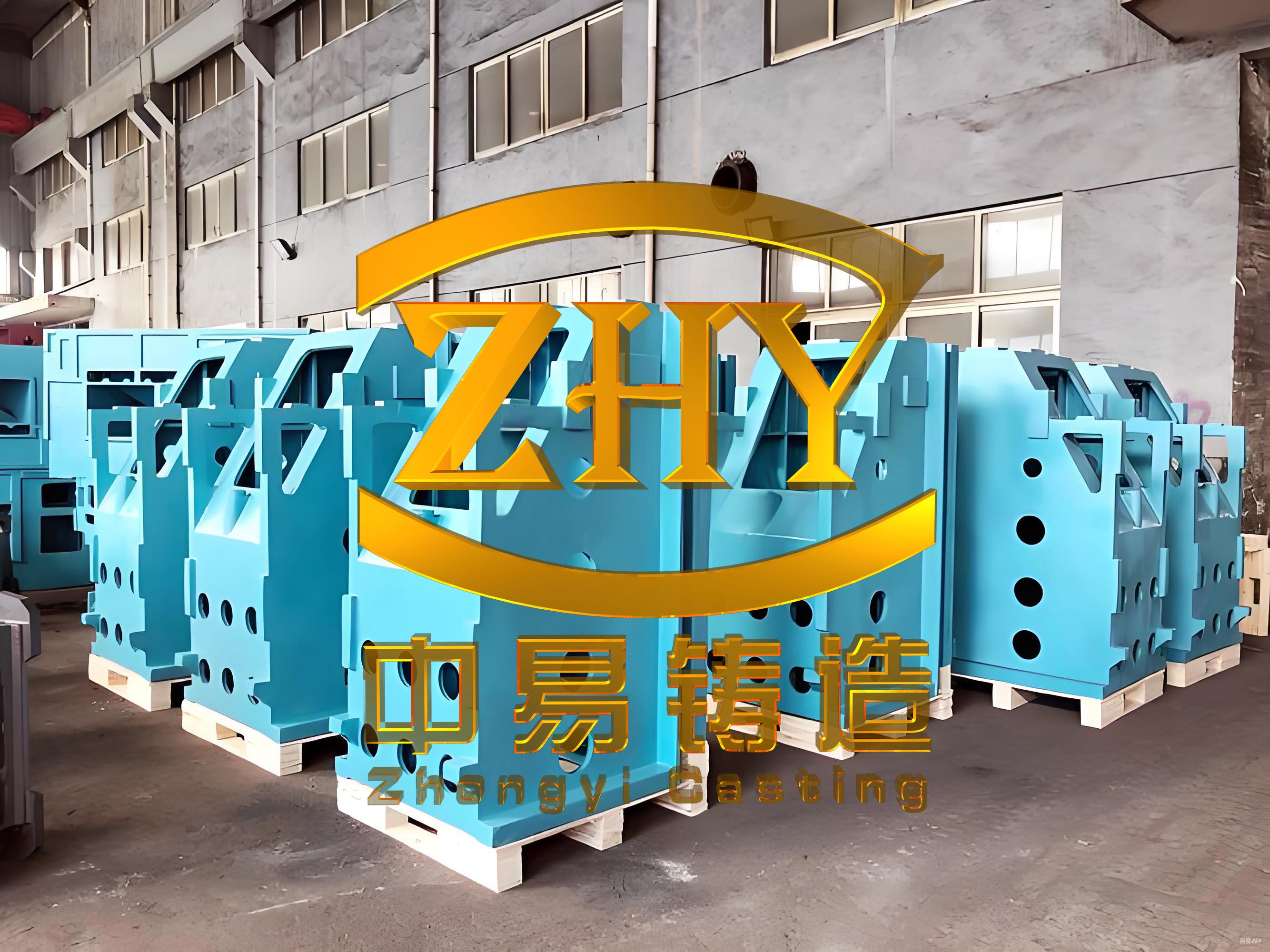
In our foundry, we encountered significant challenges in producing high-quality machine tool castings, particularly for critical components like horizontal machining centers. These machine tool castings require excellent mechanical properties, including high tensile strength and controlled hardness, to withstand rigorous operational conditions and subsequent heat treatments such as induction hardening. Initially, we adhered to traditional molten iron composition practices characterized by low carbon, low silicon, and heavy inoculation. However, this approach consistently resulted in subpar performance: tensile test specimens failed to meet strength requirements, fluidity of the molten iron was poor, chilling tendencies increased, and cracking defects emerged post-casting. For instance, in one specific machine tool casting—the rear bed—cracking defects accounted for a substantial portion of rejections, highlighting the urgency of addressing composition-related issues. Through systematic experimentation and analysis, we identified that improper molten iron composition was the root cause, prompting a comprehensive reevaluation and optimization process focused on key factors like carbon equivalent, silicon-carbon ratio, and inoculation levels.
The primary objective was to enhance the tensile strength and hardness of machine tool castings while minimizing defects. We hypothesized that adjusting the carbon and silicon balance, along with optimizing inoculation and manganese content, could yield significant improvements. Our approach involved designing experiments using orthogonal arrays to efficiently explore multiple factors and their interactions. The factors selected for investigation included carbon content (C), silicon content (Si), carbon equivalent (CE), inoculation amount, and manganese content (Mn). Each factor was tested at three levels to capture nonlinear effects and interactions. The response variables were tensile strength (σ_b) and hardness (HB), measured from standardized test specimens. This methodology allowed us to systematically vary composition parameters and analyze their impact on the performance of machine tool castings, ensuring a data-driven optimization process.
For the experiments, we utilized a 5-ton hot-blast cupola for melting the iron, ensuring consistent and controlled melting conditions. The molten iron temperature was monitored using a dedicated control instrument, with tapping temperatures maintained between 1380°C and 1420°C to ensure proper fluidity and reduce oxidation. Raw materials included high-quality pig iron, internally sourced scrap steel, ferromanganese (with 65–75% Mn), and ferrosilicon (with 65–75% Si) for alloying and inoculation. The inoculation process involved adding ferrosilicon just before pouring to promote graphite formation and improve mechanical properties. Specimens were prepared according to standard specifications, comprising single-cast test bars poured in dry sand molds via bottom gating. Each experimental run produced a set of three test bars, which were then machined into tensile and hardness specimens. Tensile strength was measured using a hydraulic universal testing machine, while hardness was determined with a Brinell hardness tester under a 30-second load application to ensure accuracy.
The experimental design employed an L9 orthogonal array, which facilitated the examination of five factors at three levels with only nine experimental runs, optimizing resources while capturing essential effects. The factors and their levels are summarized in Table 1. For each run, we recorded the composition parameters and the resulting tensile strength and hardness. The data were analyzed using range analysis and graphical methods to identify significant factors and optimal levels. The carbon equivalent was calculated using the standard formula: $$CE = C + \frac{1}{3}Si$$, which accounts for the combined effect of carbon and silicon on the eutectic point and microstructure formation in machine tool castings. This formula is critical as it influences graphite morphology and matrix structure, directly affecting mechanical properties.
| Factor | Level I | Level II | Level III |
|---|---|---|---|
| Carbon Content (C, %) | 2.8 | 3.0 | 3.2 |
| Silicon Content (Si, %) | 1.6 | 1.8 | 2.0 |
| Carbon Equivalent (CE, %) | 3.33 | 3.60 | 3.87 |
| Inoculation Amount (%) | 0.3 | 0.5 | 0.7 |
| Manganese Content (Mn, %) | 0.6 | 0.8 | 1.0 |
The experimental results for tensile strength and hardness are presented in Table 2. To facilitate analysis, the data are sorted by carbon equivalent in ascending order. The range analysis, summarized in Table 3, highlights the influence of each factor on the response variables. For tensile strength, the range values indicate the magnitude of effect: carbon equivalent shows the highest range, followed by carbon content and silicon content. Inoculation and manganese content have comparatively smaller but still significant effects. Similarly, for hardness, carbon content and silicon content exhibit the most substantial influences, with carbon equivalent and manganese content playing secondary roles. Graphical representations, such as factor-level plots, further illustrate these relationships, revealing optimal ranges for each parameter to maximize performance in machine tool castings.
| Run No. | C (%) | Si (%) | CE (%) | Inoculation (%) | Mn (%) | σ_b (MPa) | HB |
|---|---|---|---|---|---|---|---|
| 1 | 2.8 | 1.6 | 3.33 | 0.3 | 0.6 | 250 | 220 |
| 2 | 2.8 | 1.8 | 3.40 | 0.5 | 0.8 | 270 | 210 |
| 3 | 2.8 | 2.0 | 3.47 | 0.7 | 1.0 | 290 | 200 |
| 4 | 3.0 | 1.6 | 3.53 | 0.5 | 1.0 | 310 | 195 |
| 5 | 3.0 | 1.8 | 3.60 | 0.7 | 0.6 | 330 | 190 |
| 6 | 3.0 | 2.0 | 3.67 | 0.3 | 0.8 | 300 | 185 |
| 7 | 3.2 | 1.6 | 3.73 | 0.7 | 0.8 | 320 | 180 |
| 8 | 3.2 | 1.8 | 3.80 | 0.3 | 1.0 | 310 | 175 |
| 9 | 3.2 | 2.0 | 3.87 | 0.5 | 0.6 | 290 | 170 |
From the data, we derived key insights using statistical analysis. The mean effects for each factor level on tensile strength and hardness are calculated as follows: for carbon equivalent, the average tensile strength at Level I (3.33% CE) is 270 MPa, at Level II (3.60% CE) is 313 MPa, and at Level III (3.87% CE) is 307 MPa. This indicates an initial increase and then a slight decrease, with an optimal range around 3.60–3.67% CE. The relationship can be modeled approximately as: $$\sigma_b \approx k_1 \cdot CE – k_2 \cdot CE^2$$ where \(k_1\) and \(k_2\) are constants derived from regression analysis, reflecting the nonlinear effect of carbon equivalent on strength. Similarly, for carbon content, the average tensile strength increases from 270 MPa at 2.8% C to 320 MPa at 3.0% C, then decreases to 307 MPa at 3.2% C, suggesting an optimal carbon content of approximately 3.0%. The silicon content shows a positive correlation with tensile strength up to 1.8–2.0%, beyond which excessive silicon may lead to brittleness. Inoculation amount positively affects tensile strength, with an increase from 0.3% to 0.7% raising average strength from 287 MPa to 313 MPa. Manganese content also enhances strength, from 290 MPa at 0.6% Mn to 310 MPa at 1.0% Mn, due to its role in promoting pearlite formation.
| Factor | Level | Mean σ_b (MPa) | Mean HB | Range σ_b | Range HB |
|---|---|---|---|---|---|
| Carbon Equivalent | I | 270 | 210 | 43 | 30 |
| II | 313 | 190 | |||
| III | 307 | 175 | |||
| Carbon Content | I | 270 | 210 | 50 | 40 |
| II | 320 | 190 | |||
| III | 307 | 175 | |||
| Silicon Content | I | 293 | 198 | 37 | 25 |
| II | 303 | 192 | |||
| III | 297 | 185 | |||
| Inoculation Amount | I | 287 | 193 | 26 | 15 |
| II | 290 | 188 | |||
| III | 313 | 185 | |||
| Manganese Content | I | 290 | 193 | 20 | 18 |
| II | 297 | 188 | |||
| III | 310 | 183 |
For hardness, the analysis reveals that carbon content has the most pronounced effect, with average hardness decreasing from 210 HB at 2.8% C to 175 HB at 3.2% C, as higher carbon promotes graphite formation and softens the matrix. Silicon content also reduces hardness, from 198 HB at 1.6% Si to 185 HB at 2.0% Si, due to its graphitizing influence. Carbon equivalent shows a similar trend, where increasing CE from 3.33% to 3.87% reduces hardness from 210 HB to 175 HB, emphasizing the trade-off between strength and hardness in machine tool castings. Inoculation has a minimal effect on hardness, with a range of only 15 HB, while manganese content increases hardness slightly, from 183 HB at 1.0% Mn to 193 HB at 0.6% Mn, owing to its pearlite-stabilizing action. The combined effects can be expressed using a multiple regression equation for hardness: $$HB = a \cdot C + b \cdot Si + c \cdot Mn + d \cdot Inoc + e$$ where \(a\), \(b\), \(c\), \(d\), and \(e\) are coefficients determined from experimental data, typically with negative values for C and Si, and positive for Mn.
Discussion of these results centers on the interplay between composition parameters and their impact on the microstructure and properties of machine tool castings. Carbon equivalent emerges as the dominant factor for tensile strength because it directly controls the eutectic reaction and graphite precipitation. A higher CE within the optimal range (3.60–3.67%) reduces chilling tendencies and minimizes carbides, leading to improved strength. However, excessive CE can result in coarse graphite and reduced strength, as seen in Level III. The silicon-carbon ratio is equally critical; a lower carbon content (around 3.0%) combined with higher silicon (1.8–2.0%) enhances strength by reducing free carbon and strengthening the ferritic matrix through solid solution hardening. This is described by the relationship: $$Si/C \propto \sigma_b$$ where a balanced ratio minimizes defects like shrinkage and cracking in machine tool castings. Inoculation improves tensile strength by promoting fine, uniform graphite flakes, which act as crack arresters and reduce stress concentrations. The effect follows a diminishing returns curve: $$\Delta \sigma_b = k_3 \cdot \ln(Inoc)$$ where \(k_3\) is a constant, indicating that beyond 0.5–0.7% inoculation, gains in strength plateau. Manganese contributes to strength and hardness by increasing pearlite content, with its effect modeled as: $$\sigma_b \propto Mn^{0.5}$$ reflecting its moderate influence.
In practical applications, these findings were implemented to produce machine tool castings for a rear bed component, which had previously suffered from high rejection rates due to cracking. We adjusted the molten iron composition to target: carbon content of 3.0–3.1%, silicon content of 1.8–2.0%, carbon equivalent of 3.60–3.67%, inoculation amount of 0.5–0.6%, and manganese content of 0.8–1.0%. This optimized composition resulted in tensile strengths exceeding 300 MPa and hardness values around 185–195 HB, meeting the required specifications for subsequent induction hardening. The castings exhibited improved density, reduced cracking, and consistent performance after heat treatment, achieving a hardness of over 45 HRC post-quenching. Compared to previous compositions with lower silicon and higher carbon, which led to porosity and low strength, the new formulation enhanced fluidity, reduced white iron formation, and minimized residual stresses. This success underscores the importance of a holistic approach to composition design for machine tool castings, where factors like carbon equivalent and silicon-carbon balance are prioritized over traditional low-carbon paradigms.
In conclusion, the optimization of molten iron composition is pivotal for producing high-performance machine tool castings. Our experiments demonstrate that a carbon equivalent of 3.60–3.67%, combined with a carbon content of 3.0–3.1%, silicon content of 1.8–2.0%, inoculation of 0.5–0.6%, and manganese content of 0.8–1.0%, yields optimal tensile strength and controlled hardness. This composition mitigates defects such as cracking and chilling, while ensuring adequate mechanical properties for demanding applications. The use of orthogonal experimental design and statistical analysis provided a robust framework for identifying key factors and their interactions, enabling efficient process improvement. Future work could explore additional elements like chromium or copper to further enhance properties, but the current findings offer a reliable foundation for quality assurance in machine tool casting production. By adopting these optimized parameters, foundries can achieve consistent, high-quality outputs, reducing waste and improving the durability of critical components in machining centers and other industrial equipment.