
This study focuses on the precision investment casting process optimization of ZL114A alloy seal sleeves through numerical simulation and experimental validation. The methodology addresses critical challenges in producing complex thin-walled components with stringent metallurgical requirements.
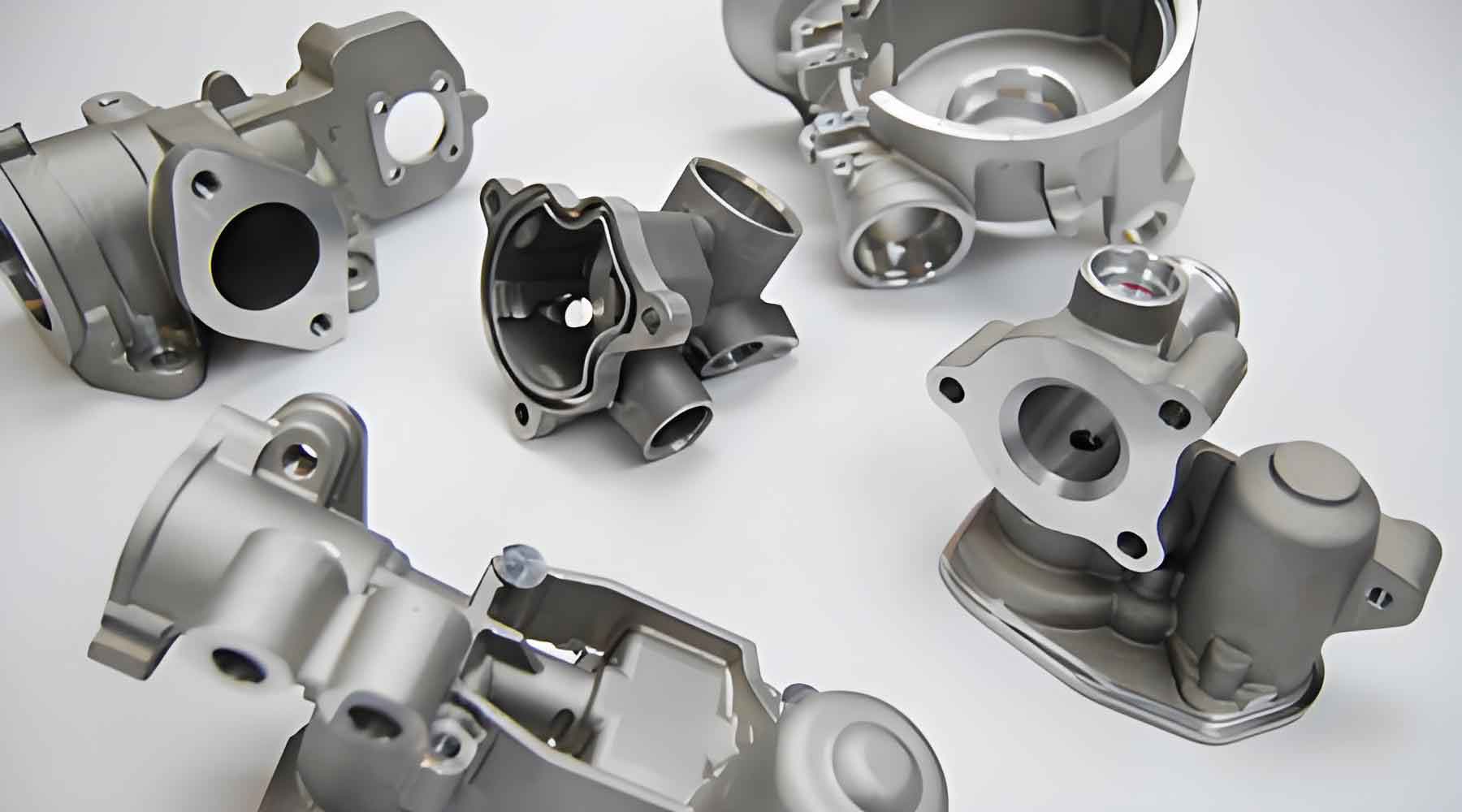
1. Structural Analysis and Process Design
The seal sleeve features a cylindrical geometry (ø390 mm × 127 mm) with non-uniform wall thickness ranging from 1.08 mm to 13 mm. Precision investment casting was selected for its ability to maintain dimensional accuracy (±0.15 mm) and surface finish (Ra ≤ 3.2 μm). Key process parameters include:
| Parameter | Value |
|---|---|
| Pouring Temperature | 710°C |
| Shell Preheating | 300°C |
| Cooling Medium | Air (Initial Process) |
The thermal gradient during solidification follows Fourier’s law of heat conduction:
$$ \frac{\partial T}{\partial t} = \alpha \nabla^2 T $$
where α represents thermal diffusivity (2.34 × 10⁻⁵ m²/s for ZL114A).
2. Numerical Simulation of Air Cooling Process
ProCAST simulations revealed critical solidification behavior:
| Defect Location | Porosity Risk (%) |
|---|---|
| Flange Sections | 23.7 |
| Thin-Wall Transition | 18.9 |
The Niyama criterion predicts shrinkage porosity:
$$ NY = \frac{G}{\sqrt{\dot{T}}} $$
where G is thermal gradient (°C/mm) and $\dot{T}$ is cooling rate (°C/s). Critical values below 1.0 indicate high porosity risk.
3. Experimental Validation
Thermal profiling confirmed simulation accuracy:
| Measurement Point | Simulation (°C) | Experimental (°C) |
|---|---|---|
| Flange Center | 582 | 575 |
| Mid-Wall | 618 | 623 |
The solidification time equation explains defect formation:
$$ t_f = \frac{(T_p – T_m)^2}{\pi \alpha \left( \frac{\partial T}{\partial x} \right)^2} $$
where $T_p$ is pouring temperature and $T_m$ is melting point.
4. Forced Air Cooling Optimization
Implementing forced convection (2.5 m/s airflow) improved solidification control:
| Parameter | Air Cooling | Forced Air |
|---|---|---|
| Cooling Rate | 12°C/s | 23°C/s |
| Porosity Index | 0.82 | 1.24 |
The enhanced heat transfer follows Newton’s cooling law:
$$ q” = h(T_s – T_\infty) $$
where h increased from 85 W/m²K to 210 W/m²K through forced convection.
5. Metallurgical Quality Improvement
Final process parameters achieved:
| Quality Metric | Result |
|---|---|
| X-Ray Inspection | ASTM E505 Level 1 |
| Leakage Rate | < 1×10⁻⁹ mbar·L/s |
The success of this precision investment casting optimization demonstrates that proper thermal management enables production of complex aluminum alloy components with:
$$ \sigma_{UTS} \geq 310\ MPa,\ \varepsilon \geq 4\% $$
meeting aerospace sealing requirements.