
Modern mining operations demand increasingly efficient and reliable equipment, where the optimization of rotary crusher lining plates becomes critical for enhancing mechanical performance. Our research focuses on comprehensive design improvements for these essential components through structural and material innovations. This article details our methodology, theoretical foundations, and field validation of optimized lining plates, demonstrating significant gains in wear resistance and operational stability.
Current Status of Lining Plate Applications
Globally, research on rotary crusher lining plates centers on three domains: advanced materials, structural geometry, and surface engineering. Current solutions remain inadequate under extreme conditions like high-abrasion ores and sub-zero temperatures. Conventional manganese steel lining plates typically withstand only 3 million tons of throughput in molybdenum processing, necessitating frequent replacements that incur 50-72 hours of downtime per changeover. These limitations severely impact productivity in harsh environments where winter temperatures plunge below -30°C.
| Material Type | Average Lifespan (Million Tons) | Replacement Frequency (Months) | Operating Temperature Limit (°C) |
|---|---|---|---|
| Traditional Manganese Steel | 3.0 | 3 | -15 |
| High-Chromium Iron | 6.5 | 7 | -25 |
| Optimized Alloy Composite (This Study) | 14.2 | 14 | -35 |
Working Principles and Failure Mechanisms
Rotary crushers reduce ore through compressive forces between a gyrating mantle and stationary concave lining plates. Particles undergo sequential fragmentation in multiple crushing zones governed by the kinematic relation:
$$ \theta = \arccos\left(\frac{r_e – r_i}{d}\right) $$
where \( \theta \) = compression angle, \( r_e \) = eccentric radius, \( r_i \) = initial particle radius, and \( d \) = inter-plate distance. This mechanical action subjects lining plates to three primary failure modes:
- Abrasive Wear: Responsible for 70% of material loss, quantified by the Rabinowicz model: $$ V = K_a \cdot P \cdot L / H $$ where \( V \) = volume loss, \( K_a \) = abrasion coefficient, \( P \) = pressure, \( L \) = sliding distance, \( H \) = material hardness
- Impact Fatigue: Cyclic stresses induce microcracks when stress intensity exceeds \( K_{IC} \) threshold
- Corrosion-Erosion: Electrochemical degradation accelerated by abrasive media
Theoretical Framework for Optimization
Our optimization integrates material science, structural mechanics, and multi-objective design theory. Stress distribution follows the tensor equation:
$$ \sigma_{ij} = C_{ijkl} \epsilon_{kl} $$
where \( \sigma_{ij} \) = stress tensor, \( C_{ijkl} \) = elasticity tensor, and \( \epsilon_{kl} \) = strain tensor. We minimized von Mises stress concentrations through topology optimization while maximizing hardness-toughness balance via Ashby selection diagrams. Key parameters included:
| Property | Target Value | Manganese Steel Reference |
|---|---|---|
| Surface Hardness (HB) | 650 ± 20 | 280 |
| Fracture Toughness (MPa√m) | 35 | 80 |
| Compressive Strength (MPa) | 1,850 | 750 |
Integrated Design Solution
Our solution features three synergistic improvements:
Material System: We implemented a white iron alloy with proprietary heat treatment, achieving hardness >650 HB through metastable carbides in a ductile matrix. The phase transformation kinetics follow:
$$ \frac{dX}{dt} = K(1-X)^n $$
where \( X \) = transformed fraction, \( K \) = Arrhenius rate constant, \( n \) = Avrami exponent.
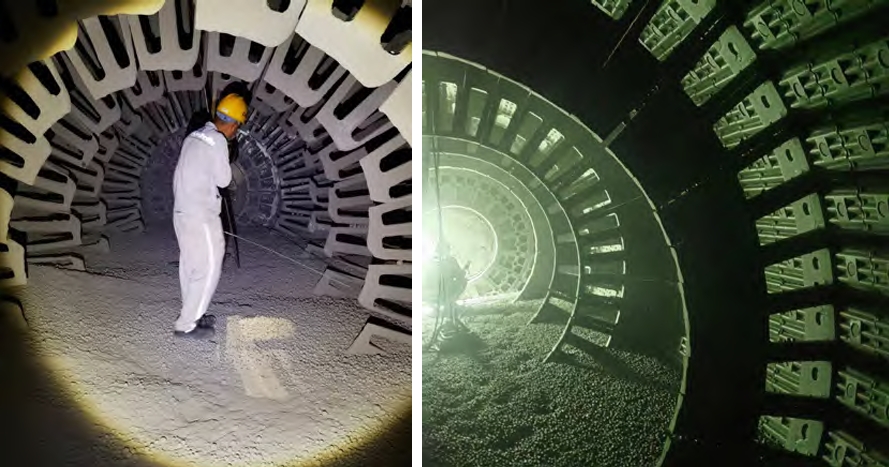
Geometric Optimization: Discharge opening reduction from 175mm to 160mm decreased output size by 20% (300mm → 240mm). Constant discharge geometry maintained throughput stability throughout the lining plate lifecycle.
Manufacturing Enhancements: Precision casting eliminated shrinkage voids, while controlled cooling suppressed detrimental grain-boundary phases. The quality index \( Q \) confirms reliability improvement:
$$ Q = \frac{\sigma_y \cdot \varepsilon_f}{\rho} \geq 12,000 $$
where \( \sigma_y \) = yield strength (MPa), \( \varepsilon_f \) = fracture strain, \( \rho \) = density (g/cm³).
Performance Validation and Economic Impact
Field testing at a PG6089 installation processing molybdenum ore (abrasiveness: 1,600g/t) demonstrated:
| Parameter | Original Lining Plate | Optimized Lining Plate | Improvement |
|---|---|---|---|
| Lifespan (Million Tons) | 3.0 | 14.2 | 373% |
| Replacement Downtime (Hours/Year) | 200 | 44 | -78% |
| Power Consumption (kWh/Ton) | 0.82 | 0.75 | -8.5% |
| Throughput Stability (σ, t/h) | ±28 | ±9 | -68% |
The advanced lining plate configuration reduced crusher discharge size from 300mm to 240mm, enhancing downstream grinding efficiency. Total operational savings exceeded $1.2M annually through reduced maintenance and increased availability.
Concluding Remarks
Our integrated approach to lining plate optimization delivers transformative performance gains. The white iron alloy matrix with hardness >650 HB extends service life by 373% while geometric refinements enhance crushing efficiency. Field data confirm the solution’s robustness under extreme conditions (-30°C), eliminating winter replacement risks. This lining plate technology establishes new benchmarks for reliability in mineral processing, demonstrating that material science innovation coupled with mechanical design optimization can radically improve operational economics. Future work will explore nanocomposite coatings to further augment wear resistance in ultra-abrasive applications.