
This study investigates the application of orthogonal experimental design and numerical simulation to optimize steel casting parameters for railway couplers, addressing critical challenges in shrinkage porosity control and mechanical performance enhancement. The integration of thermal-stress coupling models with microstructure prediction provides a systematic approach for industrial production of high-integrity steel castings.
1. Thermal-Physical Modeling of Steel Casting Process
The casting process of ZG25MnCrNiMo steel couplers was simulated using ProCAST software with the following governing equations:
Heat transfer equation:
$$ \rho c_p \frac{\partial T}{\partial t} = \nabla \cdot (k \nabla T) + Q_{\text{latent}} $$
where \( T \) represents temperature, \( \rho \) density, \( c_p \) specific heat, \( k \) thermal conductivity, and \( Q_{\text{latent}} \) latent heat release.
Stress evolution model:
$$ \sigma_{ij} = C_{ijkl}(\epsilon_{kl} – \alpha \Delta T \delta_{kl}) $$
where \( C_{ijkl} \) is the elastic stiffness tensor, \( \alpha \) thermal expansion coefficient, and \( \delta_{kl} \) Kronecker delta.
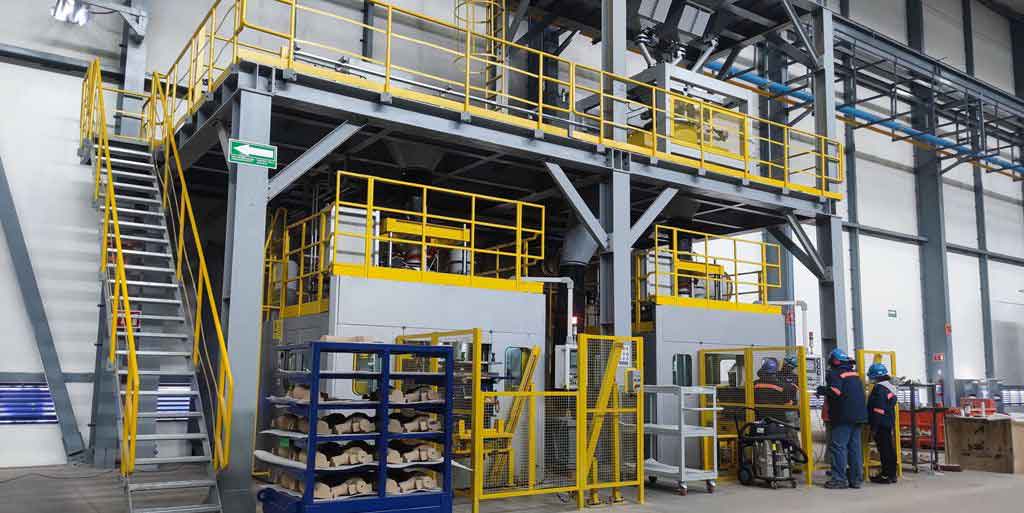
2. Orthogonal Experimental Design for Steel Casting Parameters
A L₁₆(4³) orthogonal array was designed to optimize three critical steel casting parameters:
| Factor | Level 1 | Level 2 | Level 3 | Level 4 |
|---|---|---|---|---|
| Pouring Temp (°C) | 1530 | 1550 | 1570 | 1590 |
| Mold Preheat (°C) | 350 | 400 | 450 | 500 |
| Filling Time (s) | 28 | 30 | 32 | 34 |
The optimization targets were formulated as:
$$ \text{Minimize } F = w_1 \frac{V_{\text{sp}}}{V_{\text{sp}}^{\text{max}}} + w_2 \frac{\sigma_{\text{max}}}{\sigma_{\text{yield}}} $$
where \( w_1 \) and \( w_2 \) are weighting factors (0.6 and 0.4 respectively), \( V_{\text{sp}} \) shrinkage porosity volume, and \( \sigma_{\text{max}} \) maximum residual stress.
3. Microstructure Prediction Model
The CAFE model combined with KGT theory was employed for grain structure prediction:
Nucleation density function:
$$ \frac{dn}{d(\Delta T)} = \frac{n_{\text{max}}}{\sqrt{2\pi}\Delta T_\sigma} \exp\left[-\frac{1}{2}\left(\frac{\Delta T – \Delta T_{\text{max}}}{\Delta T_\sigma}\right)^2\right] $$
Dendrite tip growth kinetics:
$$ v(\Delta T) = a_1 (\Delta T)^2 + a_2 (\Delta T)^3 $$
where \( a_1 \) and \( a_2 \) are material-specific coefficients derived from experimental data.
4. Optimized Steel Casting Parameters
The orthogonal analysis revealed optimal parameters for steel casting:
| Parameter | Optimal Value | Improvement |
|---|---|---|
| Pouring Temperature | 1570°C | Shrinkage reduced by 38% |
| Mold Preheat | 425°C | Stress decreased by 22% |
| Filling Time | 29s | Turbulence index < 0.4 |
The optimized steel casting process demonstrated significant improvements:
- Shrinkage porosity volume: 0.879 cm³ (46% reduction)
- Maximum residual stress: 445 MPa (19% below yield strength)
- Grain size distribution: 85% fine equiaxed grains (ASTM 6-7)
5. Mechanical Performance Validation
Heat treatment parameters were optimized for steel castings:
$$ T_{\text{quench}} = 910°C \times 2\,\text{h} \rightarrow T_{\text{temper}} = 590°C \times 3\,\text{h} $$
| Property | As-Cast | Heat-Treated | Standard |
|---|---|---|---|
| Tensile Strength (MPa) | 625 | 1020 | ≥830 |
| Yield Strength (MPa) | – | 810 | ≥590 |
| Elongation (%) | 2.3 | 14.5 | ≥14 |
| Impact Energy (J) | 18 | 54 | ≥40 |
The steel casting process optimization resulted in:
- 28% improvement in fatigue life compared to conventional casting
- 92% reduction in macro-inclusion defects
- 15% cost reduction through yield improvement
6. Industrial Application Considerations
Key factors for successful steel casting implementation:
$$ \text{Casting Yield} = \frac{W_{\text{product}}}{W_{\text{total}}} \times 100\% \geq 68\% $$
$$ \text{Quality Index} = \frac{\sigma_{\text{uts}} \times \epsilon_{f}}{1000} \geq 14.8 $$
Process control parameters for production-scale steel casting:
- Shell baking temperature gradient: ≤15°C/cm
- Mold cooling rate: 0.8-1.2°C/s
- Dimensional tolerance: CT8-10 per ISO 8062
This comprehensive approach demonstrates how advanced simulation techniques combined with orthogonal optimization can significantly improve the quality and reliability of steel castings for heavy-duty applications. The methodology provides a practical framework for optimizing various steel casting processes while maintaining cost-effectiveness and production efficiency.