
In the production of large machine tool castings, such as crossbeams for heavy-duty machine tools, achieving high tensile strength and stiffness to resist deformation and support substantial loads is critical. QT600-3, a pearlitic matrix ductile iron, offers excellent strength and hardness, making it suitable for these applications. However, producing as-cast QT600-3 machine tool castings with significant wall thickness variations presents challenges, including controlling carbide content in thin sections, ensuring full pearlitic transformation in thick areas, and preventing issues like graphite flotation, chunk graphite, and graphite distortion. This article details our approach to optimizing the melting process for such large machine tool castings, focusing on chemical composition control, spheroidization, and inoculation techniques to achieve consistent quality in as-cast conditions.
We began by addressing the chemical composition, as it plays a pivotal role in determining the microstructure and mechanical properties of machine tool castings. For QT600-3, we targeted specific ranges for each element to balance graphite formation and matrix stability. Carbon (C) promotes graphitization, improves spheroidization, and increases graphite nodule count, reducing chilling tendencies. However, excessive carbon equivalent can lead to graphite flotation in large castings due to prolonged solidification times. Thus, we controlled C content between 3.5% and 3.8%, aiming for a near-eutectic composition. Silicon (Si) strongly encourages graphitization and ferrite formation, but for high-strength grades like QT600-3, we kept Si low, between 1.9% and 2.2%, to minimize ferrite and enhance pearlite. Manganese (Mn) aids in pearlite refinement and strength but can segregate at grain boundaries, forming carbides that impair mechanical properties. We limited Mn to 0.3%–0.6% to optimize strength without excessive brittleness. Phosphorus (P) and sulfur (S) are detrimental elements; we maintained P as low as possible and controlled S below 0.020% in the base iron to facilitate effective spheroidization while minimizing adverse effects.
Additionally, we incorporated alloying elements like copper (Cu), tin (Sn), and antimony (Sb) to stabilize the pearlitic matrix. Cu promotes graphitization and refines pearlite, with an optimal range of 0.3%–0.6%. Sn and Sb strongly encourage pearlite formation; we restricted Sn to below 0.05% and Sb to below 0.015% to prevent excessive hardening and graphite distortion. Barium (Ba) was used in inoculation due to its strong deoxidizing and desulfurizing capabilities, forming compounds that serve as effective nuclei for graphite formation, thereby increasing nodule count and improving graphite roundness. The chemical composition ranges for the final iron are summarized in Table 1.
| Element | Base Iron | Final Iron |
|---|---|---|
| C | 3.8–4.1 | 3.5–3.8 |
| Si | 0.7–1.2 | 1.9–2.3 |
| Mn | 0.3–0.6 | 0.3–0.6 |
| S | <0.020 | <0.020 |
| P | <0.04 | <0.04 |
| Cu | — | 0.3–0.6 |
| Sn | — | <0.05 |
| Sb | — | <0.015 |
The carbon equivalent (CE) is a critical parameter for predicting graphitization behavior, calculated using the formula: $$CE = C + \frac{Si + P}{3}$$ For our composition, CE typically ranged from 4.2 to 4.5, ensuring a near-eutectic balance to avoid defects in large machine tool castings. This control is essential for maintaining fluidity and reducing shrinkage porosity while preventing graphite flotation.
In the production process, we focused on melting, spheroidization, and inoculation to achieve the desired microstructure. For melting, we used raw materials including Q10 pig iron (low in S and P) at 40%–60% and ordinary carbon steel scrap at 60%–40%, with graphite-based carburizer added to adjust carbon content. Pig iron was introduced later in the process to enhance inherent graphite nucleation. Superheating the iron to 1500–1540°C helped eliminate impurities and break down coarse graphite inheritance, while the optimal spheroidization temperature was maintained at 1400–1440°C to minimize magnesium loss and ensure complete dissolution of the spheroidizer. Pouring temperature was controlled at 1300–1350°C to prevent defects like shrinkage cavities or cold shuts, with subsequent inoculation during pouring to counteract inoculation decay.
Spheroidization was performed using an inverted ladle process with a heavy rare-earth spheroidizer, which offers long-lasting effects and improved resistance to decay. The spheroidizer composition included Mg (6%–7%), RE (1.5%–2.5%), Ca (1.5%–2.5%), Ba, Si (42%–45%), and trace elements like Bi and Sb, as shown in Table 2. The addition rate was 1.2%–1.5%, and the inverted ladle method allowed simultaneous treatment of multiple ladles, reducing processing time and enhancing nucleation.
| Element | Content |
|---|---|
| Mg | 6–7 |
| RE | 1.5–2.5 |
| Ca | 1.5–2.5 |
| Ba | Trace |
| Si | 42–45 |
| Bi, Sb | Trace |
Inoculation involved multiple stages of composite treatment to enhance graphite nucleation and prevent decay. First, transport ladle inoculation used 0.1%–0.3% ferrosilicon (5–15 mm grain size) for preliminary deoxidation. Second, spheroidization ladle inoculation included 0.4%–0.7% Ba-containing inoculant (ω(Ba) 2%–6%) placed over the spheroidizer, along with Cu, Sn, and Sb alloys, covered by a steel plate. Third, during spheroidization, 0.1%–0.3% Ba-containing inoculant was added after one-third of the iron was treated. Finally, stream inoculation during pouring used 0.1% fine-grained inoculant (0.5–1.5 mm) to boost effectiveness. This multi-stage approach ensured a high nodule count and roundness, crucial for the performance of machine tool castings.
The effectiveness of this process can be explained through nucleation theory. In spheroidized iron, the interface energy between the melt and the prismatic plane (10\(\bar{1}\)0) of graphite is higher than that with the basal plane (0001), favoring growth along the [0001] direction. Spheroidization and inoculation reduce oxygen and sulfur levels, forming oxides and sulfides that act as nucleation sites. The reaction kinetics can be described by the free energy change: $$\Delta G = -RT \ln K$$ where \(K\) is the equilibrium constant for compound formation. Elements like Ba and Ca have lower free energies for sulfide formation compared to MnS, making them more effective nuclei. This promotes heterogeneous nucleation, increasing graphite nodule density and improving mechanical properties in machine tool castings.
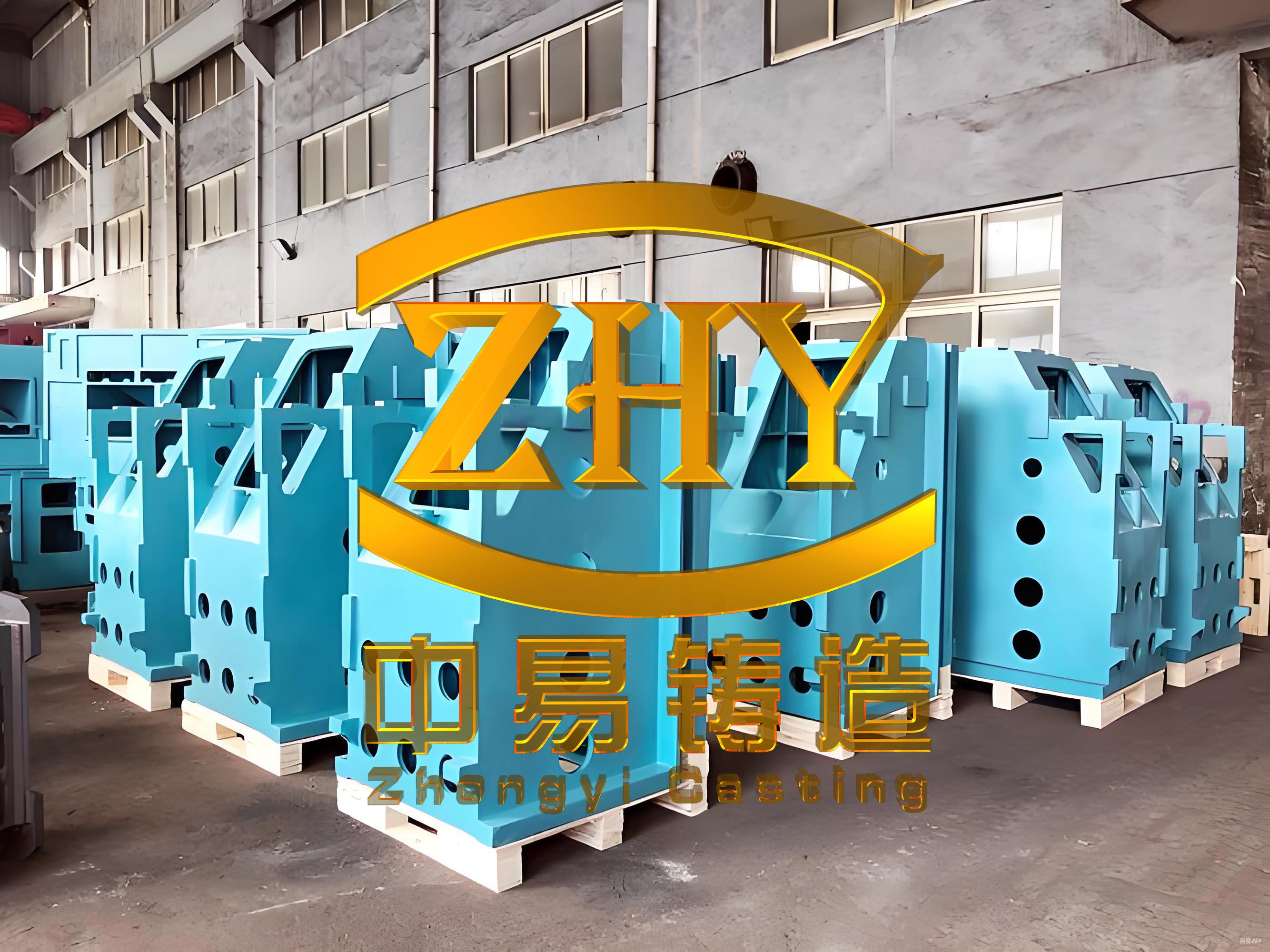
In actual production, we applied this optimized process to manufacture large machine tool castings, specifically 9-meter-long crossbeams with a rough weight of 18.7 tons. These machine tool castings had average wall thicknesses of 30 mm, rib plates at 25 mm, and guideways at 120 mm, presenting challenges in uniform microstructure control. We conducted tests on Y-block and attached test samples to evaluate metallographic structure and mechanical properties. The results, summarized in Table 3, showed that the as-cast properties met or exceeded GB/T 1348-2019 standards for QT600-3, with spheroidization grades of 2, graphite size grades of 6–7, pearlite content around 95%, and hardness values between 229–269 HBW. The graphite nodule count per unit area ranged from 158 to 286 nodules/mm², indicating effective nucleation.
| Sample ID | Test Block Type | Spheroidization Grade | Graphite Size Grade | Pearlite Content (%) | Hardness (HBW) | Graphite Nodules (nodules/mm²) | Tensile Strength (MPa) | Elongation (%) |
|---|---|---|---|---|---|---|---|---|
| Beam-1# | Y-Block | 2 | 7 | 95 | 269 | — | 726 | 4.5 |
| Beam-1# | Attached (40 mm) | 2 | 6 | 95 | 229 | 286 | 677 | 3.0 |
| Beam-1# | Attached (70 mm) | 2 | 6 | 95 | 229 | 194 | 617 | 3.0 |
| Beam-2# | Attached (40 mm) | 2 | 6 | 95 | 255 | 196 | 705 | 4.5 |
| Beam-2# | Attached (70 mm) | 2 | 6 | 95 | 241 | 158 | 608 | 4.0 |
Analysis of the results revealed variations between Beam-1# and Beam-2#, despite similar carbon equivalents. Beam-1# exhibited coarser graphite and medium pearlite lamellae, suggesting a hypereutectic solidification sequence, whereas Beam-2# had finer, more uniform graphite and fine pearlite lamellae, indicative of eutectic solidification. This difference likely arose from variations in solidification rates, affecting graphite roundness and mechanical properties. The relationship between elongation and graphite roundness can be expressed using a simplified model: $$\epsilon = k \cdot \frac{1}{d}$$ where \(\epsilon\) is elongation, \(k\) is a material constant, and \(d\) is the average graphite diameter. Higher roundness in Beam-2# contributed to better elongation, demonstrating the importance of process control for large machine tool castings.
In conclusion, our optimized melting process for QT600-3 as-cast large machine tool castings successfully addresses the challenges of graphite control and matrix stabilization. By employing inverted ladle spheroidization, multiple composite inoculations, and precise chemical composition adjustments, we achieved high nodule counts, improved graphite roundness, and stable pearlite content in as-cast conditions. This approach enables the production of large machine tool castings, such as 9-meter crossbeams, with mechanical properties exceeding standard requirements. The integration of alloying elements and advanced inoculation techniques ensures consistent performance, making it a reliable method for heavy-section machine tool castings in industrial applications. Future work could focus on further refining solidification models to minimize variations and enhance the durability of these critical components.