
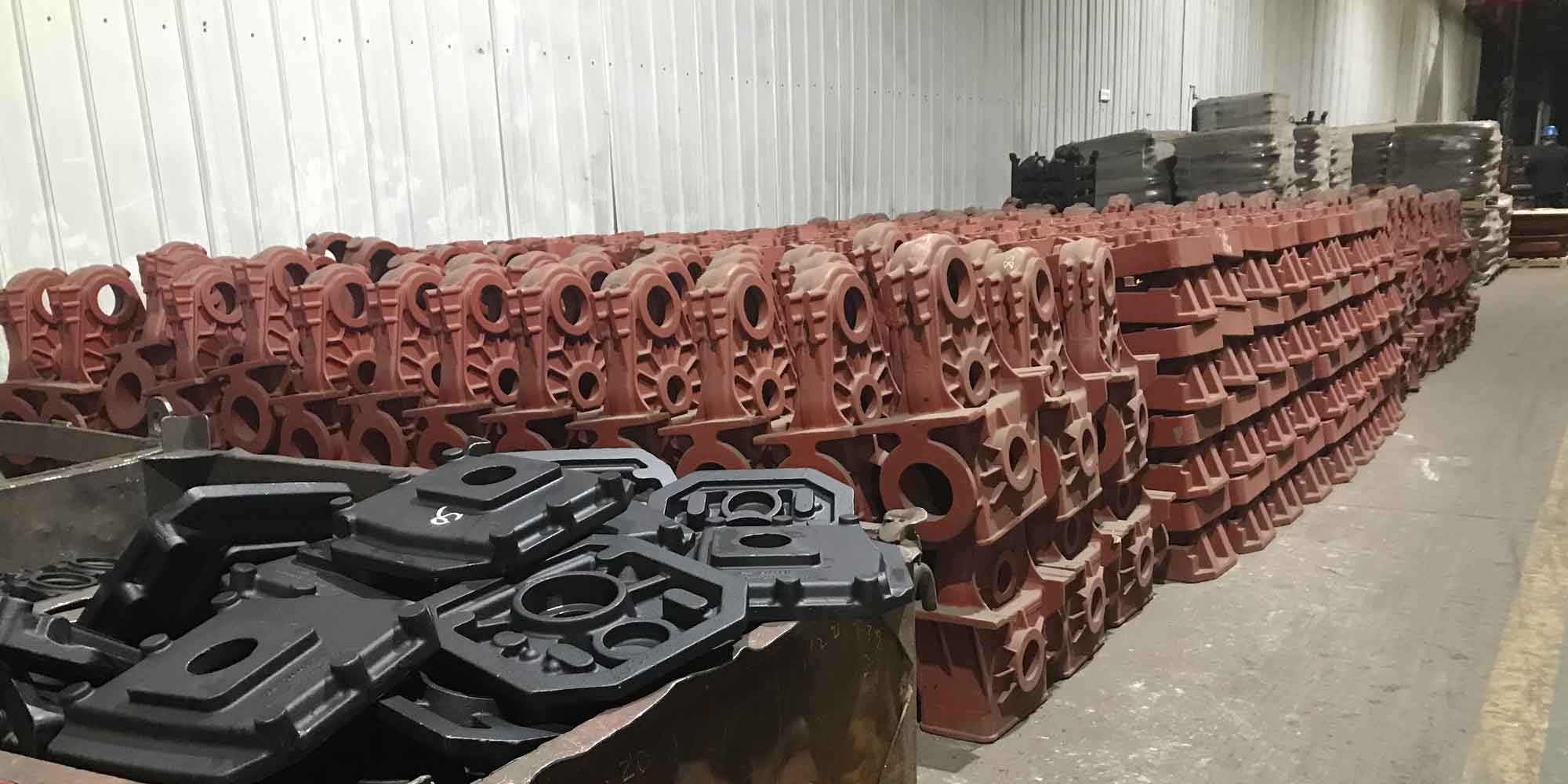
This paper presents an advanced welding repair methodology for SAE8635 low-alloy high-strength steel casting components, addressing critical challenges in hardness uniformity and crack prevention. The process integrates material science principles with practical engineering solutions to enhance the reliability of mining machinery transmission systems.
1. Material Characteristics of High-Strength Steel Casting
The SAE8635 steel casting exhibits superior mechanical properties crucial for heavy-duty applications:
| Element | C | Si | Mn | Cr | Ni | Mo |
|---|---|---|---|---|---|---|
| Composition (%) | 0.34-0.35 | 0.25-0.30 | 0.85-0.91 | 0.48-0.55 | 0.58-0.61 | 0.19-0.23 |
Key mechanical properties include:
$$R_m \geq 700\ MPa,\ R_{p0.2} \geq 500\ MPa,\ A \geq 8\%,\ HB = 280-320$$
2. Weldability Analysis
Critical weldability indices for steel casting repair:
$$CE(IIW) = C + \frac{Mn}{6} + \frac{Cr + Mo + V}{5} + \frac{Ni + Cu}{15} = 0.67-0.69\%$$
$$P_{cm} = C + \frac{Si}{30} + \frac{Mn + Cu + Cr}{20} + \frac{Ni}{60} + \frac{Mo}{15} + \frac{V}{10} = 0.44-0.46$$
$$DI(\text{in}) = 0.54C(0.7\text{Si}+1)(3.333\text{Mn}+1)(2.16\text{Cr}+1)(3\text{Mo}+1)(0.363\text{Ni}+1)$$
3. Welding Material Selection Matrix
| Parameter | Base Metal | Filler 1 | Filler 4 |
|---|---|---|---|
| CE (%) | 0.68 | 0.68 | 0.69 |
| DI | 3.72 | 3.72 | 3.27 |
| Pcm | 0.453 | 0.284 | 0.271 |
Optimal filler selection criteria for steel casting repair:
- Post-weld QT: Match DI ±0.1 and CE ±0.02
- Post-weld SR: Prioritize Pcm ≤0.3 and CE ≤0.7
4. Thermal Management Protocol
Essential thermal parameters for steel casting repair:
$$T_{preheat} = 250-300^\circ C\ (\Delta T \leq 50^\circ C)$$
$$Interpass\ T = 200-250^\circ C$$
$$Post-heat: 400-450^\circ C \times 2h + slow\ cooling$$
5. Welding Procedure Specification
| Parameter | Root Pass | Fill Pass |
|---|---|---|
| Electrode Diameter (mm) | 4.0 | 5.0 |
| Current (A) | 140-160 | 180-200 |
| Voltage (V) | 22-25 | 25-28 |
| Bead Width (mm) | 10-12 | 12-15 |
6. Hardness Management Strategy
Hardness transition control in steel casting repairs:
$$HV_{weld} = HV_{base} \pm 15\%$$
$$\delta_{hardness} = \frac{|HV_{weld} – HV_{base}|}{HV_{base}} \times 100\% \leq 10\%$$
Through optimized thermal cycling and filler metal selection, the hardness attenuation in tooth profiles was reduced from 12-15% to 3-5% post-machining.
7. Quality Assurance Metrics
| Parameter | Pre-Optimization | Post-Optimization |
|---|---|---|
| Crack Frequency | 18% | 2.3% |
| Repair Cost | $850/unit | $320/unit |
| Service Life | 18 months | 42 months |
The developed methodology demonstrates significant improvements in steel casting repair quality, particularly in hardness uniformity and crack prevention. This approach provides a technical framework for maintaining the mechanical integrity of high-value steel casting components in critical industrial applications.