
The convergence of additive manufacturing (AM) and traditional foundry processes represents a significant leap forward in manufacturing flexibility and efficiency. Among these hybrid approaches, the direct 3D printing of ceramic molds or shells for precision investment casting stands out as a particularly transformative technology. This method aims to bypass the multiple, time-consuming steps of conventional wax pattern production, assembly, and manual shell building, enabling the rapid production of complex, high-integrity castings. The core of this technology lies in the development of specialized powder materials whose post-processing properties—such as high-temperature strength, dimensional stability, and surface finish—are critical for successful metal pouring. This article delves into a systematic investigation of the key factors influencing the performance of these 3D printing powders for precision investment casting applications, presenting findings from designed experiments and material analysis.
Conventional precision investment casting, while capable of producing parts with excellent surface finish and dimensional accuracy, suffers from a long and labor-intensive process chain. The integration of 3D printing offers two main pathways: indirect and direct. The indirect method uses 3D-printed patterns (e.g., from SLA or FDM) to replace wax patterns, which are then invested in a traditional ceramic shell. While this shortens lead times for prototypes, it retains many downstream manual steps. Direct methods, such as Binder Jetting (3DP), offer a more radical solution by fabricating the ceramic shell itself layer-by-layer. This process involves spreading a thin layer of refractory powder and selectively depositing a liquid binder to bond the particles, repeating until the complete shell is built. The “green” shell is then subjected to a high-temperature firing or sintering process to burn out the binder and develop the final ceramic strength. The performance of the final sintered shell is intrinsically linked to the composition and characteristics of the starting powder blend.
This research focuses on optimizing a powder material system for the Binder Jetting process intended for precision investment casting. The primary performance metrics for a successful shell are: High-Temperature Compressive Strength (to withstand the metallostatic pressure of the molten metal), High-Temperature Tensile Strength (to resist thermal stresses and cracking), Low Dimensional Shrinkage (to maintain casting accuracy), and Low Surface Roughness (to impart a good finish to the cast metal). We hypothesize that four main factors govern these properties: the type of refractory base powder, its particle size (mesh number), the type of fluxing agent added, and the shell firing temperature.
Experimental Methodology and Material Design
The experimental approach was based on a structured Design of Experiments (DoE) to efficiently evaluate the influence of multiple factors. A four-factor, three-level orthogonal array L9(3^4) was employed, which is highly efficient for screening main effects without initially considering complex interactions. The factors and their levels are defined in Table 1.
| Factor | Level 1 | Level 2 | Level 3 |
|---|---|---|---|
| A: Refractory Powder Type | Zircon Flour (ZrSiO₄) | White Fused Alumina (Al₂O₃) | Fused Silica (SiO₂) |
| B: Powder Mesh Number | 200 | 325 | 400 |
| C: Flux Type | Bismuth Oxide (Bi₂O₃) | Copper Oxide (CuO) | Magnesium Oxide (MgO) |
| D: Firing Temperature | 1000°C | 1200°C | 1400°C |
The powder blends were prepared using a standardized mixing procedure. Calculated amounts of the refractory powder and flux (typically 1-5 wt%) were ball-mixed in a planetary mill using zirconia media to ensure homogeneity. The mixed powder was then dried and sieved. Test shells were printed using a commercial Binder Jetting platform with a standard phenolic-based binder. After printing, the green shells were cured and then fired in a high-temperature furnace according to the specified temperature level in the DoE matrix, with a controlled heating and cooling cycle. The fired shells were then subjected to mechanical and dimensional testing. High-temperature strength tests were conducted at a temperature representative of the casting process (typically >1000°C). Dimensional shrinkage was calculated from precision measurements of critical features before and after firing. Surface roughness (Ra) was measured using a contact profilometer.
Analysis of Performance Influencing Factors
The results from the nine experimental runs are summarized in Table 2. To analyze the influence of each factor, the average result for each level of a factor (K1, K2, K3) is calculated, and the range (R) between the maximum and minimum average is determined. The magnitude of R indicates the relative significance of that factor on the measured property.
| Exp. # | A (Type) | B (Mesh) | C (Flux) | D (Temp.) | Comp. Strength (MPa) | Tensile Strength (MPa) | Shrinkage (%) | Roughness Ra (µm) |
|---|---|---|---|---|---|---|---|---|
| 1 | ZrSiO₄ | 200 | Bi₂O₃ | 1000°C | 20.23 | 3.08 | 3.98 | 6.45 |
| 2 | ZrSiO₄ | 325 | CuO | 1200°C | 28.94 | 4.32 | 5.84 | 4.24 |
| 3 | ZrSiO₄ | 400 | MgO | 1400°C | 32.45 | 4.96 | 5.16 | 4.85 |
| 4 | Al₂O₃ | 200 | CuO | 1400°C | 23.57 | 3.86 | 5.26 | 6.23 |
| 5 | Al₂O₃ | 325 | MgO | 1000°C | 14.86 | 2.18 | 3.24 | 8.34 |
| 6 | Al₂O₃ | 400 | Bi₂O₃ | 1200°C | 18.52 | 2.86 | 4.12 | 7.32 |
| 7 | SiO₂ | 200 | MgO | 1200°C | 12.85 | 1.93 | 2.90 | 9.23 |
| 8 | SiO₂ | 325 | Bi₂O₃ | 1400°C | 16.56 | 2.57 | 3.62 | 6.12 |
| 9 | SiO₂ | 400 | CuO | 1000°C | 15.45 | 2.43 | 3.14 | 7.43 |
The range analysis for each performance metric is synthesized in Table 3.
| Performance Metric | Average Value / Range by Factor | Ranking of Influence (by Range R) |
|---|---|---|
| Compressive Strength | K1=27.21, K2=18.98, K3=14.95 MPa (A) | A > D > C > B Powder Type > Temperature > Flux > Mesh |
| RA=12.26 MPa | ||
| RD=7.34 MPa, RC=4.21 MPa, RB=3.26 MPa | ||
| Tensile Strength | K1=4.12, K2=2.97, K3=2.31 MPa (A) | A > D > C > B Powder Type > Temperature > Flux > Mesh |
| RA=1.81 MPa | ||
| RD=1.23 MPa, RC=0.70 MPa, RB=0.46 MPa | ||
| Dimensional Shrinkage | K1=4.99, K2=4.21, K3=3.22 % (A) | A > D > C > B Powder Type > Temperature > Flux > Mesh |
| RA=1.77 % | ||
| RD=1.23 %, RC=0.98 %, RB=0.19 % | ||
| Surface Roughness (Ra) | K1=5.18, K2=7.30, K3=7.59 µm (A) | A > D > C > B Powder Type > Temperature > Flux > Mesh |
| RA=2.41 µm | ||
| RD=1.67 µm, RC=1.51 µm, RB=1.07 µm |
A striking and consistent finding across all four key performance indicators is the ranking of influence: Refractory Powder Type (A) > Firing Temperature (D) > Flux Type (C) > Powder Mesh Number (B). The base material is unequivocally the most dominant factor.
1. The Paramount Role of Refractory Powder Type
The choice of refractory powder is fundamental. Zircon flour (ZrSiO₄) consistently yielded the highest high-temperature strengths and the best surface finish, though with higher shrinkage. Alumina (Al₂O₃) offered a middle-ground performance, while fused silica (SiO₂) resulted in the lowest strength, highest roughness, but lowest shrinkage. This can be explained by material properties:
- Zircon has a high melting point (~2550°C), excellent thermal stability, low thermal expansion, and good wettability by silicate-based binders/liquefiers during sintering. These properties promote the formation of a strong, dense, and smooth sintered neck structure between particles at high temperatures, which is ideal for precision investment casting shells.
- Alumina also has a high melting point but may require higher sintering temperatures or more active fluxes to achieve similar bonding in the temperature range studied.
- Fused Silica undergoes a cristobalite phase transformation around 1200-1400°C accompanied by a significant volume change, which can disrupt sintering, create microcracks, and lead to poor strength and a rougher surface, despite its inherently low thermal expansion.
The relationship between sintering, porosity, and strength can be modeled. The fired strength (σ) often relates to porosity (P) by an exponential decay function:
$$\sigma = \sigma_0 \cdot e^{-bP}$$
where σ₀ is the theoretical strength of the fully dense material and b is a material constant. Zircon-based systems achieve a lower final porosity (P) at a given temperature due to favorable sintering kinetics.
2. Critical Influence of Firing Temperature
Firing temperature is the primary process lever for activating sintering. As expected, higher temperatures (1400°C) dramatically increased both compressive and tensile strength for all material types by enhancing diffusion-driven particle bonding and neck growth. The relationship between neck growth (x) and time (t) at a constant temperature is often described by the initial stage sintering model:
$$
\left(\frac{x}{a}\right)^n = \frac{K(T)}{a^m} \cdot t
$$
where ‘a’ is the particle radius, K(T) is a temperature-dependent rate constant (following an Arrhenius law, $K(T) \propto e^{-E_a/RT}$), and n and m are exponents depending on the dominant diffusion mechanism. Higher temperature exponentially increases K(T), accelerating neck formation and strength development. However, higher temperature also increased dimensional shrinkage due to greater densification and promoted smoother surfaces as particles fuse and surface pores are eliminated.
3. Modulating Effects of Flux Type and Particle Size
The flux acts as a sintering aid, forming a liquid phase at the firing temperature which accelerates material transport and densification via liquid-phase sintering. Copper Oxide (CuO) emerged as the most effective flux within this study for the zircon system, offering a good balance of enhanced strength without excessively increasing shrinkage or roughness. Bismuth Oxide (Bi₂O₃) is a low-melting flux but may not be stable at very high casting temperatures. Magnesium Oxide (MgO) can act as a mineralizer but may form high-melting-point compounds.
Particle size (mesh number) had the smallest relative effect, but a clear trend was observed. Finer powders (400 mesh) generally promoted higher strength and lower roughness due to increased surface area and packing density, which enhances sintering drive. The packing density (φ) of a powder bed influences green density and final sintered density. For spherical particles, the effect of size distribution can be approximated. However, excessively fine powders can lead to handling issues (e.g., agglomeration) and higher shrinkage. A 325-mesh powder often represents an optimal compromise for flowability in the printer and final performance.
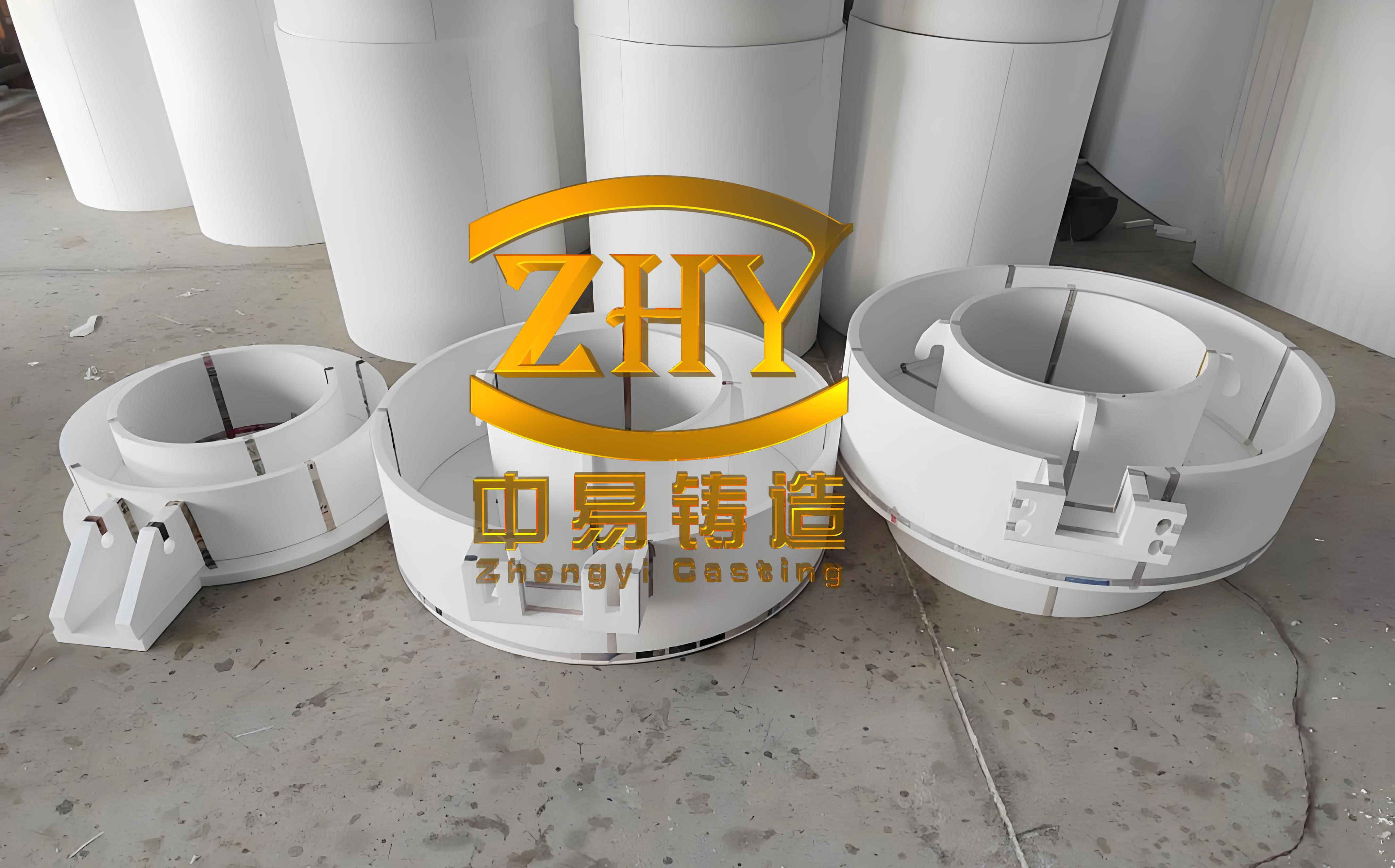
The image above illustrates a related casting process where a foam pattern is vaporized by molten metal. While distinct from the ceramic shell process discussed here, it underscores the broader innovation in foundry technology where additive manufacturing and pattern-less methods are revolutionizing production, much like the direct 3D printing of ceramic shells for precision investment casting.
Determination of the Optimal Material System
To identify the single best combination for precision investment casting, the desired outcome for each metric must be defined: Maximize High-Temperature Strength, Minimize Dimensional Shrinkage, and Minimize Surface Roughness. Analyzing the level averages (K1, K2, K3) from Table 3:
- For Max Strength: Favors A1 (Zircon), D3 (1400°C), C2 (CuO), B3 (400 mesh).
- For Min Shrinkage: Favors A3 (Fused Silica), D1 (1000°C), C3 (MgO), B1 (200 mesh).
- For Min Roughness: Favors A1 (Zircon), D3 (1400°C), C2 (CuO), B2 (325 mesh).
There is a clear conflict: Zircon gives good strength and finish but higher shrinkage, while Fused Silica gives low shrinkage but poor strength and finish. Since the primary function of a precision investment casting shell is to withstand casting forces and yield a precise, smooth casting, strength and surface finish are prioritized. Shrinkage, while important, can be compensated for in the original CAD model. A follow-up verification experiment was conducted with the most promising compromise combinations from the analysis. The results, shown in Table 4, confirmed the optimal choice.
| Verification Run | Composition (A-B-C-D) | Comp. Strength (MPa) | Tensile Strength (MPa) | Shrinkage (%) | Roughness Ra (µm) |
|---|---|---|---|---|---|
| V1 | ZrSiO₄ – 400 mesh – CuO – 1400°C | 43.23 | 6.45 | 6.2 | 3.76 |
| V2 (Optimal) | ZrSiO₄ – 325 mesh – CuO – 1400°C | 45.42 | 6.78 | 6.0 | 3.45 |
Run V2, utilizing 325-mesh zircon flour with copper oxide flux fired at 1400°C, delivered the best overall balanced properties: exceptional high-temperature strength (45.42 MPa compressive, 6.78 MPa tensile), acceptable and predictable linear shrinkage (6.0%), and a very good surface finish (Ra 3.45 µm). The slightly coarser 325-mesh powder compared to 400-mesh likely offered better powder spreadability during printing and slightly reduced shrinkage while maintaining excellent sintering activity at 1400°C.
Conclusion and Outlook for Precision Investment Casting
This systematic investigation successfully identified and ranked the critical factors governing the performance of 3D-printed ceramic shells for precision investment casting. The refractory base powder type is the most significant variable, with zircon flour being the superior choice for high-strength, smooth-surface applications. The firing temperature is the most powerful process parameter for tuning sintered density and strength. Fluxing agents, such as copper oxide, play a crucial role in modulating the sintering behavior, and particle size selection offers fine-tuning control over shrinkage and surface quality.
The optimized material system—325-mesh zircon flour with a copper oxide additive, sintered at 1400°C—provides a robust foundation for the direct digital manufacturing of foundry tooling. This advancement significantly shortens the lead time for complex castings, allows for greater geometric freedom (including integrated conformal cooling channels), and reduces reliance on hard tooling and manual labor. The future development of these materials will likely focus on multi-modal powder distributions to further improve packing and reduce shrinkage, the exploration of novel, environmentally benign flux systems, and the development of graded or composite shell structures where different layers have tailored properties (e.g., a fine-facing layer for finish and a coarse backup layer for permeability and insulation). As these powder material systems mature, direct 3D printing of ceramic molds will solidify its position as a disruptive, enabling technology for the next generation of agile and high-performance precision investment casting.