
As a widely utilized wear-resistant material, white cast iron offers exceptional performance against abrasive wear under moderate to low stress conditions. Its suitability for production in cupola furnaces presents significant advantages in terms of cost-effectiveness and process simplicity. However, the inherent brittleness of conventional white cast iron often limits its application scope. While modification treatments can refine carbide morphology and confer some improvement in toughness, the extent of this enhancement frequently remains unsatisfactory. The adoption of austempering heat treatment has emerged as a transformative approach, enabling the development of a lower bainite matrix microstructure. This structural alteration can lead to a remarkable and concurrent increase in both toughness and hardness, thereby synergistically improving wear resistance. This article details a systematic investigation into the effects of key austempering process parameters on the mechanical properties of a pre-developed modified low-chromium white cast iron, employing a rigorous orthogonal experimental methodology to elucidate optimal processing windows.
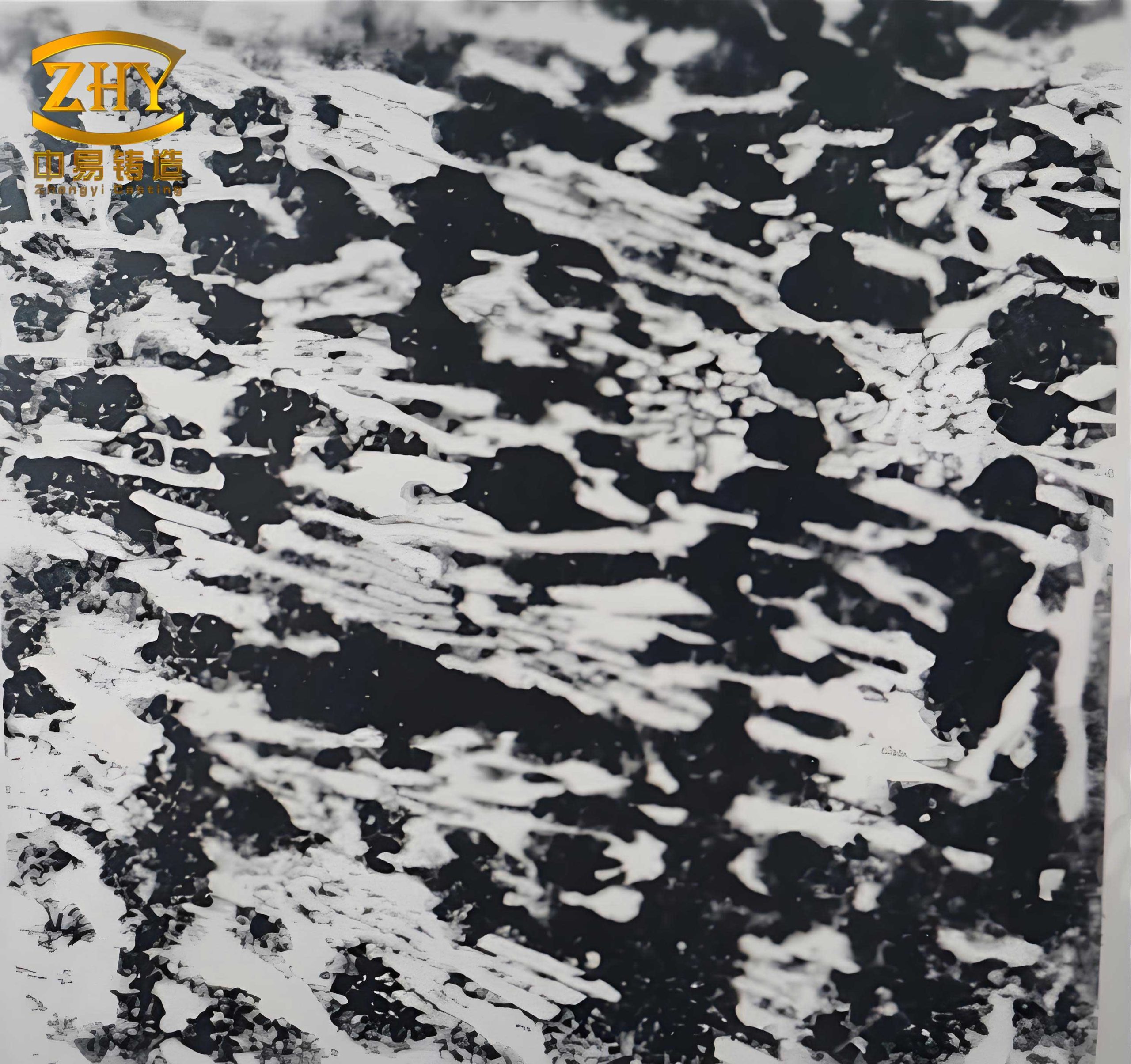
The foundation of this study rests on a specific grade of modified low-chromium white cast iron. The base composition was meticulously prepared using common foundry inputs such as pig iron, steel scrap, ferrochromium, and ferromanganese. The target chemical composition, crucial for establishing a fully carbide-stabilized structure free of graphite, is presented in Table 1. Prior to casting, a proprietary composite modifier—comprising rare-earth silicide, calcium-silicon, ferrosilicon, and a minor fraction of low-melting-point metal particles—was introduced via the bell-jar immersion technique. This modification step is critical for the initial refinement of the carbide network in the as-cast white cast iron, setting the stage for subsequent heat treatment.
| Carbon (C) | Chromium (Cr) | Silicon (Si) | Manganese (Mn) | Iron (Fe) |
|---|---|---|---|---|
| 2.6 | 1.0 | 1.1 | 0.8 | Balance |
The experimental methodology was designed for maximum efficiency and statistical reliability in exploring the multi-factor space. A three-factor, five-level quadratic orthogonal rotational composite design was implemented. This design allows for the construction of a predictive response surface model while minimizing the number of required experiments. The three independent variables (factors) selected were: austenitizing temperature ($T_{\gamma}$), austenitizing time ($t_{\gamma}$), and austempering temperature ($T_{iso}$). The austempering time ($t_{iso}$) was held constant at 150 minutes for all trials, and a molten salt bath of 50 wt.% KNO3 + 50 wt.% NaNO2 served as the isothermal quenching medium. The coding scheme for the factor levels, which transforms the actual physical values into dimensionless coded variables ($x_1$, $x_2$, $x_3$), is detailed in Table 2. This coding facilitates the analysis and modeling of the effects.
| Coded Variable | Factor | -1.682 (Low Star) | -1 (Low) | 0 (Center) | +1 (High) | +1.682 (High Star) |
|---|---|---|---|---|---|---|
| $x_1$ | $T_{\gamma}$ (°C) | 800 | 841 | 900 | 959 | 1000 |
| $x_2$ | $t_{\gamma}$ (min) | 30 | 66 | 120 | 174 | 210 |
| $x_3$ | $T_{iso}$ (°C) | 200 | 241 | 300 | 359 | 400 |
The primary response variables were macro-hardness, measured on the Rockwell C scale (HRC), and unnotched impact toughness ($a_k$), determined using standard Charpy-style specimens (10mm x 10mm x 55mm). The resulting experimental data, spanning the defined parameter space, was analyzed to generate quadratic regression models for each property. The general form of the model for a response $Y$ (e.g., Hardness or Toughness) is:
$$Y = \beta_0 + \sum_{i=1}^{3}\beta_i x_i + \sum_{i=1}^{3}\beta_{ii} x_i^2 + \sum_{i < j}\beta_{ij} x_i x_j + \epsilon$$
where $\beta_0$ is the constant term, $\beta_i$ are linear coefficients, $\beta_{ii}$ are quadratic coefficients, $\beta_{ij}$ are interaction coefficients, and $\epsilon$ is the error. The significance of these coefficients reveals the influence and interplay of the process parameters.
Analysis of Parameter Effects on Mechanical Properties
The investigation into the processing of this modified white cast iron revealed complex, interdependent relationships between heat treatment parameters and final properties. The following sections dissect these relationships through the lens of interaction effects.
Interplay of Austenitizing Temperature and Time
Holding the austempering temperature constant at the center point (300°C), the combined effect of $T_{\gamma}$ and $t_{\gamma}$ was profound. When either the austenitizing temperature or time was at a relatively low level, both hardness and impact toughness exhibited a distinct peak as the other parameter increased. This non-monotonic behavior can be modeled phenomenologically. Initially, the increase in properties can be attributed to enhanced solute uptake by the austenite. The diffusion-controlled dissolution of carbon and chromium from carbides into the austenite matrix follows an Arrhenius-type relationship, where the effective solute content $C_{eff}$ after time $t$ is approximated by:
$$C_{eff}(t) = C_{sat} – (C_{sat} – C_0) \cdot \exp(-k_D \cdot t)$$
where $C_{sat}$ is the temperature-dependent saturation limit, $C_0$ is the initial solute in austenite, and $k_D$ is a temperature-dependent rate constant. Higher $T_{\gamma}$ or longer $t_{\gamma}$ increases $C_{eff}$, leading to stronger, tougher lower bainite upon isothermal transformation and a potential reduction in undissolved carbide volume, benefitting toughness.
However, beyond an optimal point, excessive temperature or time promotes austenite grain coarsening (described by the classic grain growth law $d^n – d_0^n = K t \exp(-Q/RT)$) and a significant increase in the retained austenite ($\gamma_R$) content after austempering. While $\gamma_R$ can enhance toughness via transformation-induced plasticity effects, an excessive amount, especially when coupled with coarse bainitic ferrite plates, leads to a net reduction in hardness. The interaction effect is summarized in the response surface coefficients. A simplified representation of the peak hardness condition for a fixed $T_{iso}$ can be derived from the partial derivatives of the regression model:
$$\frac{\partial HRC}{\partial T_{\gamma}} = 0, \quad \frac{\partial HRC}{\partial t_{\gamma}} = 0$$
The solution to this system indicates the optimal combination within the studied range. Notably, the magnitude of the linear and quadratic coefficients for $x_1$ ($T_{\gamma}$) in the statistical model was consistently greater than those for $x_2$ ($t_{\gamma}$), indicating that the austenitizing temperature exerts a more dominant influence on the properties of this white cast iron than the austenitizing time.
| Parameter Regime | Effect on Hardness (HRC) | Effect on Toughness ($a_k$) | Dominant Microstructural Change |
|---|---|---|---|
| Low $T_{\gamma}$ / Low $t_{\gamma}$ → Moderate Increase | Increase to a Peak | Increase to a Peak | Increased solute in austenite; finer bainite. |
| Beyond Optimal $T_{\gamma}$ / $t_{\gamma}$ | Decrease | Decrease | Austenite grain coarsening; high $\gamma_R$. |
| High $T_{\gamma}$ / Long $t_{\gamma}$ | Increase | Increase | Formation of B+M+$\gamma_R$ multiphase. |
Interplay of Austenitizing and Austempering Temperature
With austenitizing time fixed at the center point (120 min), the interaction between $T_{\gamma}$ and $T_{iso}$ revealed another layer of complexity. For a constant $T_{iso}$, as $T_{\gamma}$ increased, both hardness and toughness again displayed a rising-then-falling trajectory, though the decline in toughness was less pronounced. The initial rise is linked to the same solute strengthening mechanism described earlier. The subsequent softening is primarily due to increased retained austenite stability. The higher carbon content in austenite achieved at high $T_{\gamma}$ suppresses the bainite finish temperature and stabilizes $\gamma_R$ against both bainitic transformation and subsequent martensite formation during final cooling.
The effect of $T_{iso}$ at a fixed $T_{\gamma}$ was markedly different for the two properties. Hardness decreased monotonically with increasing $T_{iso}$. This is a direct consequence of the bainite transformation thermodynamics and kinetics. Lower $T_{iso}$ results in a greater driving force for transformation, producing finer bainitic ferrite plates with a higher dislocation density and finer, more dispersed carbides within the ferrite (characteristic of lower bainite). The hardness of bainite ($HB_{bainite}$) can be empirically related to the transformation temperature:
$$HB_{bainite} \approx A – B \cdot T_{iso}$$
where $A$ and $B$ are positive constants. Conversely, impact toughness showed a clear maximum at an intermediate $T_{iso}$. In the lower bainite range (~200-300°C), toughness increases with $T_{iso}$ due to thicker, less brittle ferrite plates, larger carbide spacing, and a higher fraction of retained austenite which provides ductility. However, as $T_{iso}$ enters the upper bainite region (>~350°C), the formation of coarse cementite particles at the ferrite plate boundaries acts as potent crack initiation sites, causing toughness to fall. The peak toughness thus represents a trade-off between the ductility of the matrix and the embrittling effect of coarse interlath carbides. Statistical analysis confirmed that the influence of $T_{\gamma}$ on property variation was stronger than that of $T_{iso}$.
Interplay of Austenitizing Time and Austempering Temperature
Fixing $T_{\gamma}$ at 900°C, the interaction between $t_{\gamma}$ and $T_{iso}$ echoed patterns observed previously. The effect of $t_{\gamma}$ was similar to that of $T_{\gamma}$: a peak in properties at intermediate times due to the competing effects of solute dissolution versus austenite coarsening/high $\gamma_R$ stabilization. The effect of $T_{iso}$ mirrored the description above: a steady decrease in hardness and a peak in toughness with increasing temperature. The comparative analysis of coefficient magnitudes from the regression models established the following hierarchy for the influence of individual parameters on the mechanical properties of this modified white cast iron: Austenitizing Temperature ($T_{\gamma}$) > Austenitizing Time ($t_{\gamma}$) > Austempering Temperature ($T_{iso}$). This ranking is critical for prioritizing control factors in industrial heat treatment of white cast iron.
| Process Parameter | Primary Effect on Hardness | Primary Effect on Toughness | Underlying Mechanism |
|---|---|---|---|
| Austenitizing Temp. ($T_{\gamma}$) | Strong, Non-monotonic (Peak) | Strong, Non-monotonic (Peak) | Controls austenite composition, grain size, and $\gamma_R$ stability. |
| Austenitizing Time ($t_{\gamma}$) | Moderate, Non-monotonic (Peak) | Moderate, Non-monotonic (Peak) | Governs completeness of solute diffusion and carbide dissolution. |
| Austempering Temp. ($T_{iso}$) | Monotonic Decrease | Non-monotonic (Peak in lower bainite range) | Dictates bainite fineness, carbide morphology, and $\gamma_R$ fraction. |
The Superiority of Multiphase Microstructures
A pivotal finding from this study concerns regimes involving high austenitizing temperatures and/or extended times. Under these conditions, the austenite becomes highly enriched with carbon and alloying elements. During subsequent isothermal holding, a substantial fraction of this austenite may remain untransformed due to its increased chemical stability. Upon final cooling to room temperature, a portion of this retained austenite may undergo a martensitic transformation. The resulting microstructure is not merely lower bainite, but a complex, multiphase aggregate comprising Lower Bainite (B), Martensite (M), and a significant amount of Retained Austenite ($\gamma_R$): a B+M+$\gamma_R$ multiphase structure.
This multiphase structure often exhibited superior combinations of hardness and impact toughness compared to microstructures consisting predominantly of lower bainite. The enhancement can be explained by composite strengthening and toughening mechanisms. The high-hardness martensite provides load-bearing capacity and wear resistance. The tougher lower bainite and, crucially, the ductile retained austenite provide avenues for energy absorption and crack tip blunting. The $\gamma_R$ can undergo stress-induced transformation to martensite (TRIP effect) in the strain field ahead of a crack, creating compressive stresses that hinder crack propagation. The overall property set can be approximated by a rule of mixtures, but with synergistic interactions:
$$P_{composite} = f_B \cdot P_B + f_M \cdot P_M + f_{\gamma} \cdot P_{\gamma} + \Delta P_{synergy}$$
where $f$ and $P$ represent the volume fraction and property (e.g., hardness, fracture toughness) of each phase, and $\Delta P_{synergy}$ accounts for the positive interaction effects, particularly from the TRIP mechanism.
While this multiphase structure is desirable, achieving it through excessively high temperatures or prolonged times is inefficient and can lead to detrimental grain growth and energy waste. The optimization challenge, therefore, lies in identifying the minimal thermal budget (a combination of $T_{\gamma}$ and $t_{\gamma}$) sufficient to achieve the necessary austenite chemistry that will yield this beneficial B+M+$\gamma_R$ multiphase upon a carefully chosen $T_{iso}$ treatment. This approach maximizes the performance of the austempered white cast iron while maintaining economic and microstructural efficiency.
Conclusions and Practical Implications
The orthogonal experimental study on the modified low-chromium white cast iron yields several definitive conclusions for optimizing its austempering process:
- Non-monotonic Response: Within common processing windows, the hardness and impact toughness of this white cast iron exhibit peak values as functions of austenitizing temperature and time. This necessitates careful selection to avoid either under-austenitizing (incomplete solute uptake) or over-austenitizing (excessive grain growth and retained austenite).
- Multiphase Microstructure Advantage: The formation of a lower bainite-martensite-retained austenite (B+M+$\gamma_R$) multiphase structure, achievable through specific thermal cycles, provides a superior balance of mechanical properties compared to single-phase lower bainite structures, leveraging composite and transformation-induced plasticity effects.
- Parameter Influence Hierarchy: For the constant austempering time investigated, the process parameters affect the final properties in the following order of descending influence: Austenitizing Temperature > Austenitizing Time > Austempering Temperature. This hierarchy provides clear guidance for process control priority in the heat treatment of this white cast iron.
These insights form a quantitative framework for tailoring the properties of austempered white cast iron. The derived regression models allow for the prediction of hardness and toughness within the studied parameter space, enabling the design of heat treatment schedules targeted for specific application requirements—whether prioritizing extreme hardness for maximum abrasion resistance or a tougher grade for impact-prone environments. The fundamental understanding of the microstructural evolution, from solute diffusion and bainite kinetics to the stabilization of beneficial retained austenite, underscores the potential of austempering as a critical technology for advancing the performance envelope of white cast iron as a modern, high-performance wear material.