
During excavator operation, the boom-to-frame connection component endures multidirectional alternating loads. Traditional welded fabrication carried fracture risks at joints. Switching to casting significantly reduced both production costs and failure probabilities. This study details how ProCAST simulation optimized the process for a critical excavator casting part, eliminating defects while ensuring quality.
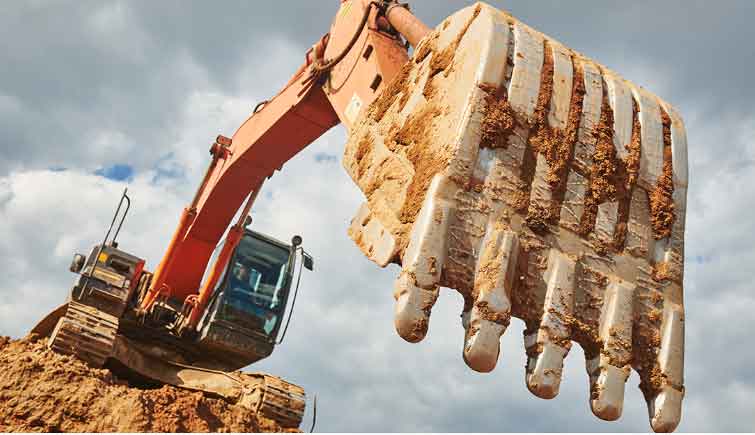
The ZG25 steel excavator casting part measured 754 mm × 171 mm, featuring thin walls (minimum 15 mm) and thick sections (maximum 67 mm). Key requirements included:
- Zero shrinkage porosity or inclusions
- Surface cracks ≤ 2 mm via fluorescent magnetic particle inspection
Initial horizontal casting setup used CO₂-hardened sodium silicate sand molds. Two Φ150 mm × 300 mm risers were placed at thick-section bosses (Figure 2). Chiller configurations were evaluated to manage thermal stress:
| Scheme | Chiller Position | Dimensions (mm) |
|---|---|---|
| 1 | Part bottom | 32 × 40 × 750 |
| 2 | Thick sections | 32 × 30 × 120 × 2 |
| 3 | None | — |
ProCAST simulations modeled filling, solidification, and stress using these parameters:
- Mesh: 10 mm (part), 40 mm (mold)
- Pouring time: 25 s
- Pouring temperature: 1565°C
- Interface heat transfer:
$$ h_{chiller/part} = 2000 \text{W/(m²·K)} $$
$$ h_{mold/sand} = 300 \text{W/(m²·K)} $$
Results for the critical excavator casting part revealed:
| Parameter | Scheme 1 | Scheme 2 | Scheme 3 |
|---|---|---|---|
| Filling time (s) | 25.0 | 25.0 | 24.1 |
| Avg. solid fraction at fill end (%) | 14.9 | 10.9 | 11.2 |
| Total solidification time (s) | 4918 | 5020 | 5041 |
| Peak core temperature (°C) | 1421.0 | 1420.0 | 1594.7 |
Hot tearing risk was quantified using the Hot Tearing Indicator (HTI):
$$ HTI = \frac{\sigma_{effective}}{E \cdot \alpha \cdot \Delta T} $$
where $\sigma_{effective}$ is von Mises stress, $E$ is Young’s modulus, $\alpha$ is thermal expansion coefficient, and $\Delta T$ is temperature drop. Critical zone values:
| Scheme | HTI | Max. stress (kPa) |
|---|---|---|
| 1 | 0.0042 | 316 (y-direction) |
| 2 | 0.0029 | 150 (y-direction) |
| 3 | 0.0030 | 222 (y-direction) |
Scheme 1’s high HTI correlated with actual thermal cracks (Figure 4). Though Scheme 2 reduced HTI, chillers increased gas defect risks. Scheme 3 avoided chillers but showed core sand burn-in due to excessive temperatures. Final optimization replaced silica sand cores with limestone equivalents, yielding:
$$ HTI_{optimized} = 0.0027 \quad ; \quad \sigma_{y} = 185 \text{kPa} $$
Validated castings exhibited no cracks, minimal inclusions, and eliminated bore burn-in. This excavator casting part process demonstrates how simulation-driven design enhances reliability while reducing trial cycles.