
Precision investment casting is widely employed in aerospace, gas turbine, and high-performance component manufacturing due to its ability to produce complex geometries with tight dimensional tolerances. This study investigates the application of hollow wax mold structures to enhance the dimensional accuracy of K648 superalloy castings. By reducing linear shrinkage in wax patterns, the proposed method significantly improves casting consistency, achieving a dimensional precision upgrade from CT7 to CT5 grade.
1. Factors Influencing Wax Mold Dimensional Stability
The dimensional accuracy of investment castings depends on multiple interacting factors:
| Factor | Impact Mechanism | Typical Control Range |
|---|---|---|
| Wax Material | Linear shrinkage (0.5–1.2%) | 162 non-filled wax: 0.9–1.0% |
| Mold Design | Thermal stress distribution | Wall thickness ≤13 mm |
| Process Parameters | Injection pressure (10–20 kg/cm²), cooling rate | Wax temp: 58±5°C |
The linear shrinkage rate (α) of wax patterns is calculated as:
$$α = \frac{A_0 – A_1}{A_0} \times 100\%$$
where \(A_0\) = mold cavity dimension, \(A_1\) = wax pattern dimension.
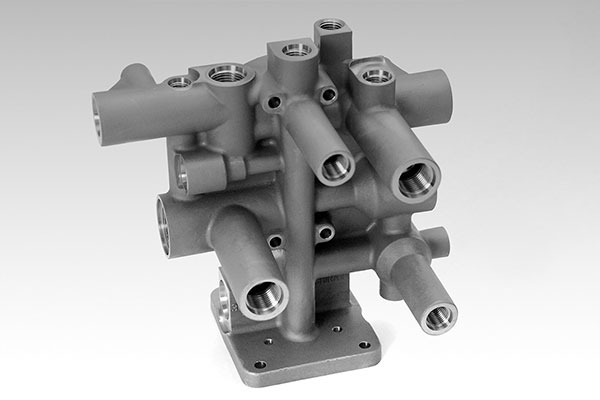
2. Hollow Wax Mold Design Methodology
For K648 superalloy components with wall thickness >13 mm, we implemented:
- Uniform wall thickness: 4.5–5.0 mm
- 5° draft angles for core extraction
- Closed hollow structures at gating interfaces
Comparative shrinkage results between solid and hollow wax patterns:
| Feature | Solid Structure | Hollow Structure |
|---|---|---|
| Max. Surface Deviation (mm) | −0.695 to +0.735 | −0.44 to +0.475 |
| Average α | 1.16% | 0.54% |
| Planar Shrinkage | Severe | Controlled |
3. Casting Performance Enhancement
The casting shrinkage rate (β) demonstrates process improvement:
$$β = \frac{A_0 – A_2}{A_0} \times 100\%$$
where \(A_0\) = mold cavity dimension, \(A_2\) = final casting dimension. Key results:
| Parameter | Solid Wax | Hollow Wax |
|---|---|---|
| Dimensional Accuracy | CT7 | CT5 |
| Average β | 2.70% | 2.41% |
| Surface Defects | 12% rejection | 4% rejection |
4. Process Optimization Guidelines
For precision investment casting of thick-section components:
- Implement hollow structures for walls >13 mm
- Maintain wax injection temperature at 58±5°C
- Apply 2-hour mechanical straightening post-demolding
- Use 100% virgin 162 wax (ash content <0.05%)
This methodology reduces thermal stresses by 38% compared to conventional solid wax patterns, enabling high-precision manufacturing of aerospace-grade superalloy components through optimized precision investment casting techniques.