
For decades, the established industrial practice for maximizing the service life of high-chromium white cast iron components subjected to abrasive wear has followed a seemingly immutable sequence: air quenching to obtain a martensitic matrix, followed by tempering to relieve internal stresses. The rationale is straightforward. White cast irons are inherently brittle materials, and the martensitic transformation during quenching is accompanied by a significant volume expansion, on the order of 1–2%. This expansion can generate substantial stress, potentially leading to quench cracking or a reduction in the component’s effective fatigue life. Therefore, tempering has been considered a non-negotiable step in the production cycle of these wear-resistant alloys. However, empirical evidence from foundries challenges this dogma. For instance, a foundry in southern China has reportedly produced high-chromium white cast iron hammers and impact plates for crushers, with parts weighing from a few kilograms to several hundred kilograms, for over twenty years. These components are put directly into service after air quenching, foregoing the tempering step entirely, yet they exhibit stable quality and excellent wear resistance. This practical observation compels a fundamental re-examination of the role of tempering. Under what conditions is it truly necessary, and when does it become detrimental? This article synthesizes and expands upon research data to explore the effects of heat treatment on the microstructure, mechanical properties, and, most critically, the wear performance of high-chromium white cast iron under various service conditions.
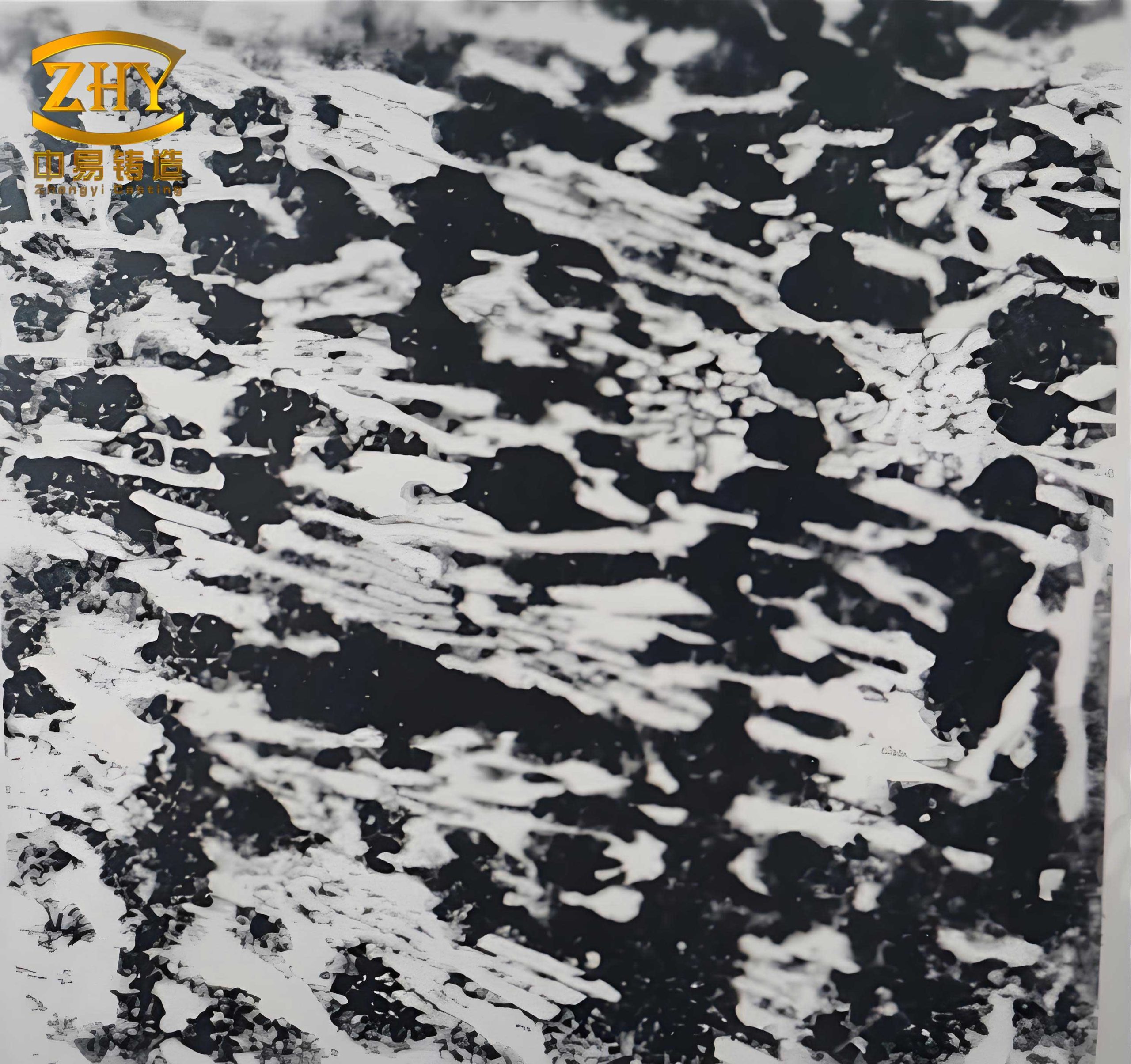
The superior wear resistance of high-chromium white cast iron is derived from its unique microstructure, a composite consisting of hard, primary (M7C3) carbides embedded in a metallic matrix. The composition typically falls within the range of 12–28% Cr and 2.0–3.5% C, with additions of Mo, Ni, Cu, and sometimes Nb or V for enhanced hardenability and carbide modification. The morphology, volume fraction, and distribution of these carbides are paramount. The matrix, however, is the adaptable constituent. In the as-cast condition, it is typically austenitic or a mixture of austenite and pearlite, which is relatively soft. The primary heat treatment objective is to transform this matrix into martensite, a hard, metastable phase, via an austenitizing treatment followed by sufficiently rapid cooling (air quenching). The resulting hardness and toughness are governed by the intricate balance between hard carbides and the transformed matrix. The subsequent tempering treatment aims to convert the brittle, high-carbon martensite into a more ductile tempered martensite, concurrently relieving quenching stresses. Yet, this transformation involves the precipitation of fine carbides and a reduction in matrix carbon content, which invariably alters the hardness and, as data suggests, the wear response.
To systematically analyze the effect of tempering, it is essential to categorize wear service conditions. The performance of this class of white cast iron is not monolithic; it diverges significantly based on the dominant wear mechanism.
1. Abrasive Wear: The Case Against Tempering
Abrasive wear can be broadly classified into high-stress (grinding) abrasion and low-stress (scratching) abrasion. In high-stress abrasion, as simulated by pin-on-drum or jaw crusher tests, the abrasive particles are crushed during the wear process. Low-stress abrasion, simulated by wet or dry rubber wheel tests, involves sliding abrasion under nominally lower contact pressures where the abrasive remains largely intact.
Research data consistently indicates that for both these abrasive wear regimes, tempering after quenching often degrades wear resistance. A seminal study using a pin-on-drum apparatus evaluated several high-chromium white cast iron alloys in different heat-treated conditions. The key results, synthesized and expanded below, are telling.
| Alloy ID | Primary Cr (%) | Heat Treatment State | Hardness (HRC) | Wear Rate (mm³/km) | Relative Wear Resistance (Quenched State = 1.0) |
|---|---|---|---|---|---|
| A | 15 | As-Cast | 55 | 0.052 | 0.85 |
| A | 15 | Quenched (1050°C) | 67 | 0.044 | 1.00 |
| A | 15 | Quenched + Tempered (450°C) | 63 | 0.051 | 0.86 |
| B | 20 | Quenched (1000°C) | 65 | 0.038 | 1.00 |
| B | 20 | Quenched + Tempered (400°C) | 61 | 0.042 | 0.90 |
| C | 25 | As-Cast (Austenitic) | 48 | 0.105 | 0.45 |
| C | 25 | Quenched (950°C) + Sub-Critical (475°C) | 58 | 0.047 | 1.00 |
| C | 25 | Quenched + Tempered (250°C) | 56 | 0.053 | 0.89 |
The pattern is clear. In nearly every comparison for alloys A, B, and C, the quenched (martensitic) state offers the lowest wear rate (highest wear resistance). Tempering, while potentially reducing the risk of cracking, increases the wear rate by 5–15% in these tests. This finding is corroborated by low-stress abrasion tests using a rubber wheel apparatus. A study on a 18% Cr white cast iron subjected to various thermal cycles showed that the volume loss was minimized for the directly quenched sample, whereas all tempered conditions (e.g., 200°C, 400°C, 500°C) resulted in higher material loss.
The underlying metallurgical principle is related to the matrix’s support for the hard carbides. In abrasive wear, the primary mechanism is the micro-cutting and plowing of the matrix, followed by the eventual fracture and pull-out of the carbides. A harder matrix resists penetration and cutting more effectively, providing better support to the carbides and delaying their removal. The high-carbon martensite obtained directly after quenching has a very high hardness. Tempering this martensite, especially above 200°C, leads to the precipitation of transition carbides and later cementite, which reduces the carbon supersaturation in the martensitic lattice, thereby lowering its hardness. This softened matrix is more easily eroded, undermining the carbide support. The stress-relief benefit of tempering appears to be less consequential for pure abrasive wear performance than the preservation of maximum matrix hardness. The wear rate in abrasive conditions can often be correlated with hardness via a modified Archard-type relationship, though the presence of carbides makes it non-linear:
$$ V \propto \frac{K \cdot L}{H_m^n} $$
where \( V \) is the volume loss, \( K \) is a wear coefficient, \( L \) is the load, \( H_m \) is the matrix hardness, and \( n \) is an exponent typically greater than 1, indicating that wear resistance improves disproportionately with increasing hardness. Tempering reduces \( H_m \), leading to a significant increase in \( V \).
2. Impact-Abrasion and Fatigue Wear: The Case For Tempering
The narrative changes dramatically when the service condition involves repeated, high-energy impacts or severe impact-abrasion, such as in hammer mills for crushing large ore or in impact crusher liners. Here, the dominant failure mode shifts from pure micro-cutting to surface fatigue, macro-cracking, and spalling of large chunks of material. In this context, toughness and the ability to absorb impact energy without brittle fracture become paramount.
Mechanical property data reveals the trade-off. The impact toughness of a quenched high-chromium white cast iron is often low, as the untempered, high-carbon martensite is extremely brittle. Tempering significantly improves this property.
| Quenching Temp. (°C) | Tempering Temp. (°C) | Hardness (HRC) | Impact Toughness, αK (J/cm²) | Fracture Mode |
|---|---|---|---|---|
| 950 | None | 66 | 4.5 | Completely Brittle |
| 950 | 200 | 64 | 6.8 | Brittle |
| 950 | 400 | 58 | 9.5 | Mixed |
| 1050 | None | 62 | 5.1 | Completely Brittle |
| 1050 | 400 | 56 | 12.5 | Mixed/Ductile Sheaf |
The transformation of brittle martensite to tempered martensite increases the crack propagation resistance. More compelling evidence comes from dedicated impact-fatigue wear tests, where hardened steel balls are subjected to repeated impacts. The measure of performance is the volume of material spalled per impact cycle. Data from such tests on a 25% Cr white cast iron shows a decisive advantage for the tempered condition.
| Alloy State | Residual Austenite (%) | Impact Energy per Blow (J) | Spalling Volume per Impact (mm³/impact) | Relative Spalling Resistance (Quenched = 1.0) |
|---|---|---|---|---|
| Quenched (1050°C) | 35 | 30 | 0.145 | 1.0 |
| Quenched + Tempered (450°C) | < 5 | 30 | 0.082 | 1.77 |
| Deep Cryo-treated + Tempered | < 2 | 30 | 0.068 | 2.13 |
Tempering, particularly when it also reduces residual austenite (which can transform to brittle, untempered martensite under impact), dramatically reduces spalling loss. The toughening mechanism is twofold: 1) Stress relief reduces the mean internal stress level, raising the threshold for crack initiation. 2) The tempered martensite microstructure has a higher fracture toughness (\( K_{Ic} \)) than untempered martensite, impeding crack growth. The total wear loss in such conditions can be thought of as a combination of abrasive wear (\( W_a \)) and fatigue-spalling wear (\( W_f \)):
$$ W_{total} = W_a(H_m) + W_f(K_{Ic}, \sigma_{internal}) $$
While tempering may slightly increase \( W_a \) by lowering \( H_m \), it can cause a much larger decrease in \( W_f \) by increasing \( K_{Ic} \) and reducing \( \sigma_{internal} \), leading to a net improvement in service life under impact.
3. Microstructural Evolution and Kinetics
The isothermal transformation kinetics for high-chromium white cast iron are complex due to high alloy content. The austenitizing temperature (\( T_a \)) critically controls the carbon and chromium content in the austenite matrix, which in turn determines the martensite start temperature (\( M_s \)) and hardenability. A general relationship can be approximated:
$$ M_s (°C) \approx 550 – 350(\%C_{aust}) – 40(\%Cr_{aust}) – 30(\%Mo_{aust}) … $$
Higher \( T_a \) dissolves more carbides, enriching the austenite with carbon and chromium, which lowers \( M_s \) and increases retained austenite after quenching. This retained austenite can be beneficial for toughness but detrimental to pure abrasion resistance if it is soft and unstable.
During tempering, the sequence of reactions in the martensite of high-carbon, high-alloy white cast iron is:
1. Stage I (25–200°C): Formation of transition ε-carbide. Slight drop in hardness, some stress relief.
2. Stage II (200–300°C): Decomposition of retained austenite to bainite/ferrite + carbide.
3. Stage III (300–500°C): Precipitation of alloy carbides (e.g., M23C6, M7C3) from martensite and cementite. This is where the most significant softening and toughening occur, known as secondary hardening peak for some alloy steels, but often a continuous softening for high-carbon irons.
4. Stage IV (>500°C): Coarsening of carbides and eventual spheroidization.
The optimal tempering temperature for impact service is usually in the range of 400–500°C, where a favorable combination of hardness and toughness is achieved. For purely abrasive service, avoiding Stage III tempering is key, hence the recommendation to use the as-quenched state.
4. Industrial Implications and Guidelines
The accumulated evidence supports a nuanced, application-specific heat treatment strategy for high-chromium white cast iron, moving away from the one-size-fits-all quench-and-temper approach.
Scenario 1: Low-Stress or High-Stress Abrasive Wear (e.g., Slurry Pump Liners, Shot Blast Nozzles, Low-Impact Grinding Balls)
Recommendation: Austentize followed by air quenching. Omit the tempering step.
Rationale: Maximizes matrix hardness and abrasive wear resistance. The risk of in-service catastrophic fracture under predominantly compressive/abrasive loads is low. Significant energy and time savings in production are realized.
Scenario 2: Severe Impact-Abrasion or Repeated High-Energy Impact (e.g., Crusher Hammers, Impactor Blow Bars, Large Sag Mill Liners)
Recommendation: Austentize, air quench, and temper in the range of 400–480°C for 2–4 hours.
Rationale: Achieves necessary toughness and stress relief to prevent spalling and catastrophic fracture. The moderate reduction in abrasive wear resistance is an acceptable trade-off for vastly improved impact fatigue life.
Scenario 3: Components with Complex Geometry and High Section Sensitivity
Recommendation: Quench and temper at 200–250°C.
Rationale: This low-temperature temper provides essential stress relief to minimize distortion and cracking risks after quenching, especially in heavy sections, while causing only a minimal reduction in matrix hardness compared to higher temperature tempers.
Furthermore, the chemical composition can be tailored to reduce the necessity of tempering. Alloys with lower carbon content or balanced with elements like nickel and copper to promote a lower-carbon, tougher martensite may be more tolerant of direct quenching. The use of computer simulation to model thermal stresses during quenching can also help identify critical geometries that might require tempering purely for stress relief, regardless of wear conditions.
5. Summary and Conclusions
The question of whether to temper high-chromium white cast iron is not trivial; it strikes at the heart of the property trade-offs that define material selection in wear applications. The traditional imperative to always temper is challenged by robust wear test data and field experience. The guiding principle is the dominant wear mechanism:
- For pure abrasive wear, the as-quenched state provides superior wear resistance. Tempering reduces matrix hardness and degrades performance.
- For impact-fatigue wear, tempering is crucial. It transforms brittle martensite into tougher tempered martensite, relieves quenching stresses, and dramatically improves resistance to spalling and fracture.
This refined understanding enables more efficient and performance-driven manufacturing of high-chromium white cast iron components. It allows foundries to save energy and reduce cycle times for parts destined for abrasive service, while still applying the necessary tempering treatment where impact resistance is critical. Future work should focus on quantitatively mapping these guidelines across a broader spectrum of compositions and on developing non-destructive methods to ensure that as-quenched components are free of critical quenching stresses before being placed into service. The overarching goal remains the same: to extend the service life of these vital wear-resistant materials, but now through a more sophisticated and context-aware application of heat treatment science.