
In my experience with high manganese steel casting, achieving optimal mechanical properties and minimizing defects such as cracks and porosity requires precise control over various parameters, particularly pouring temperature. High manganese steel casting is widely used in applications demanding high impact resistance and wear durability, but its narrow crystallization range—approximately 50°C between liquidus and solidus temperatures—makes it highly sensitive to thermal conditions. As a practitioner, I have observed that even slight deviations in pouring temperature can lead to coarse grain structures, columnar crystals, and internal defects, which compromise the integrity of high manganese steel casting components. This article delves into the effects of pouring temperature on performance, outlines effective control strategies, and analyzes crack formation mechanisms, supported by empirical data, formulas, and practical insights to enhance the quality of high manganese steel casting production.
The pouring temperature in high manganese steel casting directly influences grain size and mechanical properties. For instance, when the pouring temperature is excessively high, the rapid solidification can result in enlarged grains and reduced toughness. Conversely, overly low temperatures may cause incomplete filling and inclusion entrapment. Table 1 summarizes the impact of varying pouring temperatures on grain size and mechanical properties, based on experimental data from high manganese steel casting trials. The data clearly indicate that lower pouring temperatures promote finer grain structures and improved tensile strength and elongation, underscoring the need for stringent thermal management in high manganese steel casting processes.
| Pouring Temperature (°C) | Grain Size (ASTM Number) | Tensile Strength (MPa) | Elongation (%) |
|---|---|---|---|
| 1450 | 1 | 393 | 4.32 |
| 1400 | 3 | 484 | 11 |
| 1380 | 4 | 511 | 18 |
| 1350 | 5 | 467 | 21.2 |
| 1330 | 6 | 608 | 23.4 |
To quantify the relationship between pouring temperature and grain growth in high manganese steel casting, I often refer to the Arrhenius-type equation for grain boundary mobility: $$D = D_0 \exp\left(-\frac{Q}{RT}\right)$$ where \(D\) is the diffusion coefficient, \(D_0\) is a pre-exponential factor, \(Q\) is the activation energy, \(R\) is the gas constant, and \(T\) is the absolute temperature in Kelvin. This formula helps explain why higher pouring temperatures accelerate grain coarsening, leading to diminished performance in high manganese steel casting components. Additionally, the thermal stress during solidification can be modeled using the equation: $$\sigma = E \alpha \Delta T$$ where \(\sigma\) is the thermal stress, \(E\) is Young’s modulus, \(\alpha\) is the coefficient of thermal expansion, and \(\Delta T\) is the temperature gradient. High manganese steel casting, with its low thermal conductivity—approximately one-fourth to one-sixth that of carbon steel—experiences significant thermal stresses, increasing the risk of hot tearing.
Controlling the pouring temperature in high manganese steel casting involves a multi-faceted approach centered on the principle of “high-temperature melting and low-temperature pouring.” In my practice, I ensure that the melting temperature ranges between 1480°C and 1500°C to facilitate impurity flotation and reduce gas absorption. After melting, the steel is held for 5–8 minutes to allow for proper degassing and inclusion removal. Deoxidation is critical; inadequate deoxidation can elevate MnO content, reducing strength and wear resistance. I typically employ carbon powder and silicon carbon for diffusion deoxidation, followed by titanium ferrite addition 15 minutes before tapping, and final deoxidation with aluminum to achieve a residual aluminum content of 0.03%–0.06%. The slag should contain less than 0.5% FeO and a combined FeO and MnO content below 1.2% to ensure effective deoxidation in high manganese steel casting.
Modification treatment with rare earth alloys is another key step I use to enhance the quality of high manganese steel casting. Adding 0.2%–0.3% rare earth alloy during tapping refines inclusions and improves their distribution, which boosts toughness and reduces crack susceptibility. Furthermore, human factors and production management play a vital role. I emphasize training operators to maintain preheated ladles above 800°C, ensure smooth crane operations for rapid pouring, and arrange molds strategically to minimize temperature loss. These measures create an environment conducive to low-temperature pouring, essential for high-quality high manganese steel casting.
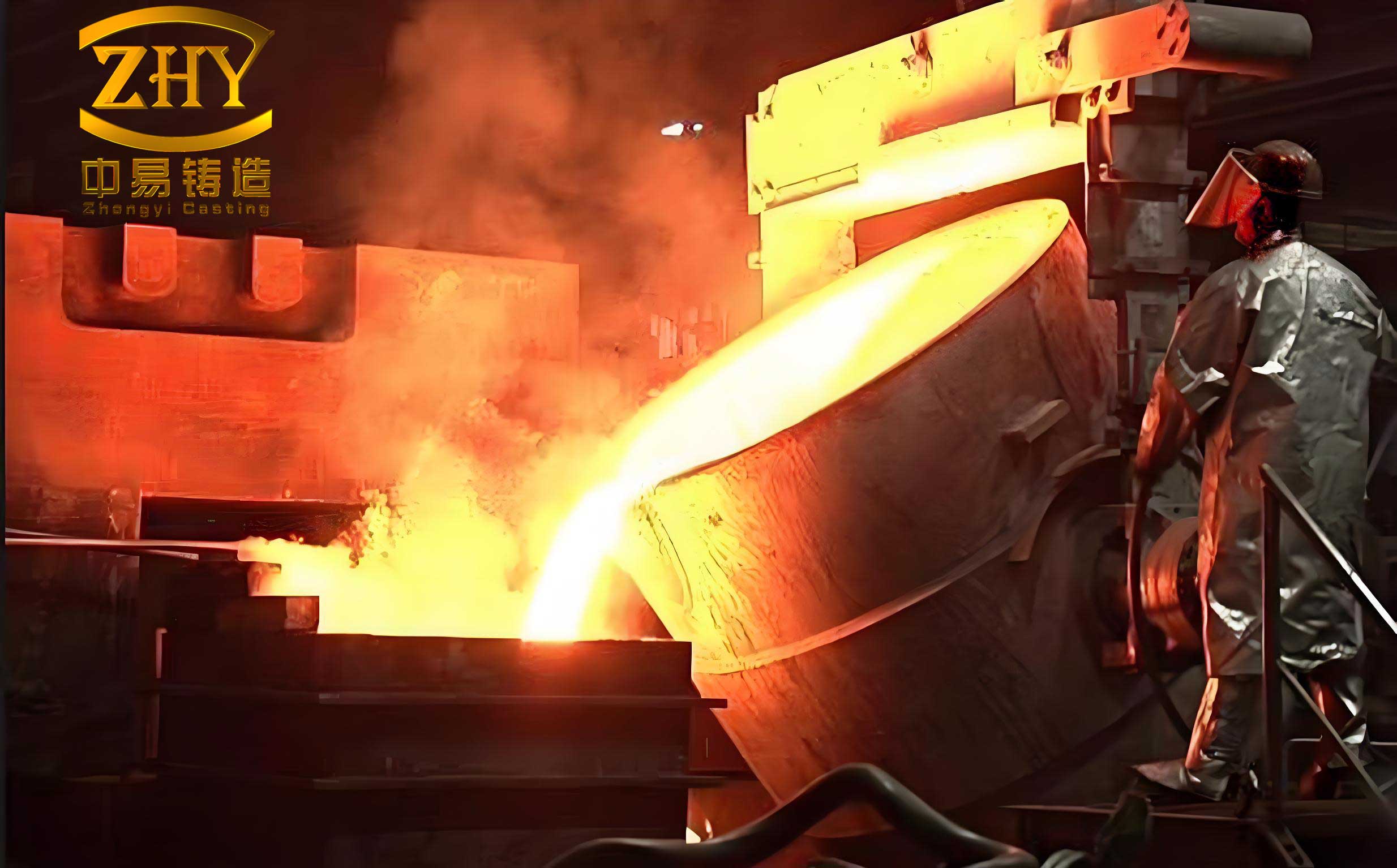
Crack formation in high manganese steel casting, particularly hot cracks, is a major concern due to the material’s high linear shrinkage value of 2.4%–3.0% and low thermal conductivity. In my analysis, hot cracks originate during solidification when thermal stresses exceed the material’s strength at elevated temperatures. The solidification process begins with shell formation at hot spots, where stress concentration can cause initial cracking. If not filled by residual liquid, these cracks propagate inward. The propensity for cracking is exacerbated by coarse as-cast grain boundaries and brittle carbides, which act as stress raisers. To assess crack risk, I apply the strain-based criterion for hot tearing: $$\varepsilon_c = k \cdot \frac{\Delta T}{T_s – T_l}$$ where \(\varepsilon_c\) is the critical strain for crack initiation, \(k\) is a material constant, \(\Delta T\) is the temperature drop, \(T_s\) is the solidus temperature, and \(T_l\) is the liquidus temperature. This highlights the importance of controlling cooling rates in high manganese steel casting to minimize thermal gradients.
Preventive measures for cracks in high manganese steel casting include optimizing mold design to allow for free contraction, using chills to uniformize cooling, and implementing post-casting practices such as early box opening and controlled cooling. For example, I recommend loosening mold restraints after 8 hours and decoring after 38 hours to reduce residual stresses. Additionally, hot cutting of risers above 200°C helps prevent thermal shock. Table 2 outlines common defects in high manganese steel casting and their mitigation strategies, based on my operational data. These approaches have proven effective in reducing scrap rates and enhancing the reliability of high manganese steel casting products.
| Defect Type | Primary Causes | Preventive Measures |
|---|---|---|
| Hot Cracks | High thermal stress, coarse grains | Control pouring temperature, use modification treatment |
| Porosity | Gas entrapment, rapid solidification | Improve deoxidation, optimize gating system |
| Shrinkage Cavities | Inadequate feeding, high pouring temperature | Employ risers, regulate cooling rates |
| Inclusions | Poor slag removal, improper deoxidation | Implement rare earth treatment, extend holding time |
The mechanical performance of high manganese steel casting can be further optimized through heat treatment, such as water toughening, which involves solution annealing at 1050°C–1100°C followed by rapid quenching to dissolve carbides and achieve a homogeneous austenitic structure. The hardness and impact toughness relationship can be expressed as: $$HV = C + K \cdot \varepsilon$$ where \(HV\) is Vickers hardness, \(C\) and \(K\) are constants, and \(\varepsilon\) is the true strain. This equation aids in tailoring heat treatment parameters for specific high manganese steel casting applications. In summary, meticulous control of pouring temperature, combined with advanced deoxidation, modification, and stress management techniques, is paramount for producing defect-free high manganese steel casting components. My firsthand experiences confirm that these methods significantly improve mechanical properties and service life, making high manganese steel casting a reliable choice for demanding industrial environments.
In conclusion, the success of high manganese steel casting hinges on a holistic approach that integrates thermal regulation, metallurgical treatments, and operational diligence. By adhering to low pouring temperatures, ensuring thorough deoxidation, and addressing crack initiation mechanisms, manufacturers can overcome the inherent challenges of high manganese steel casting. The formulas and tables provided here serve as practical tools for optimizing processes, and the embedded image illustrates typical high manganese steel casting outcomes. As industry demands evolve, continued refinement of these techniques will further enhance the durability and efficiency of high manganese steel casting, solidifying its role in critical applications worldwide.