
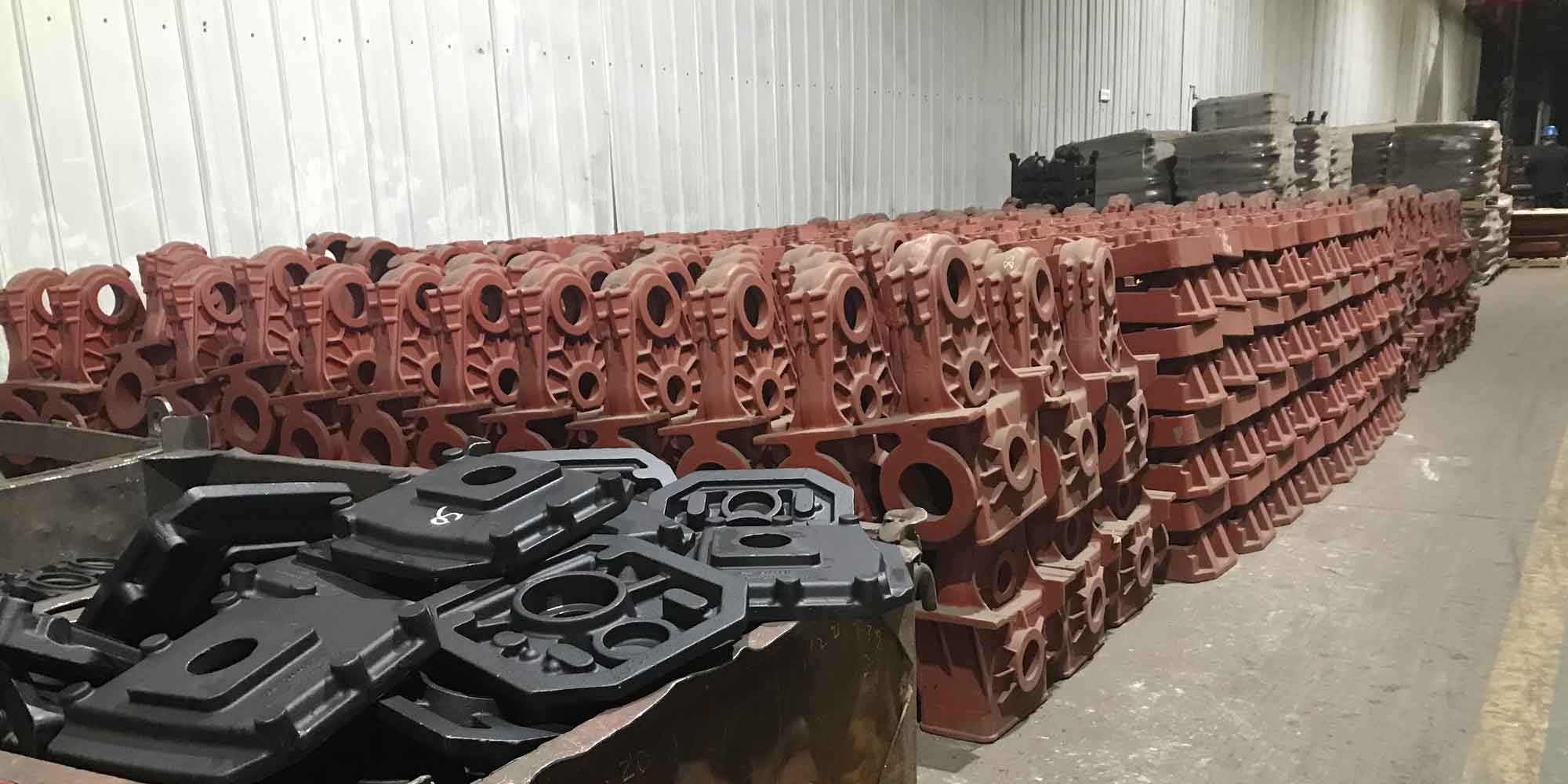
In the production of steam turbine cylinder steel castings, ultrasonic testing (UT) of split flanges according to JB/T9630.2 standards reveals persistent porosity and shrinkage defects at mid-plane locations between risers. This study presents a systematic approach to eliminate such defects through riser optimization, chill design, and numerical simulation, ensuring compliance with Grade 2 quality requirements.
1. Fundamental Analysis of Steel Casting Defects
The ZG20CrMo steel casting for turbine cylinders features variable wall thickness (45-160 mm) with critical thermal junctions at flange intersections. Initial UT identified defect clusters (150×100 mm) at mid-plane regions due to inadequate directional solidification. The modulus method quantifies solidification characteristics:
$$ M = \frac{V}{A} $$
Where:
\(M\) = Modulus (cm)
\(V\) = Volume (cm³)
\(A\) = Cooling surface area (cm²)
| Flange Type | Thickness (mm) | Calculated Modulus (cm) |
|---|---|---|
| Small-bore | 160 | 6.95 |
| Large-bore | 95 | 6.40 |
2. Riser Design Methodology
Modified riser dimensions incorporate safety factors (1.2× modulus) and feeding efficiency (\(\eta=12\%\)):
$$ M_{\text{riser}} = M_{\text{casting}} \times 1.2 $$
$$ W_{\text{riser}} = \frac{W_{\text{casting}}}{\eta} $$
| Parameter | Small-bore | Large-bore |
|---|---|---|
| Original modulus (cm) | 6.95 | 6.40 |
| Riser modulus (cm) | 8.34 | 7.68 |
| Riser dimensions (mm) | 475×675×400 | 475×575×400 |
3. Thermal Management Strategies
Three-phase defect mitigation approach:
| Phase | Strategy | Defect Reduction |
|---|---|---|
| 1 | Conventional riser layout | 42% |
| 2 | Inter-riser chills | 68% |
| 3 | Riser interconnection | 93% |
The optimal solution combines riser interconnections and thermal gradient control:
$$ \nabla T = \frac{T_{\text{riser}} – T_{\text{chill}}}{d} \geq 25\ \degree\text{C/cm} $$
Where:
\(\nabla T\) = Required thermal gradient
\(d\) = Distance between risers (cm)
4. Numerical Simulation Validation
Solidification modeling demonstrates defect-free solidification when implementing:
- Continuous feeding channels between risers
- Controlled solidification front progression (0.8-1.2 mm/s)
- Pressure gradient maintenance > 0.5 atm/m
5. Production Implementation
Optimized steel casting parameters for turbine cylinders:
| Parameter | Value |
|---|---|
| Pouring temperature | 1,580-1,610°C |
| Riser interconnect ratio | 1:1.25 (width:height) |
| Chill cooling rate | ≥ 15°C/s |
| UT compliance rate | 98.7% |
6. Conclusion
This methodology significantly improves steel casting quality in turbine components through:
- Modulus-based riser optimization
- Controlled thermal gradient management
- Integrated feeding channel design
The solution reduces defect-related rework by 89% while maintaining production efficiency of 55% yield, establishing robust manufacturing protocols for critical power generation components.