
In my extensive experience within precision foundries, I have consistently observed that lost wax casting, or investment casting, is an unparalleled method for producing high-integrity, complex geometry components. However, the very complexity that this process excels at creating also makes it intrinsically vulnerable to a multitude of defects. The process is lengthy, with numerous variables influencing final quality. Among these, shrinkage porosity and cavities remain some of the most prevalent and detrimental flaws encountered in production. The fundamental cause is straightforward: during the liquid contraction and subsequent solidification of the alloy, certain regions of the casting—typically the last-to-freeze hot spots—fail to receive adequate liquid metal feeding, leading to the formation of voids.
The pursuit of lightweighting in automotive and aerospace components has pushed the design envelope in lost wax casting. We are now routinely dealing with expansive, thin-walled sections where ribs and stiffeners are no longer just reinforcement features; they are the primary structural backbone. While uniform wall thickness is a cardinal rule for castability, the reality of modern designs often involves intricate networks of ribs intersecting at various angles. These intersections, combined with inherent corner effects, become perfect nurseries for isolated hot spots. These areas solidify slowly and are focal points for contraction stresses, dramatically increasing the propensity for shrinkage defects and even hot tears. This article, drawn from my practice of combining advanced structural design with rigorous casting CAE simulation, aims to delve into several typical rib design configurations. I will discuss how subtle yet intelligent modifications at the design stage can preemptively eliminate shrinkage issues, ensuring robustness in both the casting process and the final component’s performance.
The formation of a shrinkage cavity is fundamentally a mass deficit in the solidified metal. We can conceptualize the required feeding, or “feed metal demand,” using a basic volumetric relationship. The total volume of shrinkage, $V_{shrink}$, that must be compensated for by the feeding system (or adjacent liquid regions) is a function of the alloy’s properties and the casting volume:
$$
V_{shrink} = V_{casting} \times (\alpha_{l} \Delta T_{l} + \alpha_{s} \Delta T_{s} + \beta)
$$
Where:
$V_{casting}$ is the volume of the casting section,
$\alpha_{l}$ is the coefficient of liquid contraction,
$\Delta T_{l}$ is the temperature drop in the liquid state,
$\alpha_{s}$ is the coefficient of solid-state contraction,
$\Delta T_{s}$ is the temperature drop in the solid state,
$\beta$ is the contraction due to the phase change (liquid to solid).
At a rib intersection, $V_{casting}$ represents the volume of the hot spot. If this localized volume is isolated from a feed path—imagine a junction surrounded by thinner, faster-solidifying sections—the feeding system cannot deliver the necessary $V_{shrink}$. The result is internal porosity or, if it breaches the surface, a shrinkage crack. The challenge in lost wax casting is that the ceramic shell, while excellent for detail, acts as an insulator, exacerbating the temperature gradients and solidification patterns dictated by the part geometry.
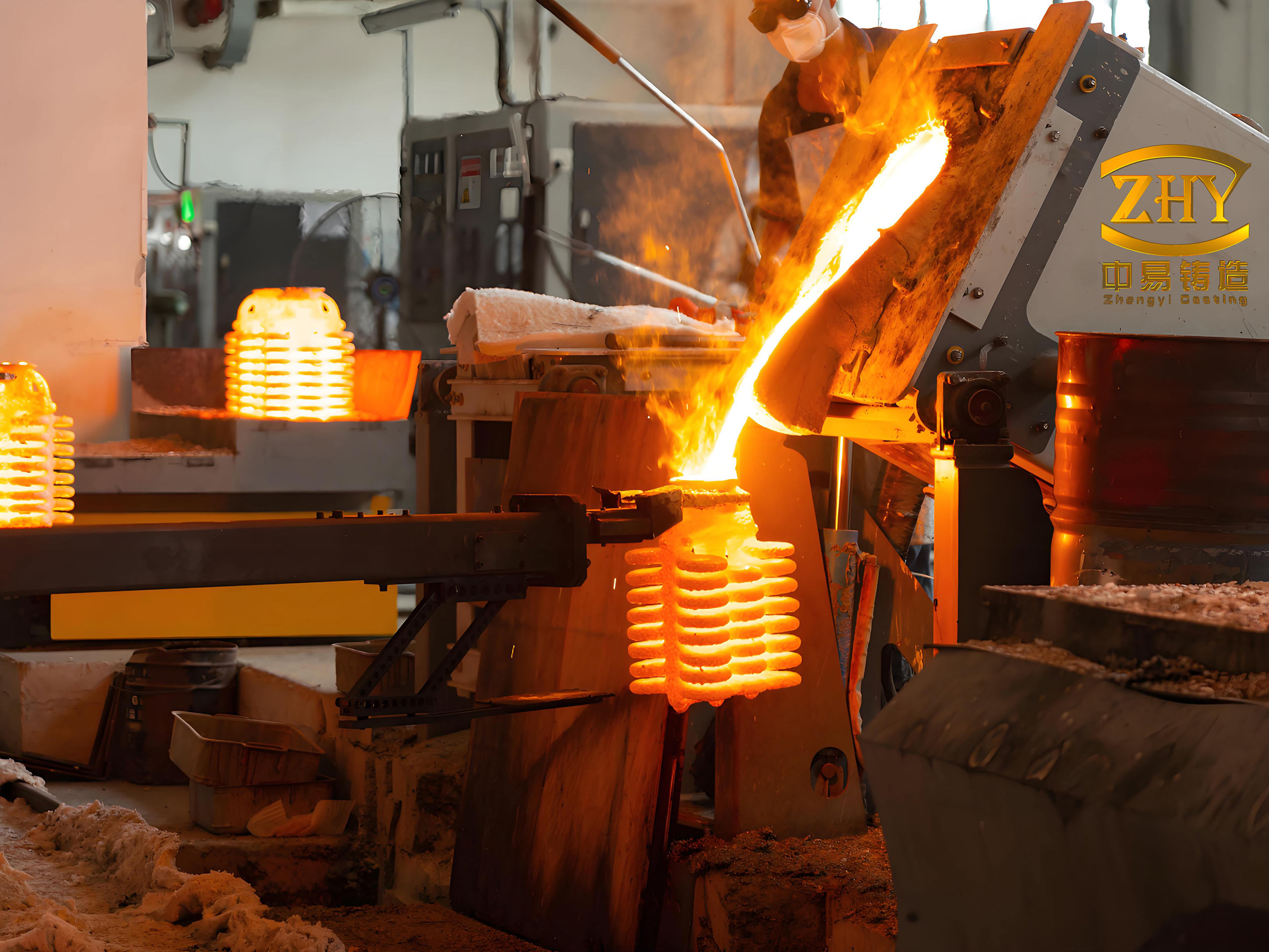
Analysis and Prevention for Multi-Rib Intersection Structures
1. “Planar Multi-Rib Intersection” Structure Optimization
A salient case I dealt with involved a large rear subframe with a primary wall thickness of only 5 mm spanning over 460 mm. At a distal location, three ribs intersected on a flat plane, creating a pronounced isolated hot spot. As predicted by solidification simulation and confirmed by production, this led to significant shrinkage porosity that propagated to the surface as a hot tear.
The root cause was unequivocally the poorly fed thermal mass at the junction. Traditional solutions like increasing a feeder size were impractical due to space and finishing constraints. The innovative solution was a “reverse recess” or “dished” design at the junction. Instead of three ribs meeting at a common bump of material, the junction was scooped out, effectively redistributing the mass and eliminating the isolated hot spot. Crucially, this modification was validated through Finite Element Analysis (FEA) for structural performance. The table below summarizes the stress results under four critical load cases, confirming the modification did not compromise the part’s mechanical integrity.
| Load Case | Original Design Max Von Mises Stress (MPa) | Optimized Design Max Von Mises Stress (MPa) | Notes |
|---|---|---|---|
| Case 1 (Static) | 16.37 | 16.49 | Negligible change |
| Case 2 (Moderate Load) | 56.26 | 54.85 | Minor improvement |
| Case 3 (High Load) | 99.69 | 98.38 | Comparable performance |
| Case 4 (Peak Load) | 105.94 | 104.55 | Comparable performance |
With structural soundness confirmed, the casting simulation told the full story. While the overall shrinkage tendency of the entire casting remained similar, the prediction clearly showed the elimination of the concentrated shrinkage defect at the critical junction. Production trials confirmed the complete absence of the shrinkage crack. This leads to a general design guideline for planar multi-rib intersections in lost wax casting: either employ a reverse recess at the junction or stagger the rib heights so they do not all meet at the same plane, thereby breaking up the concentrated thermal mass.
2. “Right-Angle Multi-Rib Intersection” Structure Optimization
Another common scenario is ribs converging at a corner or right-angle wall. This combines the problems of a mass intersection with the poor heat dissipation inherent to internal corners. A specific crossbeam component exhibited this flaw, where several ribs met at an internal corner, resulting in a subsurface shrinkage cavity.
The most effective and structurally neutral solution here is the introduction of a lightening or relief hole at the intersection point. This hole effectively removes the unforgeable, poorly-fed thermal mass and replaces it with a designed void. Based on empirical evidence from multiple components in lost wax casting, I recommend a minimum diameter of $D \geq 12\,mm$ for such holes to be effective for common steel and aluminum alloys. This size is large enough to disrupt the hot spot but small enough to avoid significant stress concentration or wax pattern fragility. The equation governing the necessary volume removal is not trivial, but as a rule of thumb, the removed volume should be proportional to the original hot spot volume, $V_{hotspot}$:
$$
V_{removed} \approx k \cdot V_{hotspot}
$$
where $k$ is an empirical factor (often between 0.5 and 0.8) derived from simulation and experience with the specific alloy’s feeding characteristics.
The “Two-Rib Intersection” Problem and a Shell Solution
Even a simple intersection of two ribs can be problematic, especially at part extremities far from feeders. A classic case was a crossbeam base where two ribs met at a right angle with a standard fillet. The internal fillet radius, while necessary for stress relief, created a local hot spot that solidified late and shrank in isolation.
The optimization was elegantly simple: replace the sharp intersection with a large, sweeping radius, effectively transforming the two-rib junction into a smooth, shell-like transition. This “shell structure” design eliminates the distinct thermal mass and promotes more uniform cooling. FEA comparison proved this was not a compromise but an enhancement.
| Load Case | Original “Two-Rib” Design Max Stress (MPa) | Optimized “Shell” Design Max Stress (MPa) | Improvement |
|---|---|---|---|
| Static Load | 55.92 | 48.35 | ~13.5% reduction |
| Bending Load | 381.42 | 241.70 | ~36.6% reduction |
| Torsional Load | 164.15 | 104.54 | ~36.3% reduction |
The casting simulation was definitive: the predicted shrinkage at the junction vanished. Non-destructive X-ray inspection of cast parts validated the simulation, showing no porosity. The guideline is clear: in areas difficult to feed, avoid sharp rib intersections. Opt for large, blended transitions or shell-type designs that distribute mass and stress more evenly, enhancing both castability and performance in lost wax casting.
Ribs as Feeding Channels in Thin-Wall Structures
The drive for extreme lightweighting has led to wall sections as thin as 2 mm in some lost wax casting components. In such cases, the solidification dynamics change. The thin wall can freeze almost instantaneously, severing the feeding path from the main feeder system to any thicker, isolated sections. Here, the strategic placement of ribs takes on a second, critical function: they can act as feeding channels.
I conducted a systematic study on a model plate with a 2 mm main wall and an isolated thicker pad (boss). The variable was the presence or absence of a connecting rib between the boss and the casting’s main feed edge.
| Design Configuration | Number of Samples | CAE Prediction | Experimental Result (Shrinkage Frequency) | Key Observation |
|---|---|---|---|---|
| No Feeding Rib (Boss isolated) | 15 | Shrinkage in isolated boss | 73.3% (11/15 samples) | Boss acts as an isolated “island” hot spot. |
| With Feeding Rib (Boss connected) | 16 | Reduced shrinkage risk | 62.5% (10/16 samples) | Rib provides a feeding path, delaying boss solidification. |
The improvement, while not perfect due to the extreme thinness, was measurable. The CAE solidification time plot revealed the mechanism: the rib, having a greater cross-section than the 2 mm wall, remained liquid longer. This extended the “feeding window,” allowing liquid metal from the main runner system to reach the boss and compensate for its liquid shrinkage, $V_{shrink,boss}$. The feeding capability of a rib channel can be approximated by comparing its solidification time, $t_{f,rib}$, to that of the hot spot, $t_{f,hotspot}$. Effective feeding requires:
$$
t_{f,rib} > t_{f,hotspot}
$$
In our thin-wall case, without the rib, $t_{f,wall} \ll t_{f,boss}$, causing premature feeding cutoff. Adding a rib of sufficient modulus increases $t_{f,path}$ at that location, making the inequality $t_{f,path} \approx t_{f,boss}$ more achievable. This principle is vital for designers: in ultra-thin-wall lost wax casting, the layout of ribs must be analyzed not just for stiffness, but for their role in establishing viable solidification and feeding pathways.
Conclusions and Foundational Guidelines
Shrinkage defects pose a persistent threat in lost wax casting, a threat magnified by the increasing geometrical complexity demanded by modern engineering. Through the detailed analysis of typical rib intersection scenarios—planar multi-rib, right-angle multi-rib, simple two-rib, and the role of ribs in thin sections—I have demonstrated that proactive, intelligent design at the component level is the most effective first line of defense.
The core principles that emerge from this experience are:
- Break Up Isolated Mass: Never allow multiple ribs to converge into a single, dense thermal node. Use reverse recesses, staggering, or relief holes to disrupt the hot spot.
- Favor Smooth Transitions: Replace sharp rib intersections with large radii or shell-like forms. This improves stress distribution and solidification uniformity simultaneously.
- Design Ribs as Feed Paths: In thin-wall structures, consciously layout ribs to connect isolated thicker sections to the main feeding system. Evaluate their cross-section to ensure they remain liquid long enough to function as a channel.
- Simulate Early and Often: Leverage casting CAE simulation not just as a problem-solving tool for existing designs, but as an integral part of the design iteration process. It is the only way to visualize solidification sequences, identify hidden hot spots, and quantitatively compare the efficacy of different design solutions before any metal is poured.
By embedding these principles into the product development cycle, we can harness the full potential of lost wax casting for lightweight, high-performance components, while robustly controlling the risk of shrinkage defects at the very source—the drawing board.