
In my extensive experience within the precision casting industry, few projects encapsulate the intricate balance of material science, process engineering, and practical problem-solving as effectively as the production of a complex, thin-walled stainless steel exhaust elbow. This component, a critical part of an engine’s exhaust system, presented a formidable set of challenges that required a holistic re-evaluation and optimization of the entire investment casting process. The goal was not merely to produce a casting but to achieve consistent, high-integrity parts with stringent requirements on dimensional accuracy, surface finish, weldability, and high-temperature performance. This deep dive into the investment casting process chronicles the systematic approach taken, from wax pattern creation to final heat treatment, highlighting the critical decisions and innovative solutions that ultimately led to a successful and reliable manufacturing route.
The component in question is a hollow structure featuring flanges, angled side ports, and threaded bosses, with a uniform wall thickness of approximately 3 mm. Its service environment—exposure to temperatures around 500°C and subsequent welding into an assembly—dictated the material choice. Austenitic stainless steel AISI 304 (0Cr18Ni9) was selected for its excellent corrosion resistance, superior toughness, and good weldability, all stemming from its face-centered cubic (FCC) crystal structure. However, the very properties that make it suitable for service also introduce complexities into the investment casting process. Its low carbon content and specific solidification characteristics can lead to mistun and filling issues in thin sections, while its high alloy content demands careful handling during melting to prevent contamination.
The foundational challenge, and arguably the most critical step in this investment casting process, was the creation of a precise wax pattern that accurately represented the complex internal hollow geometry. A flawed pattern inevitably leads to a defective casting. We explored and implemented three distinct methodologies, each with its own merits and considerations for production scale and quality targets.
The first approach utilized a soluble urea core. A metal die was used to form a solid urea core, which was then placed into the main wax injection die. Molten wax was injected around it, and after ejection, the wax assembly was immersed in water to dissolve the urea core, leaving a hollow wax pattern. The key process optimization here was the modification of the urea melt. We found that adding a small percentage of sugar significantly increased the melt’s viscosity, which helped to eliminate gas bubbles during core molding, leading to a smoother core surface. The thermal shock during cooling had to be managed; initial cooling in warm water prevented wax cracking caused by the differential contraction between the wax and the dissolving urea core. The relationship for ideal core dissolution time can be approximated by considering Fick’s law of diffusion for a cylindrical geometry:
$$ t \approx \frac{r^2}{4D} $$
where \( t \) is the dissolution time, \( r \) is the characteristic thickness of the core, and \( D \) is the effective diffusivity of urea in water, which is temperature-dependent. While cost-effective, this method added manual steps and environmental considerations for urea handling.
The second method involved creating the wax pattern in two halves using a split-die design with interlocking features (tongue-and-groove). After injection, the halves were carefully aligned and bonded using a hot wax “welding” technique. This method eliminated the need for soluble cores, improving production rate and reducing material costs. The strength of the bond is critical. The shear strength \( \tau_{bond} \) of the welded joint must exceed the stresses induced during subsequent handling and shell building, which include gravitational and capillary forces from the ceramic slurry:
$$ \tau_{bond} > \rho g V / A_{joint} + \gamma \cos(\theta) / r_{pore} $$
where \( \rho \) is wax density, \( g \) is gravity, \( V \) is volume, \( A_{joint} \) is bonded area, \( \gamma \) is surface tension of the slurry, \( \theta \) is contact angle, and \( r_{pore} \) is pore radius in the joint. This method demanded high skill from operators to ensure perfect, leak-proof seams.
The third and most technically advanced approach employed a multi-part, collapsible metal die with numerous extractable side cores. This allowed for the direct injection of a one-piece, hollow wax pattern without bonding or soluble cores. Although requiring a significant initial investment in high-precision tooling, it offered the best combination of pattern accuracy, repeatability, and production efficiency. The design principle ensured that no undercuts locked the pattern in the die, following the geometric condition for core extraction. A comparison of these methods is summarized below:
| Wax Pattern Method | Key Advantages | Key Challenges | Best Suited For |
|---|---|---|---|
| Soluble Urea Core | Low tooling cost, accurate internal geometry. | Added process steps, environmental control, potential for core shift or breakage. | Prototyping & low-volume production. |
| Split & Bond | Faster than urea core, no soluble materials. | High operator skill required, risk of bonding defects (leaks, misalignment). | Medium-volume production with skilled labor. |
| Collapsible Multi-Core Die | Highest accuracy and repeatability, single-piece pattern, fast cycle time. | Very high initial tooling cost and complexity. | High-volume production. |
Following pattern assembly onto a wax gating system—designed as a top-fed cluster to aid filling and slag floatation—the next critical phase in the investment casting process is ceramic shell building. For a high-integrity stainless steel casting, the shell must exhibit exceptional refractory stability, strength, and permeability. We employed a colloidal silica (silica sol) binder system for its environmental friendliness and excellent surface finish replication. The ceramic flour for the primary coats was zircon flour (ZrSiO4), chosen for its high refractoriness (~1800°C) and low thermal expansion, which minimizes interaction with the steel and reduces the risk of hot tearing. The shell was built up in a sequence of layers, each with a specific function, as detailed in the following sequence table.
| Layer Number | Type | Binder | Refractory Flour | Stucco Sand | Primary Function |
|---|---|---|---|---|---|
| 1 & 2 | Face Coat | Silica Sol | Zircon Flour | Zircon Sand (70/140 mesh) | Form precise, smooth cavity surface. |
| 3 & 4 | Transition Coat | Silica Sol | Alumina-Silica Flour | Fused Silica Sand (50/100 mesh) | Bind face coats to backup coats, prevent delamination. |
| 5-7 | Backup Coat | Silica Sol | Alumina-Silica Flour | Fused Silica Sand (30/60 & 16/30 mesh) | Build shell strength, provide permeability. |
| 8 | Seal Coat | Silica Sol | Alumina-Silica Flour | None (Dip only) | Consolidate surface, improve strength, reduce sand shedding. |
The drying of each layer is governed by the diffusion and evaporation of water from the colloidal silica gel. The drying time \( t_d \) for a layer of thickness \( L \) can be modeled as:
$$ t_d \propto \frac{L^2}{D_{eff}} $$
where \( D_{eff} \) is the effective moisture diffusivity, which is a function of air temperature, humidity, and velocity. Strict control of the drying climate (22-25°C, 40-60% RH, gentle air flow) was essential to prevent cracking or poor inter-layer adhesion.
After shell completion, the cluster undergoes dewaxing and firing. We used high-pressure saturated steam autoclaving for dewaxing, where the rapid heat transfer melts and expands the wax, cracking the shell. The steam pressure \( P \) and time \( t \) must be optimized to ensure complete wax removal without shell damage. The fired shell must then be heated to eliminate residual volatiles and sinter the ceramic bonds. The firing temperature \( T_f \) for a silica sol shell is typically between 1000°C and 1150°C, held for several hours. This process develops the final shell strength \( \sigma_{shell} \), which is crucial to withstand the metallostatic pressure \( P_m \) of the molten metal during pouring:
$$ P_m = \rho_{steel} \cdot g \cdot h $$
$$ \sigma_{shell} > \frac{P_m \cdot R}{t_{shell}} $$
where \( h \) is the metal head height, \( R \) is the effective cavity radius, and \( t_{shell} \) is the shell thickness. A properly fired shell appears white and translucent.
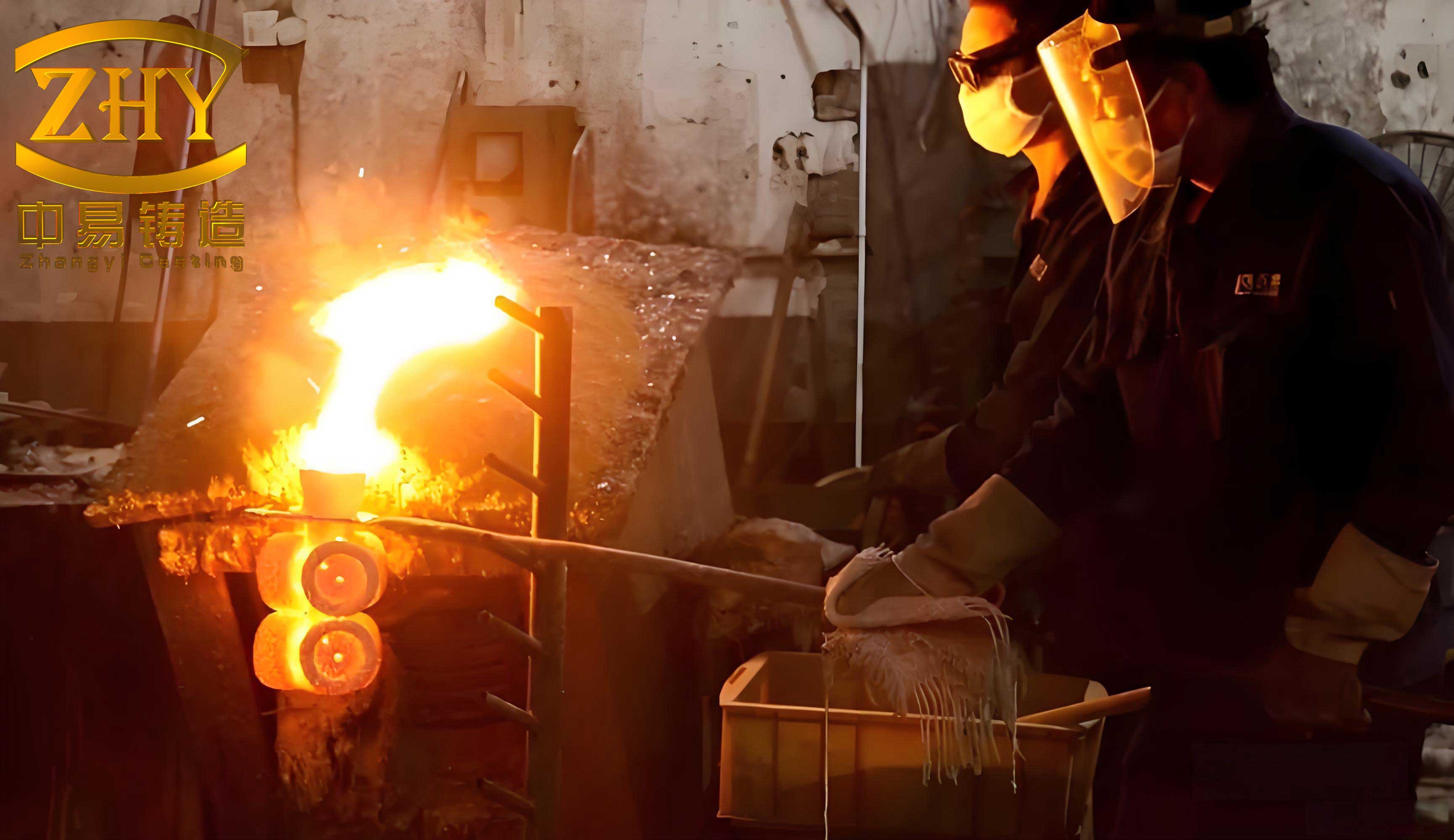
The melting and pouring stage is where material science directly intersects with the investment casting process. For 304 stainless steel, preventing the pickup of impurities is paramount. We dedicated a medium-frequency coreless induction furnace with a neutral (alumina-based) lining to avoid reactive slag formation from acid or basic linings. The ladle was also lined with a similar refractory. The target chemical composition, critical for achieving the desired austenitic structure and properties, is shown below:
| Element | C | Si | Mn | P | S | Cr | Ni |
|---|---|---|---|---|---|---|---|
| Wt. % (AISI 304) | ≤ 0.08 | ≤ 1.00 | ≤ 2.00 | ≤ 0.045 | ≤ 0.030 | 18.0-20.0 | 8.0-11.0 |
The fluidity of low-carbon stainless steel is inferior to that of carbon steels. To fill the 3 mm thin walls completely, a careful thermal balance was required. The superheat temperature \( \Delta T_{sh} \) must be sufficient to maintain fluidity but not so high as to promote excessive metal-mold reaction or coarse grain structure. We established the following protocol: Tap temperature from the furnace: 1730-1750°C. Pouring temperature into the preheated shell: 1650-1680°C. The shell was poured while still near the furnace firing temperature (a “hot shell” practice) to minimize the temperature gradient and extend the fluid life of the metal. The filling time \( t_{fill} \) for a thin-section casting can be estimated using Bernoulli’s principle modified for viscous flow:
$$ t_{fill} \approx \frac{V_{cavity}}{A_{choke} \cdot \sqrt{2gH}} \cdot f(\mu, Re) $$
where \( V_{cavity} \) is cavity volume, \( A_{choke} \) is the choke cross-sectional area, \( H \) is the effective metal head, \( \mu \) is dynamic viscosity, and \( f(\mu, Re) \) is a function accounting for viscous effects and Reynolds number \( Re \).
Post-casting operations require careful handling due to the soft, ductile nature of austenitic stainless steel. The gates were removed using plasma cutting to avoid mechanical shock. For internal cleaning and surface finishing, we exclusively used stainless steel shot in vibratory and blasting equipment. Using conventional steel shot would embed ferrous particles into the surface, creating potential sites for galvanic corrosion. The specification for the stainless steel shot is as follows:
| Parameter | Specification |
|---|---|
| Material Grade | 430 Stainless Steel |
| Hardness | HRC 35-40 |
| Shape | Conditioned Cut Wire |
| Size | S-330 (0.8 mm avg. diameter) |
The final and essential thermal operation in this investment casting process is solution annealing, or固溶处理 (solid solution treatment). As-cast 304 stainless steel can have non-uniform structures, interdendritic segregation, and residual stresses. The purpose of solution annealing is to dissolve any chromium carbides (Cr23C6) that may have precipitated at grain boundaries during cooling—a phenomenon called sensitization which drastically reduces corrosion resistance—and to homogenize the alloying elements into a single-phase austenitic matrix. The process involves heating the castings to a temperature where the carbides are fully dissolved, typically 1050-1100°C, holding for sufficient time (1.5-2 hours for our section thickness), and then quenching rapidly in water. The kinetics of carbide dissolution can be related to the diffusion of carbon and chromium. The time \( t_s \) required to dissolve a carbide particle of radius \( r_0 \) is governed by:
$$ r_0^2 – r(t)^2 = K(T) \cdot t $$
where \( K(T) \) is a temperature-dependent rate constant following an Arrhenius relationship \( K(T) = K_0 \exp(-Q/RT) \), with \( Q \) being the activation energy for the dissolution process. Rapid quenching “freezes” the single-phase austenitic structure, restoring maximum ductility, toughness, and corrosion resistance, which is critical for the component’s subsequent welding and high-temperature service.
Throughout this project, the integration of fundamental principles with practical shop-floor adjustments was key to optimizing the investment casting process. The table below summarizes some of the key process parameters and their optimized ranges established through this development work.
| Process Stage | Key Parameter | Optimized Value/Range | Rationale |
|---|---|---|---|
| Wax Injection | Injection Pressure & Temperature | 6-8 bar, 58-62°C | Balance between filling fine detail and minimizing wax contraction/air entrapment. |
| Shell Building | Primary Slurry Viscosity | 22-24 seconds (Zahn Cup #4) | Ensures adequate coating thickness without sagging on thin walls. |
| Drying | Intercoat Drying Time | 10-12 hours (Controlled Climate) | Ensures complete gelling and drying without “green” cracks. |
| Firing | Temperature & Time | 1100°C for 3 hours | Achieves full sintering and burnout, provides adequate hot strength. |
| Melting | Furnace Lining | High-Alumina Neutral | Minimizes FeO·SiO2 slag formation and Si/Mn loss. |
| Pouring | Metal Superheat (ΔT) | ~120-150°C above liquidus | Compensates for low fluidity of 304 steel, ensures fill of 3mm walls. |
| Heat Treatment | Solution Anneal Quench Delay | < 10 seconds | Prevents reprecipitation of carbides in the sensitization temperature range (500-800°C). |
Furthermore, a defect analysis framework was crucial. For instance, the tendency for mistrun in thin sections was countered by optimizing gating to increase metal velocity and using hotter shells. The Hall-Petch relationship reminded us that finer grain size improves yield strength, which is beneficial for thin-walled parts, and this was promoted by controlling pour temperature and inoculant practice if needed:
$$ \sigma_y = \sigma_0 + k_y \cdot d^{-1/2} $$
where \( \sigma_y \) is yield strength, \( \sigma_0 \) and \( k_y \) are material constants, and \( d \) is the average grain diameter.
In conclusion, the successful production of this demanding stainless steel exhaust elbow was a testament to a meticulously controlled and optimized investment casting process. It was not a single “silver bullet” but a series of interconnected optimizations: selecting the correct pattern-making technique for quality and volume; engineering a robust, refractory shell system; implementing a contamination-controlled melting and precise pouring practice; and finalizing with the correct metallurgical heat treatment. Each step was underpinned by scientific principles—from fluid dynamics and heat transfer to diffusion kinetics and materials thermodynamics. This holistic approach to the investment casting process ensures that complex, high-performance components can be reliably manufactured, pushing the boundaries of what is possible in precision metal forming.