
In my extensive experience within the foundry, few defects are as persistent and aesthetically damaging in stainless steel precision investment casting as surface flow lines. These shallow, streak-like depressions, typically 0.05 to 1.00 mm deep, mar the otherwise smooth surface of components, particularly on large flat or curved external surfaces. While often considered a cosmetic issue, their presence can signal underlying process instabilities and, in severe cases, may be deemed unacceptable for high-integrity applications. Through systematic investigation and process refinement, I have come to understand that this defect is not an inevitability but a consequence of specific interactions between the ceramic shell and the molten metal. The following analysis details my perspective on the formation mechanism and the comprehensive control strategies necessary for its elimination.
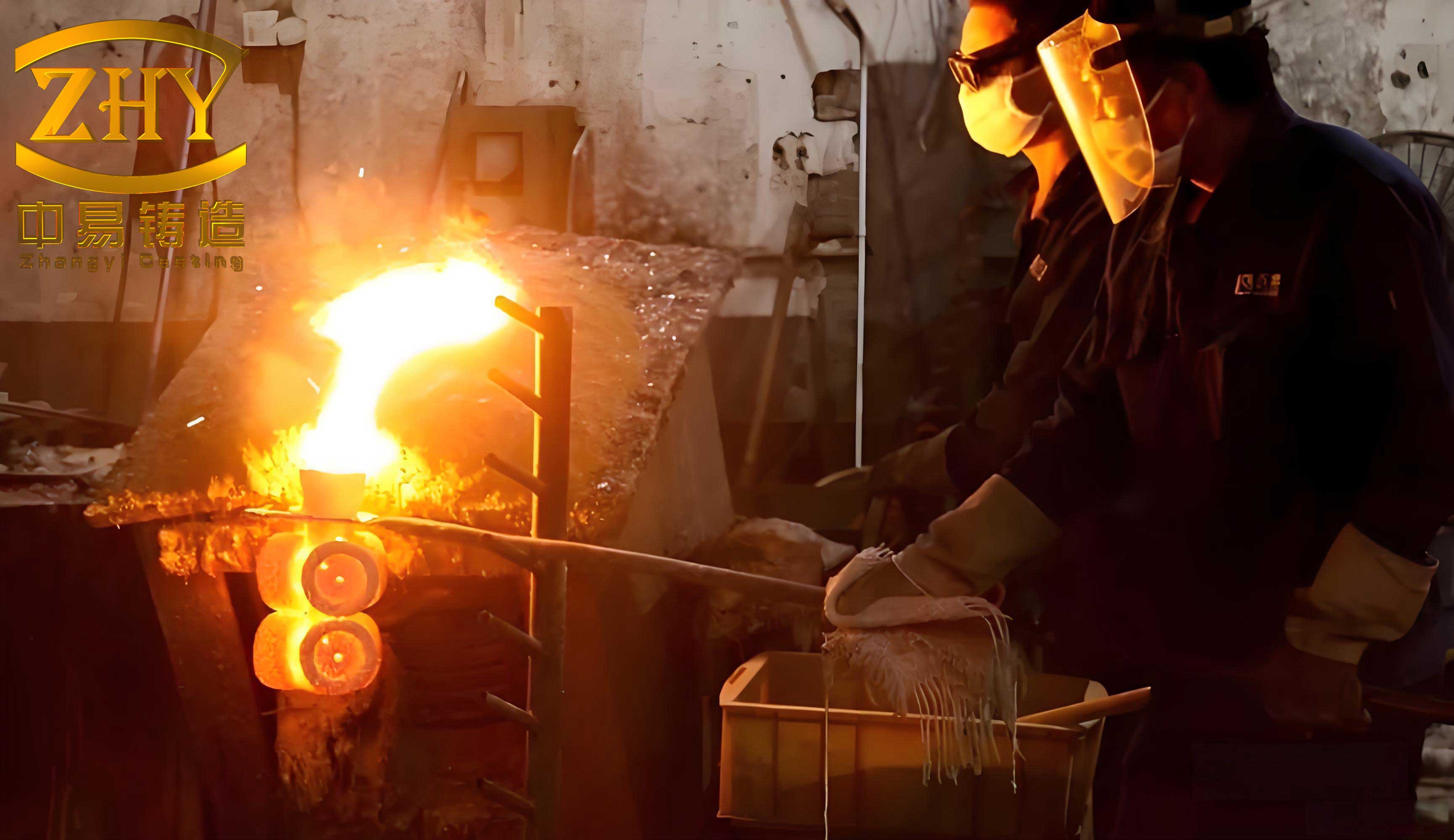
The pursuit of flawless surface finish is a cornerstone of precision investment casting. Unlike carbon steels, where surface oxidation plays a more dominant role in streak formation, my observations on 304 and 316 stainless grades point decisively towards a mechanical-gas interaction model. The defect consistently correlates with the condition of the shell’s interior surface post-dewaxing. Shells exhibiting a network of fine, hairline cracks after autoclave dewaxing almost invariably produce castings with flow lines, whereas shells with an intact interior yield sound surfaces. This led me to focus on the sequence of events from shell building to pouring.
The root cause lies in the vulnerability of the shell’s inner layers during dewaxing. In the widely used silica-sol binder system, the shell is inherently semi-permeable. During autoclaving, high-pressure steam rapidly transfers heat through the shell wall. The wax expands upon heating, exerting significant tensile stress on the confining ceramic. Simultaneously, residual moisture within the shell’s binder phases can flash to steam, creating localized high-pressure zones. The combined stress from wax expansion and internal steam pressure often exceeds the green strength of the inner shell layers, resulting in micro-cracking. These cracks are the foundational flaw.
The formation mechanism of the flow line itself is a fascinating study in pressure equilibrium. During pouring, the molten stainless steel fills the cavity, displacing the resident air. This air, along with gases generated from any residual mold contaminants, is pushed towards the shell walls. If micro-cracks are present, this gas is forced into them. The critical moment occurs next. As the hot metal (at temperature $T_m$) radiates heat into the crack, the trapped gas heats up dramatically from its initial shell temperature ($T_s$). Assuming the crack volume ($V$) remains relatively constant and the gas behaves ideally, the pressure rise can be described by a simplified relation derived from the ideal gas law:
$$P_2 = P_1 \cdot \frac{n_2}{n_1} \cdot \frac{T_m}{T_s}$$
Where $P_1$ and $P_2$ are the gas pressures in the crack before and after heating, and $n_1$ and $n_2$ are the molar quantities of gas. The term $\frac{n_2}{n_1}$ represents the gas venting efficiency; a value of 1 means no gas escaped. In a low-permeability silica-sol shell, venting is poor ($n_2 \approx n_1$), and the pressure spike $P_2$ can be severe due to the high ratio $\frac{T_m}{T_s}$.
This elevated gas pressure ($P_{gas}$) acts against the metallostatic pressure and surface tension forces trying to keep the metal in contact with the shell. A balance of forces at the crack location determines if a flow line forms. The metal will locally recede, forming a concave meniscus, if the internal gas pressure exceeds the external pressures:
$$P_{gas} > P_{atm} + \rho g h + \frac{2\sigma \cos\theta}{r}$$
Here, $P_{atm}$ is atmospheric pressure, $\rho g h$ is the metallostatic head at that point, $\sigma$ is the liquid steel’s surface tension, $\theta$ is the contact angle, and $r$ is the radius of curvature of the meniscus. When the inequality holds, the metal pulls back, solidifies in that recessed position, and leaves a permanent, linear indentation tracing the path of the subsurface crack. In cases where the crack is wider, metal may initially infiltrate, forming a fin or “flash,” but gas trapped further down the narrow tip of the same crack can still cause recession, explaining the observed phenomenon where a flow line appears as an extension of a fin.
Therefore, the battle against flow lines is fought on two fronts: preventing the initiation of shell inner-layer cracks and managing the pressure of any gas that does become trapped. A holistic approach to the entire precision investment casting process is required.
Front 1: Fortifying the Shell – Preventing Micro-Cracking
The shell is our first and most crucial line of defense. Its behavior during dewaxing is paramount. From my practice, the following interconnected factors are key to building a crack-resistant shell.
1. Optimizing Shell Architecture for Stress Relief: The goal during dewaxing is to melt and evacuate the surface layer of wax before the core of the pattern expands significantly. This creates a relief gap. To achieve this, the shell’s face coat must have controlled permeability and thermal conductivity.
- Face Coat Permeability: Using a slightly coarser refractory flour (e.g., -325 mesh instead of -400 mesh) and a higher sand grain size for the first stucco (e.g., 80-120 mesh) increases the interconnected pore pathways. This allows the initial molten wax to wick into the shell face rather than building pressure against it.
- Slurry Parameters: A marginally lower refractory-to-binder ratio in the prime slurry, while maintaining adequate coating thickness, can reduce green strength slightly but dramatically increase permeability, facilitating wax egress.
- Pattern Etching: A controlled chemical etch of the wax pattern prior to shell building is not just for improving slurry adhesion. The microscopic texture it creates provides capillary channels that accommodate the first melt fraction, further decoupling the wax from the shell.
2. Mastering the Drying Process: In silica-sol systems, drying is not merely water removal; it’s a strength-building process via sol-gel transition. Incomplete drying of the inner layers leaves them weak and prone to steam explosion during autoclaving.
| Shell Layer | Primary Function | Drying Goal | Key Control Parameter |
|---|---|---|---|
| Prime (1st) | Surface finish, initial barrier | Full gelation, no cracking | Controlled humidity & time; ~30-50% RH |
| Secondary (2nd) | Strength building, stress transition | High dry strength (>90% weight loss) | Robust air flow, lower humidity, sufficient time |
| Back-up Layers | Structural strength | Maximum practical dryness | Extended drying times, forced air circulation |
The secondary coat is critically influential. A well-dried second layer provides a strong foundation for the face coat and draws moisture from it during its own application and drying. Prolonged dipping time for the second slurry should be avoided as it re-hydrates the prime coat.
3. Intelligent Gating and Pattern Assembly: Dewaxing stress is a function of the wax volume ($V$) and the cross-sectional area ($A$) available for its escape—often expressed as a Dewaxing Index ($V/A$). My approach is two-fold:
- Maximize Escape Routes: Design generous ingate cross-sections. For complex patterns, consider auxiliary wax vents that are plugged before casting.
- Minimize Bulk Stress: Avoid overly thick runner bars. While they aid in feeding, they create large, thermally sluggish wax volumes that expand forcefully. Instead, use multiple, smaller runners to distribute wax mass. Limit the number of patterns per cluster to reduce the total $V$ relative to the main sprue’s $A$.
4. Executing a Controlled Dewax Cycle: The autoclave operation is where theory meets practice. The cycle must be aggressive enough to melt the wax skin quickly but not so violent as to shock the shell.
- Rapid Pressurization: The shell should be loaded quickly into a pre-heated autoclave, and pressure should be ramped to the operating level (typically 0.7-0.8 MPa) as fast as the system allows. This delivers maximum heat flux instantly to the wax surface, promoting the desired skin-melt and relief gap.
- Gentle Depressurization: After the hold cycle, pressure release must be slow and controlled. A rapid pressure drop creates a large differential pressure across the shell wall, risking delamination or explosive failure of the now-wax-free cavities.
5. Wax Pattern Properties: The wax itself is a key variable. A low-melting-point, low-viscosity wax will flow out more readily under lower thermal stress. A wax with a low coefficient of thermal expansion minimizes the expansion force exerted on the shell during the initial heating phase.
Front 2: Managing Gas Pressure – Mitigating the Consequence of Cracks
Despite best efforts, microscopic imperfections may exist. The second strategic front involves making the shell system more forgiving by ensuring any trapped gas can dissipate or its pressure effect minimized.
1. Enhancing Overall Shell Permeability: This is the most direct way to reduce the $\frac{n_2}{n_1}$ ratio in our gas pressure equation. If gas can escape through the shell wall, its final pressure $P_2$ is lower.
- Back-up Coat Modifications: Introducing combustible materials into the later shell layers creates interconnected porosity after firing. Additions like fine graphite powder to the slurry or carbon sand/coal dust as a stucco material burn out during the high-temperature shell preheat, leaving a permeable network.
- Stucco Grading: Employing a graduated stucco schedule, moving to progressively coarser grains in backup layers, ensures a naturally permeable structure without compromising shell strength.
2. Optimizing Thermal Conditions at Pouring: The temperature terms in the pressure equation $P_2 = P_1 \cdot \frac{n_2}{n_1} \cdot \frac{T_m}{T_s}$ offer powerful levers.
- Elevate Shell Preheat Temperature ($T_s$): Pouring into a “hot shell” (e.g., 900-1000°C) serves multiple purposes: it reduces thermal shock, improves metal fluidity, and critically, raises the initial gas temperature $T_s$. This shrinks the $\frac{T_m}{T_s}$ ratio, directly lessening the pressure multiplier effect.
- Lower Metal Pouring Temperature ($T_m$): While sufficient superheat is needed to fill thin sections, minimizing excessive superheat reduces $T_m$. A lower $T_m$ decreases the final gas temperature and also promotes faster skin solidification, “freezing” the surface before gas pressure can cause recession.
| Process Parameter | Target Adjustment for Flow Line Control | Primary Effect on Gas Pressure |
|---|---|---|
| Shell Preheat Temp ($T_s$) | Increase (e.g., to >950°C) | Reduces $\frac{T_m}{T_s}$ ratio |
| Metal Pouring Temp ($T_m$) | Decrease to minimum for fill | Reduces $T_m$ and $\frac{T_m}{T_s}$ ratio |
| Shell Permeability | Increase via back-up layers | Decreases $\frac{n_2}{n_1}$ ratio (more venting) |
| Dewaxing Pressure Ramp | Maximize rate | Prevents crack formation (lowers $n_1$) |
A Systematic Implementation Framework
In my work, addressing flow lines is not about applying a single fix but implementing a process control philosophy. I recommend a step-by-step validation approach:
- Diagnostic Analysis: Systematically inspect dewaxed shells for inner surface micro-cracks using dye penetrants or simple magnification. Correlate findings with flow line occurrence on castings.
- Shell Process Review: Audit slurry parameters, stucco types, and drying records. Focus on the dryness of the secondary coat as a leading indicator.
- Dewaxing Audit: Instrument the autoclave to verify pressurization rate and temperature profile. Ensure steam supply is adequate for rapid recovery.
- Thermal Profiling: Measure actual shell preheat temperatures in the furnace, not just setpoints. Record metal pouring temperatures with calibrated pyrometers.
The following table summarizes the root causes and the corresponding corrective actions from a process engineering standpoint:
| Root Cause Category | Specific Origin | Corrective & Preventive Actions |
|---|---|---|
| Shell Integrity | Low green strength of inner layers | Optimize secondary coat drying; ensure full gelation. |
| High thermal stress during dewaxing | Increase shell permeability (coarser face coat); use etched patterns; optimize dewax index (V/A). | |
| Steam explosion in undried layers | Implement rigorous, monitored drying schedule for all coats. | |
| Process Execution | Slow autoclave pressurization | Use pre-charged steam accumulator; standardize fast loading procedure. |
| Excessive metal superheat / Cold shell | Lower pouring temperature to functional minimum; increase shell preheat temperature. | |
| Material Properties | Wax with high expansion/ high viscosity | Source or blend wax for lower expansion and melting point. |
| Gas Pressure Management | Low shell venting capacity | Incorporate burnout materials in backup coats; use permeable stucco systems. |
In conclusion, the phenomenon of surface flow lines in stainless steel precision investment casting is a definitive example of a defect born from process interaction rather than a single failure. It originates from the fragile state of the ceramic shell’s interior, which is compromised during dewaxing, creating pathways for gas entrapment. The subsequent pressure imbalance during solidification etches these pathways onto the casting surface. The solution is equally multifaceted, demanding a disciplined focus on shell engineering—through controlled permeability, rigorous drying, and intelligent gating—coupled with precise thermal management during mold preheat and pouring. By understanding and controlling the fundamental physics described by the pressure relationships, we can transform the art of precision investment casting into a more predictable science, consistently producing stainless steel castings with the impeccable surface quality the process is renowned for. The journey from a flow-lined scrap part to a flawless component is a systematic one, built on the pillars of prevention, mitigation, and relentless process control.