
In my experience working with nodular cast iron components, particularly end cap castings for railway engines, I have encountered numerous challenges related to defect repair. These castings, made from QT500-7 nodular cast iron, are critical for engine assembly and must meet stringent performance criteria, including a tensile strength exceeding 500 MPa and freedom from defects in machined surfaces. Due to the complex geometry and high铸造 difficulty, defects such as porosity or inclusions occasionally emerge, necessitating reliable repair methods. Welding repair, specifically manual arc cold welding, has proven effective under controlled conditions. This article delves into the comprehensive control流程 for welding repair of nodular cast iron end caps, emphasizing process standardization, parameter optimization, and quality assurance. Through extensive trials and practical applications, I have developed a robust framework that enhances first-time repair success rates, reduces welding risks, and ensures repaired castings meet assembly and operational demands. The key insight from this work is that using nickel-iron alloy electrodes for nodular cast iron welding requires careful post-weld inspection; magnetic particle testing can lead to misjudgment, whereas penetrant testing is more reliable.
Nodular cast iron, also known as ductile iron, is widely used in industrial applications due to its excellent mechanical properties, such as high strength and ductility, derived from the spheroidal graphite microstructure. However, its welding性 is notoriously poor because of high carbon and impurity content (e.g., sulfur and phosphorus), low plasticity, and susceptibility to cracking. For end cap castings, where structural integrity is paramount, welding repair must restore at least 80% of the base metal’s tensile strength. Cold welding is preferred over hot welding to minimize distortion and residual stress, but it introduces challenges like white iron formation and hard zones. Thus, a meticulous control流程 is essential. Below, I outline the welding process control flow, supported by tables and formulas to summarize critical aspects.
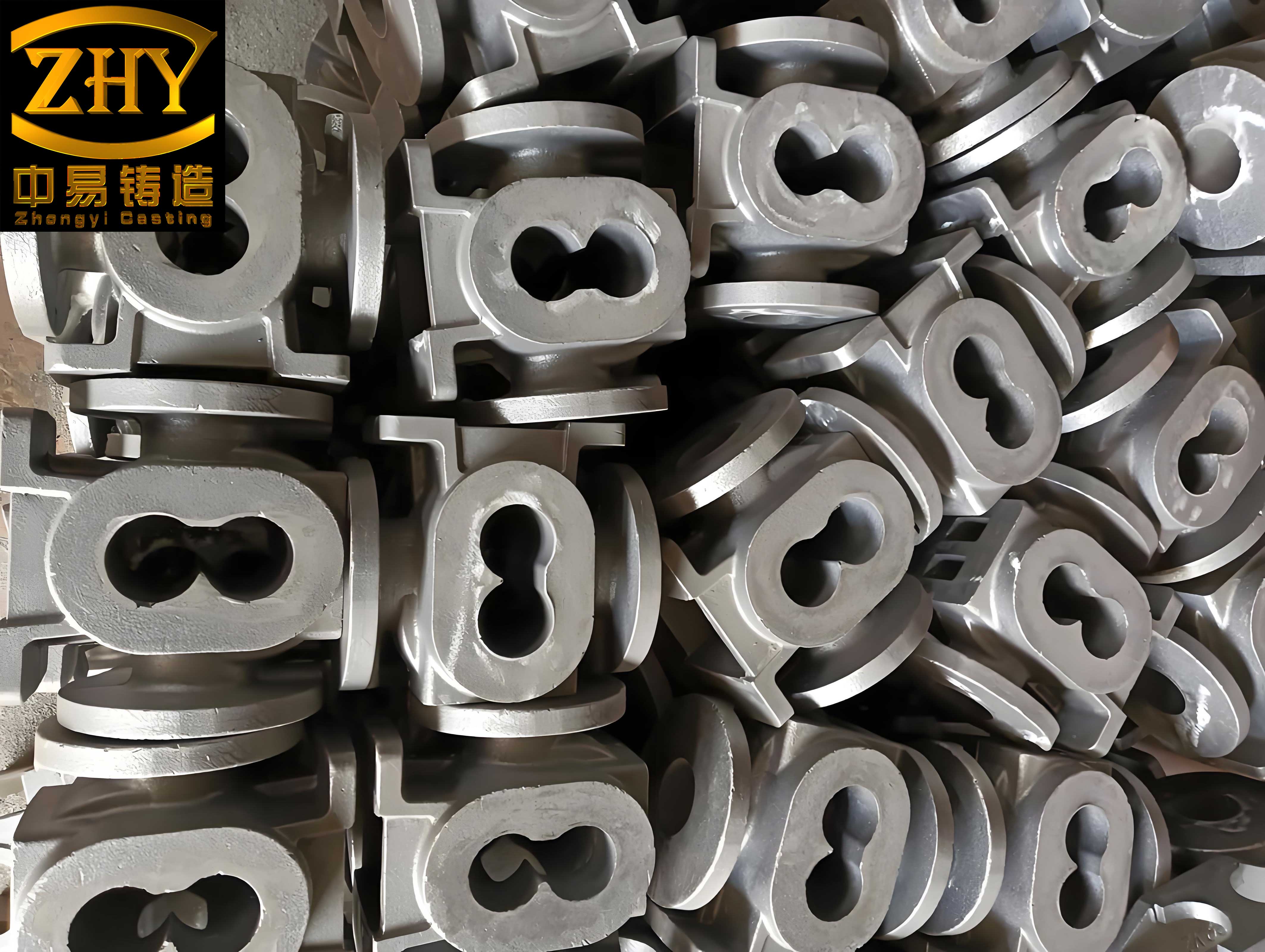
The welding process control for nodular cast iron end caps begins with understanding the material’s welding性. Nodular cast iron typically has a composition that promotes graphite spheroids, but during welding, the heat-affected zone (HAZ) can undergo phase transformations. The carbon equivalent (CE) is a crucial parameter for assessing weldability, calculated as:
$$ CE = C + \frac{Si}{3} + \frac{P}{3} $$
For QT500-7, the carbon content ranges from 3.4% to 3.8%, and silicon from 1.9% to 2.5%, leading to a high CE that increases cracking risk. To mitigate this, pre-weld and post-weld treatments are vital. The mechanical properties of nodular cast iron must be maintained after repair; Table 1 summarizes the requirements for QT500-7, which serve as a baseline for welding qualification.
| Element | Composition (wt%) |
|---|---|
| C | 3.4–3.8 |
| Si | 1.9–2.5 |
| Mn | <0.4 |
| P | <0.025 |
| S | <0.025 |
| Mg | 0.035 |
Table 1: Chemical composition of QT500-7 nodular cast iron.
| Property | Value |
|---|---|
| Tensile Strength | >500 MPa |
| Yield Strength | >320 MPa |
| Elongation | >7% |
Table 2: Mechanical properties of QT500-7 nodular cast iron.
To formalize the welding repair process, I adhere to a structured control流程 inspired by industry standards like AWS D11.2. This流程 involves six key steps: developing a Welding Procedure Specification (WPS), conducting Welding Procedure Qualification Records (WPQR), obtaining third-party certification if needed, certifying welders, creating作业指导书, and定期审查. Each step ensures consistency and reliability. For nodular cast iron end caps, the WPS details parameters such as electrode type, current, and preheat temperature, while the WPQR validates these through destructive testing. I have found that this systematic approach reduces variability and enhances repair quality.
The selection of welding materials is critical for nodular cast iron repair. I prefer nickel-iron alloy electrodes (e.g., ENiFe-Cl) over pure nickel electrodes because they offer better strength and ductility in the weld metal. The nickel content (45–60% by weight) helps prevent carbide formation and reduces shrinkage stress. Table 3 compares typical weld metal properties, showing that nickel-iron alloys meet the 80% strength requirement for nodular cast iron.
| Electrode Type | Tensile Strength (MPa) | Yield Strength (MPa) | Elongation (%) |
|---|---|---|---|
| ENiFe-Cl (as-welded) | 397–579 | 296–434 | 6–13 |
| ENiFe-Cl (annealed) | 449–500 | 310–358 | 8–19 |
Table 3: Mechanical properties of weld metal from nickel-iron alloy electrodes for nodular cast iron.
Before welding, electrodes must be dried at 150°C for at least 1 hour to remove moisture, which can cause porosity. I store them in a holding oven at 40–60°C to maintain dryness. For defect preparation, I use rotary files to remove defects until sound metal is exposed, followed by cleaning with solvents or heat evaporation (above 398°C) to eliminate contaminants. Magnetic particle testing (MT) is applied pre-weld to confirm defect removal, but I avoid penetrant testing (PT) at this stage to prevent residue-induced porosity.
Groove design significantly impacts weld quality. For nodular cast iron end caps, where defects are rarely through-thickness, I recommend U-shaped grooves over V-shaped ones. The U-groove allows better access to the root and minimizes welding width, promoting fusion and stress relief. The groove angle is typically 30–60 degrees, with specific dimensions as shown in Figure 3 of the original text (though not referenced here). The groove volume can be estimated using the formula for a truncated cone:
$$ V = \frac{1}{3} \pi h (R^2 + Rr + r^2) $$
where \(h\) is the groove depth, \(R\) is the top radius, and \(r\) is the bottom radius. This helps in planning filler material usage.
Welding parameters must be tightly controlled. I set the current between 95–150 A for manual arc welding, depending on electrode diameter and position. The interpass temperature is kept below 65°C to prevent overheating and microstructural degradation. After each layer, I perform peening with a尖锤 to relieve residual stresses; the peening intensity can be quantified by the indentation depth \(d\), related to the hammer force \(F\) and material hardness \(H\):
$$ d \propto \frac{F}{H} $$
This reduces crack susceptibility. For as-cast end caps, post-weld heat treatment (PWHT) is beneficial: slow heating (<65°C/h) to 550–600°C, holding for 4 hours, and cooling (<55°C/h) to below 200°C. For machined castings, PWHT is avoided due to dimensional concerns; instead, I cover the weld with insulating materials to slow cooling and minimize stress.
The welding sequence is another vital aspect. When multiple weld beads are required, I overlap them sequentially rather than welding independently. This ensures thermal uniformity and reduces distortion. For a U-groove, the sequence starts from the root and progresses outward, with each bead laid over the previous one. I use a numerical model to optimize the sequence, minimizing the thermal gradient \(\nabla T\), which correlates with stress \(\sigma\):
$$ \sigma = E \alpha \Delta T $$
where \(E\) is Young’s modulus, \(\alpha\) is the thermal expansion coefficient, and \(\Delta T\) is the temperature difference. Table 4 summarizes key welding parameters for nodular cast iron end caps.
| Parameter | Range/Value |
|---|---|
| Electrode | ENiFe-Cl (3.2 mm diameter) |
| Current | 95–150 A DC |
| Voltage | 22–28 V |
| Interpass Temperature | ≤65°C |
| Welding Speed | 10–15 cm/min |
| Peening | After each layer |
Table 4: Welding parameters for nodular cast iron end cap repair.
The WPQR process involves preparing test coupons with designed grooves, welding them according to the WPS, and then conducting destructive tests. I extract tensile specimens,宏观 samples, and hardness test pieces from the welded coupon, as per AWS guidelines. The tensile strength of the weld must exceed 80% of the base metal’s strength. In my trials, fractures often occurred in the母材 or HAZ, indicating good weld fusion. Table 5 shows results from a typical WPQR for nodular cast iron.
| Specimen ID | Tensile Strength (MPa) | Failure Location |
|---|---|---|
| PQR-01 | 505.8 | HAZ |
| PQR-02 | 511.3 | Base Metal |
| PQR-03 | 476.4 | Base Metal |
Table 5: WPQR tensile test results for nodular cast iron welding.
Hardness testing across the weld zone reveals the presence of hard phases. I measure Vickers hardness (HV) in the base metal (BM), HAZ, and weld metal (WM). For nodular cast iron, the HAZ may show increased hardness due to martensite formation, but nickel-iron electrodes mitigate this. The hardness gradient can be modeled as:
$$ HV(x) = HV_{BM} + (HV_{WM} – HV_{BM}) e^{-kx} $$
where \(x\) is the distance from the fusion line, and \(k\) is a decay constant. Typical values for nodular cast iron welds are: BM ~ 200 HV, HAZ ~ 250 HV, WM ~ 220 HV.
Post-weld inspection is crucial for quality assurance. I discovered that magnetic particle testing (MT) can falsely indicate cracks in welds made with nickel-iron electrodes on nodular cast iron, due to magnetic property differences. Therefore, I use penetrant testing (PT) for final inspection, as it reliably detects surface defects without such issues. The detectability of defects depends on factors like defect width \(w\) and penetrant sensitivity \(S\), approximated by:
$$ w \geq \frac{S}{\sqrt{t}} $$
where \(t\) is the dwell time. For critical applications, ultrasonic testing (UT) or radiography (RT) may be considered, but PT is cost-effective for nodular cast iron end caps.
In conclusion, the welding repair process control for nodular cast iron end caps requires a holistic approach, from procedure development to final inspection. By implementing rigorous WPS and WPQR protocols, optimizing parameters like groove design and interpass temperature, and selecting appropriate electrodes, I have achieved high repair success rates for nodular cast iron components. The key takeaway is that nickel-iron alloy electrodes are suitable for nodular cast iron, but post-weld MT should be avoided in favor of PT. This流程 not only reduces scrap but also extends the service life of critical castings. Future work could explore advanced techniques like laser welding for nodular cast iron to further enhance precision and efficiency.
Throughout this article, I have emphasized the importance of nodular cast iron in industrial contexts and how controlled welding repair can sustain its performance. The tables and formulas provided offer a concise summary of the technical aspects, aiding practitioners in implementing similar processes. As nodular cast iron continues to be a material of choice for demanding applications, refining repair methodologies will remain essential for sustainable manufacturing.